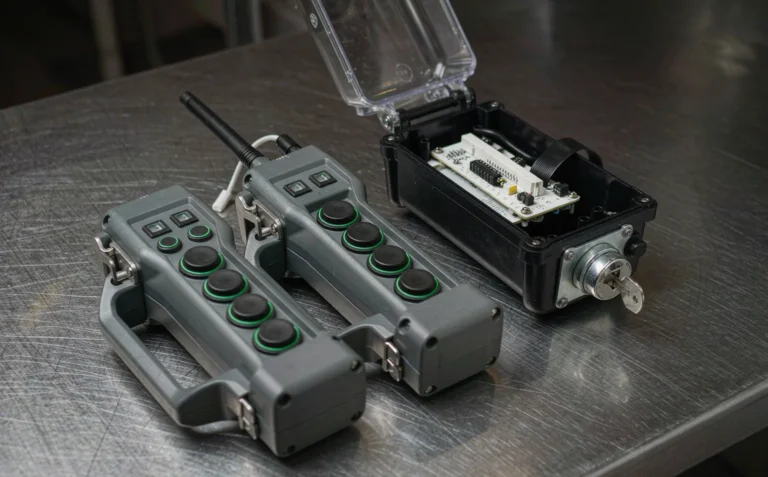
Grab Bucket and Magnet Cranes: Specifying the Remote Control
Published: Author: Lisa
A grab bucket or magnet crane does not need a bigger remote control, it needs remote functions that behave differently from a hook crane’s. Two things change: some commands must latch rather than follow the button, and the machine’s cycle has more simultaneous actions. Counting those extras properly at enquiry stage is what separates a working installation from a transmitter that runs out of buttons in its first week.
This article is about specifying a grab bucket crane remote control for scrap handling, bulk material and lifting-magnet duty. It covers how the duty differs from hook work, how to count the outputs, which functions have to be maintained rather than pulsed, and what the environment does to the unit over a few years of shifts.
How grab and magnet duty differs from hook duty
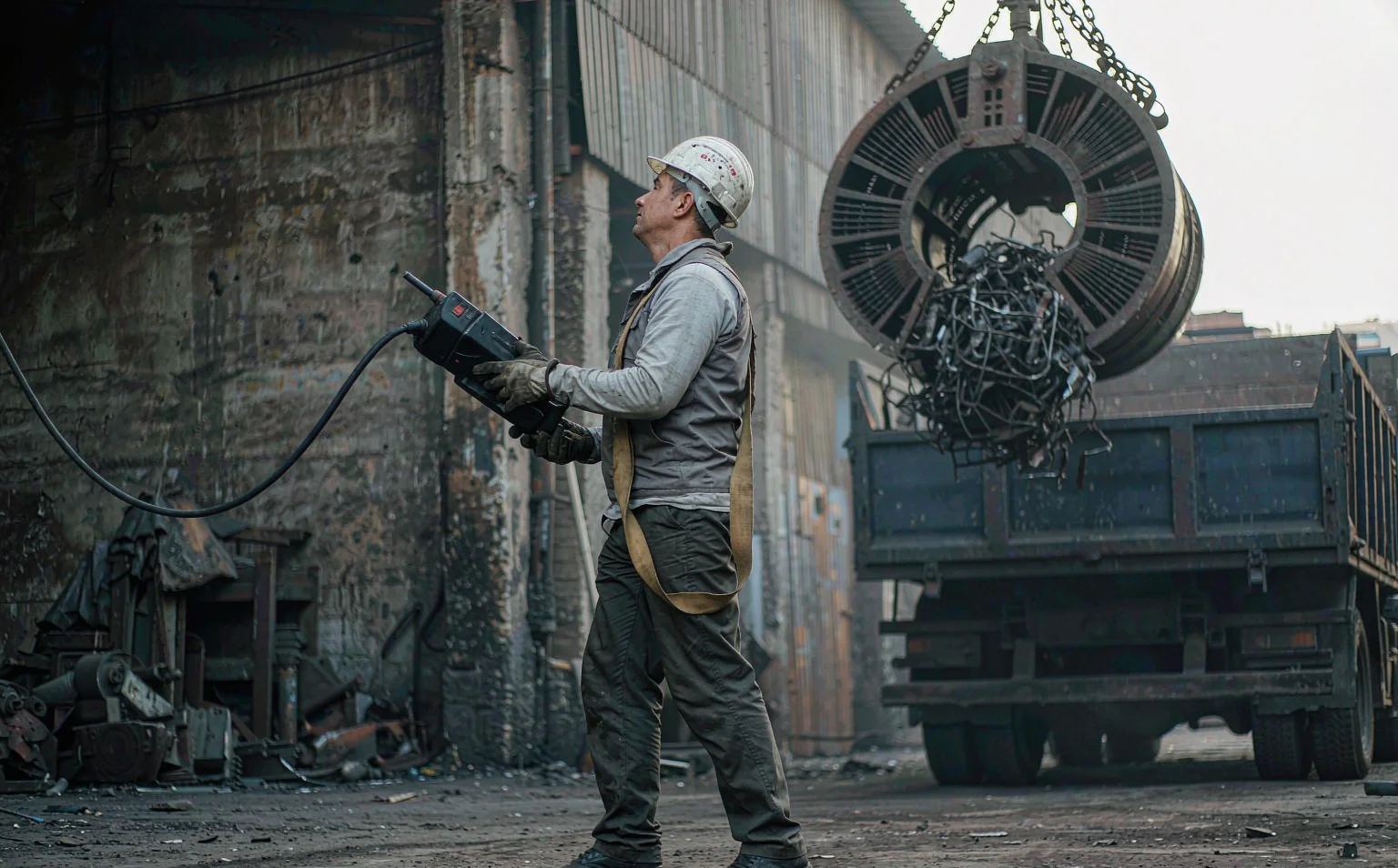
A hook crane is a series of discrete moves: lift, travel, lower, stop. The operator’s hand is on the button for every one of them, and when the button is released the motion stops. A grab crane adds a tool action that has its own state — the grab is open or closed — while a magnet crane adds an electrical state that outlasts any button press. The operator now manages a tool state and a motion at the same time.
The cycle rate is also higher. Scrap and bulk handling is repetitive, often with the hoist, trolley and bridge moving together between the pile and the truck or the feed hopper. That combination — more simultaneous actions, more cycles per hour — is what pushes the requirement from an eight-function layout toward ten or twelve, and it is the reason a unit chosen on button count alone disappoints in service.
Counting the outputs
Build the list from the panel drawing, not from the old transmitter’s button labels — the labels are often the thing that was wrong. Every command that has to reach a contactor or a valve coil is one output pair.
Function group
Typical commands
Output pairs
Hoist
Up, down
2 (4 with two speeds)
Trolley
Left, right
2 (4 with two speeds)
Bridge travel
Forward, back
2 (4 with two speeds)
Grab
Open, close
2
Grab rotation
Clockwise, counter-clockwise
2
Magnet
On, off (drop)
2
Generator set
Start, stop
2
Read the table as a menu. A single-speed grab crane with rotation needs eight pairs before any spare function; add a magnet and a generator set and the same crane needs twelve. Dual-speed motions on a magnet crane with no grab come to eight pairs plus the magnet pair, which lands on the ten-function layout that most scrap-handling installations end up specifying.
Which functions must latch, and which must not
This is the part that gets under-specified. Three behaviours exist, and choosing the wrong one produces a machine that either drops loads or fights the operator.
Momentary (hold to run). The command lasts as long as the button is held. All travel motions belong here, and so do most grab open and close commands on hydraulic grabs, because releasing the button stops the pump.
Maintained (latching). The output stays on after the button is released, until the opposite command. A lifting magnet is the classic case: the operator presses magnet on, releases, and the magnet holds while the crane travels. The receiver must keep that output energised, and it must keep it energised through a radio link loss — dropping the load because a battery went flat is not an acceptable failure mode.
Interlocked. Two commands that must never be active together. Grab open against grab close, magnet on against magnet drop, and in many designs hoist movement against grab rotation while the grab is closing. The interlock normally lives in the panel, but the remote control has to be wired so that the interlock sees clean, single commands rather than a latched state fighting a new command.
Ask your panel builder one question about every function: if the transmitter goes silent right now, what should this output do? For travel motions the answer is “drop out”. For a magnet, it is usually “stay on, and alarm”. Those two answers require different receiver behaviour, and a supplier cannot guess which you want.
Single-speed or dual-speed for grab work
Grab handling is where the case for dual-speed is strongest, because the last metre of a grab close is a positioning move, not a power move. Closing on a pile at full speed on a hydraulic grab either stalls the pump or crushes the material; the same close at reduced speed seats the shells cleanly. On magnet duty the argument is weaker: the motions are usually long runs over a stockpile, and single-speed with a soft start in the panel often does the job.
Dual-speed doubles the number of output pairs for every motion, so it should be justified per motion rather than applied to the whole machine. A common compromise is dual-speed hoist and trolley, single-speed bridge, which keeps the button count and the receiver size manageable. Our guide to upgrading hoist control to a remote explains how to confirm what the existing panel actually supports before you order.
Dust, scrap and heat: what the environment does
Scrap yards and foundry bays are harder on a transmitter than a machine shop. Three mechanisms do most of the damage. Abrasive dust works into button skirts and switch seals and turns a positive press into a mushy one. Ferrous dust around a magnet crane bridges contacts and finds its way into any gap that is not sealed. Radiant heat from the load softens plastics and hardens gaskets faster than the datasheet cycle suggests.
The practical specification is a sealed keypad rather than separate button skirts, a housing that survives being dropped on concrete, and a protection level chosen for washdown if the site hoses the equipment. If the crane works outdoors or on a quay, the protection question becomes the main one — the difference between IP65 and IP67 in real service is covered in our protection level comparison. Battery choice matters too: a magnet crane operator who holds a latching magnet for minutes at a time draws far more from the transmitter than a hook operator, and the duty cycle should be stated in the enquiry.
What to send the supplier
Grab and magnet enquiries go wrong because the tool is described in words instead of outputs. Send this list instead.
The existing panel drawing, or a photograph of the terminal strip with the wires labelled.
The full function list, marking each one as momentary, maintained or interlocked.
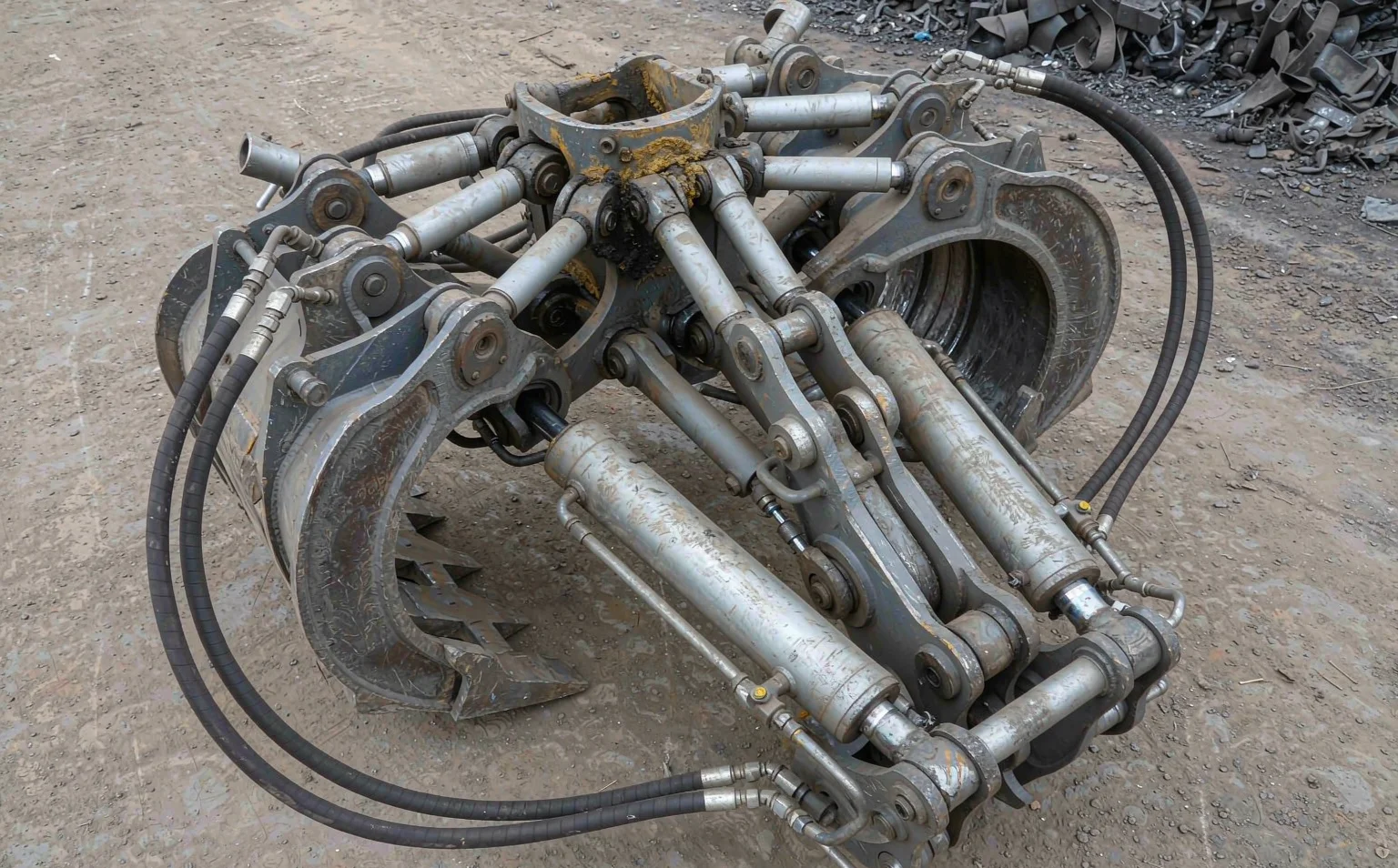
The grab type — hydraulic, mechanical or electro-hydraulic — and how many hoses or cables reach it.
For magnet duty, the magnet controller type and what should happen to the magnet on radio link loss.
The number of speed stages per motion, confirmed from the contactor count rather than from memory.
Control voltage at the panel, ambient conditions, and whether the site washes the equipment down.
Quantity, and whether spares must be interchangeable with other cranes on the same site.
With that list, a twelve-function configuration can be quoted without a single follow-up question. The F24-12S-12D covers dual-speed grab cranes with rotation, while the F24-10S-10D suits the magnet-plus-generator layout where the extra pairs are tool functions rather than second speeds.
FAQ
How many buttons does a grab crane remote control need?
Typically ten to twelve functions: six for the three motions, two for grab open and close, and two more for rotation or magnet control. Dual-speed motions add a pair each, so confirm the speed stages before fixing the count.
Can a magnet stay on if the transmitter loses signal?
That is usually what you want, and it has to be specified. The receiver should keep the magnet output energised through a link loss and raise an alarm rather than drop the load. Not every receiver handles held outputs this way by default.
Does the grab need a different remote control from a hook crane?
It needs more functions and at least one latching or interlocked command, not a different radio. Most installations use the same transmitter family as the hook cranes on site, which keeps spares and procedures consistent.
Is dual-speed necessary on a grab crane?
It helps most at the end of a grab close, where a slow final movement seats the shells instead of stalling the pump. Where the motions are long runs over a stockpile, single-speed with a soft start in the panel is often sufficient.
What protection level suits a scrap yard?
A sealed keypad and a housing rated for dust are the minimum; add a washdown-rated level if the site hoses the equipment. Abrasive dust is the failure driver, and it attacks button skirts before it affects the electronics.
If the panel drawing is not available, photograph the contactor row and the terminal strip and send those with the function list — it is usually enough to build a correct configuration. For a grab or magnet crane where the tool behaviour is still undecided, the contact form is the fastest route to a firm specification, and we will confirm which functions should latch before anything is ordered.
Ask for the file, not the mark. Five documents to request before ordering, how to check a declaration against the model in the carton, and the red flags.
A spare transmitter becomes a second authority the moment both are live. Three wiring options, what the receiver does when two operators press, and the handover rules.