What Drives the Price of an Industrial Radio Remote Control
Published: Author: Lisa
An industrial radio remote control does not have a price — it has a price for a configuration. Two units in the same housing can differ by several multiples once you change the number of outputs, the speed stages, the protection level, the frequency variant, the enclosure material and the certification package. Any supplier who quotes a single figure before asking about those six items is quoting the cheapest thing they can build, not the thing you asked for.
That is why the same industrial remote control can appear at wildly different prices in two catalogues and both be honest. This article breaks the industrial remote control price into its parts, shows where cheap units cut corners, and sets out how to compare two quotes that were never written to the same specification.
Why a supplier cannot give you a number without a specification
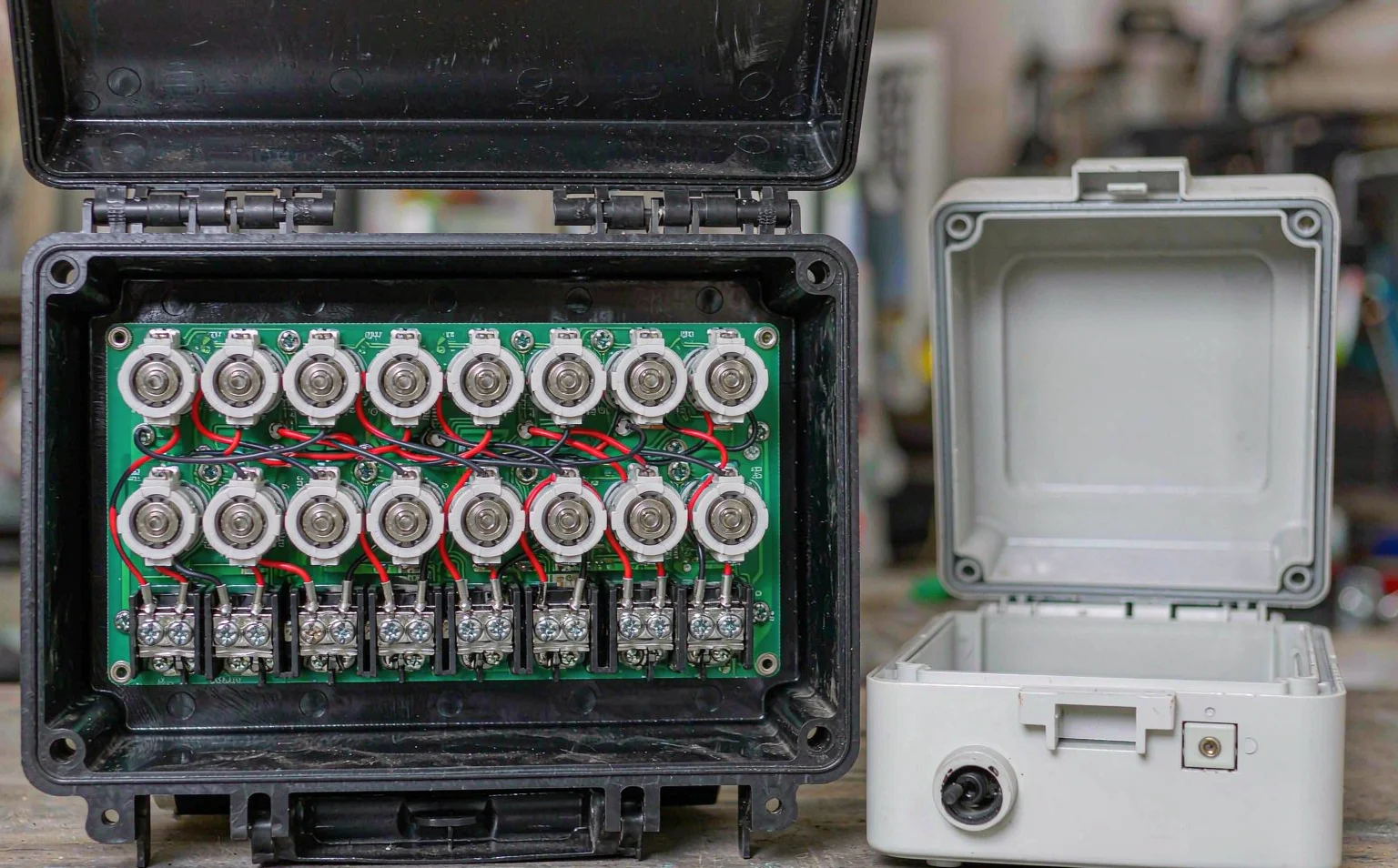
The transmitter housing, the radio module and the battery are a small part of the cost. What drives the number is the wiring inside the receiver, the relays that carry your contactor coils, the enclosure that has to survive your washdown regime, and the paperwork that has to satisfy your customs authority. Change any of those and the bill of materials changes with it.
This is also why a price given in a first reply is usually a placeholder. A serious quotation follows a specification, and a serious buyer sends one. Our guide to what to send a supplier for a quote lists the six items that shorten the exchange from a week of emails to a single reply.
The six variables that move the number
Work through them in this order. Each one has a cost effect you can predict before you receive a quotation, which makes an unusually low or high price easy to explain.
Variable
What changes on the inside
Effect on price
Output count
More relays, more terminals, larger receiver board
Rises with each output pair
Speed stages
Second contactor set per motion, extra wiring
Dual-speed costs more than single-speed
Protection level
Gaskets, sealed buttons, membrane, housing material
IP65 to IP67 is a real step, not a label
Frequency variant
Band, approval testing, documentation per market
Market-specific variants cost more
Enclosure material
Engineering plastic, aluminium, stainless
Metal housings carry a clear premium
Certification package
Test reports, declarations, traceability
Documents are a cost line, not a favour
The first two variables are the ones buyers underestimate. A ten-button unit is not a twelve-button unit with two spare caps: every extra function adds a relay, a terminal pair, a wire run and a test step. On a dual-speed crane the relay count roughly doubles for the same motion list, which is why the jump from single-speed to dual-speed is larger than the jump in button count suggests.
Where cheap units cut corners
A low price has to come from somewhere. In this product category it usually comes from four places, and only one of them is visible on a datasheet.
Relay rating. A relay rated for a resistive load will switch a contactor coil for a while and then weld. The difference between a properly rated output and a marginal one is a few currency units and most of the unit’s service life.
Antenna and radio front end. A cheaper module with narrower selectivity loses the link at the far end of the runway — the exact place where a remote control earns its money.
Emergency stop circuit. The stop path has to drop the machine’s stop circuit directly, not through firmware and not through a shared output. Shortcuts here are invisible until the day they matter.
Sealing. A gasket that passes a splash test on day one can harden and leak by the second summer. Look at the sealing method, not the IP number alone.
The fourth shortcut is documentation. A unit sold without a declaration, a test report or a wiring diagram is cheaper to produce and more expensive to import, because the missing paperwork lands on you at customs or at the customer’s audit.
Total cost of ownership, not purchase price
Purchase price is one line in a five-year cost. The rest is predictable if you ask for it at quotation stage.
Cost line
What to ask for
Why it matters
Batteries
Cell type, cycle life, replacement interval
Recurring cost per transmitter per year
Spares
Which parts are field-replaceable
A low-cost part versus a full unit replacement
Downtime
Lead time on a replacement unit
One idle crane often exceeds the price difference
Re-certification
Whether a repair voids the approval
Affects what you may legally do in-house
Two quotes that differ by a modest percentage on the unit price can invert completely once batteries, spares and a realistic downtime figure are included. Ask every supplier for the same five-year picture and the comparison becomes arithmetic rather than opinion.
How to compare two quotes fairly
Line them up against the same specification before you look at the totals.
Normalise the output count. If one quote covers eight outputs and the other twelve, you are comparing different products.
Confirm the speed stages. Single-speed and dual-speed variants are not interchangeable, and a quote that silently assumes single-speed will look cheap for the wrong reason.
Check the protection level and enclosure material. Plastic IP65 against stainless IP67 is a different product class.
Compare what is in the box. Battery, charger, belt, spare fuses, printed manual and wiring diagram are sometimes extra.
Compare the documents. Declaration of conformity, test report and radio approval should be listed by name, with the model they cover.
Compare the terms. Quantity breaks, tooling for custom legends, and the price of a second transmitter change the effective unit cost.
Quantity is the variable buyers can actually move. Standard units are built in batches, so the unit price falls as the order approaches a batch quantity, while a custom button layout adds a one-off cost that has to be spread across the run. Our article on MOQ and lead time explains where those break points sit and why a small custom order is rarely cheaper than a slightly larger standard one.
What to put in the RFQ
A short, complete request gets a firm price instead of a range. Include the crane type and duty class, the full motion list in the order they appear on the panel, the control voltage measured at the panel, the number of speed stages, the ambient conditions including dust and washdown, the destination country, the quantity for the first order and the annual volume you expect, and whether the button legends need to be customised.
Then ask one question that separates a real quotation from a brochure: which model, exactly, is being quoted, and what are its output relay ratings? A supplier who can answer both is quoting a product. One who cannot is quoting a hope.
FAQ
Why do two suppliers quote very different prices for the same remote control?
Almost always because the specifications differ. Output count, speed stages, protection level, enclosure material and documentation are the usual gaps. Normalise all five before comparing totals.
Is a cheaper remote control acceptable for light duty?
It can be, provided the duty is genuinely light: few operating hours, low duty cycle, indoor and dry, and a machine whose stop function is not safety-critical. The relay rating and stop circuit still have to be right, because those fail under light use too.
Does a higher price guarantee better quality?
No. Price tracks specification, and specification can be padded. The useful check is the bill of materials — relay rating, radio module, sealing method, housing material — not the position of the number.
How much does a custom button layout add?
It adds a one-off tooling and setup cost rather than a per-unit premium, so the effect per unit depends on order quantity. Small runs carry the whole setup; larger runs spread it thinly.
Can I get a firm price without a drawing?
Yes, if you can supply the motion list, control voltage, speed stages and quantity. A drawing shortens the process but is not essential for a standard configuration.
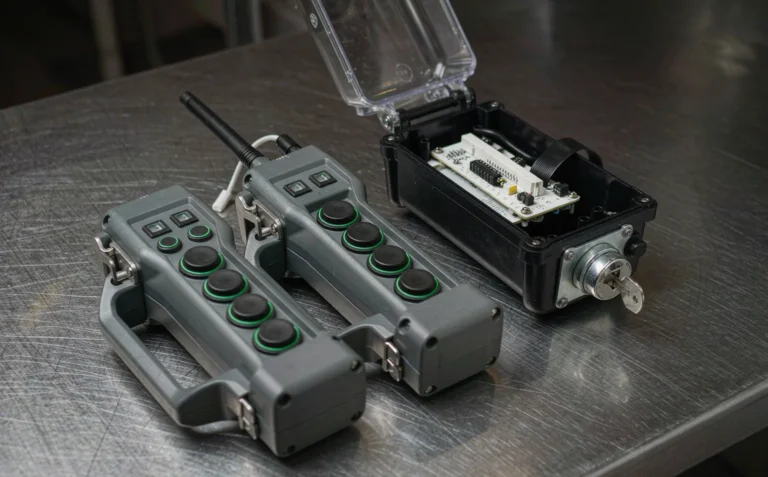
For a specific configuration — say a ten-button dual-speed crane with a custom legend — the F24-10S-10D and the F21-E1B sit at different points on the scale for a good reason: one carries ten dual-speed channels, the other a single-speed eight-function layout. Send the motion list and destination country through the contact form and you will get a price against a specification rather than a range against nothing.
Ask for the file, not the mark. Five documents to request before ordering, how to check a declaration against the model in the carton, and the red flags.
A spare transmitter becomes a second authority the moment both are live. Three wiring options, what the receiver does when two operators press, and the handover rules.