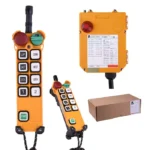
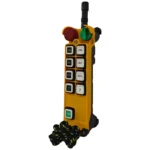
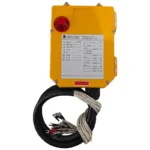
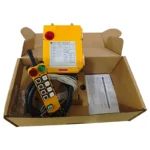
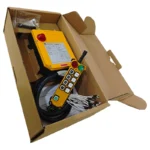
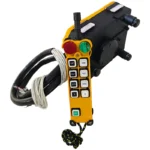
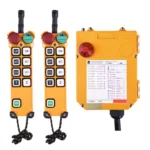
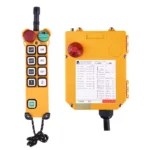
Description
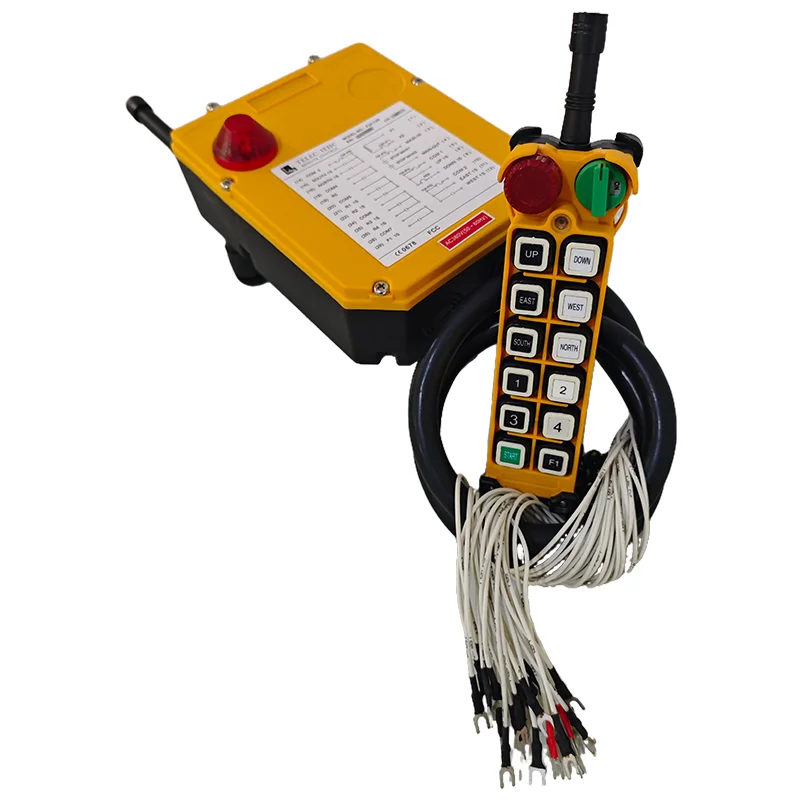
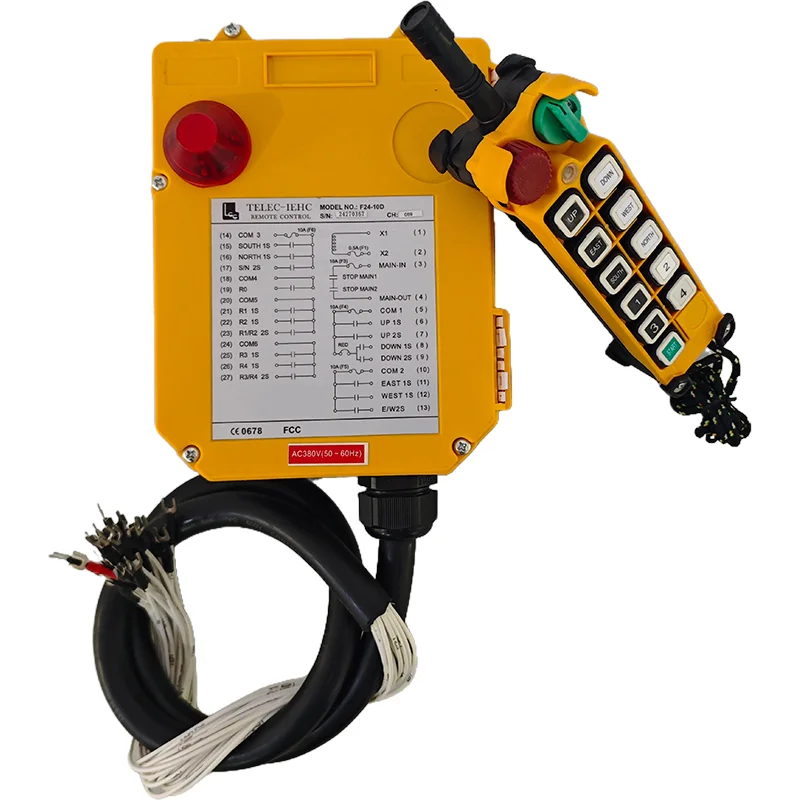
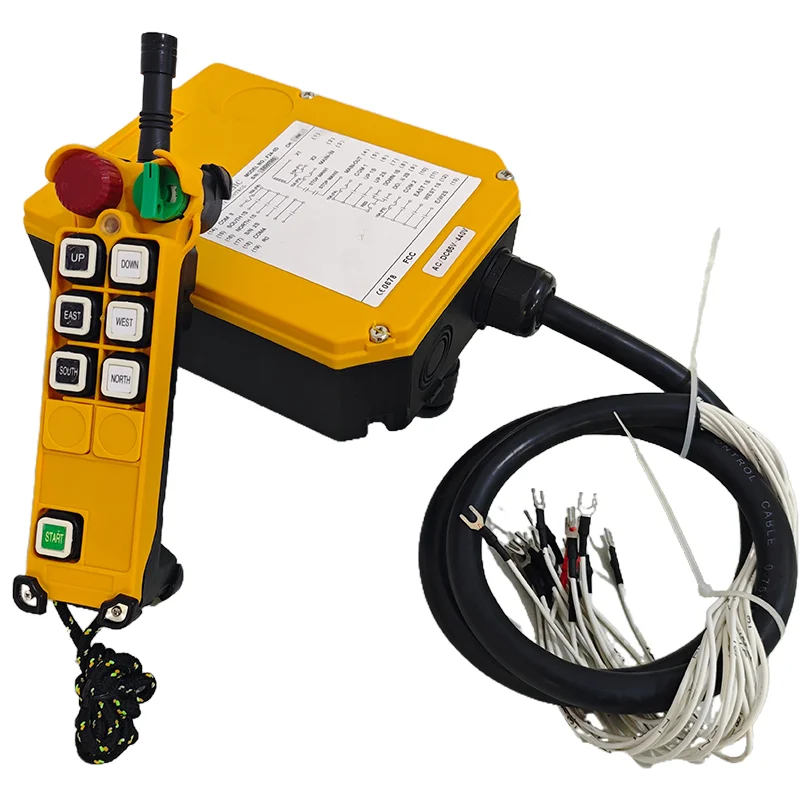
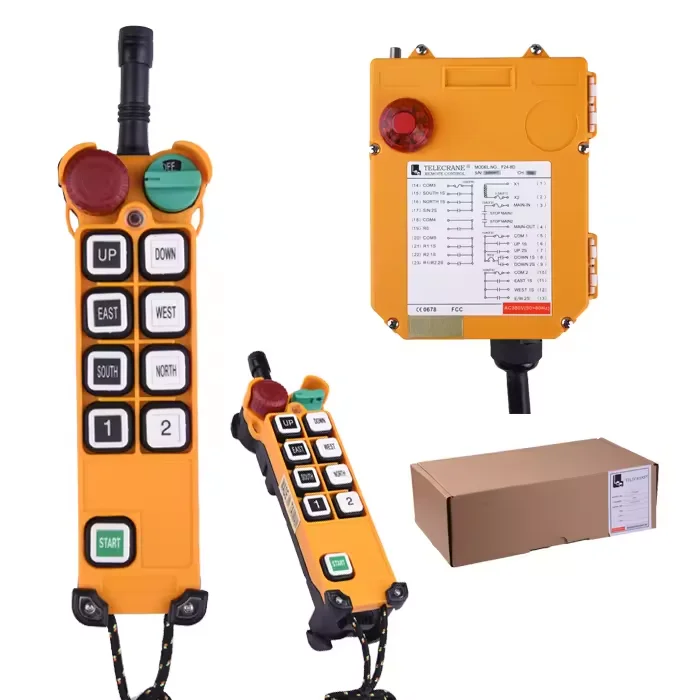
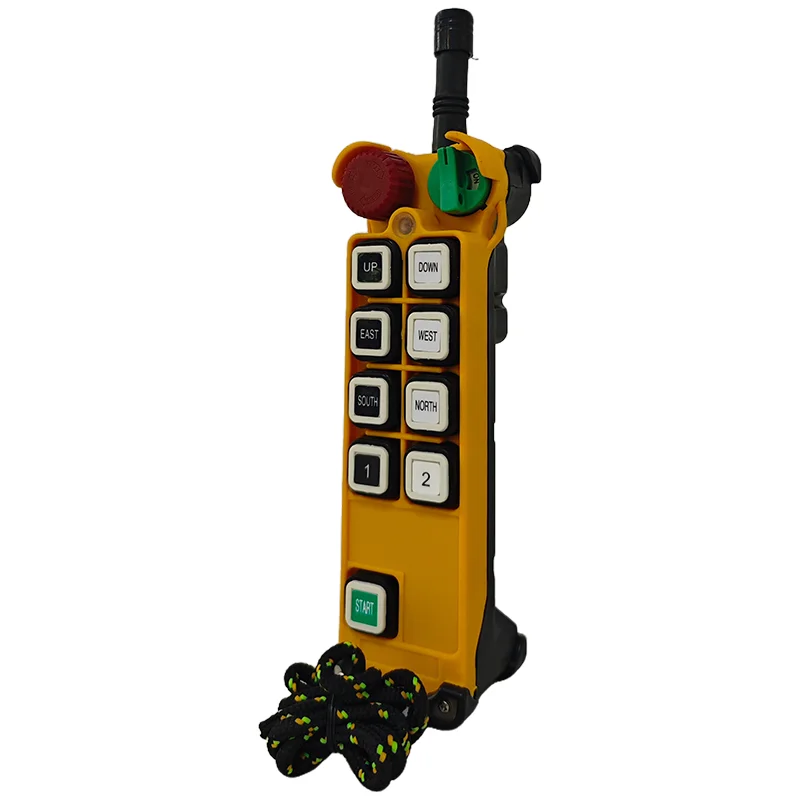
F24-8S 8D remote control is the eight-button member of the F24 wide-voltage family, offered in two builds: the F24-8S closes one contact per button, and the F24-8D gives every button a fast and a slow stage. Physically they are the same transmitter; the difference is the receiver logic and the number of outputs behind it.
Eight buttons is the smallest count that still fits a complete single-girder hoist crane — six direction functions plus start and stop — which is why this is the configuration most often specified for one-crane installations. The page below covers the S-or-D decision first, because that choice cannot be changed after the unit is built.
■ Machines that fit an eight-button layout
An eight-button transmitter covers one machine with three direction motions and no auxiliary function:
- Single-girder overhead cranes and gantry cranes — hoist up/down, trolley left/right, bridge or long-travel forward/reverse.
- Electric chain hoists on a fixed or monorail runway — hoist up/down plus one travel motion, leaving two buttons free for a horn or a lighting circuit.
- Small jib cranes and wall-mounted slewing jibs, where six direction functions are the complete motion list.
- Single-action process equipment — four to six contactor-operated movements with a start and stop gate.
If the machine has a second hoist, an auxiliary trolley or a grab, the two-button margin disappears quickly. Check the count against the F24-10S/10D before deciding — moving up one size at order time costs far less than exchanging a configured receiver later.
■ Specification
| Model variants | F24-8S (single speed) and F24-8D (dual speed, fast and slow per button) |
| Button count | 8 |
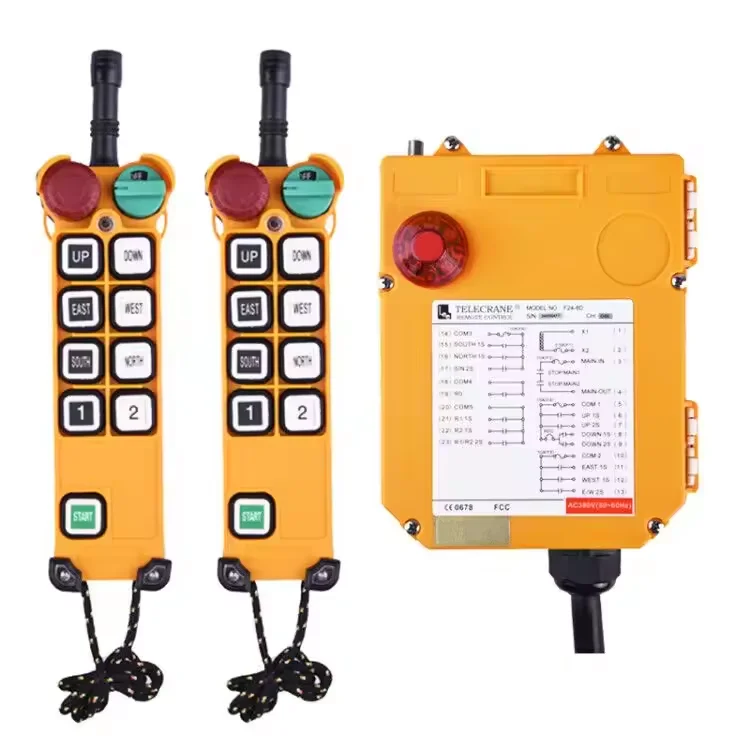
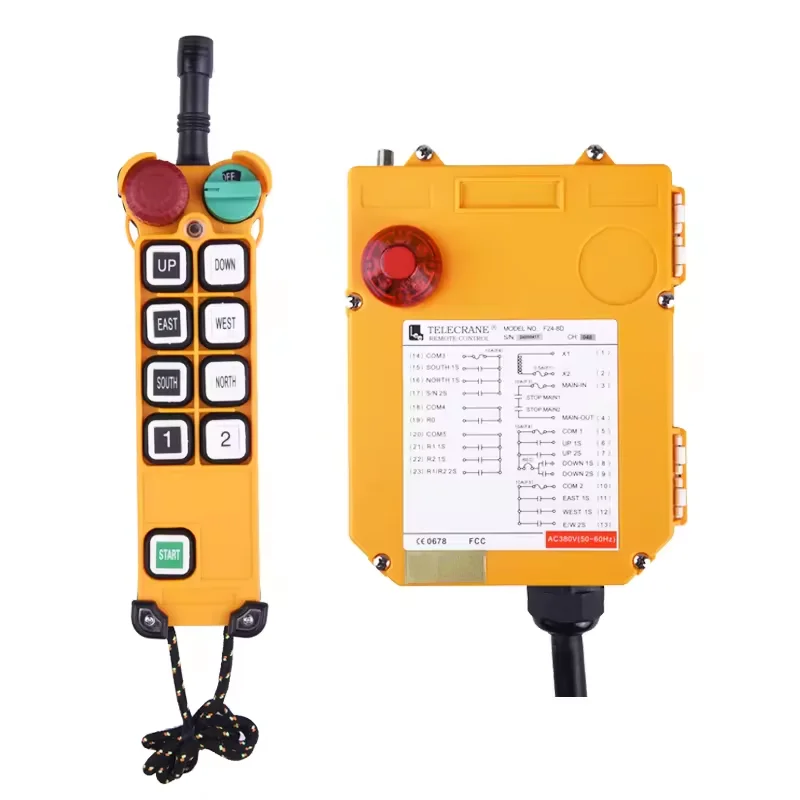
| Typical layout | 6 direction buttons plus 1 start and 1 stop |
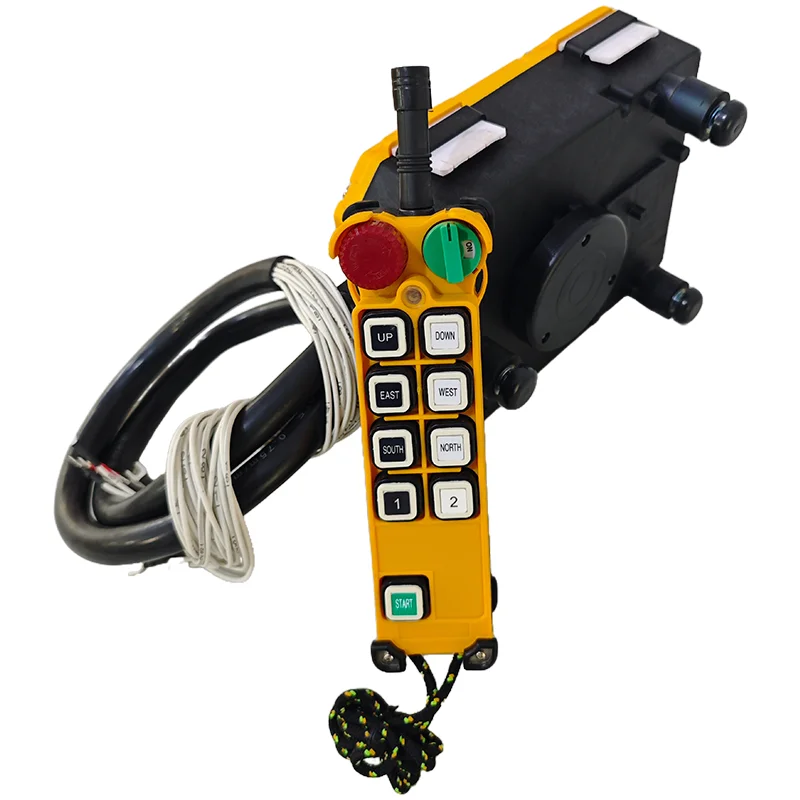
| Emergency stop | Mushroom-head button on the transmitter face |
| Safety key | Magnetic key; transmitter is disabled with the key removed |
| Housing | Glass-fibre reinforced nylon |
| Ingress protection | IP66 — dust-tight and protected against strong water jets |
| Control radius | 100 m class in open plant conditions |
| Receiver input voltage | Wide range AC 36–380 V or DC 12–24 V |
| ID code | 32-bit, over 4.3 billion combinations, Hamming code error correction |
| Pairing method | Learning code stored in the receiver |
| Operating temperature | −35 °C to +80 °C |
| Self-diagnosis | Receiver shuts the outputs down if a hardware fault is detected |
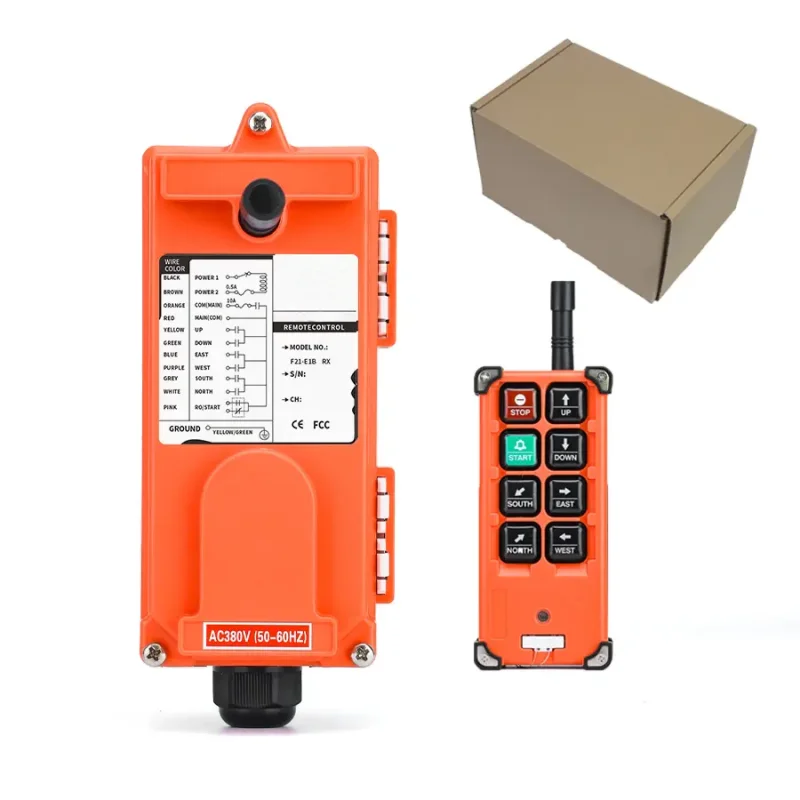
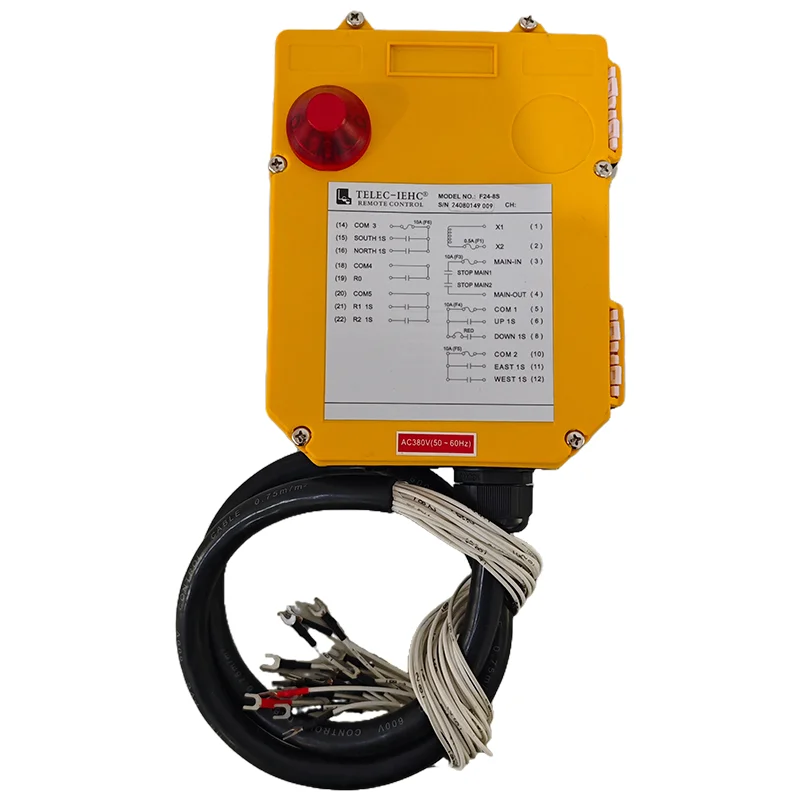
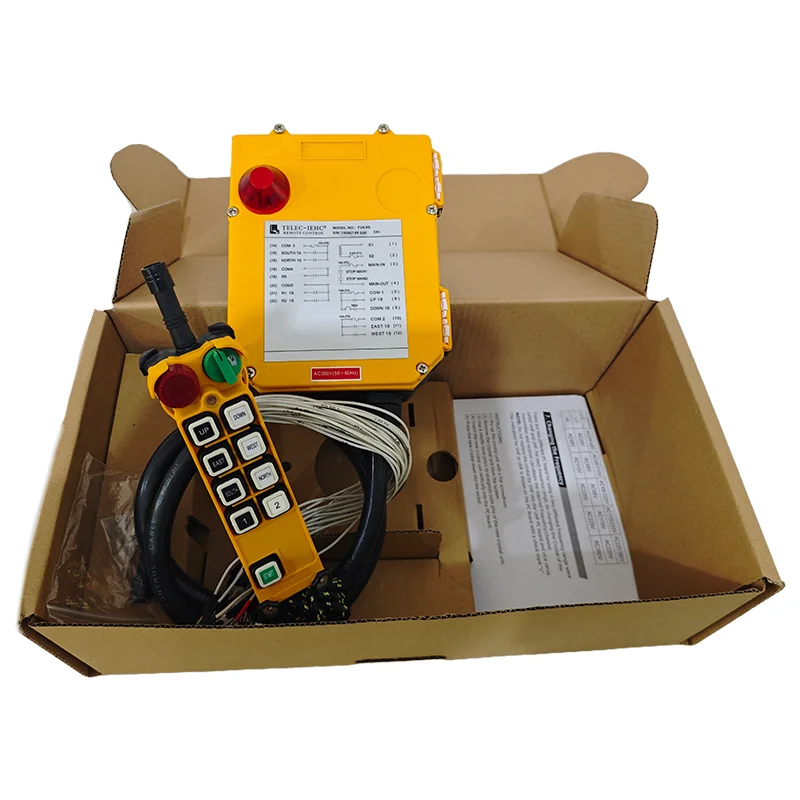
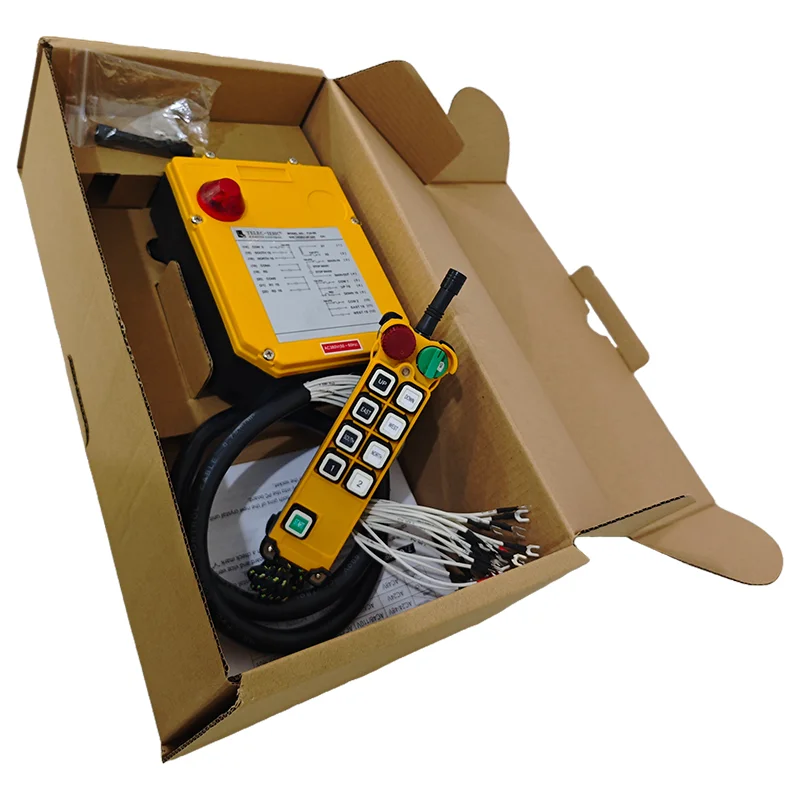
Supplied as a set: transmitter, receiver, connecting cable, batteries, transmitter pouch, manual and wiring diagram. Spare transmitters, receivers and button membranes can be added to the same order.
■ Single speed or dual speed — the one decision worth getting right
This is the choice that cannot be corrected after manufacture, so it deserves more thought than the rest of the specification combined.
- Look at the motor, not the crane. If each motion is driven by a single-speed contactor, the F24-8S is the correct build and the F24-8D would have nothing to switch on its second stage. If the motion runs a two-speed motor, a pole-changing winding or a VFD with two preset speeds, the F24-8D is needed.
- Ask how the load is set down. Creep speed matters most during final positioning. Operators who set loads onto a jig, into a press or against a stop will ask for the slow stage in the first week; if the crane only moves material between open bays, single speed is normally enough.
- Count receiver outputs, not buttons. A dual-speed receiver needs roughly twice the relay outputs of a single-speed one for the same machine. Where panel space or relay count is tight, that is a real constraint and should be raised before the logic is fixed.
- Confirm the hazard approach. Where the machine has an approach hazard, the slow stage is often required by the site’s risk assessment rather than being a preference. Check before ordering, not after.
- Consider mixed operation. On some cranes the hoist needs two speeds while trolley and travel do not. A dual-speed receiver can be programmed so that only the hoist uses its slow stage; the other outputs are simply left unused.
■ Indicative price bands for the F24-8S 8D remote control
Export price bands for a complete set, ex-works Zhejiang. Treat them as a budget guide; the quotation depends on the configuration confirmed on the order.
| Quantity | Indicative unit price (USD) |
| 1 set | 62 – 128 |
| 5–19 sets | 56 – 115 |
| 20 sets and above | 50 – 105 |
| Spare transmitter, single speed | 32 – 58 |
| Spare transmitter, dual speed | 38 – 66 |
Within a band, the position depends on four variables: the S/D build, the number of relay outputs the receiver carries, whether custom button legends or branded housings are required, and whether certification paperwork is needed for customs. Dual-speed receivers sit higher than single-speed ones at the same quantity because of the extra outputs and the longer programming step.
■ How to order, and what backs the unit after delivery
Information we need
Give us the machine type and motion list, whether each motion is single or two-speed, the panel supply voltage, the required button legends, the quantity and any branding requirement. Where the machine has an unusual sequence — an interlock between trolley and bridge travel, for instance — describe it and we will map it onto the receiver outputs for you.
Ordering, lead time and shipping
Orders are accepted from 1 set. Standard single-speed sets from stock typically ship within 5–10 working days; dual-speed receivers configured to a machine sequence take 15–25 working days. Payment terms are issued with the quotation — full payment for sample quantities, deposit and balance for production runs. Small orders travel by international courier, volume orders by air or sea freight. Units are packed in export cartons with the transmitter, receiver, cable and documentation in one box.
Quality assurance
Every set is function tested and inspected before dispatch, and the receiver is verified against the transmitter it ships with rather than sampled from a batch. Units carry CE marking and are built under an ISO quality system. The transmitter and receiver are paired at the factory, so the set works out of the box and the wiring diagram supplied with it matches the terminals you will actually find. If a fault appears in service, quote the model and serial number: the ID code is recorded, so a replacement transmitter can be supplied already learned to your receiver instead of needing on-site pairing.
■ Built by a manufacturer, not assembled by a trader
IEHC has produced electrical control equipment in Liushi Town, Yueqing, Zhejiang since 2003 — a 1,500 sqm plant with 50+ staff and 20+ sets of production and testing equipment, working as an integrated manufacturer. For a transmitter that has to survive being dropped onto a concrete floor, three details matter more than brochure claims:
- The housing is specified, not sourced down. Glass-fibre reinforced nylon is used for impact and chemical resistance, sealed to IP66 so a transmitter left out in rain or hosed down keeps working.
- Each unit is tested as a pair. Receiver and transmitter are verified together before packing, which removes the most common cause of a “dead on arrival” report.
- Wear parts are stocked alongside the units. Button membranes, key switches, housings and batteries can be ordered with the set, so maintenance stock is on the shelf before the first unit wears out.
The wider range is listed under industrial remote control systems. If eight buttons turns out to be one short, the next size up is the F24-12S/12D with twelve buttons.
Send the motion list, the single/dual-speed requirement per motion and your panel voltage through our contact page, and we will confirm the build and price. Packing, payment and documentation questions are answered on the IEHC FAQ page.
FAQ
What exactly is the difference between the F24-8S and the F24-8D?
The transmitter shell, button count and radio section are the same. The F24-8S receiver closes one contact per button, giving a single speed for each motion. The F24-8D receiver carries more outputs and closes a different contact for the fast and the slow stage of each button, which is what allows a two-speed motor or a VFD preset to be selected from the transmitter. Because the difference lives in the receiver, an S unit cannot later be turned into a D unit by changing a setting — the receiver itself is different.
Can I run it on a 220 V or a 24 V panel?
The receiver accepts a wide input of AC 36–380 V or DC 12–24 V, so the common supply voltages are covered by one build. Tell us your panel voltage when ordering anyway: for unusual supplies, or where the control circuit is derived separately from the power circuit, the factory will confirm that the standard receiver suits that arrangement before the order is released.
What does IP66 mean in practice for a hand-held transmitter?
IP66 means the enclosure is dust-tight and protected against strong water jets from any direction — the rating that matters when a transmitter is left on a crane leg in rain or washed down at the end of a shift. It is one step above the IP65 rating used on several other models in the range, and it is not an immersion rating, so the transmitter should not be allowed to sit in standing water.
What happens if a transmitter is lost or destroyed?
Because your receiver stores its paired ID code by learning, a replacement transmitter can be supplied either pre-learned at the factory or learned on site following the manual. The receiver does not have to be replaced, and no rewiring is involved. Every unit's ID code is recorded against its serial number at the factory, which is why quoting that number gets you a working replacement fastest.
Does the receiver need a separate power supply or a mounting bracket?
The receiver is designed to be mounted inside the control panel and fed from the existing control-circuit supply; it does not need a separate power unit. The unit ships with the connecting cable and reserved wire length for termination. Where the receiver has to be mounted outside a cabinet, tell us at order time so the enclosure and cable gland arrangement can be matched to the installation.
Request Quote
Tell us your specifications, quantity, or application scenario and we will reply with a tailored quote.