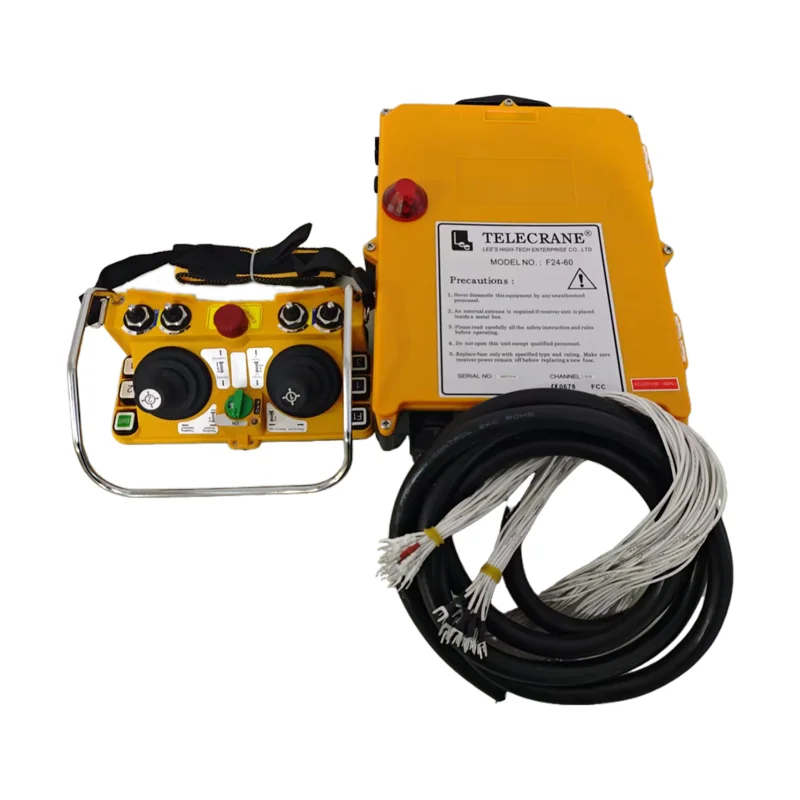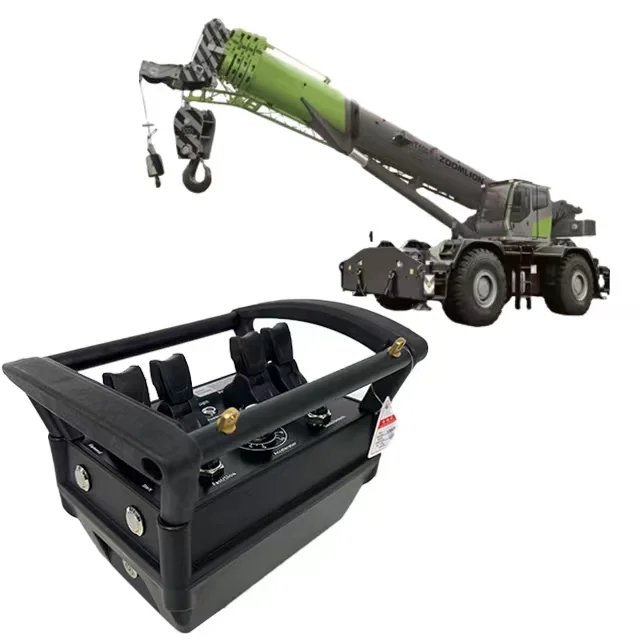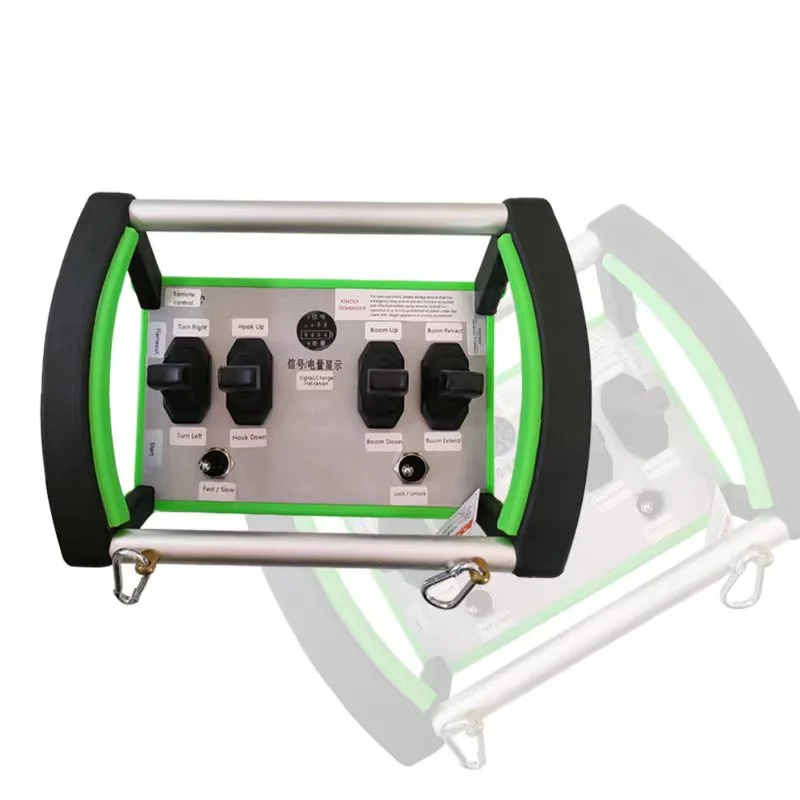
Description
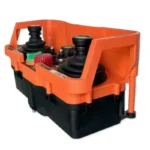
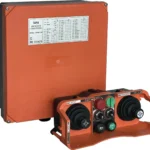
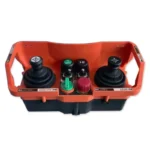
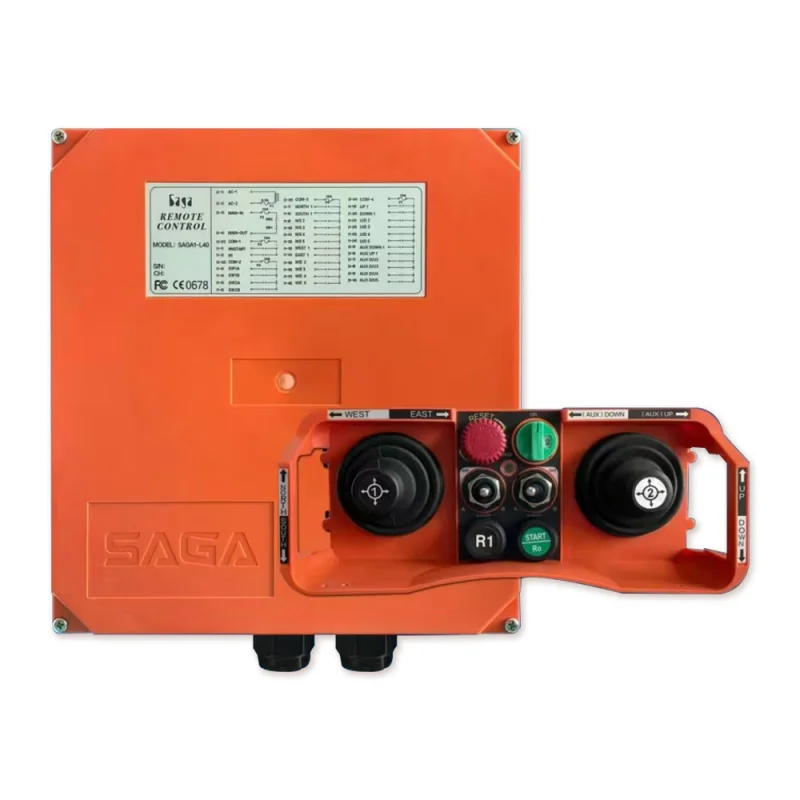
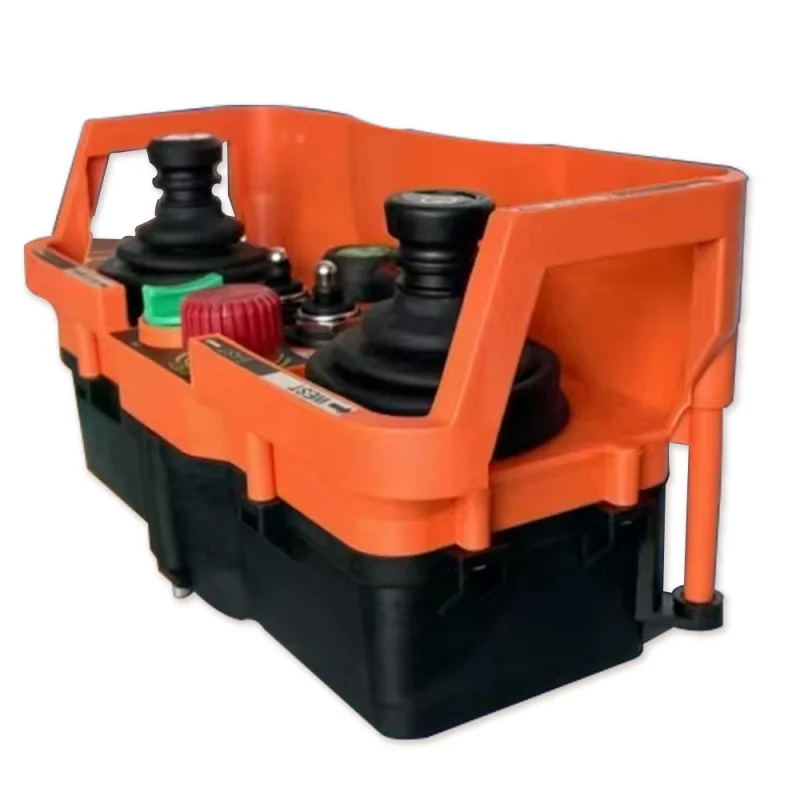
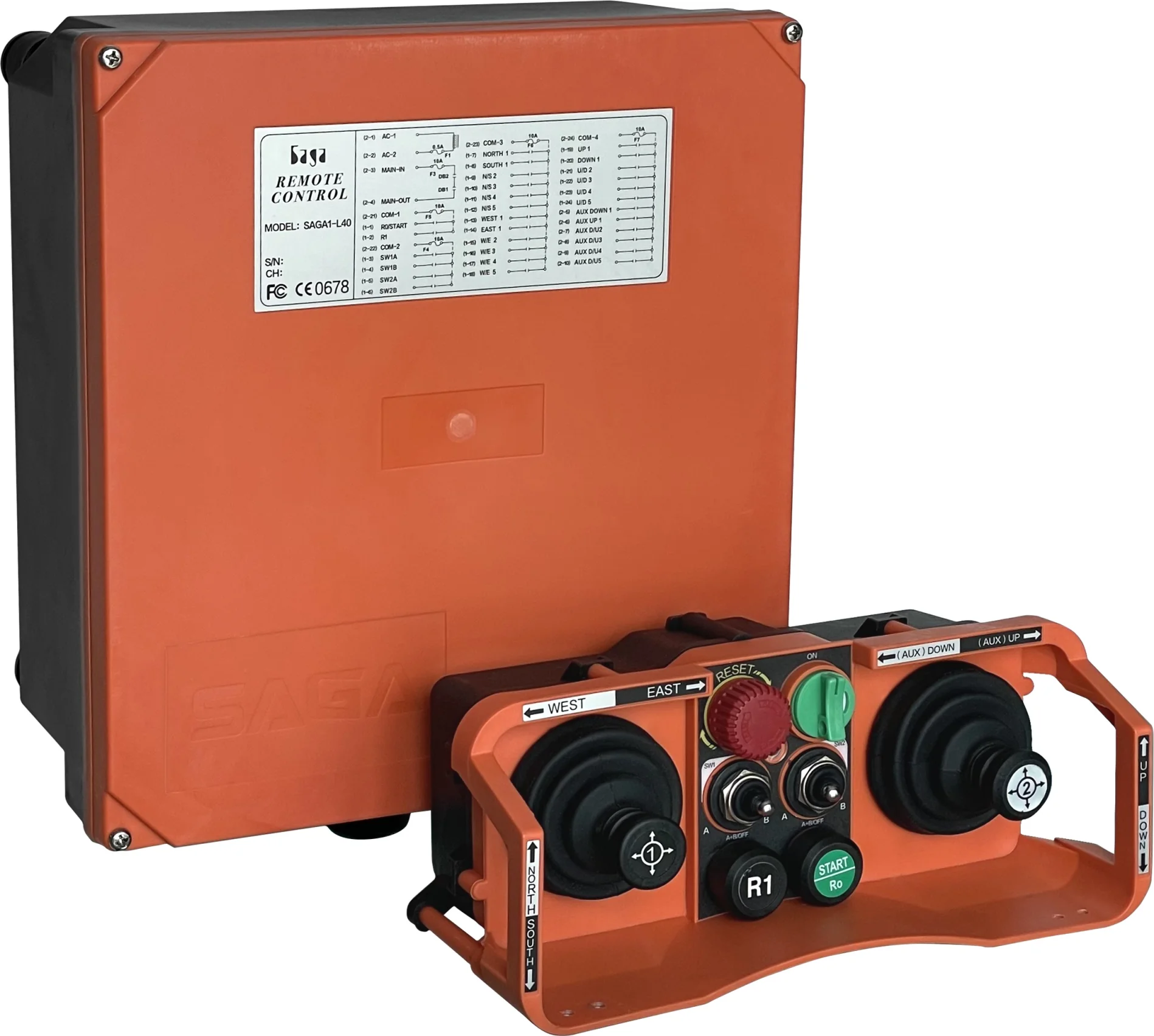
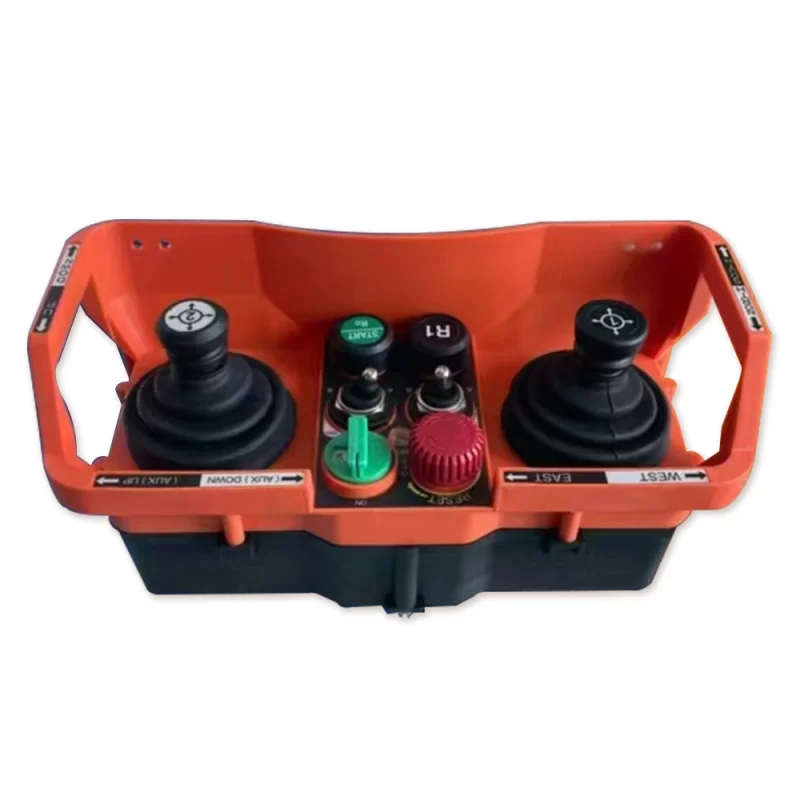
SAGA1-L40 joystick remote control is a belly-box system for machines whose control logic is more complicated than a fixed set of direction contacts. It carries two five-step joysticks, two three-position toggle switches, two single-speed pushbuttons, an emergency stop and a rotary key — and behind them, a receiver that can be built with up to forty programmable relay outputs.
That combination — analogue-feeling stick control plus logic that is written rather than wired — is why the model turns up on tower cranes, heavy gantry cranes, bridge-decking machines and production lines where the sequence has to be tailored to the machine rather than the machine adapted to the controller.
■ Machines that suit a belly-box joystick system
The transmitter is carried on a harness at waist height with both hands free, which changes what an operator can do during a lift:
- Tower and gantry cranes needing up to four axes of five-step control, where slewing and travelling have to be blended rather than stepped one at a time.
- Heavy lifting and bridge-decking equipment where several motions run simultaneously and the operator needs to see the load throughout.
- Concrete and material pumps with multi-section booms that must be moved in combination.
- Programmable production handling — lines where output mapping follows a machine sequence and a standard fixed-logic transmitter cannot express it.
■ Technical data and programmable output capacity
Transmitter
| Control set | 2 × five-step joysticks, 2 × three-position toggle switches, 2 × single-speed pushbuttons |
| Safety controls | Mushroom emergency stop and rotary key |
| Dimensions (L × W × H) | 230 × 95 × 110 mm |
| Weight | 870 g including batteries |
| Power source | 4 × AA alkaline or rechargeable cells |
| Battery indication | Multi-stage voltage indicator |
| Housing | Nylon with glass fibre, shock resistant, IP65 |
| Operating temperature | −45 °C to +80 °C |
| Antenna | Internal as standard; external passive antenna available as an option |
Receiver
| Dimensions (L × W × H) | 253 × 267 × 150 mm |
| Weight | 2,400 g excluding cable |
| Relay outputs | Up to 40 programmable outputs |
| Output assignment | Soft-set per function; a single joystick axis can be mapped to as many as 16 output points |
| Output type | Potential-free contacts, normally open or normally closed as configured |
| Input voltage | AC 24 / 48 / 110 / 220 / 380 V; DC 14–40 V |
| Frequency control | Crystal quartz |
| ID code | 32-bit, over 4 billion combinations, factory set |
| Hamming distance | ≥ 4 |
| Operating range | Up to 100 m |
| Low-voltage protection | Circuit prevents the receiver outputs from latching through a supply interruption |
■ Deciding between a belly-box and a hand-held transmitter
The control hardware question and the ergonomics question are separate, and both have to be answered the same way before this model is the right one.
- Count the relay outputs your sequence needs, then add contingency. Forty outputs is a lot, but the number a machine actually consumes is often surprising once interlocks, indicator circuits and staged speed contacts are counted. If your sequence needs fewer than twenty outputs and no software logic, a fixed-logic transmitter such as the F24-60 dual joystick remote will do the same job for less money.
- Check whether the logic has to be written or wired. Where the machine sequence involves conditions — motion A only permitted when B is in position, staged acceleration on one axis only — the programmable receiver is what makes it possible without adding external relays in the panel.
- Confirm the operator can carry a belly-box. A 870 g transmitter on a harness is comfortable for a full shift on a tower crane, and awkward on a machine where the operator has to climb, crawl or work in a confined space with the box in the way. For those machines, a hand-held unit is the better fit even when the logic is complex.
- Check the environmental extremes. The −45 °C lower limit and the wide upper limit make the unit usable in cold stores, outdoor winter work and hot process areas where standard electronics are marginal. If your site never goes below −20 °C, that capability is not a reason to choose this model.
- Decide on the antenna arrangement before installation. The standard internal antenna keeps the transmitter sealed and simple; the external passive antenna option exists for sites where the receiver sits inside a steel enclosure or where signal shadowing is a known problem. Pick one at order rather than discovering the need after commissioning.
■ SAGA1-L40 joystick remote control price
Indicative export bands for a transmitter-and-receiver set, ex-works Zhejiang. This model is configured to order, so the band is wide and the quotation follows the output count.
| Quantity | Indicative unit price (USD) |
| 1 set | 420 – 760 |
| 3–9 sets | 390 – 700 |
| 10 sets and above | 355 – 640 |
| External passive antenna option | quoted with the set |
| Additional programming, per machine logic | quoted per project |
What moves the price: the number of relay outputs the receiver is built with, whether programming is a standard four-axis logic or a documented machine-specific map, whether the external antenna is included, and the quantity. Accessories — harness, spare battery set, spare transmitter — are priced separately but ship more cheaply when added to the main order than ordered later.
■ Ordering, programming and post-sale support
What the order needs
Machine type, the complete axis and function list, the receiver input voltage, the required fail-safe behaviour for each axis, expected relay output count and the quantity. For logic that is machine-specific, send either the sequence description or the existing relay schematic — we will produce the output map from it. Harness type, spare batteries and any second transmitter should be stated on the same enquiry.
Programming, lead time and delivery
Because the receiver logic is written rather than fixed, this model is quoted from 1 set for evaluation and from 3 sets for machine-specific programmes. Typical lead time is 20–30 working days where logic is produced to your sequence, and shorter where a standard map applies. The programme and the final test record travel with the unit, so the same logic can be reproduced for a later order. Payment terms are issued with the quotation; shipments go by courier for single sets and by air or sea freight for volume.
Warranty and service life
Twelve-month warranty against manufacturing defects, excluding wear items such as joystick assemblies, batteries and housings damaged in service. The service philosophy behind this model is that hardware and software are kept consistent across the series, so a failed transmitter can be swapped without reworking the receiver programme. Technical support covers wiring, output mapping and commissioning questions, and the recorded ID code lets a replacement transmitter be supplied already matched to your receiver.
■ The manufacturer behind the unit
IEHC has been building electrical control equipment in Yueqing, Zhejiang since 2003, running a 1,500 sqm plant with 50+ employees and 20+ sets of production and testing equipment as an integrated manufacturer. Six patents, twelve trademarks and thirteen qualification certificates sit behind the control product lines, and CE marking plus an ISO quality system apply across the range.
For a programmable belly-box system, the deciding capability is not production volume but application engineering — turning a machine sequence into a verified output map, then documenting it well enough that the same logic can be reproduced years later. That work happens here, on the same site as the assembly, which is the practical difference between this model and a box shipped with no programme behind it.
Related models are grouped under the joystick remote control range. For simpler button control of a standard crane, see the industrial remote control systems range.
Send the machine type, axis list, receiver voltage and the sequence or schematic for machine-specific logic through the contact page. We will return an output map and a firm price. Ordering, packing and payment questions are covered on the IEHC FAQ page.
FAQ
What is a belly-box transmitter, and when is it the right choice?
A belly-box is a transmitter carried on a shoulder harness and held at waist height rather than in the hands. It is the right choice when the operator needs both hands free, when the shift is long enough that holding a hand transmitter becomes tiring, and when four axes of stick control have to be worked together. It is the wrong choice where the operator climbs ladders, works in confined spaces or has to move around the machine constantly, because the harness and box get in the way.
What are forty programmable relay outputs actually used for?
Each output is a potential-free contact that the receiver closes according to the programme. On a four-axis crane, one joystick axis alone can be mapped to as many as sixteen output points, because every step of travel can close a different contact, and different contacts again in each direction — which is how five-stage speed control is produced from a stepped stick. The remaining outputs carry interlocks, auxiliary motions, indicator circuits and staged acceleration. The practical figure depends on the machine, which is why the sequence has to be seen before an output count is quoted.
How is the receiver programmed — from a handset or from a PC?
Programming is done with the manufacturer's software and the matching programming tool, so the output map is produced as a file rather than set switch by switch. That is what allows a programme to be recorded, reproduced for a repeat order, or amended when a machine is modified. Where the logic is standard, tell us the axis list and the standard map applies; where it is machine-specific, send the sequence and the map is produced and documented against your machine.
Can the SAGA1-L40 really operate at −45 °C?
The stated operating range is −45 °C to +80 °C, which covers cold stores, unheated outdoor installations and hot process areas. Two practical points apply at the cold end: alkaline cells lose capacity well before the electronics stop working, so rechargeable cells are the better choice for continuous cold operation, and a transmitter left overnight outside should be brought to working temperature before a shift rather than expected to perform from a cold start.
Internal antenna or the external passive antenna?
The internal antenna is standard and keeps the transmitter fully sealed, which suits most installations and most machines. The external passive antenna option is for installations where the receiver sits inside a steel enclosure or where large steel structures shadow the signal — both common on tower crane bases and indoor gantry installations. It is chosen at order time, and the decision is best made by describing where the receiver will be mounted rather than by defaulting to it.
Request Quote
Tell us your specifications, quantity, or application scenario and we will reply with a tailored quote.