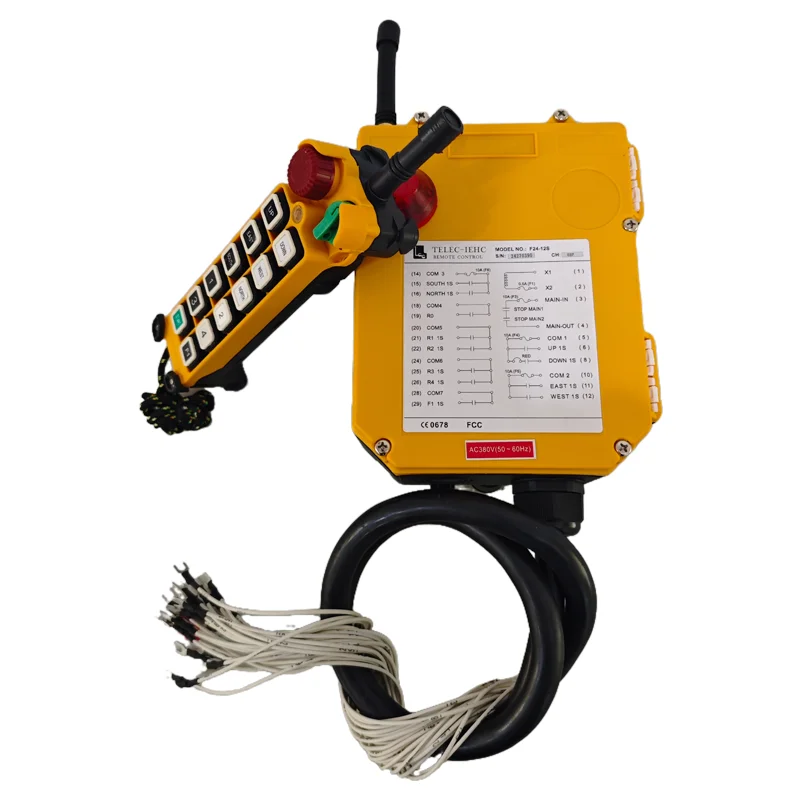
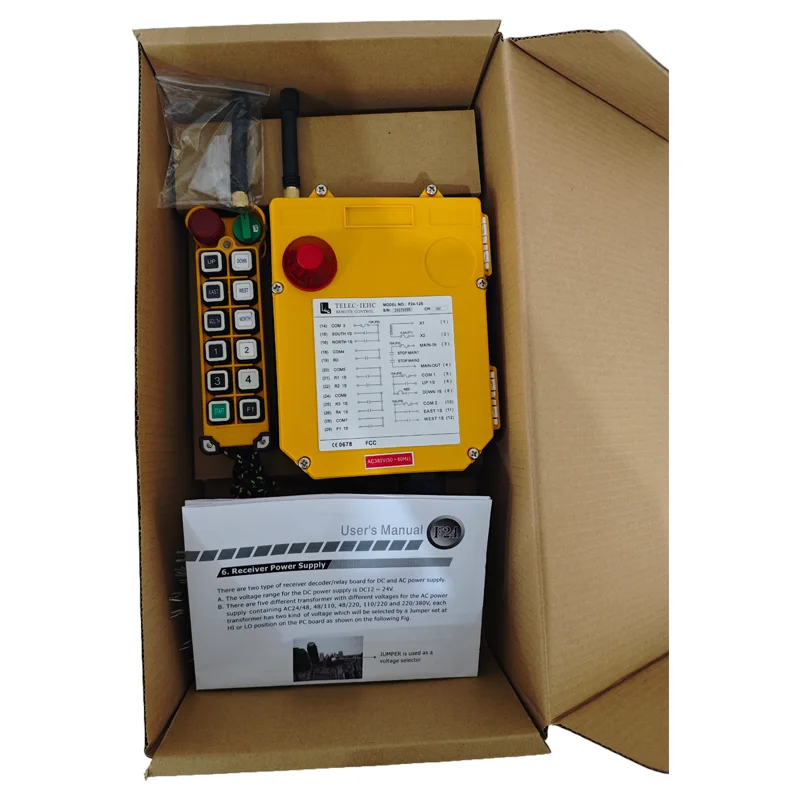
Description
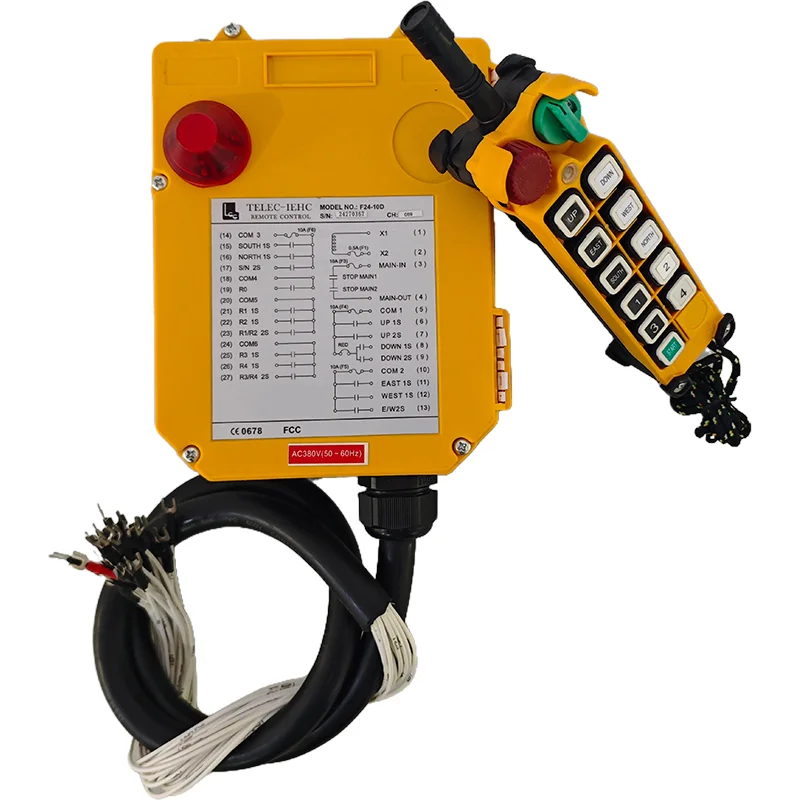
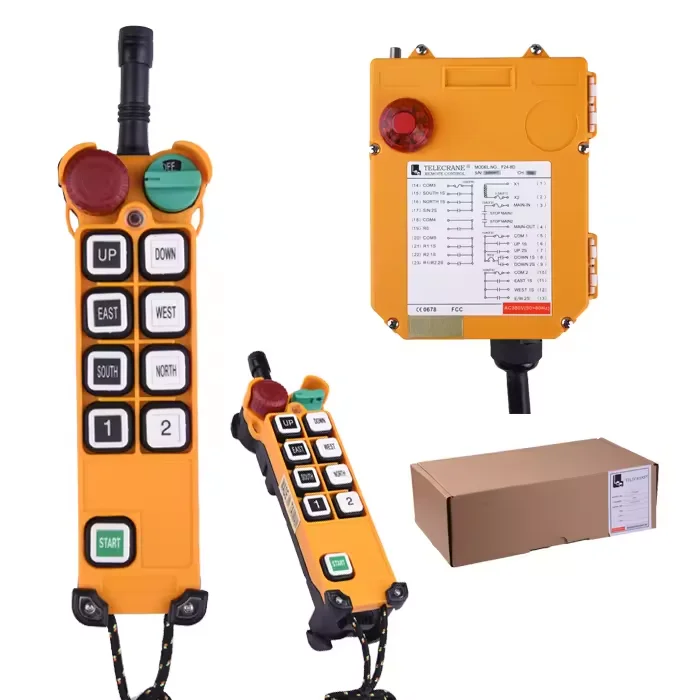
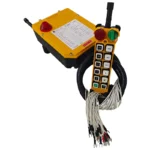
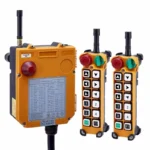
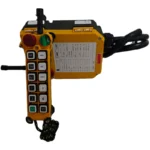
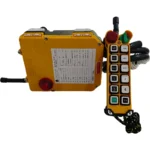
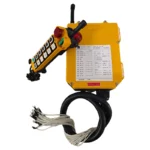
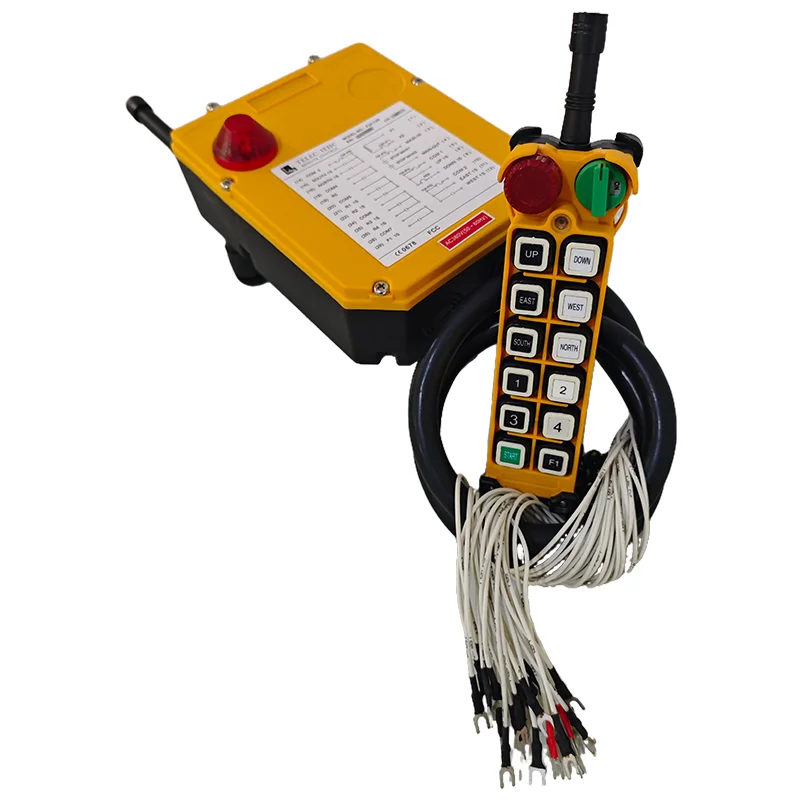
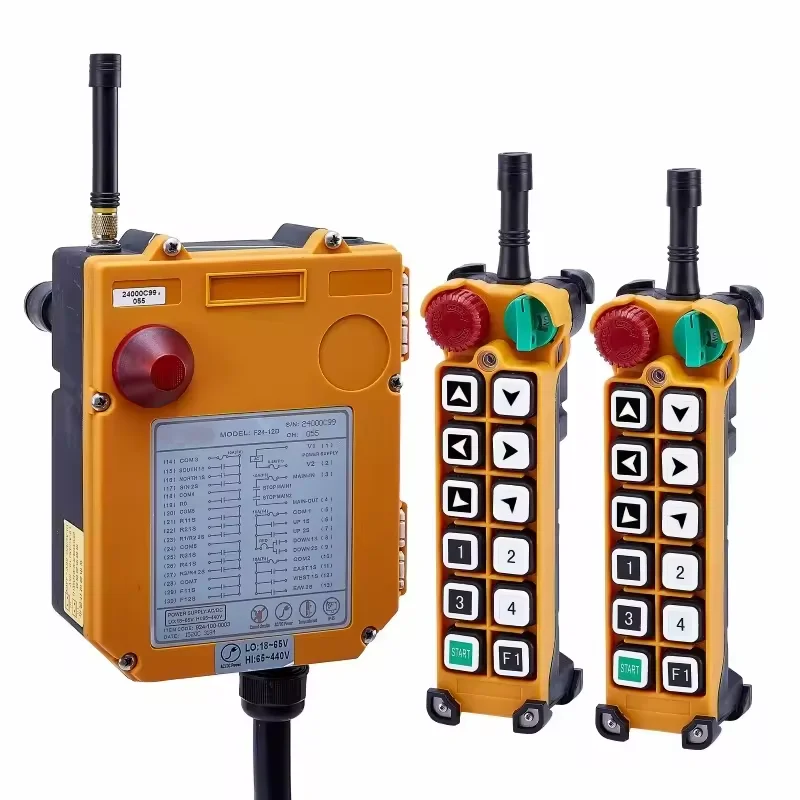
F24-12S 12D remote control is the twelve-button build in the F24 range and the one that covers the widest spread of panel voltages. Its receiver accepts a low range of 18–65 V and a high range of 65–440 V, AC or DC, from the same unit — so a single part number can be stocked for 24 V control circuits and 380 V cranes alike.
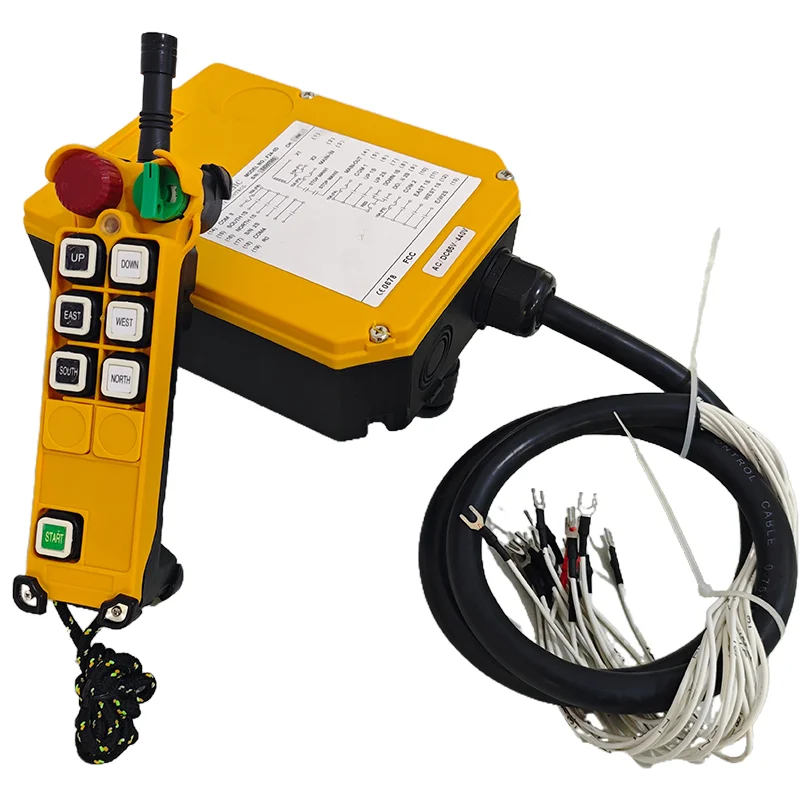
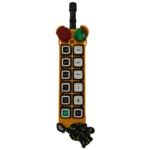
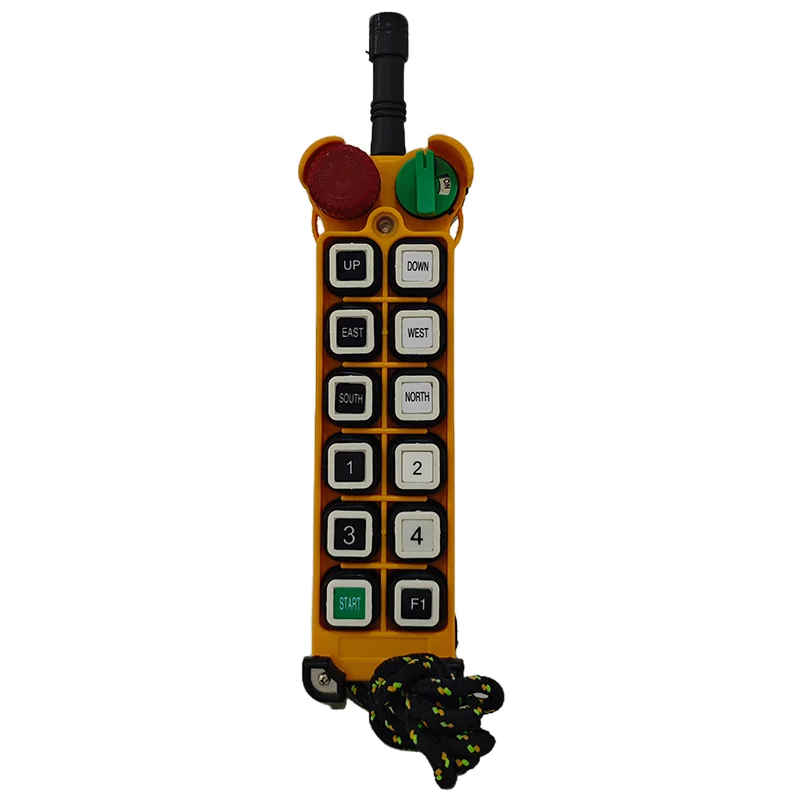
Twelve buttons is enough for a four-motion crane, for two complete three-motion sets, or for a crane carrying several auxiliary circuits. Three independent safety devices are fitted as standard: a mushroom emergency stop, a rotating magnetic key and a separate start button.
■ Where twelve buttons are the right answer
The build is usually specified in four situations:
- Four-motion cranes — hoist, trolley, bridge travel and a fourth axis such as a slewing or traversing motion, with start and stop taken out of the same count.
- Double-girder cranes with an auxiliary hoist — a main hoist, a service hoist and a travel motion, each with its own direction pair.
- Cranes with several auxiliaries — grab, magnet, rotating hook, outrigger and work light, all switched from the transmitter instead of a second pendant.
- Multi-voltage fleets — workshops maintaining both 24 V DC and 380 V AC machines from one spare-parts stock, which is where the LO/HI receiver input earns its keep.
■ Specifications and wiring data
| Model variants | F24-12S (single speed) / F24-12D (dual speed) |
| Buttons | 12 |
| Button format | Single-speed or dual-speed logic, set at order |
| Safety devices | Mushroom emergency stop, rotating magnetic key, separate start button |
| Receiver input, low range (LO) | AC/DC 18–65 V |
| Receiver input, high range (HI) | AC/DC 65–440 V |
| Housing material | PA66 nylon with glass fibre |
| Ingress protection | IP65 / IP66 depending on build |
| Control distance | Up to 100 m, maintained in electromagnetically noisy plant |
| Antenna | External high-sensitivity antenna on the receiver |
| Encoding | Advanced encoding with learning-code pairing |
| Environmental resistance | Water, dust, oil and impact resistant |
| Certification | CE, with test reports available on request |
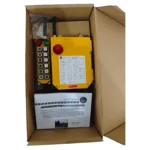
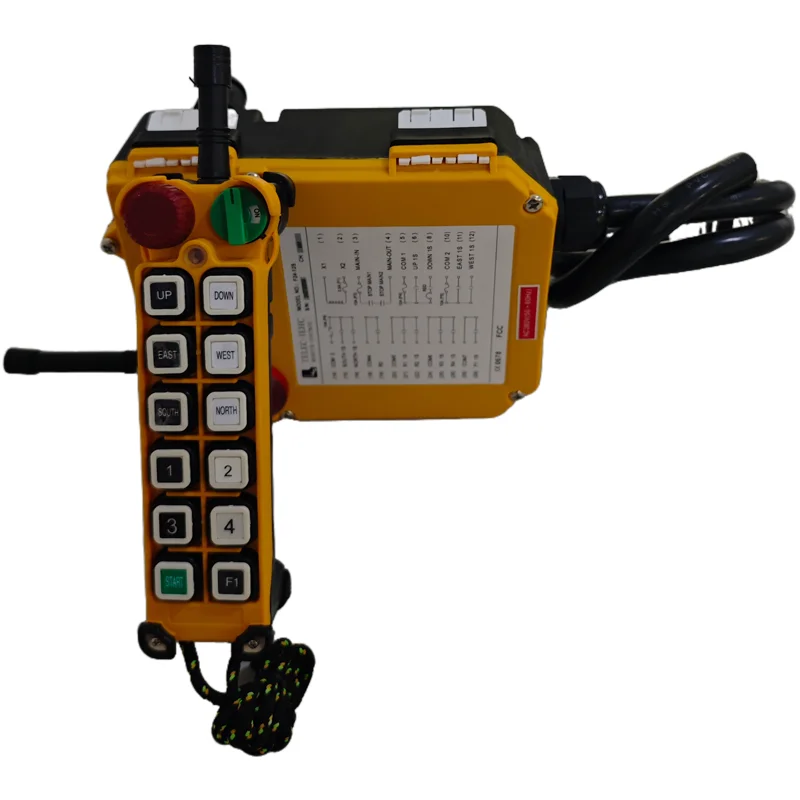
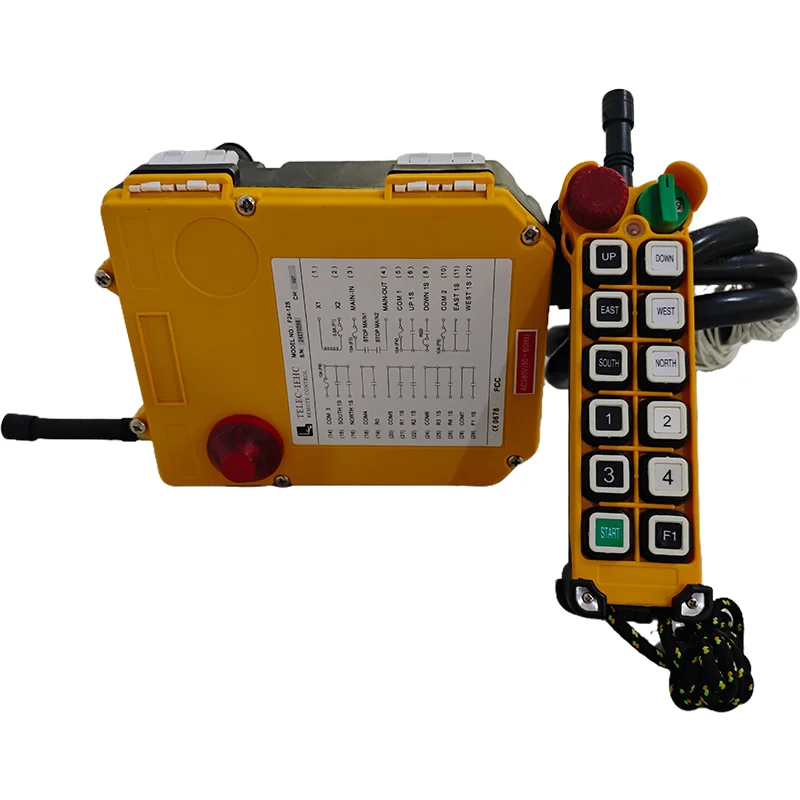
Sets ship complete with transmitter, receiver, antenna, connecting cable, batteries, pouch and the wiring diagram for the specific configuration.
■ Reading the LO/HI receiver input correctly
The two-range input is the feature buyers ask about most, and it is also the one most often mis-specified. Work through it in this order.
- Find out what the control circuit is, not what the motor is. The receiver feeds the contactor coils, not the motors. A crane with 380 V motors can still have a 24 V or 48 V control circuit, and it is the coil voltage that has to match the receiver range.
- Pick the range that contains your voltage with margin. Below 65 V the LO range applies; above it, the HI range. A 48 V control circuit belongs in LO, and a 220 V or 380 V circuit in HI. Choose the range that brackets the nominal voltage with room on both sides rather than sitting on the 65 V boundary.
- Check AC or DC. Both ranges accept alternating and direct current, which is why the same receiver suits a DC-controlled machine and an AC-controlled one. State which you have, since the internal protection arrangement differs between them.
- Decide the speed logic before the output count. A twelve-button single-speed receiver carries twelve outputs. A dual-speed receiver carrying the same twelve button positions needs additional outputs for the second stage. If panel space is limited, that is the number to check.
- Confirm the fourth axis really exists. Twelve buttons are wasted on a three-motion crane unless the auxiliary functions are genuinely used. If they are not, the F24-8S/8D or F24-10S/10D is the more economical choice and operates identically.
■ F24-12S 12D remote control price range
Indicative export bands for a complete set, ex-works Zhejiang. Final pricing is confirmed on quotation, since the receiver is configured to the machine rather than supplied in one fixed build.
| Quantity | Indicative unit price (USD) |
| 1 set | 78 – 165 |
| 5–19 sets | 72 – 150 |
| 20 sets and above | 66 – 138 |
| Spare transmitter | 40 – 80 |
| Spare receiver, configured | 45 – 95 |
Price is most sensitive to the number of receiver outputs, because a dual-speed twelve-button build carries roughly twice the outputs of a single-speed one. After that come quantity, custom button legends or branded housings, and whether certification paperwork is required for import. Spare receivers cost less when ordered with the set, because the configuration work is done once.
■ Ordering information and quality assurance
Send with your enquiry
Machine type, the complete motion and auxiliary list, control-circuit voltage and whether it is AC or DC, the speed logic required per motion, button legends, quantity and any OEM requirement. For four-motion machines include the interlock conditions — which motions may not run together — because those are programmed into the receiver rather than added at commissioning.
Ordering, lead time and terms
Orders start at one set. Standard stock configurations ship in 5–10 working days; machine-specific receiver logic and OEM branding take 20–30 working days. Payment terms are issued with the quotation. Air and sea freight are both available, with courier service for small quantities. Each set is packed in an export carton with the antenna, cable and wiring diagram packed with the units rather than shipped separately.
Verification and warranty
Every unit is tested before dispatch, and configured receivers are verified against the machine logic they were programmed for rather than only against a generic test sequence. CE marking applies, and test reports can be issued with the shipment where the buyer needs them for import. The standard warranty covers twelve months against manufacturing defects, and because each unit’s ID code is recorded, a replacement transmitter reaches you already paired to your receiver.
■ Manufacturing background
Zhejiang iehc Electrical Technology Co., Ltd has been producing electrical control equipment in Liushi Town, Yueqing since 2003. The plant covers 1,500 sqm with 50+ staff and 20+ sets of production and testing equipment, and operates as an integrated manufacturer rather than a trading operation. For a configured product like the F24-12S/12D, three capabilities do the real work:
- Receiver programming as a production step. Interlocks, speed stages and output mapping are produced and verified in-house against the machine’s sequence.
- Wide-range receiver build. Both the LO and HI input arrangements are assembled here, so one supplier covers a fleet that mixes 24 V and 380 V machines.
- Documentation packages. Wiring diagram, terminal reference and legend drawing ship with each configured set, which suits OEM customers who resell under their own name.
The full range is listed under industrial remote control systems. Where stick control rather than buttons is needed, see the F24-60 dual joystick remote.
Send the motion list, interlock conditions and control-circuit voltage through the contact page and we will confirm the LO or HI range, the output count and a firm price. Commercial questions are covered on the IEHC FAQ page.
FAQ
Which receiver range does my machine need — LO or HI?
Match the receiver to the control-circuit voltage feeding the contactor coils, not to the motor voltage. Circuits up to 65 V use the LO range, and circuits above 65 V use the HI range; both handle AC and DC. A crane with 380 V motors and a 24 V control circuit therefore takes the LO range, which is a common source of mis-ordering when the motor nameplate is used as the reference.
How many separate motions can twelve buttons control?
Twelve button positions, each driving one function in the single-speed build or two stages in the dual-speed build. A typical arrangement is a four-motion crane using eight buttons for direction functions, one start, one stop, and two for an auxiliary circuit. Because receiver outputs are assignable, the same twelve buttons can be mapped onto a different machine sequence if the logic is programmed for it.
What is the separate start button for?
It is a deliberate second step before the machine will accept a command. A transmitter that is switched on and keyed still does nothing until start is pressed, so a unit knocked against something in an operator's pocket or swung on its strap cannot move a crane. Together with the magnetic key, which cuts the transmitter when it is removed, and the mushroom emergency stop, it forms the three-layer arrangement fitted as standard to this model.
Does the external antenna make a real difference?
Yes, particularly inside steel structures. A high-sensitivity external antenna fitted to the receiver can be positioned away from the enclosure, which helps where the panel sits inside a steel box or against a wall that shadows the transmitter. Positioning matters as much as the antenna itself: keep it clear of large steel surfaces and away from VFD output cables, which are the two most common causes of reduced range that we see.
Can the F24-12D be downgraded to single speed later?
The speed logic is built into the receiver, so changing it means changing the receiver rather than changing a setting. If there is any chance that a two-speed motor will be fitted later — a planned upgrade to a VFD, for example — order the dual-speed receiver at the start. The transmitter is the same either way, so the extra cost at order time is limited to the receiver outputs.
Request Quote
Tell us your specifications, quantity, or application scenario and we will reply with a tailored quote.