433 MHz vs 2.4 GHz: Choosing a Crane Remote Control Band
Published: Author: Lisa
For most overhead crane installations in a steel-framed building, 433 MHz is the safer default: the longer wavelength bends around girders and columns and keeps the link alive where 2.4 GHz drops out. Choose 2.4 GHz when you need a return path — feedback displays, fault codes, battery status at the transmitter — or when the site is a clean open yard and you want the extra channels. The decision, in other words, is about geometry and data, not about which band is newer.
That answer surprises buyers who assume the higher number is the better product. The 433 MHz vs 2.4 GHz question comes up on almost every industrial remote control enquiry, and it is worth settling before the order, because the band cannot be changed later by swapping a setting.
The short answer, in one paragraph
Both bands are licence-free in most markets and both are in daily industrial service. 433 MHz trades data capacity for penetration: narrow channels, modest data rates, a signal that survives obstruction. 2.4 GHz trades penetration for bandwidth: wide channels, fast frequency hopping, two-way communication, compact antennas — and a much harder time getting through steel. If your transmitters only send commands, 433 MHz is usually enough and often better. If they must also receive something, 2.4 GHz is the practical choice.
What actually differs between the two bands
The difference starts with wavelength. At 433 MHz one cycle is roughly 69 cm long; at 2.4 GHz it is about 12.5 cm. A radio wave bends around objects smaller than a fraction of its wavelength and is blocked or reflected by objects much larger. Steel columns, girders and roof trusses are larger than either, but the coarser 433 MHz wave loses less energy squeezing past their edges, so the diffracted path stays usable further into the shadow region. This is the whole of the crane remote control frequency argument in physical terms.
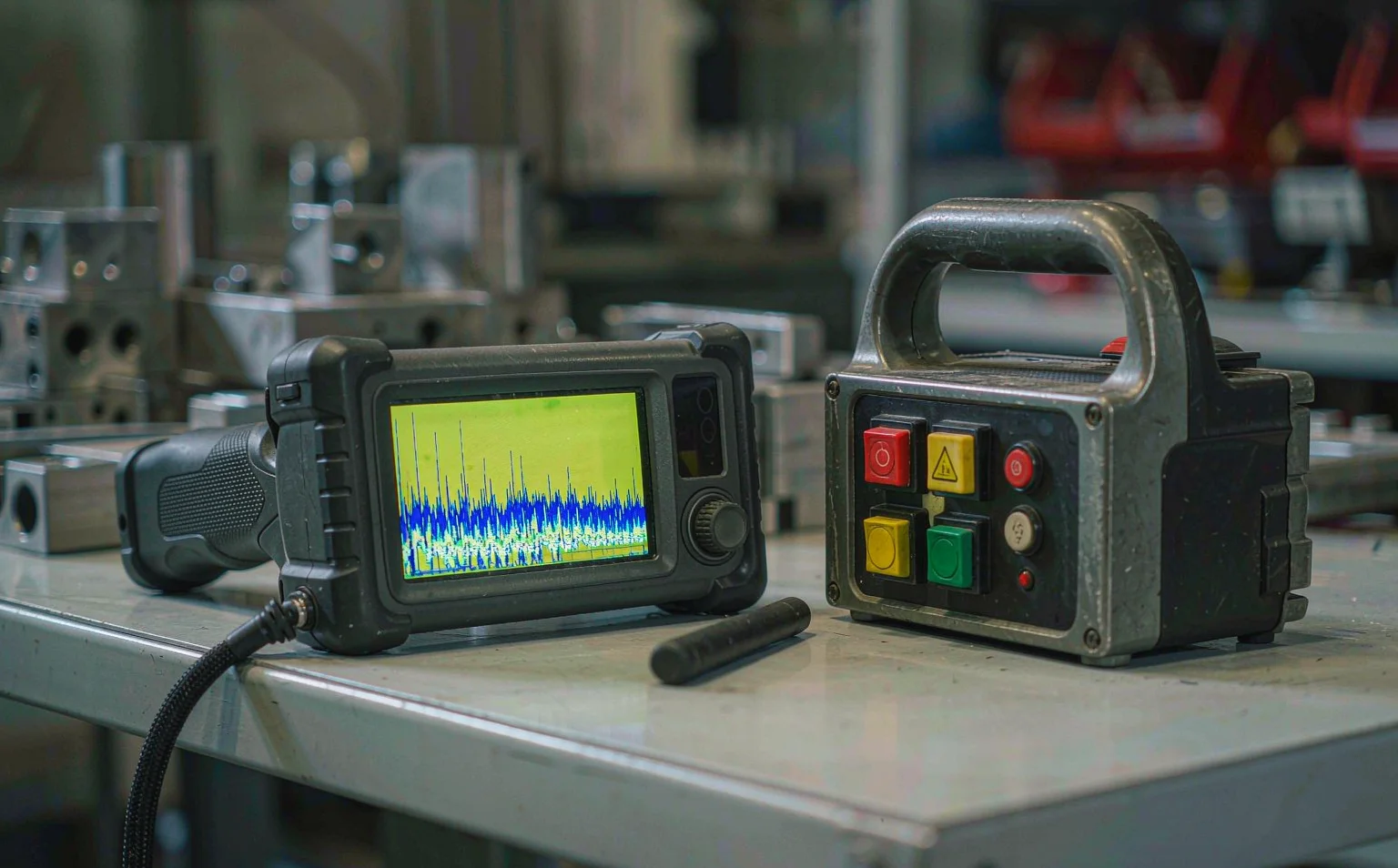
The second difference is bandwidth. A narrowband 433 MHz channel carries a few kilobits per second — plenty for a command stream and nothing more. The 2.4 GHz ISM band is about 80 MHz wide, which allows spread spectrum and fast hopping, and therefore enough capacity to send data back from receiver to transmitter.
Property
433 MHz
2.4 GHz
Wavelength
~69 cm — diffracts around obstructions
~12.5 cm — blocked more easily
Channel width
Narrow (tens of kHz)
Wide (1–2 MHz per channel)
Data capacity
Command only
Command plus return channel
Antenna in the transmitter
Internal, needs volume
Small, easy to integrate
Body shadowing
Minor
Noticeable — hand position matters
Coexistence pressure
Low in industrial plants
High — Wi-Fi, Bluetooth, cameras
Typical fit
Single-speed and dual-speed hook cranes
Systems with feedback, many units on site
What steel structures do to a radio link
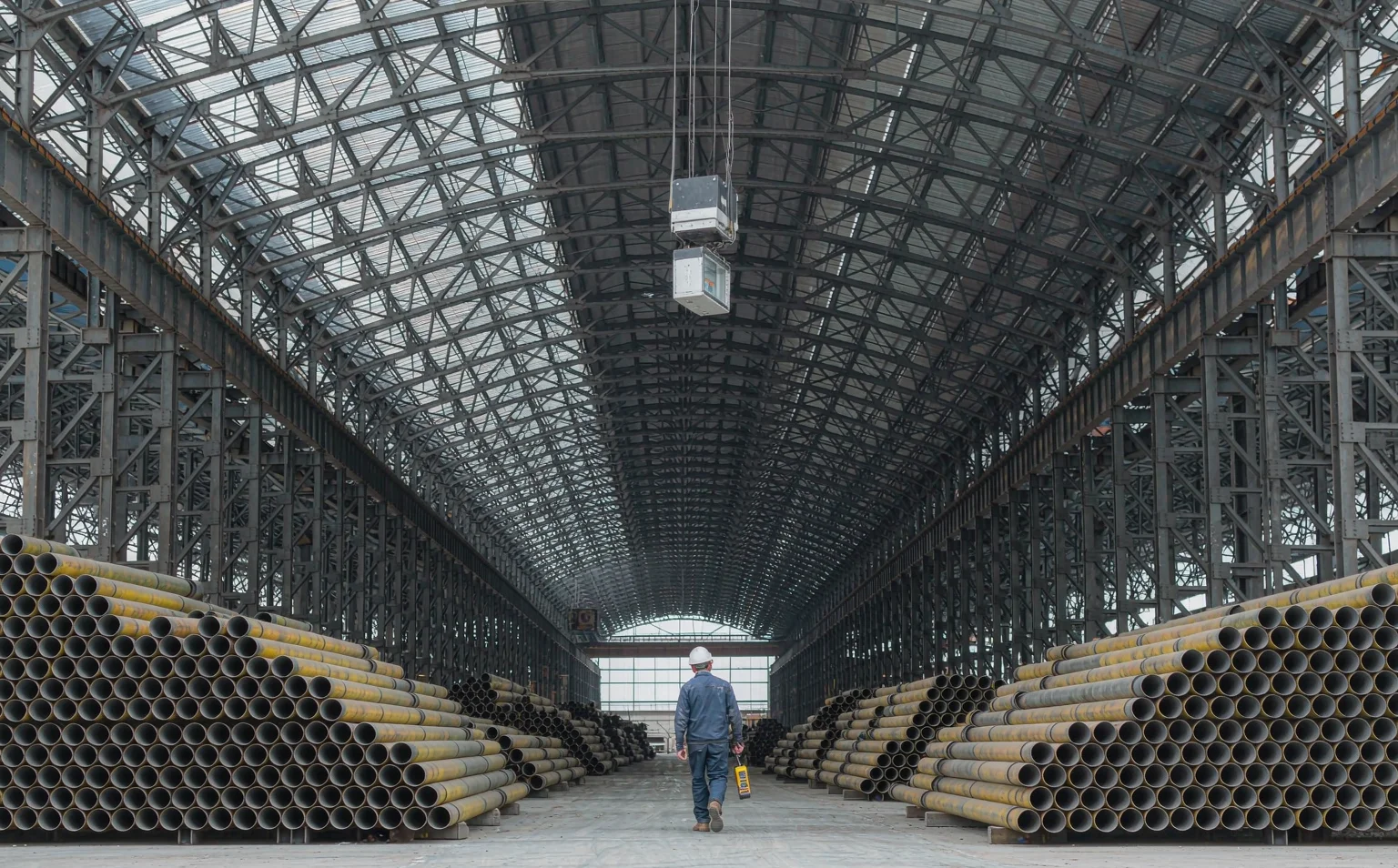
A crane bay is not a free-space path. The receiver sits 8 to 15 metres up, on a girder or in a panel, and the operator walks underneath it at the far end of the runway, behind stacks of pipe or bundles of rebar. So the link has two paths: a direct one that is usually blocked, and reflected ones from the trusses, the far wall and the load. Reflections arrive slightly later than the direct signal and either add or cancel, producing pockets of good and poor reception instead of a smooth distance curve.
At 2.4 GHz those pockets are spaced a few centimetres apart, so an operator can stand in one spot and lose the link by raising a hand to face height. At 433 MHz they are far apart, which is why an operator walking a 60-metre bay usually hits one or two dead spots rather than a continuous flutter. Neither band is immune; 433 MHz simply tolerates the ordinary movement of a shift better.
Antenna placement matters more than the band, and it is cheaper to fix. Keeping the receiver antenna clear of the panel, above the girder line and away from VFD cabinets does more for reliability than any change of frequency. Our guide to what actually affects operating distance covers that in detail.
Why 2.4 GHz shares its airspace with everything else
The 2.4 GHz band is free, which is exactly why it is crowded. A plant of any size has Wi-Fi access points, scanners, wireless cameras and Bluetooth tools. Frequency hopping helps — a hopping system loses only the slice of time that collides with a busy Wi-Fi channel and retries on another hop — but help is not immunity. Sites running dense Wi-Fi on channels 1, 6 and 11 can push a 2.4 GHz remote control toward the top of the band and reduce its margin at long range.
433 MHz has no such neighbour in a normal plant. The band is used by weather stations, tyre-pressure sensors and gate openers, none of which transmit often or with much power. For a crane that must respond on the first press every shift, that quiet spectrum is worth a great deal.
Channel capacity on multi-crane sites
One band does not support unlimited cranes. Every additional transmitter and receiver pair consumes a channel. Narrowband 433 MHz systems usually come with a fixed set of channel numbers and a pairing code; the installer assigns a different combination to each crane, and the practical ceiling is tens of pairs per bay. A 2.4 GHz hopping system spreads each link across a wide band with a hopping sequence and a network ID, which lets more pairs coexist — at the cost of a channel plan somebody has to maintain.
Above four or five cranes in one bay, ask for the channel allocation in writing with the order.
How to choose: a five-step comparison on your own site
Work through these in order.
Decide whether you need a return path. If the transmitter must show load, fault codes, remaining battery or confirmation that a command executed, you need 2.4 GHz. If it only sends commands, both bands remain open.
Map the worst-case operator position. Walk the runway and find the point furthest from the receiver with the most steel between you and it. That position, not the average one, determines whether the link holds.
Survey the 2.4 GHz band. Use any Wi-Fi analyser app on a phone near the receiver position. A quiet band with one or two weak networks is workable; a band full of strong overlapping networks on 1, 6 and 11 argues for 433 MHz.
Count the units that must coexist. More than five or six pairs in one bay pushes you toward a hopping 2.4 GHz system with a managed channel plan, or toward a documented 433 MHz channel assignment.
Check the destination market. Both bands are licence-free in the EU, the UK and most of Asia, but the permitted 433 MHz sub-band and radiated power differ by country. Confirm with your importer before ordering, and ask for the radio approval documents for the exact frequency variant you are buying.
The band is fixed at manufacture. A 433 MHz transmitter will not talk to a 2.4 GHz receiver, and no firmware switch converts one into the other. Choose once, and buy spares in the same band.
Treat the frequency band as a site decision, not a specification upgrade. If the link only has to carry commands and you work in a building full of steel, 433 MHz is the conservative and usually correct choice. If you want the transmitter to receive information, or you operate in the open, 2.4 GHz earns its weaker penetration with capacity you will actually use.
Once the band is fixed, the rest is mechanical: count the outputs, confirm the control voltage, choose the protection level. For a twelve-button dual-speed installation the F24-12S-12D and the smaller F24-10S-10D share a platform and a channel plan, which makes a mixed fleet easier to maintain. If you are unsure which variant your market admits, send the destination country and the motion list through the contact form and we will confirm the radio variant before anything is built.
FAQ
Is 2.4 GHz better than 433 MHz for crane remote controls?
Not in general. 2.4 GHz gives you a return path and more channels; 433 MHz gives better penetration and a quieter spectrum. In a steel-framed bay with obstruction between operator and receiver, 433 MHz holds a more consistent link.
Can I use a 2.4 GHz remote control where Wi-Fi is already installed?
Usually yes, because frequency hopping avoids the busiest channels. The risk rises when several strong access points occupy the whole band and the crane works at long range. A five-minute spectrum survey at the receiver position tells you whether the margin is adequate.
Will a higher frequency give me longer range?
No. Free-space loss increases with frequency, and obstruction loss increases faster. A well-placed 433 MHz antenna normally outperforms a 2.4 GHz system at equal transmitter power when steel is in the path.
Can the same transmitter work on both bands?
No. The radio module, antenna and approval are band-specific. Units sold as dual-band are effectively two radios in one housing, and price and documents should be requested for each band separately.
Which band should I pick for a single-speed eight-button system?
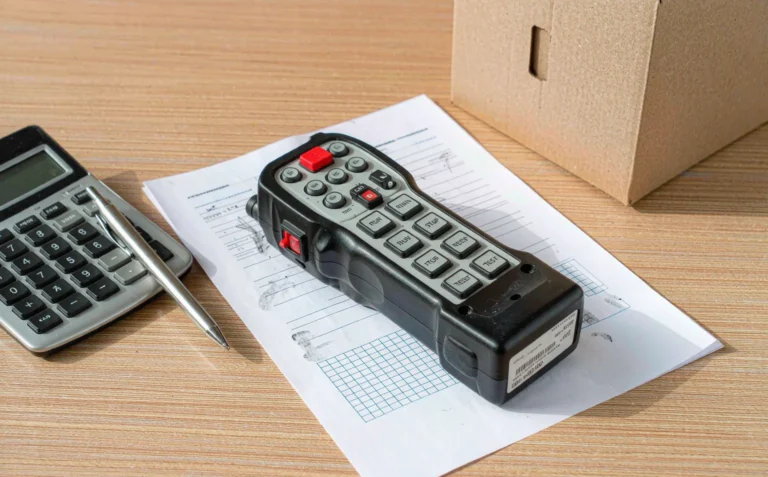
For a hook crane with no feedback requirement, 433 MHz covers the requirement and keeps the radio simple. A unit such as the F21-E1B is built for exactly that duty, while larger multi-motion cranes on the same site can run in the same band so that one spare-parts pool and one channel plan cover the whole fleet.
Ask for the file, not the mark. Five documents to request before ordering, how to check a declaration against the model in the carton, and the red flags.