Pendant Control Station Wiring: Cores, Common, Earth
Cores follow functions, not buttons. The sum that sizes the cable, why the stop must not share the button common, and five pre-power checks.
Read More

An emergency stop and a deadman function are not the same thing, and a crane remote control needs both. The emergency stop is a deliberate, latching action that drops the machine-level stop circuit and keeps it dropped until someone resets it. The deadman function is continuous: outputs fall away the moment the operator releases control, loses the radio link, or the transmitter battery fails. One is a decision, the other is an absence of input — and wiring them as if they were interchangeable is the most common safety defect found on retrofitted cranes.
This article covers what each function has to achieve in the circuit, how a receiver behaves when the link is lost, and the arrangements that look correct on a drawing but fail in practice.
The emergency stop exists to stop the machine when something has already gone wrong, including the possibility that the operator is no longer in control. That is why it must be a mushroom-head actuator, why it must latch mechanically, and why it must not depend on the transmitter’s processor to remain engaged.
The deadman function exists to stop the machine when there is no command. It is what prevents a crane from continuing a motion after the operator has been distracted, has walked behind a column, or has dropped the transmitter. It does not require an operator decision — it is the default state.
| Aspect | Emergency stop | Deadman function |
|---|---|---|
| Trigger | Deliberate operator action | Release, loss of link, power loss |
| Latching | Yes, requires manual reset | No, restores when control resumes |
| What it acts on | The machine-level stop circuit | The receiver’s direction outputs |
| Actuator | Mushroom head, mechanically held | Direction button or stick return spring |
| Failure mode to avoid | Stop that only drops a receiver relay | Outputs that hold their last state |
A crane remote control emergency stop that is wired correctly travels the same route as a pendant stop. If it does not, the machine has two stop circuits of different reliability, and the weaker one is the one the operator will reach for.
Step three is where retrofits go wrong. A transmitter stop wired only to the receiver’s output relay stops the crane as long as the receiver is powered and healthy. If the receiver loses power, is unplugged, or is removed during maintenance, that stop disappears — while the pendant stop may still work, giving the false impression that the machine still has a functioning emergency stop.
Link loss is the deadman function’s most important test case, and the one most often skipped during commissioning.
A correctly configured receiver drops its outputs when the signal disappears, so the commanded motion stops and the crane does not continue on its last command. The failure mode to guard against is a receiver that holds its last state, which turns a dropped transmitter into a crane that keeps travelling until something stops it physically.
The safe way to demonstrate this is with the crane unloaded and the travel motion running slowly: switch the transmitter off mid-function and confirm the motion stops within the expected time and does not restart when the transmitter is switched back on. A system that resumes the previous command on power-up has a latching behaviour that must be corrected before the crane is released to production.

| Arrangement | Why it fails |
|---|---|
| Transmitter stop wired only to the receiver output relay | The stop depends on the receiver being powered and healthy; remove or unplug the receiver and the stop is gone |
| Receiver outputs holding last state on link loss | A dropped or flat transmitter leaves the crane running |
| Emergency stop resetting automatically when the mushroom is released | The machine can restart with the operator still in the hazard zone |
| Direction buttons sharing the stop function | Releasing a direction button is not a stop command, and the operator has no unambiguous stop to reach for |
| Receiver powered from a circuit the stop does not drop | The receiver keeps commanding contactors that the stop has isolated, producing unpredictable behaviour at reset |
| No local stop at the panel after the pendant is removed | Anyone at the machine has no way to stop it except through the transmitter |
Three devices, not three versions of one. Most industrial transmitters carry the mushroom emergency stop, a rotating magnetic safety key, and a separate start button. They are not redundant versions of each other.
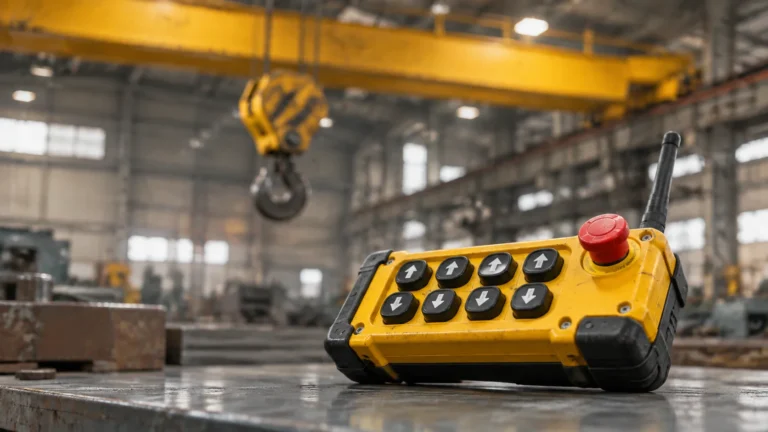
The magnetic key is an authorisation device. Removing it prevents the transmitter from being used at all, which is how a crane is locked out at the end of a shift without touching the panel. The start button is an arming step, so that inserting a battery or switching on does not immediately command a motion. The stop is the only one of the three that has to act on the machine’s stop circuit. The remote control system for industrial cranes, for example, carries a mushroom emergency stop, a start button and a removable magnetic safety key as three separate controls, alongside 32-bit ID coding with Hamming error correction so that a neighbouring transmitter cannot capture the receiver. The wired equivalent deserves the same scrutiny: the COP-2AG2 hoist pendant pairs two direction buttons with a mushroom stop, so whoever holds it can interrupt the circuit without reaching for the panel.
Seven checks, in this order, cover the logic without needing to dismantle anything.
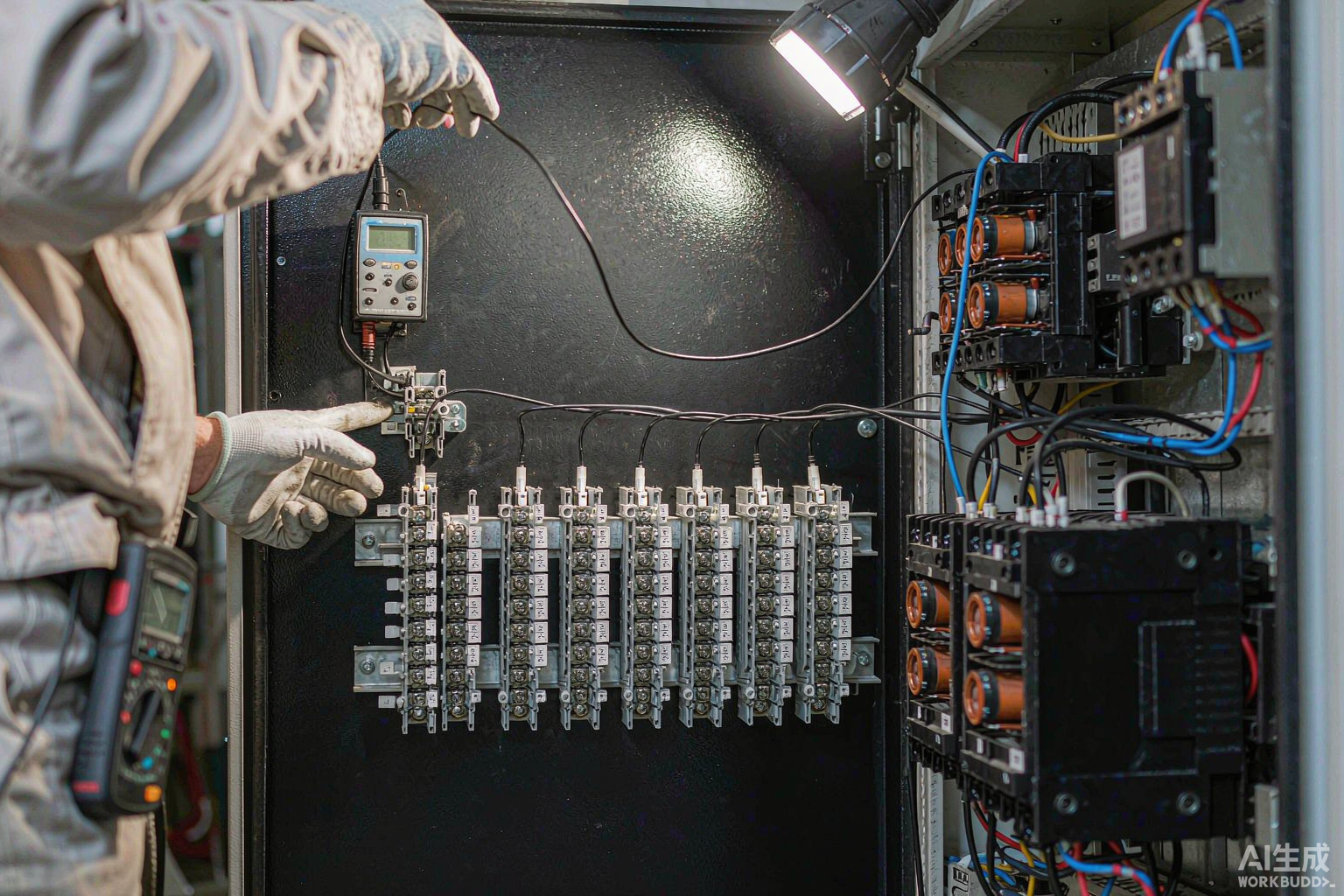
Nothing above removes the need for a stop at the machine itself. A panel-mounted disconnect, such as the ED125 with its 125 A copper contacts and mushroom actuator, gives anyone standing at the panel a way to isolate the machine without needing a transmitter. On a crane where the pendant has been removed entirely, that local stop becomes the only non-radio stop in the system, and it should be treated as mandatory rather than optional.
Treat the emergency stop as a machine-level function that the radio participates in, and the deadman function as a property of the receiver. Confirm that the transmitter stop opens the machine stop circuit rather than a receiver relay, confirm that the stop latches, and demonstrate link-loss behaviour with the machine moving. If the crane also runs a twelve-button station or a wide-voltage receiver, note that the number of safety devices must be counted in the specification — the F24-12S/12D fits three as standard, and they are not interchangeable with a plain stop button.
If you are checking an existing installation, the site FAQ covers the common stop-circuit questions, and the contact form is the place to send a panel photograph for a specific answer.
An emergency stop is a deliberate latching action that drops the machine-level stop circuit and requires a manual reset. A deadman function stops the machine when there is no input at all — the operator releases control, the radio link drops, or the battery fails. One is a command, the other is the absence of one.
On most cranes it drops the machine-level stop circuit, which in turn drops the direction contactors and any holding circuit. Isolating the main circuit is the job of a panel-mounted disconnect such as a main switch, not of the transmitter.
The receiver should drop its outputs and the motion should stop, which is the deadman function working as designed. The load then stays where it is until control is restored. A receiver that continues on the last command after losing the link is unsafe and should be corrected.
Yes, but the machine still needs a stop that does not depend on the transmitter. That means a local stop at the panel, and confirmation that the transmitter stop acts on the machine-level stop circuit. Removing the pendant without providing a local stop leaves the crane with a single point of failure.
The stop and link-loss tests should form part of every shift handover check, and a full functional test with a load should be repeated at each scheduled inspection. The link-loss test in particular is cheap to run and catches the failure mode that no visual inspection reveals.