Description
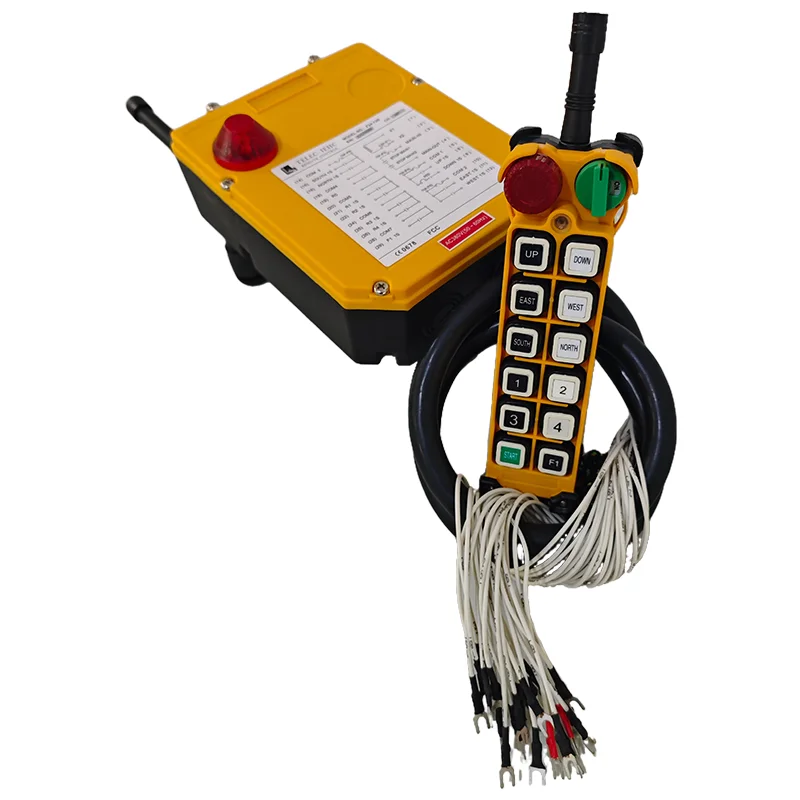
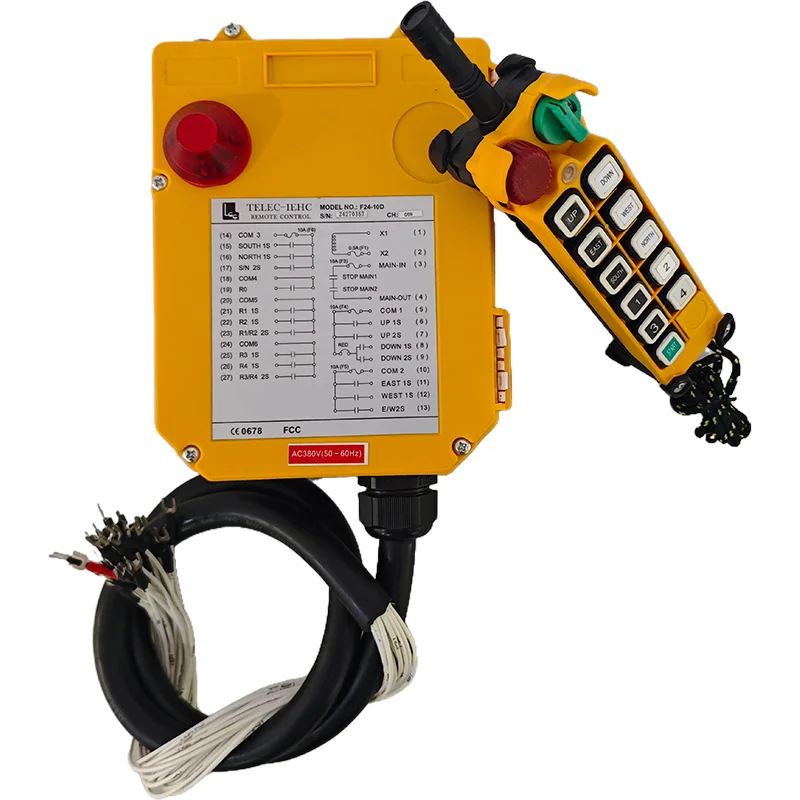
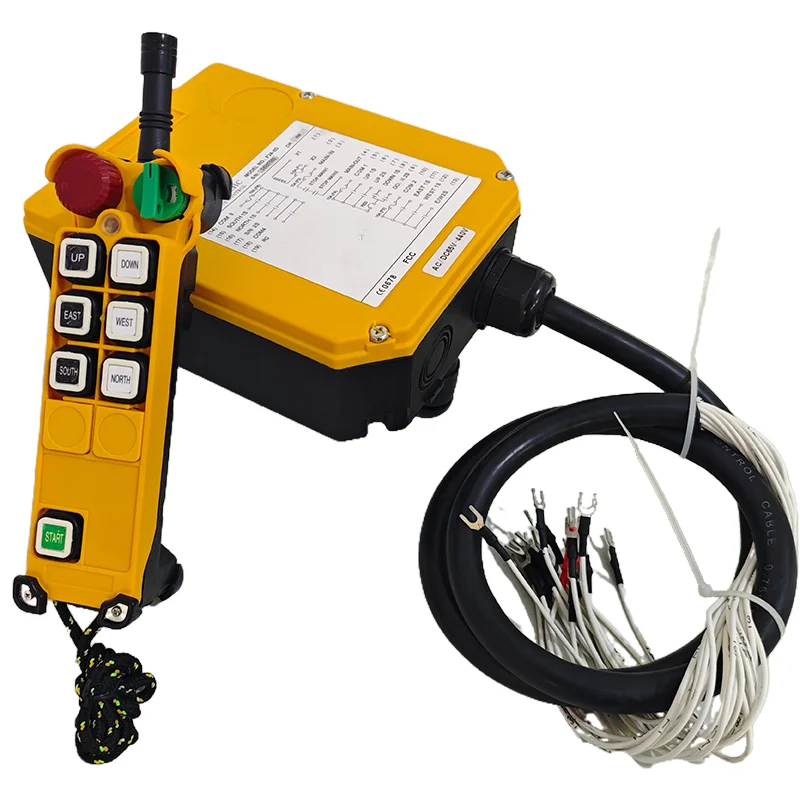
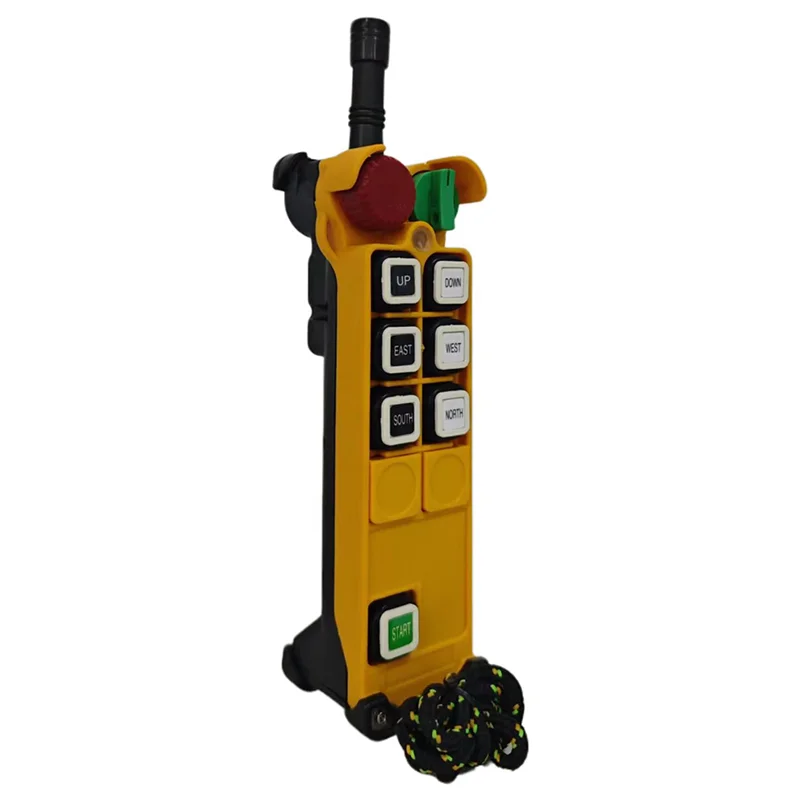
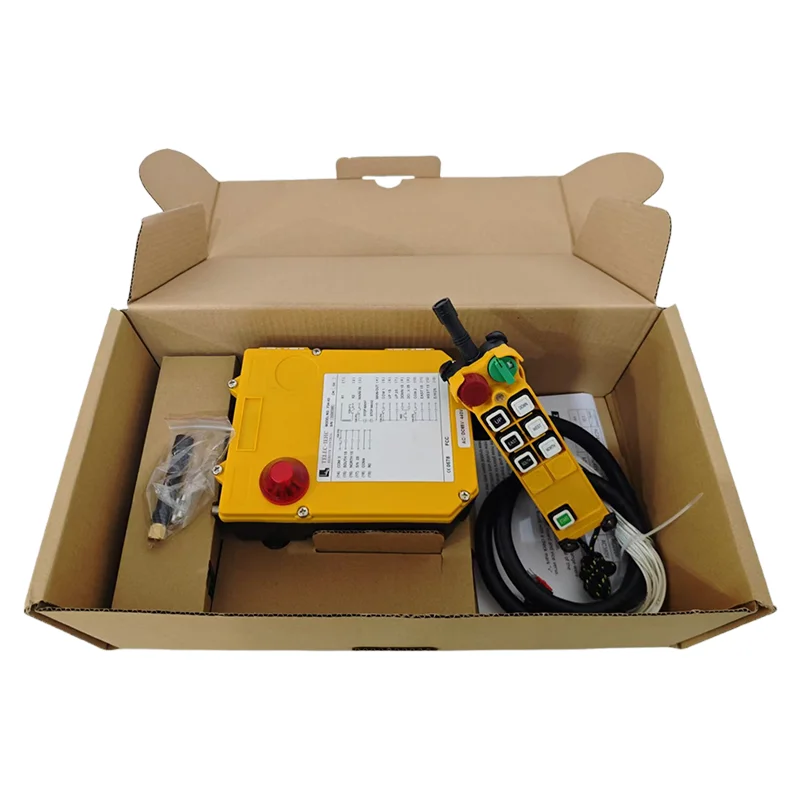
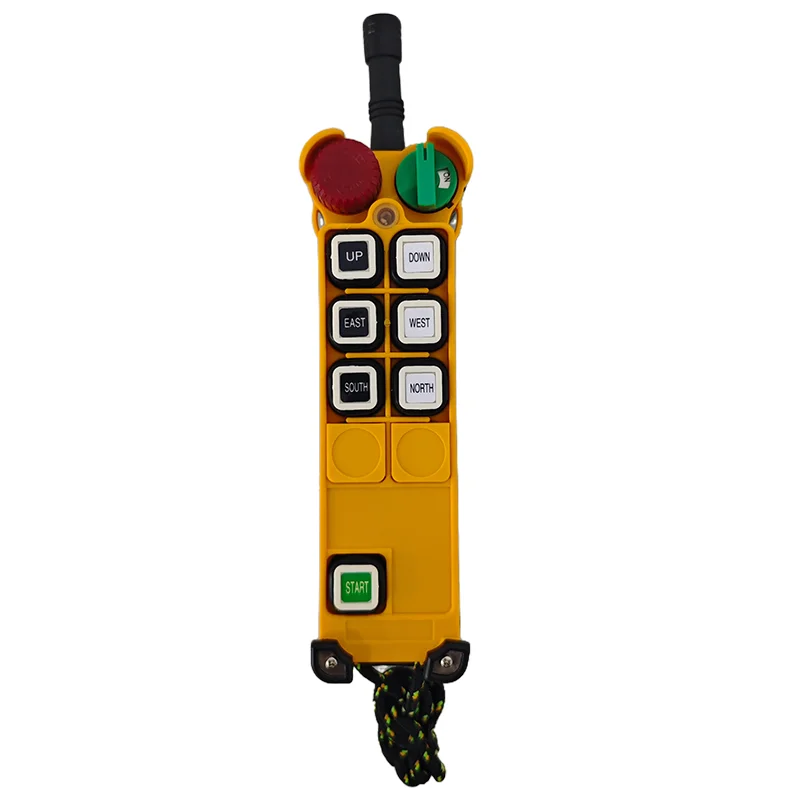
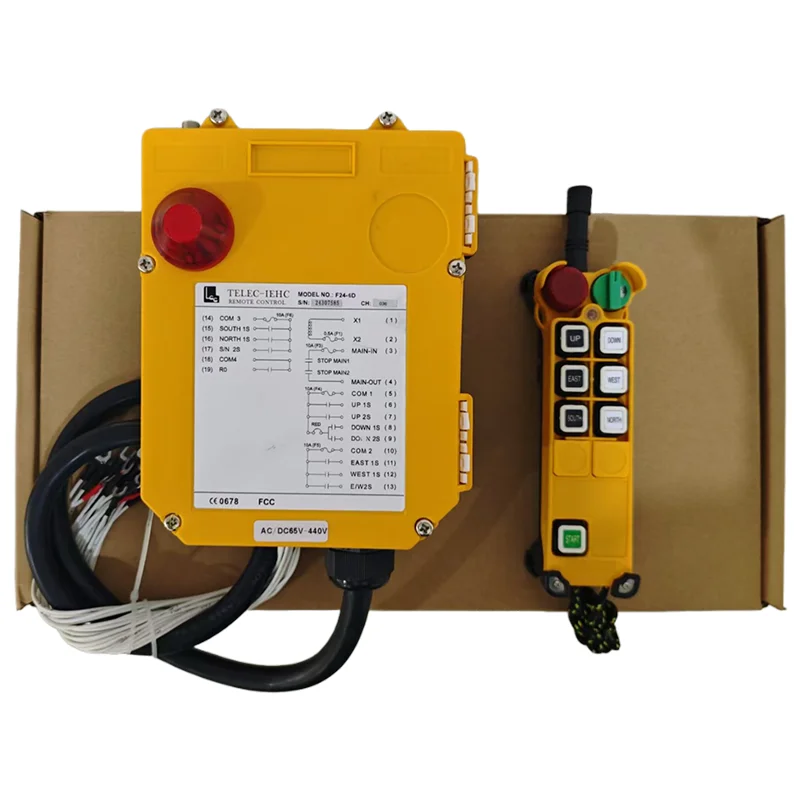
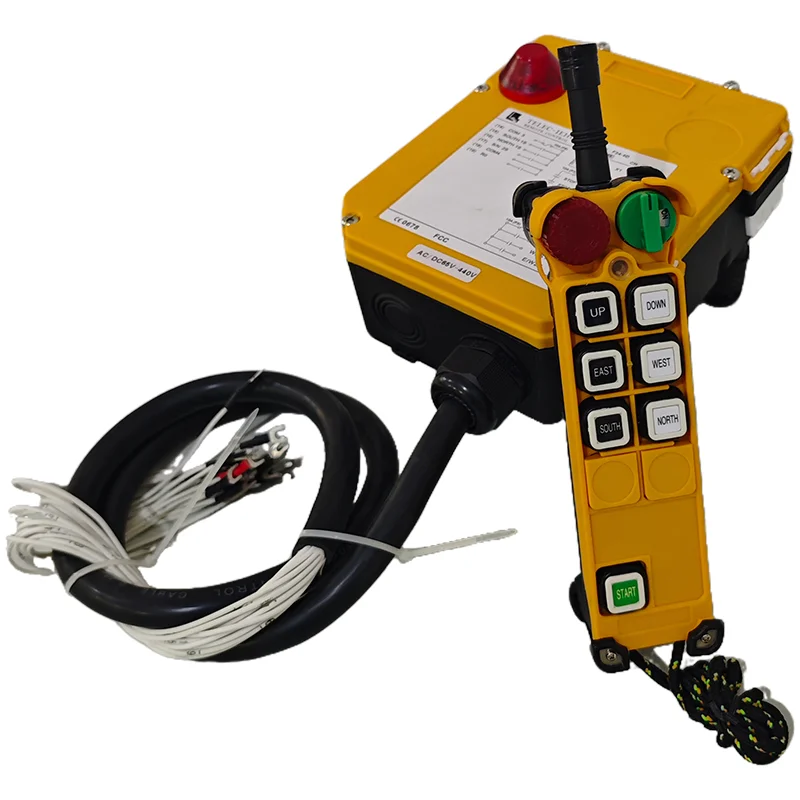
The F24-6S / F24-6D is a six-button industrial crane remote control system: a yellow hand-held transmitter paired with a panel-mounted receiver that switches the machine’s contactors through six relay outputs. The figure of six refers to the control button positions only — the mushroom emergency stop and the green start switch sit outside that count, so the transmitter carries eight physical controls in total.
The system replaces the pendant cable with a radio link, so the operator can stand where both the load and the surroundings are visible. It is supplied in two builds that look identical from the outside: the F24-6S closes one contact per button, while the F24-6D gives every direction button a fast and a slow stage. That choice is made at order and cannot be changed afterwards, because it is a difference in the receiver’s output logic rather than in the transmitter.
■ What this remote control system operates
Six buttons cover a complete machine with three direction motions and no auxiliary circuits, which is the most common single-crane configuration:
- Lifting machinery — single-girder overhead cranes, light gantry cranes, jib cranes and wall-mounted slewing jibs where the motion list is hoist, trolley and bridge, or hoist with one travel axis.
- Lifting equipment — electric chain hoists on fixed or monorail runways, wire-rope hoists, winches and lifting platforms, where four of the six buttons are used and two remain free.
- Simple process drives — conveyor start and stop, small batching pumps and single-action machine movements that need discrete forward, reverse and stop commands rather than proportional control.
Radio control changes the way a machine is risk assessed. Before ordering, confirm that wireless operation is acceptable under your own site assessment — some installations require local control or a continuous line of sight, and no transmitter can substitute for that decision.
■ Full specification table
| Model | F24-6S (single speed) / F24-6D (dual speed) — identical transmitter, different receiver logic |
| Control buttons | 6 button positions, excluding the emergency stop and the green start switch |
| Safety devices | Mushroom emergency stop, green start switch, removable magnetic safety key |
| Receiver outputs | 6 relay outputs, plus an independent output for the emergency stop |
| Contact rating | 5 A |
| Receiver input voltage | AC/DC 65–440 V — no additional control transformer required |
| Control distance | About 100 m, 360 degrees without dead corners |
| Frequency range | VHF 315 MHz / UHF 433 MHz |
| Protection class | IP65, transmitter and receiver |
| Housing material | Glass-fibre reinforced nylon (PA6) |
| Operating temperature | −35 °C to +80 °C, transmitter and receiver, excluding the batteries |
| Transmitter weight and size | 0.273 kg; 245 × 60 × 55 mm |
| Receiver weight and size | 1.34 kg; 245 × 165 × 130 mm, cable length excluded |
| Transmitter power | 4 × AA (5号) batteries — not included, ordered separately |
| Signal coding | 32-bit unique ID code with Hamming code error correction |
| Certification | CE certificate and CE test report |
| Minimum order | 1 set; OEM logo and custom button legends from 6 sets |
| Lead time and warranty | 1–12 sets shipped within 5 working days (one carton holds 6 sets); 12-month warranty |
■ How the transmitter and receiver work together
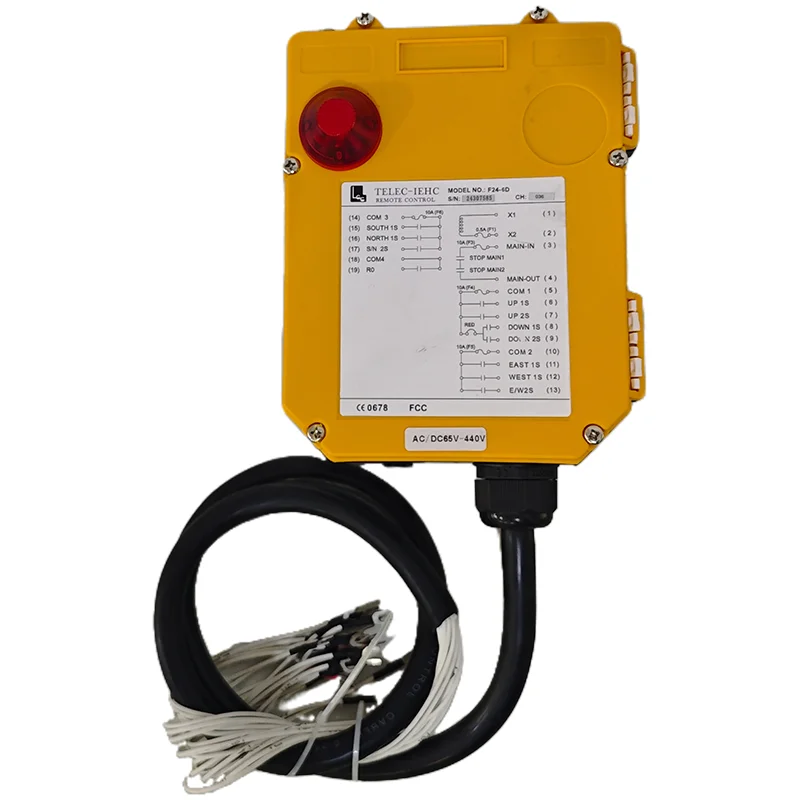
The receiver is built to sit inside the existing control cabinet, and its six outputs are wired in parallel with the pendant contactors so that either control point can operate the machine. Because it accepts anything from 65 V to 440 V AC or DC, a single part number covers most 220 V and 380 V cranes without an additional control transformer.
Check the panel’s control-circuit voltage before ordering. If the machine runs a 24 V control circuit, this receiver range does not cover it — tell us the measured voltage and the correct configuration can be confirmed first.
Each transmitter carries a 32-bit identity code with Hamming error correction. The code is stored in the receiver at pairing rather than fixed by a DIP switch, so a replacement or an additional transmitter can be learned on site. On a site where several cranes work in the same bay, that coding is what prevents one operator’s transmitter from capturing a neighbouring receiver.
■ Safety devices and the button layout
The emergency stop has its own output on the receiver, separate from the six direction outputs. That separation matters: the stop can drop the machine-level stop circuit while the direction outputs remain isolated, so the crane stops and stays stopped instead of continuing on its last command.
The green start switch is an arming step. Switching the transmitter on, or fitting a fresh set of batteries, cannot command a motion until start is operated. The removable magnetic safety key is an authorisation device — taking it out prevents the transmitter from being used at all, which is how a crane is locked out at the end of a shift without opening the panel.
Wiring the transmitter stop only to a receiver output relay is the arrangement to avoid. The radio adds a stop input to the machine stop circuit; it does not replace it, and the stop must still function when the receiver is unpowered or unplugged.
■ Choosing the right button count for the machine
Six buttons fit a machine with three direction motions and no auxiliary circuit. Sizing is arithmetic rather than preference: two buttons per motion, two for start and stop, one for each auxiliary circuit.
| Machine | Direction buttons | Start + stop | Auxiliary | Station class |
| Chain hoist, one travel axis | 4 | 2 | 0 | 6 buttons |
| Single-girder crane, three motions | 6 | 2 | 0 | 8 buttons |
| Three motions with horn and work light | 6 | 2 | 2 | 10 buttons |
| Four motions with two auxiliaries | 8 | 2 | 2 | 12 buttons |
Where more functions are needed, the same platform continues upward: the F24-8S/8D covers a three-motion single-girder crane, the F24-10S/10D adds two assignable buttons for a horn and a work light, and the F24-12S/12D carries a four-motion crane or a crane with several auxiliary circuits. Dual speed does not add buttons on this platform — each direction button carries both a slow and a fast stage, and what increases is the number of receiver outputs behind it.
■ Batteries, temperature and commissioning
The transmitter takes four AA (5号) cells, which are not included because shipping restrictions and shelf life make it simpler to source them locally. The stated −35 °C to +80 °C range applies to the transmitter and receiver as supplied, excluding the batteries — the cells you fit will have their own, narrower limit, and that is usually what governs cold-store or foundry use.
Housing material is worth checking at the quotation stage. The PA6 glass-fibre reinforced nylon body specified here is what allows the full temperature range; a general-purpose ABS housing does not reach it, and the difference is not visible from a product photograph. If a supplier cannot state the material, the temperature figure should be treated as unconfirmed.
Two details decide whether the installed system performs as specified. Keep the antenna clear of steel: a receiver sealed inside a panel with its antenna coiled inside has a fraction of its rated range, so use a remote antenna through a bulkhead fitting and route the cable away from contactor and drive cables. Then test the stop and the link loss before handover — operate the transmitter stop and confirm the machine stop circuit opens and latches, then switch the transmitter off mid-function and confirm the outputs drop and do not resume on power-up. Repeat both with a load on the hook.
To confirm the configuration against your machine, send the motion list, the measured control-circuit voltage and a panel photograph through the contact form, or compare this system with the wider industrial remote control range.
FAQ
Does the six-button count include the emergency stop?
No. Six refers to the control button positions only. The mushroom emergency stop and the green start switch sit outside that count, so the transmitter carries eight physical controls in total. On a three-motion crane the six buttons are hoist up/down, trolley left/right and bridge forward/reverse.
Should I order the F24-6S or the F24-6D?
The two share the same transmitter and differ in receiver logic. The F24-6S closes one contact per button; the F24-6D gives every direction button a fast and a slow stage. Count the direction contactors in the panel: one per direction means single speed (6S), two per direction means dual speed (6D). The choice is fixed at order and cannot be changed afterwards.
Are batteries included, and what does the transmitter take?
The transmitter uses four AA (5号) cells, which are not included — they are easier and cheaper to source locally than to ship. Fit alkaline cells for normal duty. The stated operating temperature excludes the batteries, because the cells have their own narrower limit.
What is the minimum order, lead time and warranty?
One set is the minimum order. Orders of 1–12 sets are produced and shipped within 5 working days, and one carton holds 6 sets. The warranty is 12 months. OEM logo and custom button legends are available from 6 sets.
Does the −35 to +80 °C rating apply to the whole unit?
Yes — the range covers both the transmitter and the receiver as supplied, excluding the batteries. It depends on the housing material: the PA6 glass-fibre reinforced nylon body specified here reaches the full range, while a general-purpose ABS housing does not. If a supplier cannot state the material, treat the temperature figure as unconfirmed.
Request Quote
Interested in this product? Share your requirements or questions using the form.
-
Your requirements
Include the specifications, options, or quantity you need, if known.
-
Your questions
Ask about product details, availability, or order information.
-
Your contact details
Leave an email address where you can receive a reply.