Explosion-Proof Crane Remote Control: When Your Zone Demands It
Published: Author: Lisa
An explosion-proof crane remote control is not a ruggedised version of a standard radio remote. It is a different control concept, chosen because the space the crane works in has been classified as hazardous. The deciding question is therefore not how tough the transmitter is, but which zone the crane operates in, and what equipment protection level that zone requires.
This guide explains how area classification drives the choice between an industrial remote control and a certified control station, where radio control fails compliance, and what to put in an enquiry so the quote is right the first time.
Start with the zone, not with the product
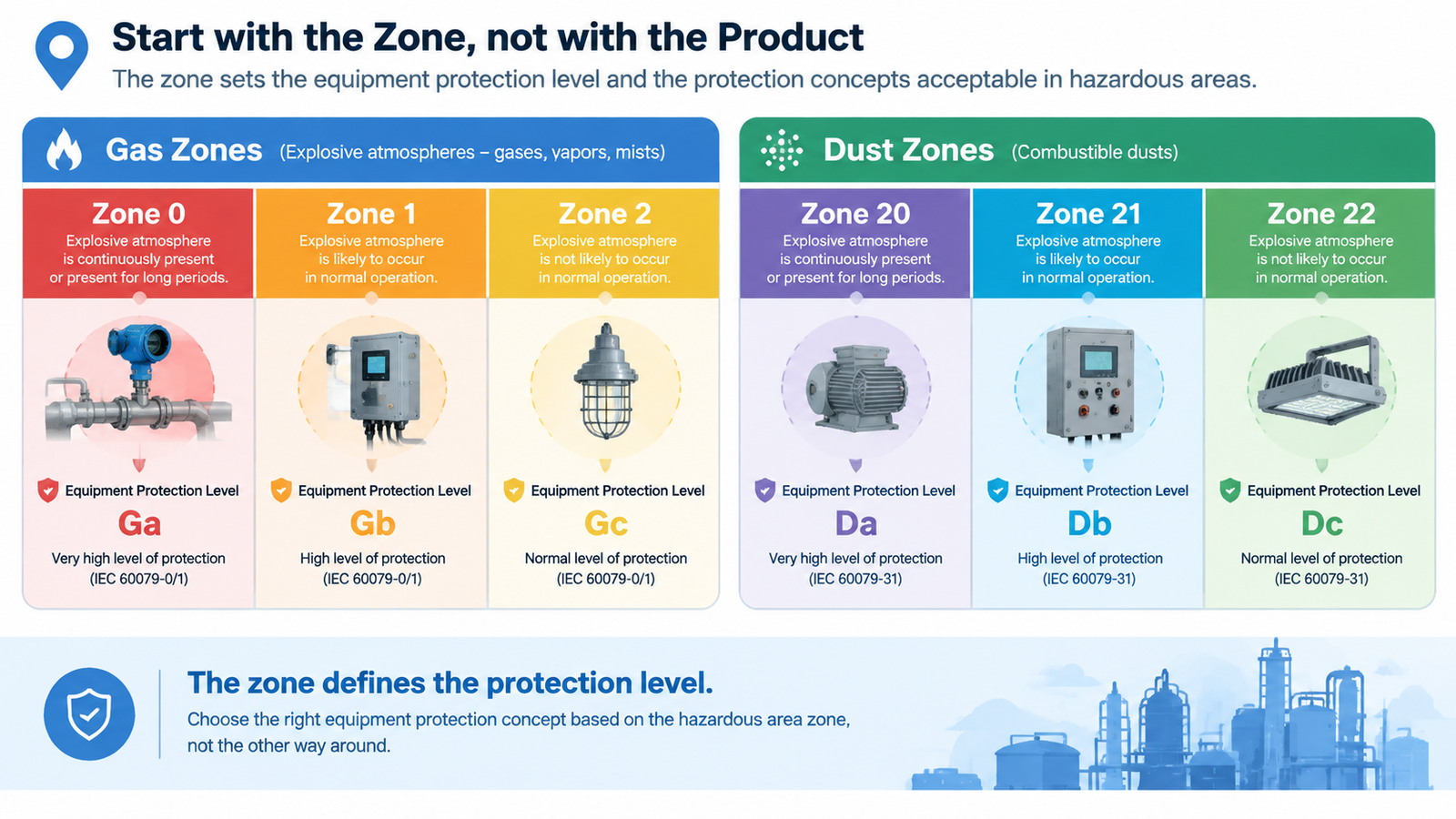
Hazardous areas are classified by how often an explosive atmosphere is expected and for how long. The IEC 60079 series, which ATEX and IECEx both build on, uses six zone definitions: three for gases and vapours, three for dust.
The zone sets the equipment protection level (EPL), and the EPL sets which protection concepts are acceptable. A product that is legal in Zone 2 is not automatically legal in Zone 1, even if it looks identical from the outside.
Area
Zone
ATEX category
EPL
Typical protection concepts
Gas or vapour
Zone 0
1G
Ga
Ex ia — very rarely practical for crane controls
Gas or vapour
Zone 1
2G
Gb
Ex d flameproof, Ex e increased safety, Ex ib
Gas or vapour
Zone 2
3G
Gc
Ex ec, Ex nA non-sparking, Ex ic
Combustible dust
Zone 20
1D
Da
Ex ta enclosure protection
Combustible dust
Zone 21
2D
Db
Ex tb, Ex d
Combustible dust
Zone 22
3D
Dc
Ex tc, Ex ec
Two further markings complete the picture. The gas group (IIA, IIB or IIC) states which gases the equipment may be used around — hydrogen and acetylene sit in IIC and are the strictest. The temperature class (T1 to T6) caps the surface temperature; T6 at 85 °C is the most restrictive.
All of this comes from the site’s hazardous area classification drawing, not from the crane supplier. If you do not have that document, the crane cannot be specified correctly — and no supplier should be asked to guess.
Why the transmitter is the difficult part
Wired controls are simple in a hazardous area: put the switching devices inside a certified flameproof or increased-safety enclosure and the problem is solved. A radio transmitter breaks that logic — battery-powered, carried in the hand, with a flexing keypad and an antenna, and it travels with the operator straight into the zone.
There are only two compliant answers for Zone 1:
An intrinsically safe transmitter. The electronics are energy-limited so that no spark or hot surface can occur under fault conditions, marked Ex ib or Ex ia, with an encapsulated battery pack. This is the standard approach for radio control in classified areas.
A transmitter that never enters the zone. Workable only where the operator stands outside the classified boundary and still has line of sight to the load — which rules out most crane work, because the operator needs to move with the lift.
The receiver is easier: it is fixed, and where its location falls inside the zone it goes into an Ex d or Ex e enclosure with the antenna brought out through a certified entry. A compliant radio system is a certified transmitter plus a certified receiver enclosure, documented as a system.
Three practical ways to control a crane in a classified area
The comparison below is the one worth having in front of a project team. Cost is not the only axis — operator position and inspection burden decide more projects than price does.
Approach
Compliance route
Operator position
Practical limits
Explosion-protected pendant station
Ex d or Ex e enclosure, certified cable gland and entries
Fixed, within cable reach of the trolley
Cable length, cable damage in the zone, operator stays close to the load path
Intrinsically safe radio remote
Ex ia or Ex ib transmitter, Ex-rated receiver enclosure
Free to move, best view of the load
Certified product family required; battery pack and spares must be part of the certified system
Cabin or wall-mounted control outside the zone
Standard equipment, zone boundary respected
Fixed, often far from the load
Only viable where sightlines and the process allow it
Most plants end up with a hybrid: a certified pendant for maintenance positioning plus a certified radio system for production lifts. Where both exist, the design must interlock the two control sources so only one is active at a time — a detail for the enquiry, not the commissioning visit.
If you are weighing wireless against a wired station for a non-classified area, the trade-offs are different and are covered in this comparison of pendant control versus radio remote control.
What to specify on the enquiry
Explosion-protected control enquiries fail for one reason: the supplier quotes a general-purpose product with a reassuring sentence about harsh environments. Six items prevent that.
Zone and EPL for the operator’s working position, not for the building. State it as, for example, “Zone 1, IIB, T4, EPL Gb”.
The required certification scheme. ATEX (Directive 2014/34/EU) is legally required to place equipment on the EU market; IECEx is the international scheme used in Australia, Southeast Asia and the Middle East; CNEx applies to domestic Chinese projects. Say which one your project inspector will accept.
The full Ex marking you expect on the nameplate, for example Ex db eb IIC T6 Gb. If the supplier cannot state the marking, they cannot supply the product.
Number of motions and control voltage, exactly as for a standard remote: hoist, trolley, bridge travel, auxiliary functions, and the receiver input voltage of the existing control circuit.
Ingress protection and ambient range, stated separately from the Ex marking. IP68 and Ex are two different claims and one does not imply the other.
Documentation package: EU-type examination certificate or IECEx certificate of conformity, declaration of conformity, and the installation and inspection instructions the site’s explosion protection document will reference.
IP68 is not the same claim as explosion-proof
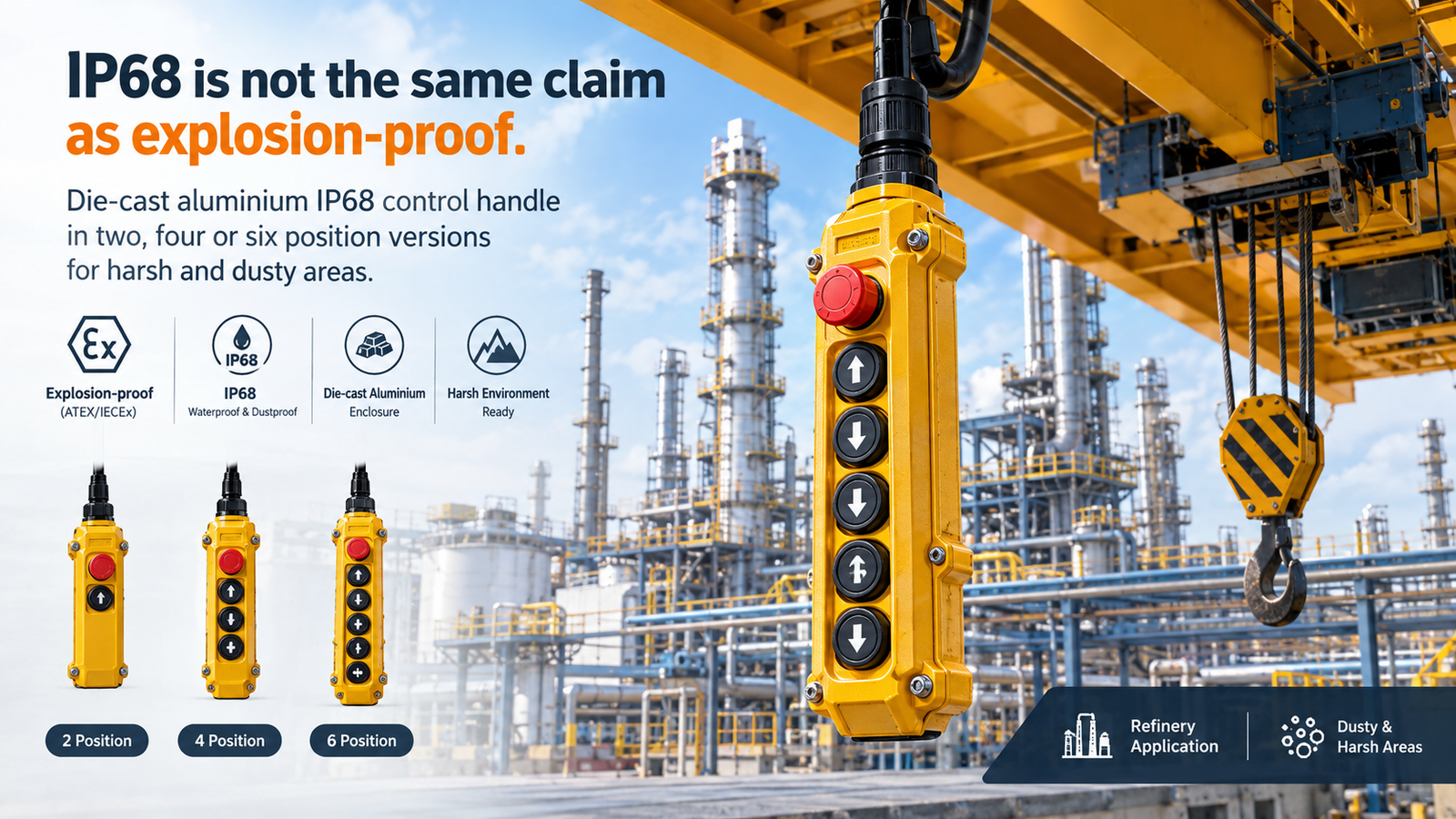
A common sourcing shortcut is to treat a heavy die-cast housing with a high ingress rating as good enough for a dusty or vapour-laden area. It is not. Ingress protection describes resistance to water and dust entering the enclosure; explosion protection describes whether the enclosure can contain an internal ignition or prevent one from occurring. A product can hold IP68 and hold no Ex certificate at all.
What a high-specification housing does buy is mechanical survival: impact resistance, a seal that keeps working after a knock, and a body that will not crack when a pendant is dropped on a steel floor. The COPB-94ER2 control handle in the IEHC range is built that way — a high-density die-cast aluminium body rated IP68, in two, four or six position versions, with CE marking and a design patent. Note the wording: an IP68 aluminium body is a durability and sealing specification. Inside a classified zone, the Ex certification scope for the specific build must be confirmed in writing before ordering; where it is not available, the unit belongs outside the zone boundary.
The control handle range covers aluminium and ABS-bodied stations, so the enclosure choice can be compared side by side. Where the risk is washdown or heavy dust rather than flammable atmosphere, the question is the protection level — see this guide to IP65 versus IP67 for crane remote controls.
Conclusion
The zone drawing decides the product, the certificate decides the supplier, and the enclosure rating only decides how long it lasts. Put the zone and the Ex marking in the enquiry in writing, ask for the certificate before accepting a quotation, and score IP ratings and explosion protection separately.
Two rules keep a certified installation compliant: replace batteries, keypads, gaskets and glands only with parts named in the certificate, and add the equipment to the site’s inspection schedule for enclosure integrity, gland condition and earth continuity. The checks in this receiver wiring guide apply, with enclosure checks on top.
If you are specifying control for a classified area and need the zone, marking and enclosure requirements checked against a proposed build, send the details through the IEHC contact page and the configuration can be reviewed against your classification document.
FAQ
Can I use a normal crane remote control in Zone 2?
Not without certification. Zone 2 requires equipment suitable for EPL Gc at minimum, typically Ex ec or Ex nA, and the transmitter the operator carries is inside that zone. A general-purpose IP65 remote has no Ex marking and cannot be justified there, even where the risk is described as low.
What is the difference between ATEX and IECEx?
Both are built on the IEC 60079 standards, so the technical requirements are close. ATEX is a European directive, legally required to place equipment on the EU market. IECEx is a voluntary international scheme accepted in Australia, Southeast Asia and the Middle East. Many makers hold both; state which one your inspector accepts.
Is an explosion-proof pendant enough on its own?
Only if it is mechanically protected and correctly installed. The pendant itself may be certified, but the cable, the cable gland and the entry into the crane’s junction box are part of the protection concept. A certified station with an uncertified gland is a common inspection finding.
What does the T4 or T6 marking mean?
It is the temperature class — the maximum surface temperature the equipment can reach in service. T4 is 135 °C, T6 is 85 °C. The gas or dust being handled determines the class required: the lower the auto-ignition temperature of the substance, the stricter the class.
One set for a standard configuration, five for volume pricing, ten for OEM branding: how MOQ, lead time and customization scope actually work on crane remote controls.
Eight buttons or twelve, single speed or dual, fixed 380 V or wide-range receiver: a side-by-side comparison of the F21-E1B and F24-12S and which crane each one fits.
Match button count, receiver voltage, speed logic, frequency and pairing method before accepting a Telecrane-compatible replacement remote control, then validate it on site.