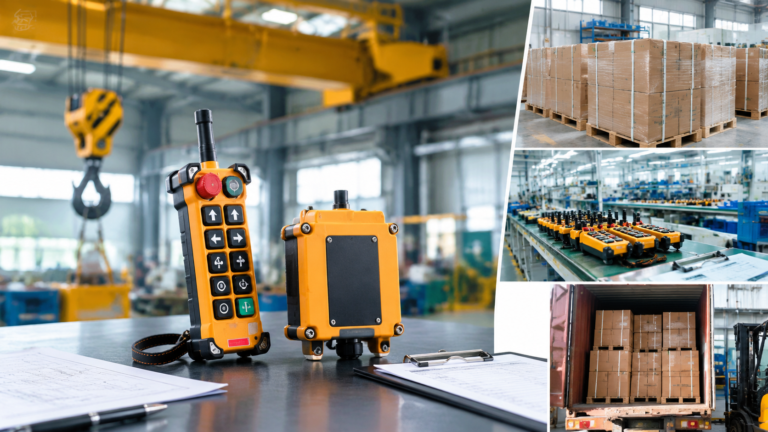
F21-E1B vs F24-12S: Which Remote Control Fits Your Machine?
Published: Author: Lisa
The F21-E1B and the F24-12S are not competitors so much as two different answers. The F21-E1B is an eight-button, single-speed set for a machine with six direction motions and a 380 V panel. The F24-12S is a twelve-button set with dual-speed logic and a receiver that accepts anything from 18 V to 440 V AC or DC. Choose the one that matches your motion count and speed logic, and the price difference is almost irrelevant; choose by price alone and one of them will be the wrong product.
This comparison sets the two side by side on the parameters that decide a crane installation — buttons, speed, voltage, protection, pairing and spares — and says which machine each one fits. Both belong to the same industrial remote control range and share the same transmitter platform logic.
The specification, side by side
Parameter
F21-E1B
F24-12S / F24-12D
Buttons
8 — 1 start, 1 stop, 6 single-speed direction
12, with single-speed (S) or dual-speed (D) logic
Typical machine
Single-girder crane, chain hoist, simple process drive
Four-motion crane, double-girder with auxiliary hoist, crane with several auxiliaries
Receiver input
AC 380 V standard; AC/DC 24 V and AC 220 V available as options
AC/DC 18–65 V (LO) and 65–440 V (HI) from the same unit
Speed logic
Single speed only
Single or dual speed, fixed at order
Ingress protection
IP65
IP65 / IP66 depending on build
Control radius
100 m or more in open plant conditions
Up to 100 m, maintained in electromagnetically noisy plant
Frequency
VHF 310–331 MHz or UHF 425–446 MHz
External high-sensitivity antenna on the receiver
Safety devices
Magnetic safety key
Emergency stop, magnetic key and separate start button
Pairing
32-bit code, factory set
Advanced encoding, learning-code pairing in the receiver
Temperature
−35 °C to +85 °C
Specified per build — confirm for the panel environment
Best reason to pick it
Proven design, low cost, long-term parts availability
Voltage flexibility and headroom for dual-speed or extra circuits
Read the table twice, because one row usually settles the decision on its own: speed logic. If any motion on the machine has a fast and a slow stage, the F21-E1B is out — not because it is a lesser product, but because it closes one contact per button and has nowhere to put the second stage.
When the F21-E1B is the right answer
The eight-button build fits a specific and very common machine: a single-girder overhead crane or chain hoist with hoist up/down, trolley left/right and bridge forward/reverse, all single speed. That is exactly six direction buttons plus start and stop, and it is what the model was designed for.
It is also the pragmatic choice for retrofit buyers for a reason that has nothing to do with specification: the design has been in continuous production for more than two decades, so transmitters, receivers, batteries and replacement housings stay available years after the first unit was installed. On a fleet where the same crane has run since 2008, that continuity is worth more than an extra feature.
Choose the F21-E1B when all of these are true:
The machine has six or fewer direction motions and no auxiliary circuit.
Every motion is single speed.
The control circuit is 380 V AC, or you can specify the 24 V or 220 V receiver option at order.
Cost and spare-part continuity matter more than headroom for future functions.
Twelve buttons buys a fourth motion, a second hoist, or a set of auxiliaries — grab, magnet, rotating hook, outrigger, work light — switched from the transmitter instead of a second pendant. The dual-speed variant adds fast and slow stages on every button, which is the deciding feature on cranes that position loads precisely.
The other half of the case is electrical. The two-range receiver accepts 18–65 V and 65–440 V, AC or DC, from the same part number, so one stock item covers a 24 V PLC-controlled machine and a 380 V crane panel. For a workshop maintaining a mixed fleet from one spares shelf, that is the feature that removes a part number rather than adding one.
Choose the F24-12S when any of these are true:
The machine has four motions, two hoists, or more than one auxiliary circuit.
Any motion needs fast and slow stages.
The control circuit voltage is unknown, mixed across the fleet, or outside 380 V AC.
You want a transmitter and receiver that pair by learning code, so a replacement transmitter can be matched without DIP switches.
Count the contactors the transmitter has to close, not the buttons on the old pendant. A crane with hoist, trolley and bridge travel needs six; add a horn and a work light and you are at eight before start and stop. Add a second hoist or a grab and eight buttons no longer fit. If the count is close to the limit, move up one size at order — exchanging a configured receiver later costs more than the difference.
2. Speed logic
Dual speed doubles the number of outputs behind the receiver and cannot be added in the field. Check the machine, not the old transmitter: two coils per direction, or a two-stage button feel, means the machine is dual speed. A ten-button build such as the F24-10S / F24-10D wireless remote control sits between the two models discussed here when the motion count is small but dual speed is required.
3. Control-circuit voltage
The receiver feeds the contactor coils, so the control circuit decides the receiver, not the motor rating. A 380 V motor with a 24 V control circuit needs a 24 V receiver. This is where the wide-range F24 receiver earns its price on mixed fleets, and where a fixed-voltage F21-E1B order has to be checked carefully before release.
What either choice needs before ordering
The motion list, written as a column of commands rather than button counts.
Measured control-circuit voltage at the receiver position, with AC or DC noted.
Single or dual speed for each motion.
The existing model, if this is a replacement, plus a photograph of the receiver terminals.
Environment — indoor bay, outdoor yard, washdown area — to confirm IP65 or IP66.
Quantity and required date, so the build and the lead time match the shutdown window.
Both models ship as complete sets with transmitter, receiver, connecting cable, batteries, pouch, manual and wiring diagram, and both carry a twelve-month warranty against manufacturing defects excluding wear items. Standard configurations typically ship in 5–10 working days; configured dual-speed receivers take longer because the logic has to be produced.
Conclusion
If the machine has six single-speed motions and a 380 V panel, the F21-E1B does the job at the lowest cost with the longest spare-part horizon. If it has a fourth motion, a second hoist, an auxiliary circuit or any dual-speed function, the F24-12S is the correct product and the F21-E1B cannot substitute for it. Everything else — protection, range, safety devices — is close enough between the two that it rarely changes the answer.
Send the motion list, the measured control voltage and a photograph of the existing receiver through the contact page and IEHC will confirm which of the two fits, or propose the ten-button build if the count falls between them. If you are replacing an obsolete set from another brand, the compatible replacement guide covers the comparison parameters in more detail.
FAQ
Can the F21-E1B be upgraded to dual speed later?
No. Single and dual speed are different receivers with a different number of outputs, and the logic cannot be changed after the unit is built. If dual speed is possible on the machine, order the dual-speed build at the start.
Is the F24-12S compatible with a 24 V control circuit?
Yes. Its receiver covers AC/DC 18–65 V on the low range and 65–440 V on the high range from the same unit, so a 24 V DC control circuit falls inside the low range with margin. Confirm the measured voltage rather than the nominal figure.
Which model has the better range?
Both are rated at a 100 m class in open conditions. Usable distance then depends on the receiver antenna position, the steelwork between operator and receiver, and interference. The F24-12S uses an external high-sensitivity antenna, which helps when the receiver is mounted inside a cabinet.
Do both models include an emergency stop?
The F24-12S is supplied with a mushroom emergency stop, a magnetic key and a separate start button as standard. The F21-E1B carries a magnetic safety key; confirm the emergency-stop arrangement required by your machine’s risk assessment when ordering.
Which one suits a mixed fleet of 24 V and 380 V cranes?
The F24-12S, because one receiver part number covers both control voltages. Standardising on the F21-E1B would mean stocking two receiver variants, which is the situation the wide-range input was designed to avoid.
Area classification decides the product. A practical guide to zones, Ex marking, transmitter certification and enclosure choice for explosion-proof crane remote control.
One set for a standard configuration, five for volume pricing, ten for OEM branding: how MOQ, lead time and customization scope actually work on crane remote controls.
Match button count, receiver voltage, speed logic, frequency and pairing method before accepting a Telecrane-compatible replacement remote control, then validate it on site.