Pendant Control Station Wiring: Cores, Common, Earth
Cores follow functions, not buttons. The sum that sizes the cable, why the stop must not share the button common, and five pre-power checks.
Read More

When one crane responds to another crane’s transmitter, the cause is almost never radio interference in the engineering sense. On a coded system it is an addressing problem: two receivers holding the same code, or a transmitter paired to a receiver it should not control. Genuine signal congestion looks different — commands arrive late or not at all, and the crane stops. Confusing the two sends sites into replacing hardware they did not need to replace.
This guide explains the difference, how coded industrial remote controls identify each other, and how to plan a bay with five, ten or twenty cranes so that the control system stays manageable as the fleet grows.
Every multi-crane complaint falls into one of three categories, and each has a different fix.
| What the operator reports | What is actually happening | Correct response |
|---|---|---|
| “My transmitter moves the crane next to mine” | Two receivers accept the same code — usually units paired in the workshop or swapped between cranes | Re-pair each transmitter to its own receiver and record the pairing |
| “Nothing happens until I walk closer” | Range or antenna problem, not addressing | Check antenna placement, then review the operating environment |
| “Commands are delayed, sometimes the crane stops” | Genuine congestion, electrical noise, or a receiver losing the link | Antenna and cable routing first, then band and channel planning |
Only the third row is an interference problem. The first — cross-control — is the dangerous one, because it means an operator can command a machine they cannot see, and it is the one most often misdiagnosed as “the radios are interfering”.
Every transmitter carries an identity code that is sent with each command. The receiver only acts on commands carrying the code it has learned. On the IEHC F21 and F24 families the code is 32-bit, giving more than 4.3 billion combinations, and pairing is done by a learning procedure on the receiver rather than by setting a switch to one of sixteen positions.
That design is what makes a site manageable — and also what makes site discipline necessary. A billion codes are worthless if two receivers have been taught the same transmitter, which happens in three predictable ways: two systems are paired on a bench before installation and the pairing is not recorded; a failed receiver is replaced and the new one is paired with whichever transmitter was nearest; or a spare transmitter is commissioned as a copy of an existing one for convenience.
The antidote is documentation, not technology. Every receiver should have one transmitter, that pairing should be written on the receiver, and any replacement should update the record on the same day.
There is no single correct architecture. The right one depends on how many cranes share a space and whether they work simultaneously.
| Approach | What it solves | Where it runs out |
|---|---|---|
| Unique coded pairing per crane | Cross-control — the baseline for any site | Does nothing for congestion or range |
| Zoning by operating area | Operators rarely move between bays | Open halls where cranes overlap |
| Band and channel planning | Congestion where many transmitters share a band | Needs a site survey and a channel ledger to stay valid |
| Dual-band or hopping systems | Dense RF environments, coexistence with plant Wi-Fi | Higher unit cost; still requires recorded pairing |
| Joystick or belly-box systems for complex cranes | Many motions and compound movements, one operator per machine | Not a solution to interference — only to control complexity |
For most industrial plants the practical stack is the first two rows plus documentation: unique pairing, cranes assigned to zones, and a written record that survives staff changes. Channel planning becomes worthwhile when the bay is dense enough that operators report dropped commands, and a dual-band system is usually a decision made at purchase rather than as a retrofit.
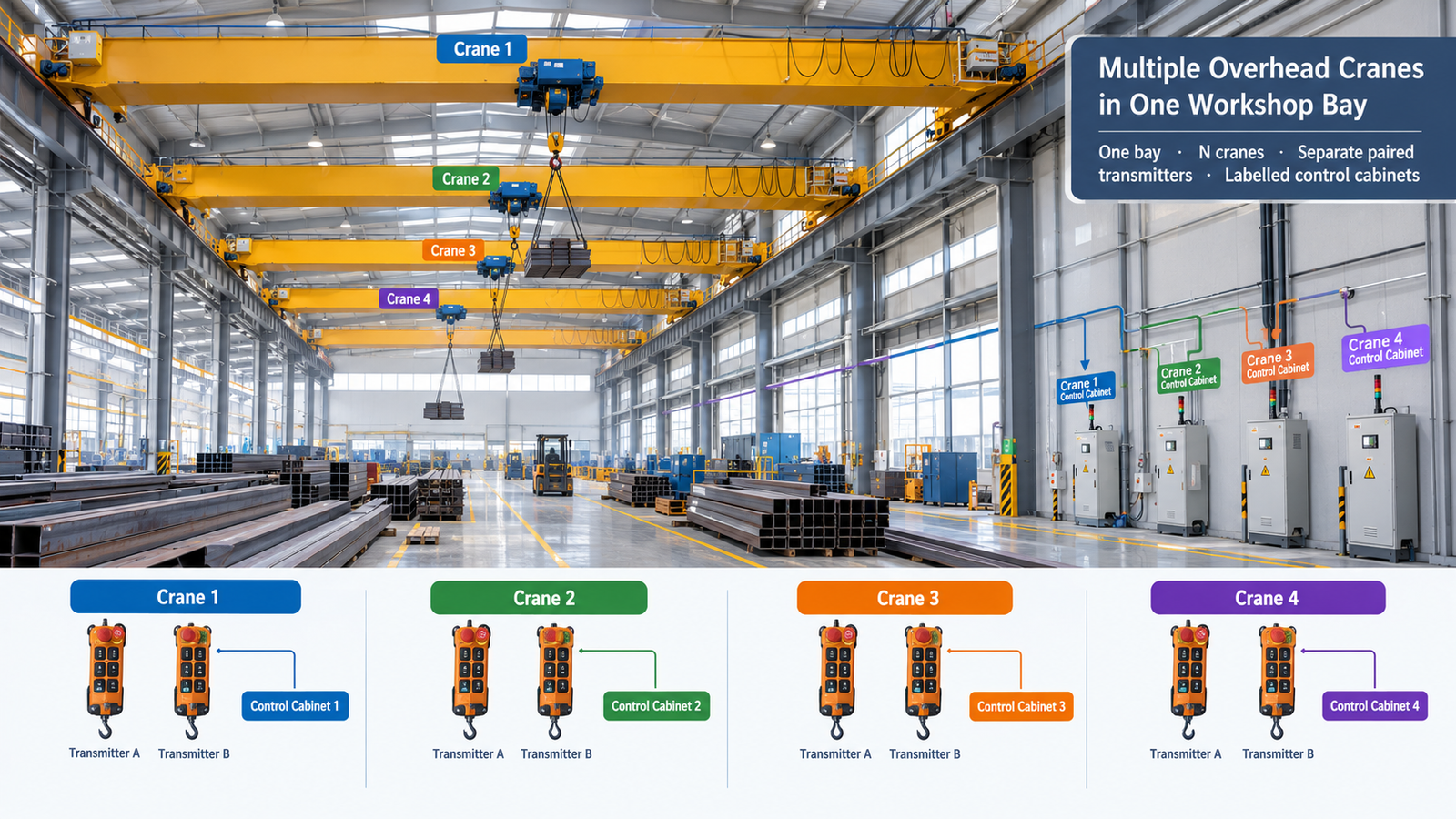
The sequence matters more than the individual steps. Do the pairing work before the cranes are handed over to production, not after the first cross-operation incident.
Step three is the one sites skip, because it takes an hour and produces no visible result when it passes. It is also the only step that catches a duplicated code before it causes an accident.
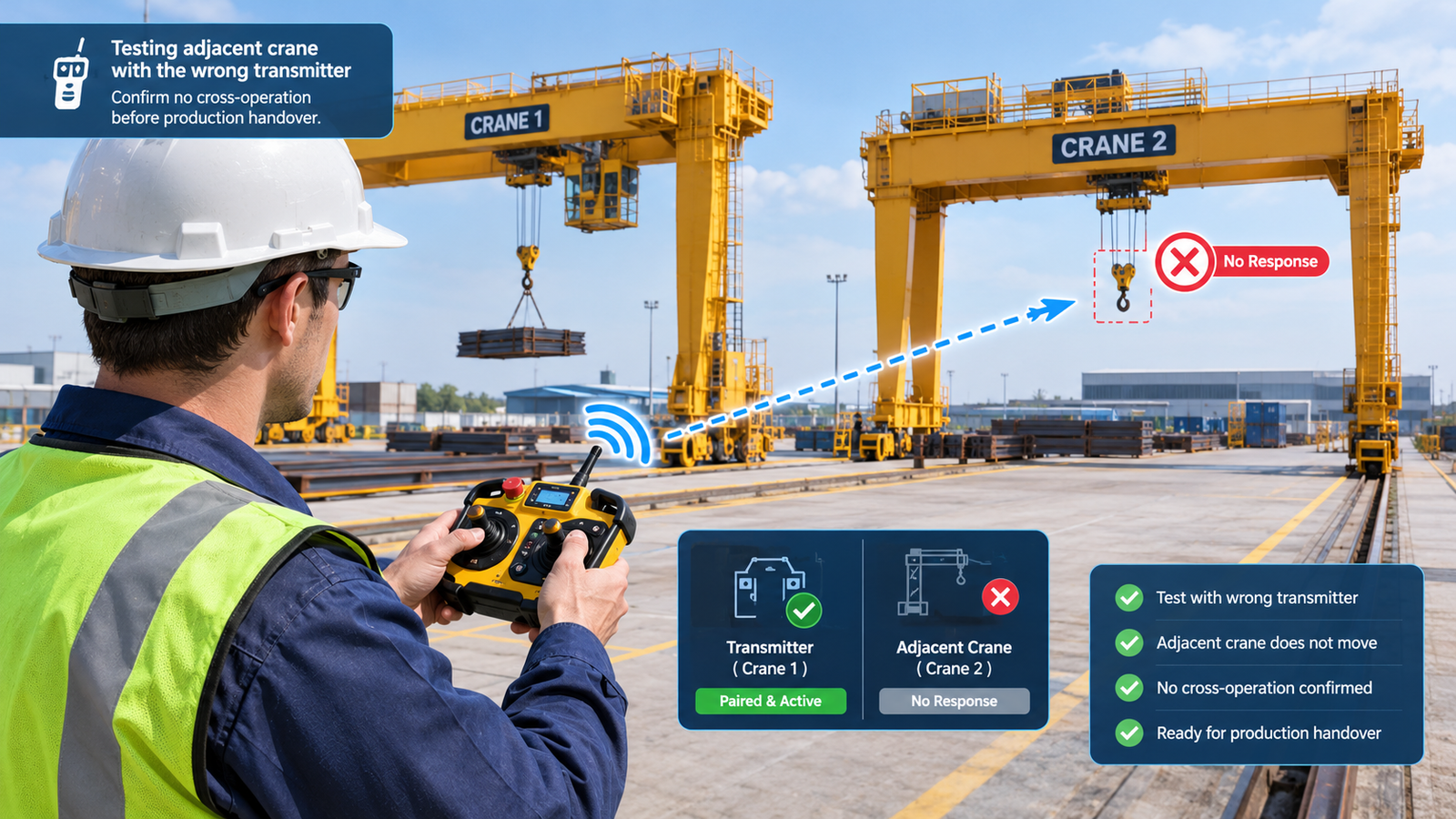
Most cross-operation incidents happen months after commissioning, when the system has quietly drifted. Five rules prevent the drift.
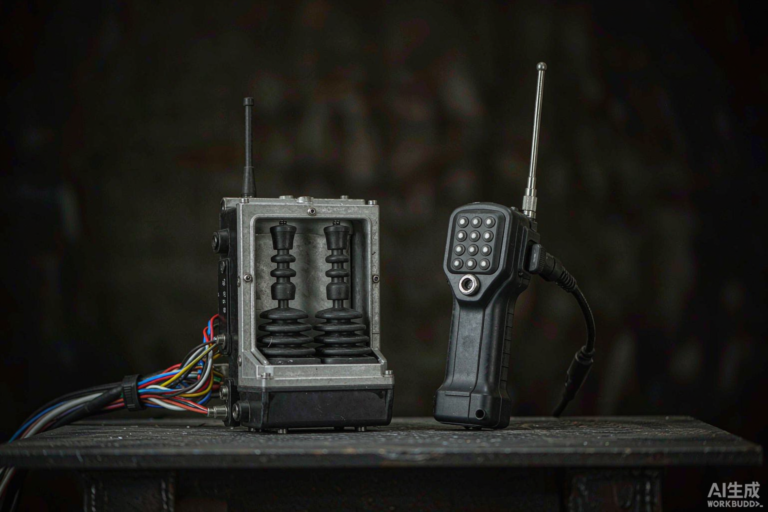
Some multi-crane sites are not really interference problems at all — they are control-complexity problems. A tower crane with four or more motions and compound movements, or a concrete pump where two axes must be blended, needs a different hand unit rather than a different radio plan. A harness-carried belly-box with two five-step joysticks, such as the F24-60 joystick controller, lets one operator ramp two functions together without leaving the load in view; the same requirement in a hand-held format is met by the SAGA1-L40 joystick remote control.
Those units belong to the joystick remote controller range, which is worth reviewing before a multi-crane site standardises on button transmitters for every machine. Standardising on one model across a fleet reduces spare-parts complexity; standardising the wrong model across a fleet of mixed machines creates a different problem.
Once addressing is correct and documented, the remaining variables are physical: how far the signal has to travel, what it has to pass through, and what else is transmitting nearby. The factors that decide usable distance in a real plant — steelwork, antenna position, band choice and noise sources — are covered in this guide to remote control operating distance, and they apply per crane rather than per site.
Cross-operation is an addressing failure, not a radio failure. Pair one transmitter to one receiver, prove it by testing adjacent cranes against each other, and write down what you paired. Everything else — zoning, channel planning, band choice — is refinement on top of that foundation.
If you are planning a multi-crane installation or standardising a mixed fleet, send the crane list, the working layout and the existing models through the contact form and the pairing and band plan can be reviewed before the next order.
Two receivers holding the same code. This happens when systems are paired on a bench without recording the pairing, when a receiver is replaced and paired with the nearest available transmitter, or when a spare is deliberately copied from an existing unit. Re-pair each transmitter to its own receiver and record the result.
Not necessarily. With unique coded pairing, cranes can share a band without controlling each other, because each receiver only accepts its own code. Different channels or bands help with congestion — dropped or delayed commands — rather than with cross-control.
There is no fixed number. What limits a site in practice is the discipline of pairing and record-keeping, plus the RF environment: how many transmitters are active at once, how much steel is between them, and what other radio equipment shares the band. Dense bays benefit from channel planning or a dual-band system.
Release the controls and press the emergency stop, then report it immediately as a safety event. Do not continue lifting and do not attempt to work around it. The system should be isolated and the pairing verified before that crane returns to service.
Technically yes on most learning-code systems, and it should not be done on a shared site. A transmitter paired to two receivers will command both machines at once, which is precisely the failure mode the pairing record exists to prevent.