Pendant Control Station Wiring: Cores, Common, Earth
Cores follow functions, not buttons. The sum that sizes the cable, why the stop must not share the button common, and five pre-power checks.
Read More

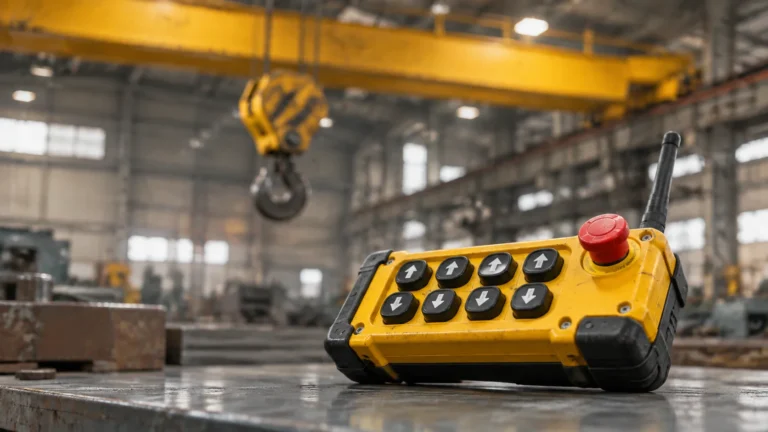
A push-button transmitter issues discrete commands: hold the button, the relay closes, release it, the motion stops. A joystick transmitter does something different — the receiver closes its relay outputs one step at a time as the stick travels, so the operator can blend two motions instead of choosing one. If your machine has to slew while it travels, or ramp a boom smoothly, you need a joystick remote controller. If it has three motions that never run together, buttons are cheaper, faster to learn and easier to diagnose.
Everything else in the decision follows from that distinction, including how the operator carries the unit and how much wiring sits behind the receiver.
A button transmitter maps one button to one contactor. The physical act is binary, and the machine either moves or it does not. This is not a limitation for most lifting work — a hoist that has to raise a load to a height does not benefit from a ramp.
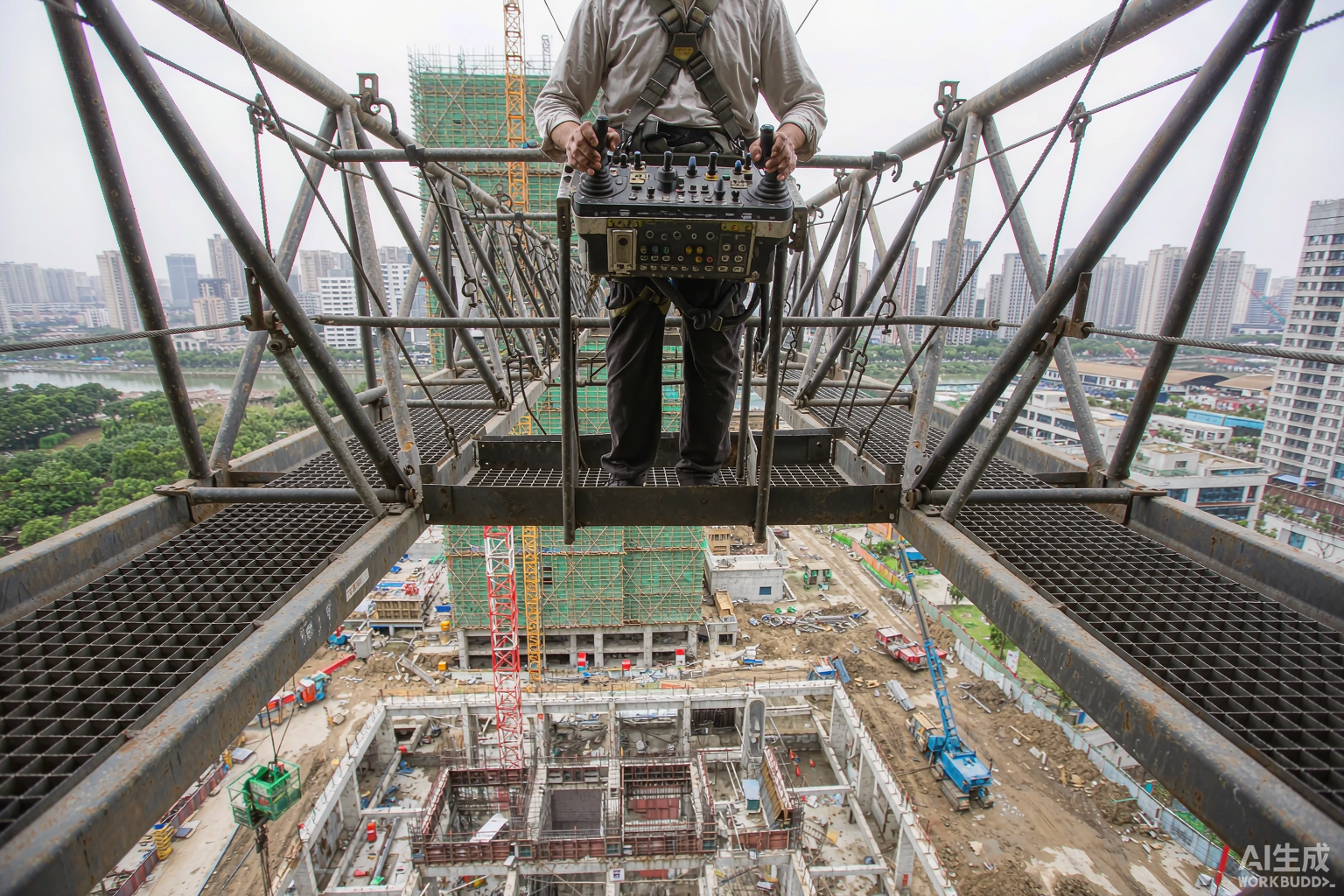
A five-step joystick maps stick position to a sequence of relay states. As the stick moves away from centre, the receiver closes output one, then output two, and so on up to five steps, which is how a smooth-feeling multi-speed response is produced from ordinary relay contacts. Two sticks on the same box means two axes can advance at once, which is what makes compound movement possible from a remote position.
The practical test is simple. Ask whether the operator needs to do two things at the same time. If the answer is yes, buttons will force a sequence of separate movements, and the operator will work around the limitation by tapping — which is exactly the behaviour that makes loads swing.
Two units cover most of this ground. The F24-60 is a harness-carried belly-box with two five-step joysticks covering four axes, IP65, with a control distance up to 100 m — enough for tower cranes, gantry cranes and concrete pumps. The SAGA1-L40 adds two three-position toggles, two pushbuttons and up to forty programmable relay outputs for machines whose control sequence has to be written rather than fixed by wiring.
Most cranes in most factories belong here, and specifying a joystick for them is usually money spent on capability nobody uses.
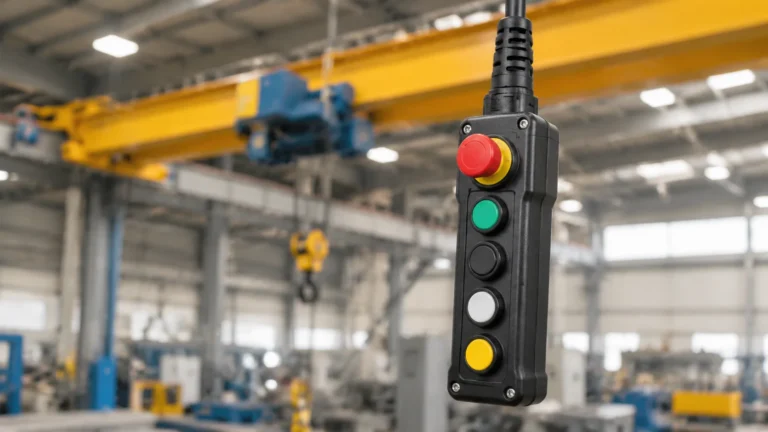
A single-girder overhead crane with hoist, trolley and bridge travel is three discrete motions. The operator commands one, watches the load, commands the next. A hand-held button transmitter lets that happen with one hand while the other stays free, which matters when the operator is also guiding a load on a tag line. The F24-12S/12D covers the twelve-button end of that range and switches between an AC/DC 18–65 V and a 65–440 V receiver input, while smaller machines are served by eight- or ten-button units in the same family.
Buttons also diagnose better. A function that does not work points to one button, one output and one contactor coil. On a joystick station, a fault can sit in the stick mechanism, the step mapping in the receiver software, or the wiring behind a particular step — three places instead of one, and the mapping is not visible from the outside.
| Dimension | Push-button transmitter | Joystick transmitter |
|---|---|---|
| Command type | Discrete, one output per button | Stepped, several outputs per axis |
| Simultaneous axes | Not practical | Native — two sticks, two axes at once |
| How it is carried | Hand-held, often one-handed | Belly-box on a shoulder harness at waist height |
| Operator posture | Free to move and look up | Both hands on sticks, load kept in view |
| Precision control | Depends on the number of speed stages | Five steps per axis, felt through stick travel |
| Wiring behind the receiver | One output per function | One output per step, multiplied by axes |
| Fault finding | Button to output to coil | Stick, step mapping and wiring all in play |
| Typical machines | Hoists, single-girder cranes, monorails, process drives | Tower cranes, boom pumps, lorry loaders, heavy handling lines |
Two practical differences follow from that table, and both are worth settling before the order rather than after: how the unit is carried, and how much it weighs in the operator’s hands over a shift.
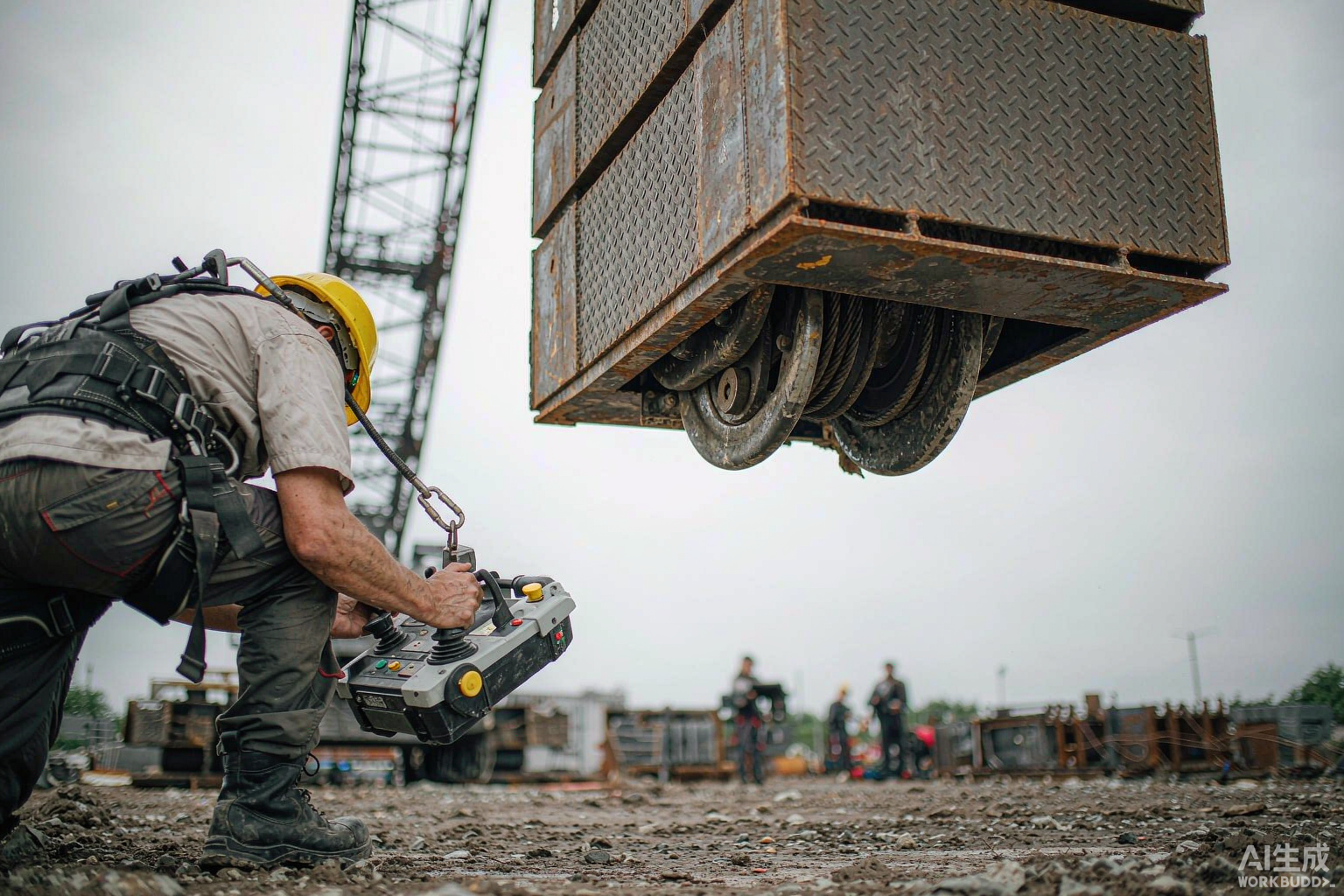
Joystick units are heavier and are worn rather than held. A belly-box sits on a harness at waist height, which frees both hands and keeps the unit steady, but it also means the operator walks to the machine rather than reaching for it. On a tower crane that is the whole point; in a busy bay where the operator steps between two cranes, a harness is an encumbrance.
Weight follows the same logic. A two-stick unit with metal joystick mechanisms and a large battery is a different object to hand for eight hours than a compact button transmitter. That is not a reason to avoid joysticks on machines that need them — it is a reason not to fit them where they are not needed.
There is a hybrid worth knowing about. A dual-speed button transmitter gives each direction button a slow and a fast stage, which produces a two-step version of the same feel a joystick offers — without the harness, the extra weight or the step-mapped wiring. For a crane that mostly works in single motions but occasionally needs a gentle approach, that is often the cheaper answer.
What it does not do is blend. Two buttons can be pressed at once on some layouts, but the ergonomics are poor and the receiver logic rarely supports genuine simultaneous ramping. If two axes must move together, it is a joystick question.
Ask whether the operator has to run two motions at the same time. If not, choose a button transmitter in the industrial remote control range sized to the function count, and use speed stages if a gentle approach is needed. If so, accept the harness and the extra wiring and specify a five-step joystick station. Choosing buttons for a machine that needs blending produces jerky work; choosing joysticks for a three-motion crane produces a heavier unit, a longer commissioning and a larger invoice for capability the operator never touches.
Describe the machine’s motions, which of them run together, and how the operator stands relative to the load, and the choice can be confirmed against the actual configuration — the contact form is the quickest route.
Some layouts allow two buttons to be pressed together, but it is not a designed mode. The ergonomics are poor, the operator has to look at the unit to find the second button, and the receiver logic usually does not support genuine simultaneous ramping. If blending is required, a joystick station is the correct answer.
Not automatically. Four motions on a crane that performs them one at a time can be handled by a twelve-button transmitter. A joystick becomes necessary when two of those motions must run together, which is more common on tower cranes than on factory overhead cranes.
As the stick travels away from centre, the receiver closes its outputs in sequence, up to five positions per direction. That gives a stepped but smooth-feeling speed response using ordinary relay contacts, without needing proportional drives in the panel.
It takes longer than a button unit, because the operator is learning stick travel rather than pressing a labelled button. In practice the learning curve is short for anyone who has operated a machine with levers, and the payoff is that compound movements become natural instead of being worked around.
Not within a single unit. The transmitter layout and the receiver logic are built as one system, so button and joystick variants are separate products. Fleets that need both keep two part numbers, which is one reason standardising on the machine type before ordering pays off.