Pendant Control Station Wiring: Cores, Common, Earth
Cores follow functions, not buttons. The sum that sizes the cable, why the stop must not share the button common, and five pre-power checks.
Read More

Most crane remote control failures are reported at the start of a shift, but they did not begin there. They began at the end of the previous one, when a transmitter with a flat battery, a cracked housing or a sticking button was handed over without comment. The handover is the cheapest place to catch a fault and the place where it is most often skipped.
A sixty-second check at changeover costs less than a single hour of lost production, and it costs nothing at all compared with an incident. This guide covers the six items worth checking, the rules for sharing one transmitter across several operators, and how to build a record sheet that people actually fill in.

A fault that develops mid-shift gets reported, because the operator who is inconvenienced is the operator who has to explain it. A fault present at the start of a shift is different. The incoming operator assumes the outgoing one knew, the outgoing one assumes it is normal wear, and the fault either survives until it fails outright or is absorbed into normal working practice. A button that needs pressing twice becomes “how this crane is”.
There is a second pressure: handover happens in the two minutes when the bay is being cleared, the next job is waiting, and both operators want to leave. Any check that requires a bench, a tool or a walk to the panel will not survive that pressure. Whatever you design has to be doable standing next to the crane with the transmitter in one hand.
Each of these can be done without opening anything and without a test instrument. Together they cover the failure modes that account for the majority of unplanned stops.
| Check | How | Pass criterion | Action if it fails |
|---|---|---|---|
| Battery | Read the indicator, then power-cycle once | Indicator above the low threshold; unit powers up first time | Swap to a charged pack; log the pack number |
| Housing and gasket | Look along the seam and around the battery cover | No crack, no gap, no dust trail at the joint | Tag out; do not return to service with a damaged seal |
| Emergency stop | Press and release once with the crane unloaded | Motion stops immediately and the reset requires a deliberate action | Remove from service immediately |
| Pairing | Confirm which receiver the transmitter is bound to | Bound to the crane being handed over, and to no other | Re-pair or issue the correct transmitter |
| Lanyard and holster | Pull firmly on the attachment point | No fraying, stitching intact, clip closes fully | Replace before the shift starts |
| Damage and note | Read the previous entry, then add your own | Every carry-over fault is acknowledged | Escalate anything left unresolved |
The emergency stop check is the one worth insisting on. It is the only item on the list that protects a person rather than a schedule, and it is also the item most likely to reveal a problem that a visual inspection cannot see.
Shared transmitters create two distinct problems, and only one of them is technical.
If a site genuinely needs two operators to control one crane at different times, bind two transmitters deliberately and define which takes priority when both are powered. Undefined priority is not a fault the equipment can solve. A card is only as good as the induction behind it, and the five actions an operator has to be able to demonstrate are usually the ones a generic induction skips.
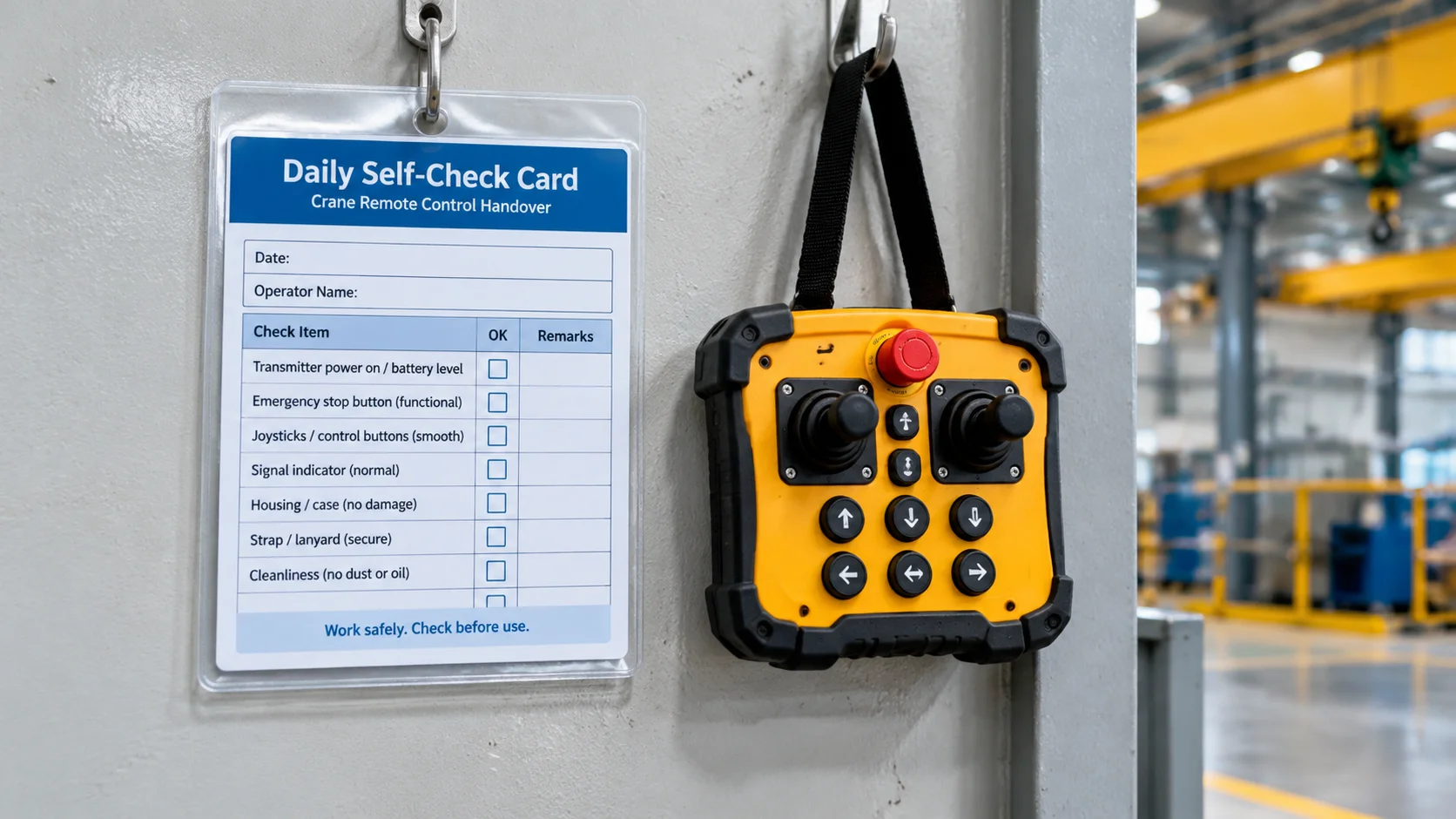
The card should be one side of A5, laminated, hanging next to the transmitter. If it needs a clipboard it will not be used.
Keep the whole thing to a minute. A check that takes five minutes will be performed for a fortnight and then quietly abandoned, which is worse than no check at all because it creates a record that says everything was fine.
The card is for the operator. The record is for whoever maintains the fleet, and it needs to answer questions the card cannot.
| Field | Why it earns its place |
|---|---|
| Transmitter ID | Connects a fault to a specific unit rather than to “a remote” |
| Date, shift, time | Reveals patterns — a fault that only appears on nights is a temperature or lighting issue |
| Crane or bay | Separates equipment faults from site faults |
| Operator name | The only way to follow up on an unclear entry |
| Battery pack number | Catches a single failing pack circulating through the fleet |
| Result per check | Turns six tick boxes into a trend rather than an anecdote |
| Action taken | Distinguishes “reported” from “resolved”, which are different problems |
Review the sheet weekly, not monthly. A weekly review catches a failing battery pack before it has been rotated through every shift, and it takes about ten minutes for a normal fleet.
Daily checks do not replace maintenance, and treating them as a substitute is how sites end up with transmitters that pass every shift check and still fail at two years. The two activities answer different questions.
The daily check asks whether the unit is fit for the next eight hours. Planned maintenance asks whether it will still be fit in six months: contact condition in the receiver, antenna cable integrity, gasket replacement on a schedule rather than on failure, and battery capacity measured rather than indicated. The spares strategy guide covers how to hold the right replacement items without tying up capital in parts that never fail.
A useful rule is that anything reported on the daily card twice in a month becomes a maintenance job, whether or not it was resolved. Repetition is the signal, and it is invisible unless the records are read as a series rather than one shift at a time. The troubleshooting checklist is the right next step when a repeated entry has no obvious cause.
If you are setting up a fleet programme and want the check card and record sheet adapted to your equipment, send us the transmitter models and shift pattern and we will draft them against your actual configuration. The F24-8S / F24-8D eight-button system is the unit most often used in shared-transmitter bays, and its pairing behaviour is the one worth writing the rule around.
Under a minute for the six items on the card. Anything longer gets skipped during a busy changeover, and a check that is skipped half the time produces a record that cannot be trusted.
Yes, with the crane unloaded and the area clear. It is the only check on the list that protects people, and it is the one most likely to reveal a fault that visual inspection cannot show.
The shift, by name, not the bay. Custody assigned to a bay becomes nobody’s responsibility within a week. A named holder per shift makes both the check and the damage report attributable.
Add two items rather than a new card: gasket condition after any freeze-thaw cycle, and battery capacity in low temperature. Both fail earlier in those environments than the standard six items suggest.
Yes, and often better than a tablet in a bay where hands are dirty. The requirement is that the entries reach whoever reviews them weekly. A card that stays on the crane and is never read is a filing exercise, not a check.