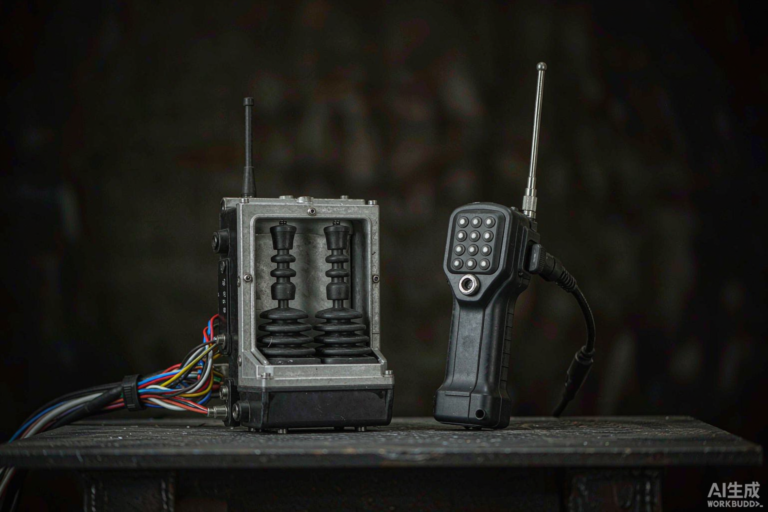
Pendant Control Station Wiring: Cores, Common, Earth
Cores follow functions, not buttons. The sum that sizes the cable, why the stop must not share the button common, and five pre-power checks.
Read More

A crane remote control that is perfectly legal in one country can be illegal to operate ten kilometres across a border, and the difference is not the hardware quality. Radio spectrum is licensed nationally. The same transmitter, at the same power, may sit inside a licence-exempt band in one market and outside it in the next. That is a paperwork problem before it is an engineering one.
The practical consequence for a buyer is simple: approval status has to be established at the specification stage, not discovered at the port. This guide covers the three routes most export orders fall into, the documents worth demanding, and the points where shipments actually get held.

Spectrum regulators allocate frequency bands for different uses, and licence-exempt bands — the ones industrial remotes normally use — differ in centre frequency, permitted bandwidth and permitted radiated power from country to country. A unit designed for a 433 MHz band with a given duty cycle may be compliant in the European Union and non-compliant in a market that reserves that band for other services.
There is a second layer: some markets require the product to be registered or the importer to hold a local approval before the equipment can be offered for sale at all. That registration is not transferable, which means the responsibility often lands on the importer rather than the manufacturer.
| Route | Where it applies | What it means in practice |
|---|---|---|
| CE, Radio Equipment Directive | European Union and markets that reference EU practice | Self-declaration supported by a technical file and harmonised standard test reports; the manufacturer signs the declaration |
| FCC Part 15 certification | United States | Equipment authorisation via an accredited test laboratory, with an FCC ID on the label; not a self-declaration |
| National licence-exempt allocation | Most other markets | Compliance with the local band plan and power limit, evidenced by a test report and sometimes a local registration |
These are not interchangeable. A CE declaration does not make a unit legal in the United States, and an FCC ID says nothing about the European Union. Where a machine is built in one market and shipped to another, the approval that matters is the one at the point of use.
Ask for these in the quotation, not after the purchase order. A supplier who cannot produce them at quotation stage usually cannot produce them later either.
The CE marking guide covers what a valid declaration should contain and the mistakes that make one worthless, and it applies well beyond Europe because most buyers use it as a reference for what a complete file looks like.
Two numbers decide almost every approval question, and both are frequently reported in a way that hides the real value.
Frequency should be declared as a band with limits, not a single figure. A system described as 433 MHz may transmit across a range of channels, and the outer channels are the ones that fail a limit test. Ask for the full channel list and confirm the highest and lowest channel sit inside the destination’s allocation.
Power is usually stated as conducted power at the antenna port, while the regulation limits radiated power. Antenna gain converts one into the other. A unit with modest conducted power and a high-gain antenna can exceed the radiated limit, which is why swapping an antenna in the field can quietly make a compliant installation non-compliant.
Where a market allows a choice, choose the lower power band. Range in an industrial bay is limited by obstruction far more than by transmit power, as the operating distance guide sets out, so headroom on the regulatory side costs very little usable range.
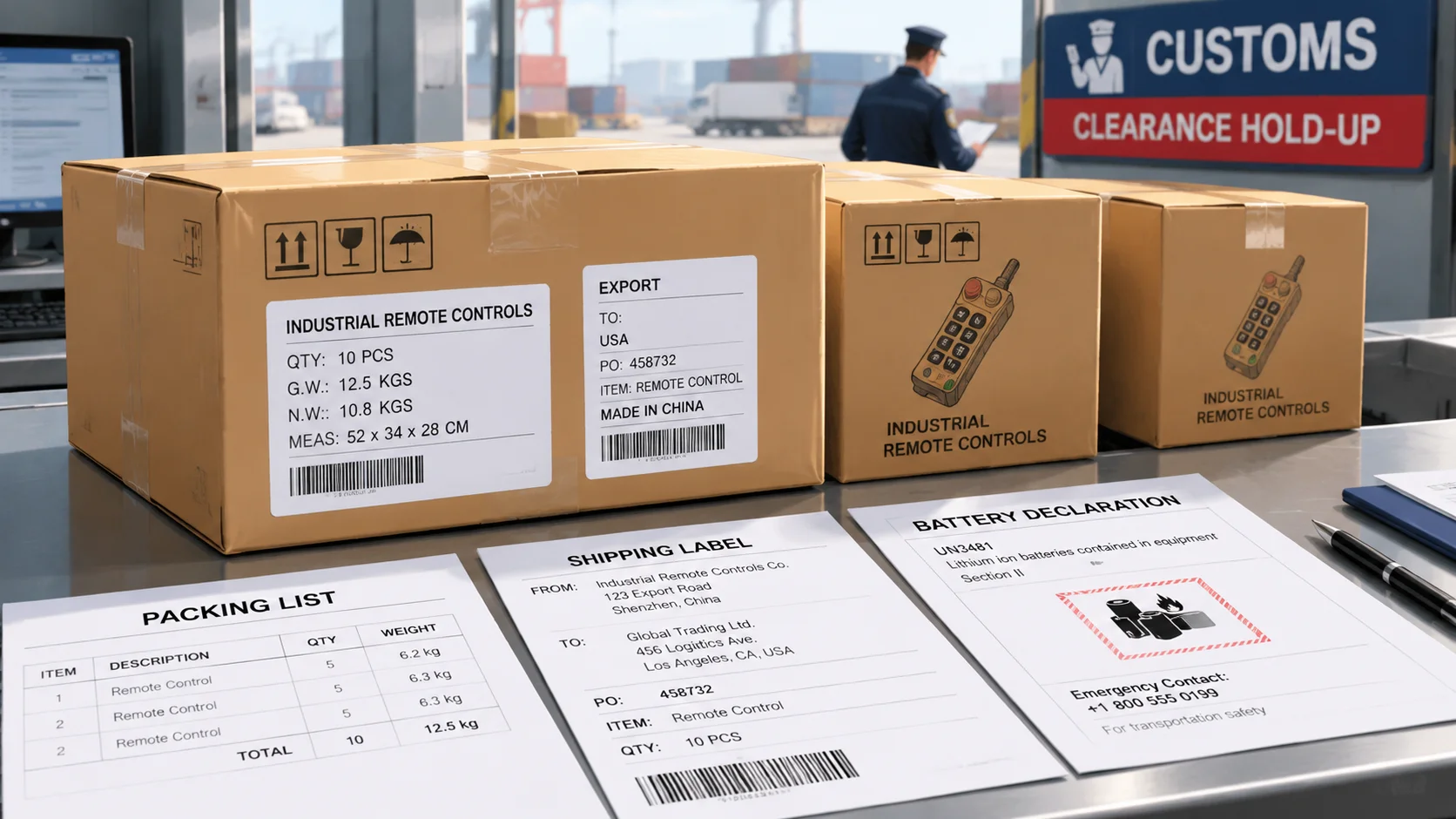
Customs delays on radio equipment cluster around four points. Each is avoidable with a document that costs nothing to prepare.
Put these lines in the RFQ and the rest of the process becomes administrative.
| Specification line | What to state |
|---|---|
| Destination market | Country of use, not country of purchase |
| Required approval | Which route from the table above, or “local allocation, evidence required” |
| Frequency band | Numerical band and channel list acceptable in that market |
| Radiated power | Limit, plus the antenna to be supplied with the unit |
| Labelling | Approval mark and identification number required on the housing |
| Documents | Declaration, test reports, manual restrictions section |
| Registration | Who files it, and what support the manufacturer provides |
| Spares policy | Whether replacement transmitters carry the same approval as the original batch |
That last line matters more than it looks. A replacement transmitter bought two years later from a different production batch can carry a different radio module and therefore a different approval position. Buyers who maintain mixed fleets discover this during an audit. The F21-E1B eight-button system is a common export configuration precisely because its documentation set is straightforward to keep aligned across batches.
If you are preparing an export order and are unsure which route applies, send the destination country and the intended duty to our team and we will confirm the band and the document set before the specification is frozen. The MOQ and lead time guide explains how approval paperwork affects the quoted schedule, since a market requiring local registration adds time that a standard order does not.
Not lawfully on the basis of the CE mark alone. The United States requires its own equipment authorisation with an FCC ID. The hardware may be identical, but the approval is a separate process and has to be evidenced separately.
For customs, often yes. For a technical audit or a customer’s own compliance review, no. A declaration without test reports behind it is a statement of intent rather than evidence, and the reports are what get examined when a question is raised.
The equipment is not permitted for use, and in most jurisdictions operating it is an offence that falls on the operator rather than the supplier. In practice the units have to be replaced or returned for a different radio module, which is far more expensive than specifying correctly.
Yes. Radiated power depends on antenna gain as well as transmitter output. Fitting a higher-gain antenna to a compliant unit can push it over the radiated limit, which is why antennas should be supplied and documented as part of the approved configuration.
Usually the importer, but the manufacturer has to provide the test data and often the technical file. Agree this explicitly in the purchase order, because registration delays stop sales even when the goods have already cleared customs.