Pendant Control Station Wiring: Cores, Common, Earth
Cores follow functions, not buttons. The sum that sizes the cable, why the stop must not share the button common, and five pre-power checks.
Read More

Most crane remote control housings are die-cast aluminium, glass-filled nylon or a PC/ABS blend, and the choice between them decides more about service life than the radio inside. The rule of thumb: aluminium for heat, impact and conducted-static sites; engineering plastic for cold, handheld comfort and cost; and both are adequate for a normal workshop.
What makes the choice confusing is that suppliers quote different things as “strength” — a drop height, an impact energy, a wall thickness, a temperature range. Those numbers are not interchangeable. This guide separates the tests, explains the trade-offs each material actually imposes, and sets out what to ask before you commit a crane fleet to one housing.

Die-cast aluminium is the default for heavy industrial handhelds. It is stiff, it conducts heat, it can be machined for a proper sealing groove, and it takes threaded inserts directly. Its weaknesses are mass and corrosion: an uncoated aluminium body in a wet or salty atmosphere will oxidise, and any stainless screw threaded into it sets up a galvanic couple.
Glass-filled nylon, usually PA6 with 30 per cent glass, is the common engineering-plastic choice. It is tough in the sense that matters for a handheld — it absorbs a knock instead of transmitting it — and it is moulded with the gasket groove and the button apertures formed in one shot. It is also the cheapest of the three at volume.
PC/ABS blends sit between the two on cost and feel. They mould cleanly and finish well, but UV and chemical resistance depend on the additive package, which is the part a cheaper grade trims.
Two numbers get quoted as impact strength and they measure different things. An IK rating follows IEC 62262 and states the energy of a single strike from a defined hammer on a defined part of the enclosure. A drop test states a height onto a defined surface. Neither predicts how a handheld transmitter behaves after two years of being set down on a steel walkway.
| Property | Die-cast aluminium | Glass-filled nylon | PC/ABS |
|---|---|---|---|
| Stiffness | High; enclosure does not flex under grip | Moderate; thin walls flex | Moderate to low |
| Impact behaviour | Resists a strike; dents rather than shatters | Absorbs energy, may crack at a sharp corner | Absorbs well at room temperature |
| Low temperature | Unaffected to well below freezing | Brittle below the grade’s limit | Impact strength falls sharply when cold |
| Heat dissipation | Good; spreads internal heat | Poor; heat stays at the source | Poor |
| Condensation inside | Higher risk on a cold body | Lower; the wall insulates | Lower |
| Static discharge | Dissipates through the body | Accumulates unless a conductive grade is used | Accumulates |
| Corrosion | Needs a coating; galvanic risk at fixings | None, but UV and solvent attack apply | None, but UV applies |
| Field repair | Machinable, re-threadable | Inserts pull out; usually a new housing | Inserts pull out |
Read it by column, not by row. No material wins everything, and the losses are what you live with for eight years.
The thermal argument cuts both ways. A sealed plastic box holds the few watts from the radio and backlight inside, while an aluminium wall conducts them out and spreads them. That is why aluminium suits a unit that runs continuously, or a foundry where ambient is already high.
The same conductivity creates the opposite problem. A cold aluminium body is a good cold surface, and in a humid hall internal moisture condenses on it. A plastic wall keeps the internal air warmer than the wall, so condensation forms less readily. Neither is a guarantee, and both are worse than a coated board.
Corrosion is the other cost. Bare aluminium in a wet or chloride atmosphere oxidises, and the oxide lifts the sealing surface under the gasket. A coating or anodising fixes it, but the coating must survive the same knocks, and a chipped anodised edge starts corrosion. Coating and sealing interact, as covered in IP65 versus IP67 for crane remote control.

Plastic housings fail in three predictable ways. Ultraviolet exposure degrades an unstabilised polymer, and the visible sign is chalking followed by surface cracking on the sun-facing side. A transmitter used outdoors on a yard crane sees this, and a grade without a UV package will look a decade old in two summers.
Static is the second. A plastic body does not dissipate charge, so it accumulates until it discharges through the nearest conductor — usually the operator’s hand on a metal button bezel, or a spark at the battery contact. On a site with a flammable atmosphere this is a genuine hazard, and conductive grades exist for exactly that reason. Even without a gas hazard, repeated small discharges are uncomfortable and operators notice.
Third is the gasket seat. A moulded groove holds its dimension until the housing distorts, and a plastic body left in a hot cabin can creep. A groove that has lost flatness stops compressing the gasket evenly, which reads as a gasket fault.
Where plastic genuinely wins is cold. A plastic body is comfortable to hold without gloves at low temperature, and it does not conduct heat out of the hand. The trade-off is that impact strength falls as temperature drops, and the grade matters: a transmitter specified for a freezer store needs a grade rated for that temperature, not a standard one. Cold store duty is treated in crane remote control for cold stores and freezer rooms.
Most sites do not need a bespoke housing, they need the right one of three. The mapping is short. A hot, abrasive or high-impact environment — foundry, steel mill, scrap yard, heavy fabrication — favours aluminium for stiffness, heat spreading and the ability to take a strike. The wider set of requirements for those sites is in crane remote control in foundries and steel mills.
A cold environment favours plastic for hand comfort and for insulating the electronics from the wall temperature, provided the grade is rated for the range. A wet or salty environment favours a coated aluminium body with marine-grade fixings, or a plastic body with a properly moulded gasket groove and a UV-stabilised grade.
Two cases override the mapping. A declared explosive atmosphere needs conductive, static-dissipative material whatever the thermal argument. And where the transmitter is dropped regularly, a rubber over-mould helps more than a stronger shell, because it spreads the strike over a larger area.
The questions below separate a housing that will last from one that will be replaced. Ask them in writing; the answers are all things a real manufacturer knows.
The wall thickness question is the one that separates a repairable unit from a disposable one, and it is almost never in a datasheet. A single-unit purchase can ignore it. A fleet of thirty cranes cannot, because the difference shows up in year three as a spares bill rather than as a failure.
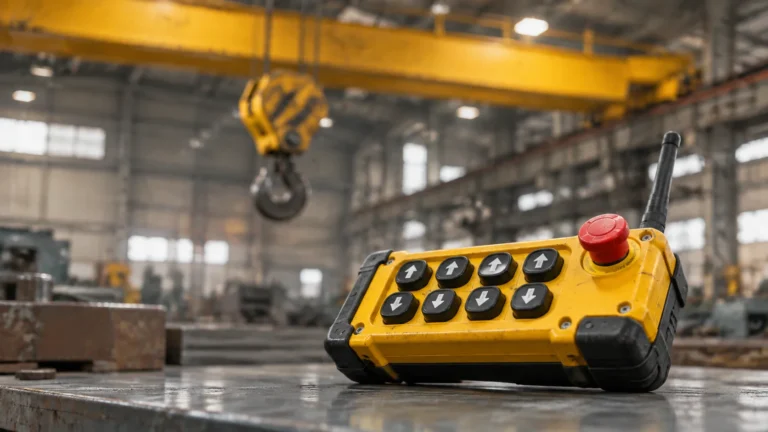
For a mixed fleet the sensible approach is to standardise on one housing type for the majority of the cranes and accept an exception for the hostile ones. Transmitter platforms such as the eight-button single and dual speed system are available in more than one enclosure, so the button layout can stay consistent while the housing changes. If you are selecting for a specific site, send the environment details and we will confirm which housing the duty justifies, or start from the industrial crane remote control system range.
It is stiffer and resists a strike better, but strength is not the only failure mode. Aluminium dents and corrodes at fixings; plastic absorbs energy and can crack at a corner when cold.
That is UV degradation of an unstabilised grade, visible as chalking and then fine surface cracks. It is a material specification issue rather than a manufacturing fault, and a UV-stabilised grade avoids it.
It accumulates charge because it does not dissipate it, which is uncomfortable and a real hazard in a flammable atmosphere. Conductive grades exist and are required for hazardous areas; for ordinary sites the effect is mostly nuisance.
Plastic, if the grade is rated for the temperature, because it insulates the electronics and is comfortable to hold. Check impact rating at the low end, since impact strength falls as it gets colder.
Usually yes, with a thread insert, which is one reason aluminium is preferred where a unit must be repairable. A plastic housing with a pulled insert normally needs replacement instead, so specify inserts rather than self-tapping screws.