Pendant Control Station Wiring: Cores, Common, Earth
Cores follow functions, not buttons. The sum that sizes the cable, why the stop must not share the button common, and five pre-power checks.
Read More

A crane remote control battery is a consumable, and it is the single most common cause of unplanned crane downtime in plants that otherwise maintain their equipment well. The practical answer is not to buy longer-lasting batteries — it is to put replacement on a calendar, keep a small spare-parts kit at each workstation, and treat a flat transmitter as a scheduled event rather than a surprise.
This guide sets out what an industrial remote control actually consumes, how to build a replacement interval you can defend, what spare parts are worth holding on site, and when replacing the whole system is cheaper than continuing to repair it.
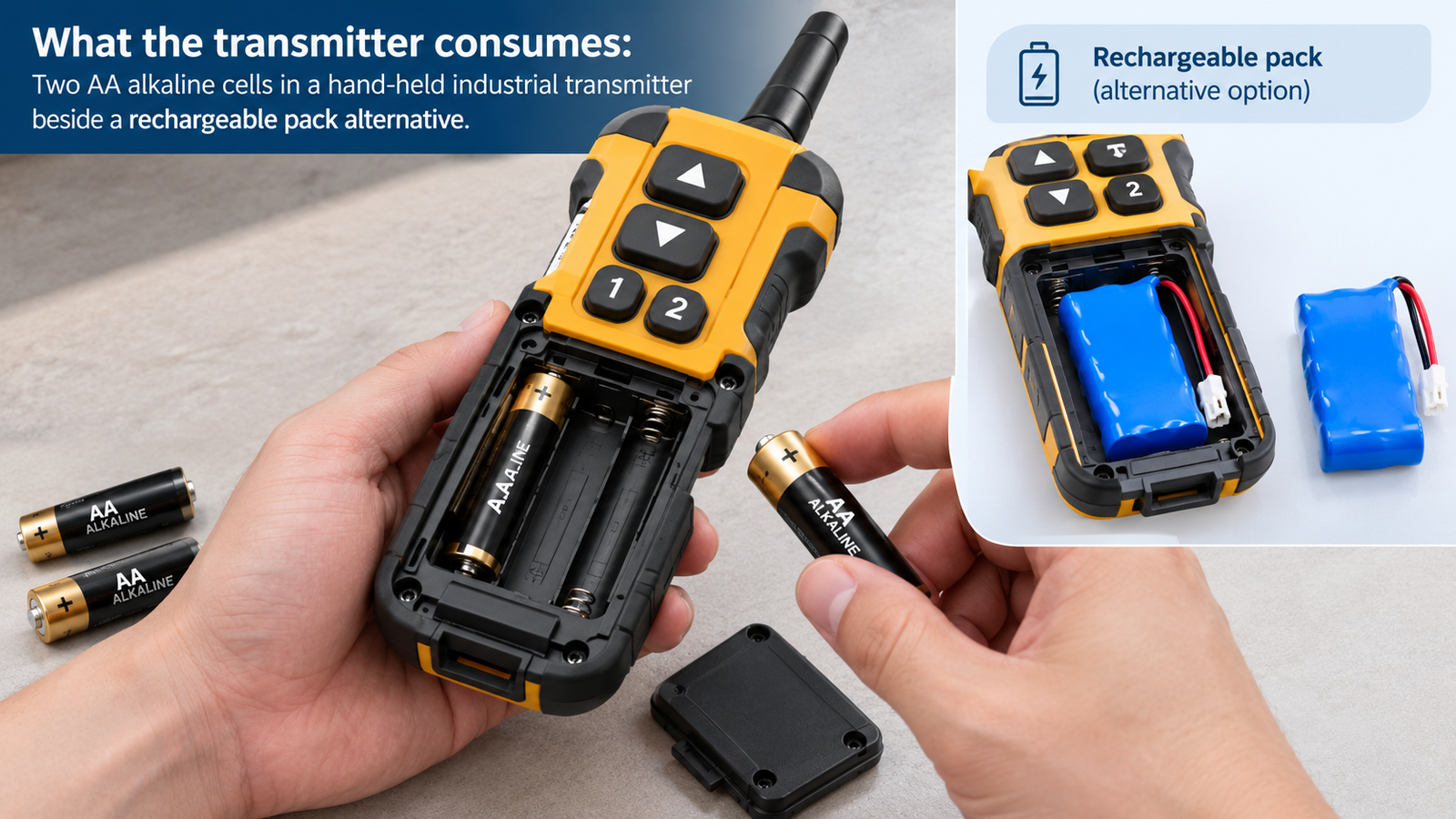
Most industrial hand transmitters run on two AA cells or on a rechargeable pack, and the difference decides your maintenance routine. A unit running on alkaline AA cells is cheap to keep alive but can fail without warning if nobody records when the cells went in. A unit with a rechargeable pack shows a state of charge but degrades slowly, so capacity falls off over months rather than stopping dead.
Take the F21-E1B as a reference point: the transmitter is powered by two AA alkaline cells, the receiver is a separate panel-mounted unit fed from the control circuit, and the set is rated IP65 with a 100 m class working radius. That split matters — the battery risk sits entirely in the hand-held unit. On a larger twelve-button system such as the F24-12S / 12D remote control, the same logic applies, with a wider receiver input range of AC/DC 18–65 V or 65–440 V and IP65/IP66 depending on build.
What you cannot read from a datasheet is duty cycle. A transmitter used for eight hours of continuous coil handling draws far more than one used for a few lifts an hour, because every button press transmits. Battery life should be measured on your own site, then turned into a fixed replacement interval with a safety margin.
The interval that works is the one that is shorter than the observed life, not equal to it. Start by logging actual replacement dates for one month on each crane, then set the calendar interval at roughly two-thirds of the shortest observed life.
| Item | Typical attention point | What tells you it is due |
|---|---|---|
| AA alkaline cells | Fixed calendar interval per transmitter | Logged date, not the low-battery indicator |
| Rechargeable pack | Capacity check under load | Runtime noticeably shorter than when new |
| Battery contacts | Inspection at each replacement | Corrosion, green deposit, loose spring tension |
| Keypad membrane | Reactive, checked monthly | Sticky or slow-returning buttons, legend worn through |
| Housing and gasket | Reactive, checked monthly | Cracks, seal compressed or hardened, water marks inside |
| Receiver antenna | Checked monthly, replaced when damaged | Bent, kinked, corrosion at the connector |
| Pendant cable (if retained) | Checked quarterly | Stiff spots, exposed conductors, damaged gland |
The advantage of a calendar interval is that it removes the decision from the operator. Waiting for a low-battery warning means replacing cells mid-shift, in a plant, with a load in the air — which is exactly the situation the schedule exists to prevent.
Where the transmitter uses a rechargeable pack, most premature failures come from handling rather than from the cells themselves.
A plant with ten cranes does not need ten of everything. It needs enough to survive a failure without waiting for a courier.
Keep the pairing record with the spare. A pre-paired transmitter is only useful if the person on shift knows which receiver it belongs to; this is the same discipline that prevents cross-operation on multi-crane sites.
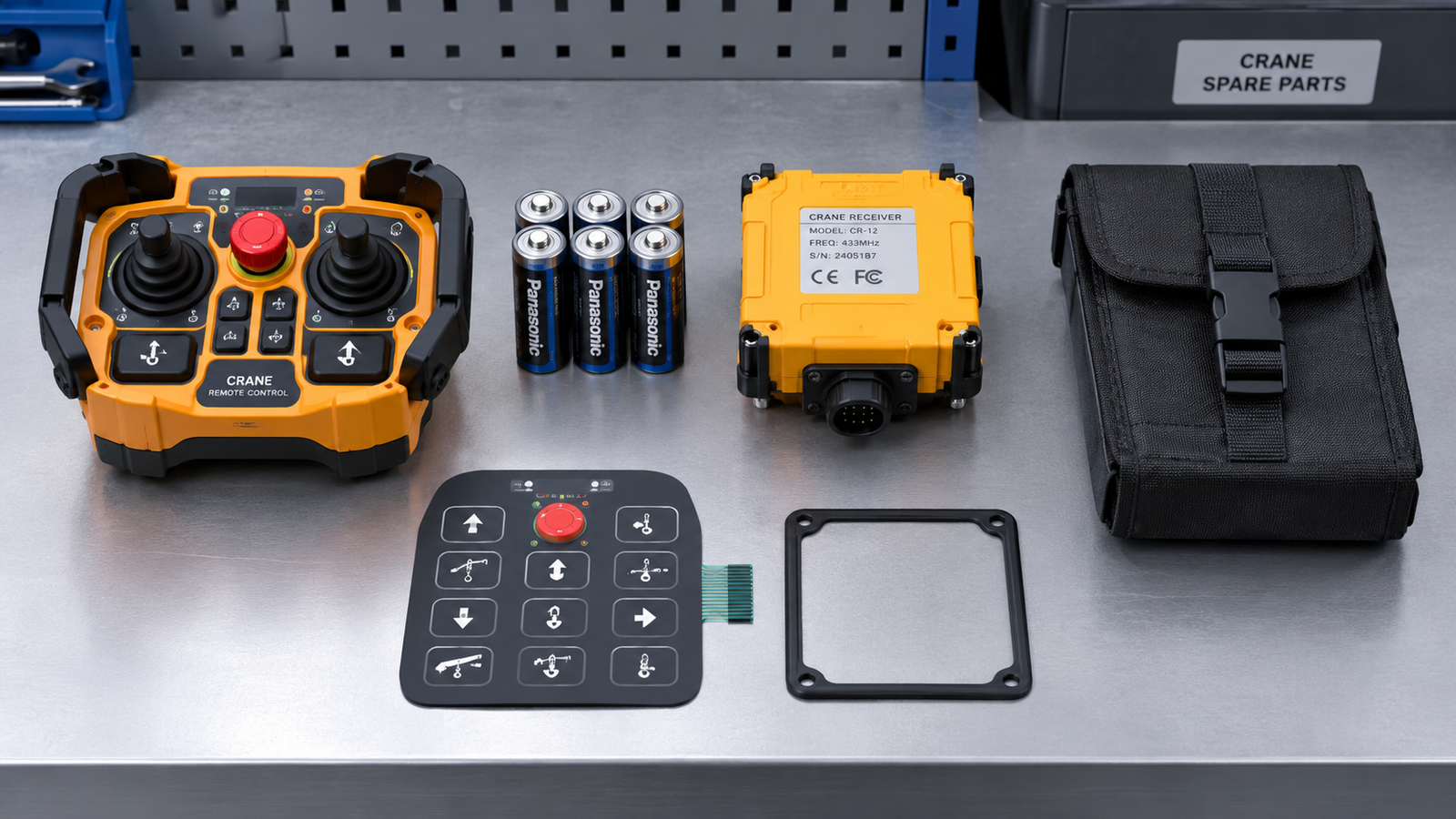
A maintenance schedule does not have to be elaborate. Three tiers cover almost everything a hand-held transmitter needs.
| Frequency | Task |
|---|---|
| Every shift | Test all motions and the emergency stop before the first lift; check the battery indicator or the logged replacement date |
| Monthly | Inspect housing, gasket, keypad and antenna; clean the keypad with a damp cloth only; check battery contacts |
| Quarterly | Range test at the furthest working position; verify link-loss stop; measure rechargeable pack capacity under load; inspect receiver terminations for tightness |
| Annually | Full function test under load; open the transmitter and inspect the interior for moisture or corrosion; replace the pack if capacity has fallen noticeably; update the pairing record |
Symptoms that appear during these checks are usually easier to diagnose than a failure on the floor. If a unit has already stopped working, the layered approach in this crane remote control troubleshooting checklist will separate a battery problem from a pairing, wiring or receiver problem before any parts are ordered.
The decision rule is arithmetic, not sentiment: if the cost of the repair plus the downtime it implies approaches the price of a replacement set, replace it. Three signals push the decision towards replacement — a model whose spare parts are no longer produced, a housing that has been repaired more than once, and a unit that has been dropped and now fails intermittently in the same way after each repair. Intermittent faults that survive two repair attempts rarely justify a third.
Where the transmitter is sound and only the consumables are worn, the F24-10S / 10D wireless remote control and the F21-E1B industrial wireless remote control are the two families most often kept in service this way, because the accessories stay available across the range.
Put battery replacement on a calendar, hold one pre-paired spare transmitter per crane, and keep the pairing record with the spare. That combination removes most of the downtime that remote controls cause, and it costs far less than the production hours it saves.
If you are building a spares list across several crane models, the IEHC FAQ page covers the common compatibility questions, and a list of your models and quantities can be quoted through the contact form.
On alkaline AA cells, use a fixed calendar interval derived from your own logged replacement dates, set to about two-thirds of the shortest life you have observed. On rechargeable packs, measure capacity under load each quarter and replace the pack when runtime has clearly fallen. Do not wait for the low-battery indicator — it leaves you changing cells mid-shift.
Use the cell type the transmitter was designed for and replace both cells at the same time. Mixed brands, mixed ages or a partially discharged cell paired with a fresh one causes heating, uneven discharge and leaks. Where the unit is used in a hot or humid area, keep cells stored dry and away from sunlight.
Yes, and it should be pre-paired and labelled with the crane number. That single item converts a potential shift-long stoppage into a two-minute swap. Keep the pairing record with the spare so the correct receiver is known without opening the cabinet.
In order of likelihood: a weak battery, a damaged or mispositioned receiver antenna, a new obstruction such as racking or stored material, or a new source of electrical noise near the receiver. Check the battery and antenna before replacing anything.
When spare parts are no longer produced, when a housing has been repaired more than once, or when an intermittent fault returns after two repair attempts. At that point the repair cost plus the downtime risk usually exceeds the price of a new set.