Pendant Control Station Wiring: Cores, Common, Earth
Cores follow functions, not buttons. The sum that sizes the cable, why the stop must not share the button common, and five pre-power checks.
Read More

A crane remote control that loses its radio link is not the same event as one that loses its power, and the two are confused constantly in fault reports. When the link drops, the receiver is still powered, still monitoring and still able to act on a decision. What it does in the next few hundred milliseconds is a design choice that somebody made, and it is the single most important thing to confirm before a radio system goes into service.
This guide separates the two failure modes, sets out three failsafe behaviours and which duty each suits, and gives a test method that runs on a live crane without special equipment.
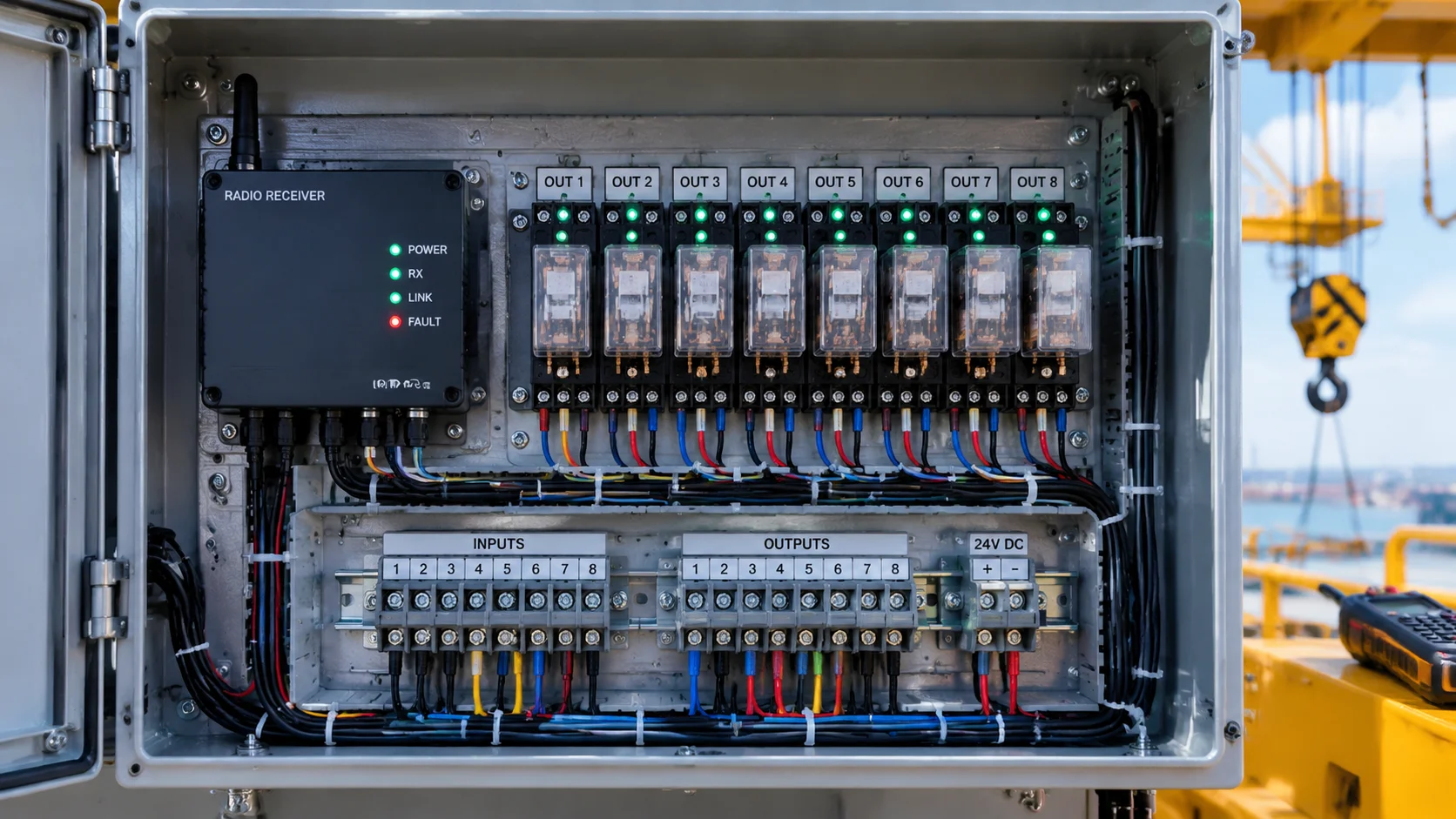
On power loss the receiver goes dark. Outputs drop because nothing is left to hold them, relays release, and the crane stops. Everyone understands that event and nobody designs for it.
Signal loss is different. The receiver is healthy, the outputs are energised, and the last valid command it received is sitting in memory. The receiver now has to decide whether the absence of a new command means “the operator released everything” or “the operator is no longer audible”. It cannot tell the difference from the radio alone, so it uses time. After a defined interval with no valid message it declares the link lost and applies whatever behaviour has been configured.
That interval is why a dropped link and a released joystick feel identical for a moment and then diverge. It is also why “the remote stopped working” is an inadequate fault description: the useful question is whether the crane stopped, kept moving, or ramped down.
The behaviours map onto the stop categories in IEC 60204-1, which is a useful vocabulary because it is the same language the crane’s electrical designer already uses.

| Behaviour | What happens on link loss | Suits | Risk if chosen wrongly |
|---|---|---|---|
| Immediate stop, outputs off | All motion outputs drop at once, brakes apply | Hoist and travel on cranes where an abrupt stop is mechanically acceptable | Load swing on long travel; shock loading on structure and rope |
| Hold last state | Outputs stay as they were until a valid signal returns or a timer expires | Almost nothing on a crane; used in some process equipment | Unattended motion. Do not accept this on a lifting machine |
| Controlled ramp-down | Outputs are removed in a defined sequence, usually decelerating travel before releasing the brake | High-speed long travel, and any axis where an abrupt stop swings the load | Needs correct sequencing; a wrong order drops a load |
Most crane installations should be immediate stop on hoist and controlled ramp-down on long travel, bounded by a maximum timeout so that “ramp down” cannot become “keep going”. Whatever is chosen has to be written into the order, because a supplier shipping a default behaviour is not making a safety decision on your behalf. The supply and output side of the same cabinet is where the other half of these faults live, and a link that is genuinely present but never reaches the contactors shows up in the wiring diagram long before it shows up on a meter at the handset.
A radio receiver does not detect “no signal”. It detects the absence of valid messages. Each transmission carries an identity code and a changing element, and the receiver discards anything that fails the check. Two mechanisms matter.
The first is the timeout. A counter runs from the last accepted message, and when it expires the failsafe triggers. Typical values sit between a fraction of a second and about a second, trading responsiveness against nuisance trips: too short and one corrupted message stops the crane, too long and it keeps moving after control is lost.
The second is the identity check. A receiver paired to one transmitter ignores messages from any other, which is why a neighbouring crane’s transmitter cannot drive your hoist. When a transmitter’s code changes after a re-pair, the receiver sees perfectly strong radio and accepts none of it: the unit has signal by every measure the operator can see and does nothing.
Testing on paper proves nothing. The behaviour has to be observed on the actual crane with the actual load path, and it can be done in a few minutes per unit.
Step two is the one people get wrong. Pulling the battery is the intuitive way to simulate a dead transmitter, but many units shut down in an orderly way when supply falls, and that shutdown is not the radio-loss path. Switching off tests radio loss; pulling the battery tests supply loss. Both are worth verifying, but they are not the same test.
Write down four things per unit: what the crane did, roughly how long it took, who observed it, and the date. That record turns a claim into evidence after an incident, and it is how you notice drift. A unit that took half a second in year one and two seconds in year four has a developing problem even though it still passes a pass/fail check.
Re-test whenever the transmitter or receiver is replaced or re-paired, when the crane’s electrical system is modified, and at the annual inspection. If the site runs a permit system for lifting operations, attach the record to it rather than filing it somewhere nobody reads.
A large share of reported signal failures are supply problems. The receiver is fed from the crane’s control circuit, and that circuit sags when a contactor pulls in, when a brake releases, or when a drive draws inrush. A receiver that resets on a supply dip looks exactly like one that lost its link: outputs drop, then it comes back. The difference is that a supply dip often leaves a trace.
Two checks separate them. Look for a pattern tied to another action rather than to position: failures that happen when a particular motion starts are supply, failures at a particular place in the building are radio. Then watch the indicators during the event. A unit that reboots shows its start-up sequence; a unit that times out does not. The supply-side causes are covered in what happens to a crane remote control on power failure, and the diagnostic sequence in the not working checklist.
One more distinction matters when specifying. Relay outputs fail safe by dropping out, which suits stop-on-loss behaviour. Solid-state outputs can be arranged either way depending on the circuit, and mixing the two types inside one receiver changes what “outputs off” actually means. The trade-offs are set out in relay versus solid-state receiver outputs.
If you are ordering a system and need a specific failsafe behaviour rather than whatever the default happens to be, state it at enquiry: which axes stop immediately, which ramp down, and the maximum timeout you will accept. The industrial crane remote control system page describes the configurable options, or send the crane specification and required behaviour and we will confirm it against the receiver configuration.
It should, and on a lifting machine it must. The receiver declares the link lost after a timeout with no valid message and then applies its configured behaviour, which is normally immediate stop on hoist and a controlled ramp-down on long travel. Confirm the behaviour in writing before the unit goes into service.
Typical settings run from a fraction of a second to about one second. Shorter settings react faster but trip on a single corrupted message; longer settings tolerate interference but let the crane keep moving after control is lost. On most industrial receivers the value is configurable at commissioning.
A brief continuation is usually the mechanical and electrical delay of contactors and brakes rather than a radio fault. If the motion continues for as long as the timeout, the receiver is not seeing the release, which points to a sticking button or a failing encoder rather than to the radio link.
It is better to switch the transmitter off at its power switch, because a battery pull may trigger an orderly low-voltage shutdown that bypasses the radio-loss path. Test both if you want full coverage, but do not treat them as the same test.
That pattern usually means the receiver is hearing radio it will not accept. The identity code no longer matches, typically after a re-pair or a transmitter swap, so the receiver discards valid messages and eventually times out. Re-pair the pair and confirm the binding before replacing hardware.