Pendant Control Station Wiring: Cores, Common, Earth
Cores follow functions, not buttons. The sum that sizes the cable, why the stop must not share the button common, and five pre-power checks.
Read More

Most reported crane remote control interference is not a radio fault at all, and the fastest way to waste a week is to start by replacing the transmitter. Variable frequency drives and welding sets inject noise through three different routes, and each route has its own fix. Identify the route first and the repair is usually a cable, a filter or a frequency setting rather than a new system.
The diagnostic question is simple: does the crane misbehave only when a specific machine is running, or at particular positions on the runway? The first answer points to a source. The second points to a path. Treating them as the same problem is why interference cases so often end with new equipment and the same symptom.
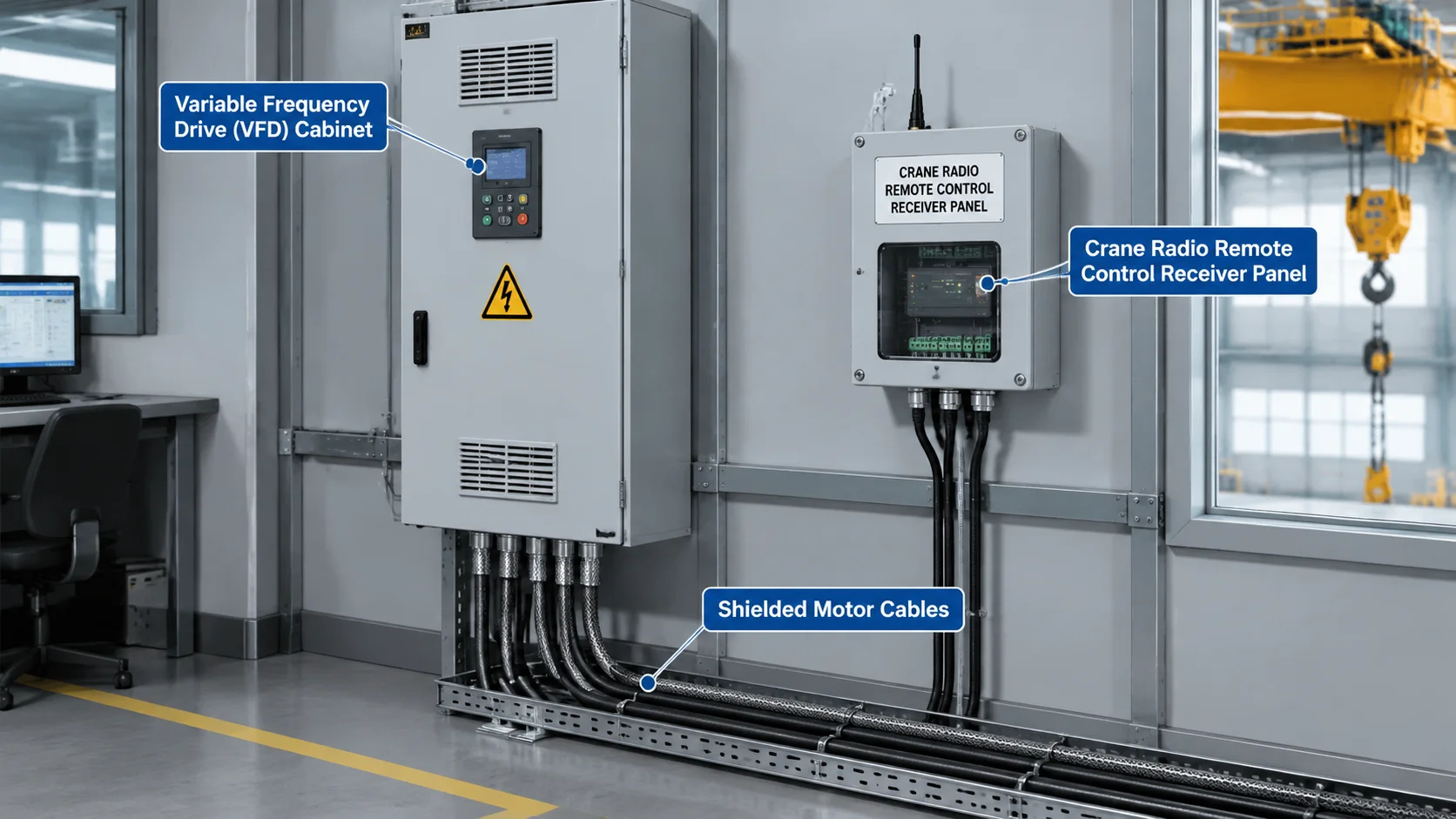
Noise from a drive or a welding set reaches a receiver by conduction, by radiation, or by contaminating the supply. The three are easy to confuse because the visible symptom, an unexpected stop, looks identical.
| Path | How it gets in | Signature | Typical fix |
|---|---|---|---|
| Conducted | Rides the motor cable or the earth conductor into the panel | Faults track drive load or acceleration | Shielded motor cable bonded at both ends, output filter or choke |
| Radiated | Leaves an unshielded cable or an open cabinet and reaches the antenna | Faults follow physical position, not load | Reroute antenna and its cable, close and bond the cabinet |
| Supply pollution | Returns through the earth or neutral to the receiver’s own supply | Faults appear when another machine starts, even at idle | Separate supply, isolation transformer, common-mode choke |
A fourth case is not interference at all: a receiver whose supply dips when a large drive starts, resets, and appears to lose its pairing until it reboots. That looks like radio dropout and is diagnosed with a multimeter, not a spectrum analyser.
Multi-crane interference is a channel allocation problem. Two transmitters on the same frequency or the same address step on each other, and the symptom is predictable: the fault happens when the other crane moves, at any position, at any load. The cure is pairing discipline and channel planning.
Drive interference is a signal-to-noise problem. The channel may be perfectly clear and the address unique, but the receiver cannot hear a valid packet over the noise floor. The fault then depends on what the drive is doing rather than on what the other crane is doing. The 433 MHz versus 2.4 GHz comparison explains why the two bands tolerate these two problems so differently: a lower frequency generally copes better with an obstructed site, while a higher one generally copes better with a congested one.
Spend one shift recording rather than repairing. Four observations separate the cases.
Write down the time, the crane position and which machine was running. Two days of that record is worth more than a week of swapping parts, and the troubleshooting checklist follows the same split between source, path and power.
Most installations improve simply by correcting the motor cable. A shielded cable with the shield bonded at both ends, using a gland that makes metal-to-metal contact with the cabinet, is the single highest-value change. A shield connected at one end only, or terminated onto a painted panel with a plastic gland, is an antenna.
After that, in order of cost against benefit:
None of these touch the remote control. That is the point: the remote is usually the messenger. Wastewater plants add a second layer to this: mixers and blowers run continuously while the chemistry attacks the housing, and water treatment and sludge crane duty is the combination that has to be specified for.
Welding is harder to fix at source because the noise is a by-product of the process and the operator is not going to stop. Practical options, cheapest first:
Where welding is continuous rather than occasional, the honest answer is that the site needs a link designed for a hostile RF environment, not a workaround.
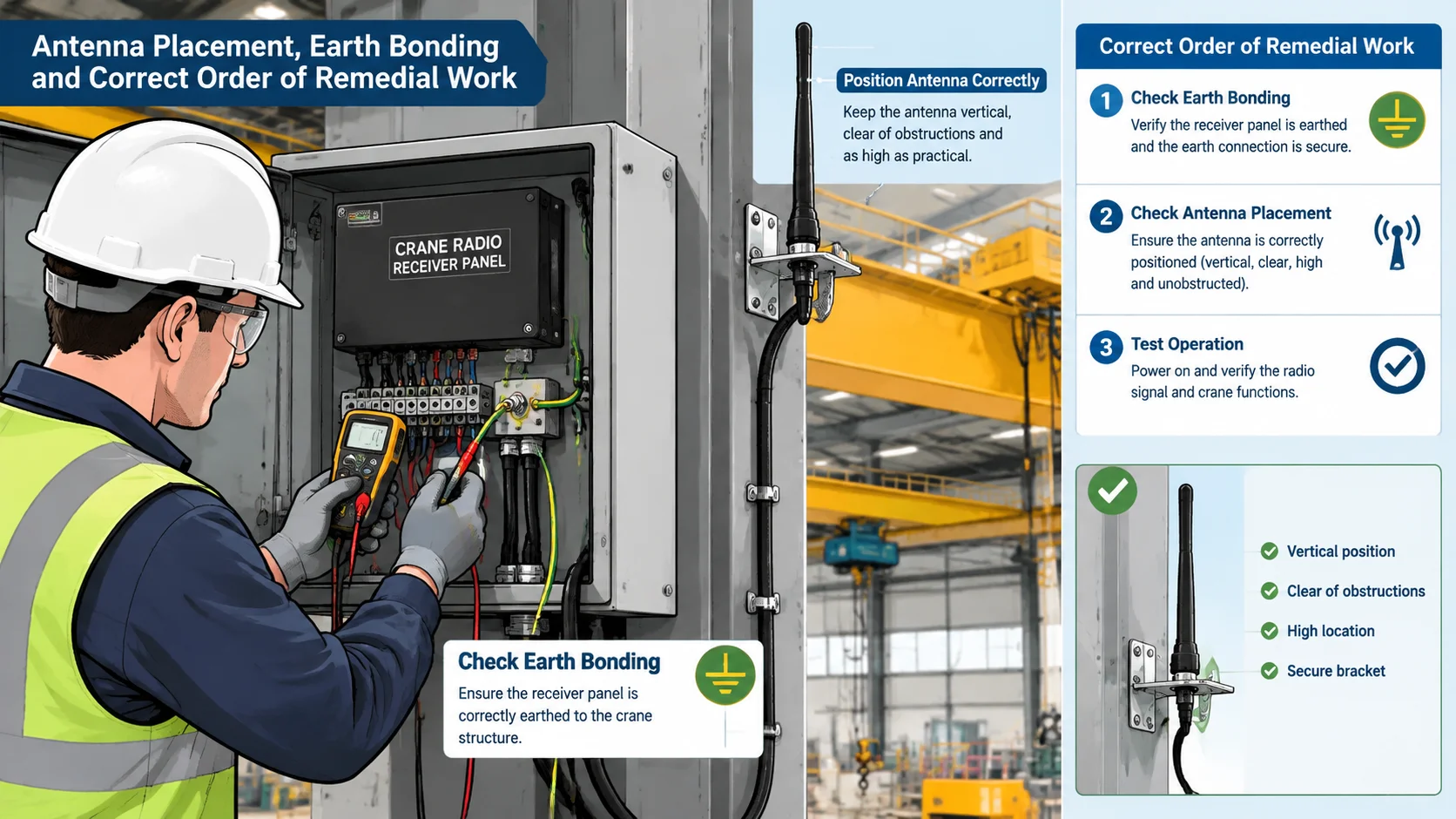
Once the source and path are understood, work through the receiver side in this order. Doing it in a different order tends to fix one case and create another.
The industrial crane remote control systems range lists which receiver variants accept an external antenna with an extended cable, and which are sealed units that do not. That detail decides whether a marginal installation can be rescued or has to be replaced.
If the symptom still does not fit any of the three paths, send the stop log and the drive settings to our engineers and we will work through the pattern with you before you change any hardware.
Sometimes, but not for the reason people expect. Both bands suffer from broadband noise; the difference is how each behaves around steel and how congested the band is. Move band only after the cable, earth and antenna work has been done, otherwise the new system inherits the same fault.
Because it is a path problem, not a source problem. Something is blocking or reflecting the signal at that position, or the receiver is seeing a reflection that cancels the direct path. Moving the antenna 300 mm often changes the result more than any electronic fix.
Usually enough to stop it affecting the remote, yes, provided the motor cable is shielded and correctly bonded. Filtering without a proper shield is largely wasted effort, because the cable radiates before the filter can act.
Occasionally, when its battery or antenna has degraded and the link is already marginal. That is why the first test is to try a known-good transmitter on the same crane. If the fault persists with a different transmitter, stop looking at the handheld.
Run the drive at the load and carrier setting that used to trigger the fault, for a full shift, while logging every unplanned stop. A fix that survives a quiet shift proves nothing.