Pendant Control Station Wiring: Cores, Common, Earth
Cores follow functions, not buttons. The sum that sizes the cable, why the stop must not share the button common, and five pre-power checks.
Read More

An OEM or ODM industrial remote control project runs through five stages: requirement definition, drawing and specification, prototype, pilot batch, then series production. The stage that decides whether the project finishes on schedule is the first one — a custom handset is only as good as the input material the buyer supplies at the start. Most delayed projects are not manufacturing problems; they are specification problems discovered at the prototype stage.
This guide sets out what an industrial remote control custom project actually involves, what the buyer has to prepare, which parts of the product can be changed and which cannot, and how to keep the schedule from slipping.
The two terms get used interchangeably in enquiries, which causes a mismatch of expectations on the first call. The distinction matters because it decides who owns the design work and who carries the tooling cost.
| OEM | ODM | |
|---|---|---|
| Who designs the product | The buyer, or the buyer’s engineering team with the factory building to that design | The factory, adapting an existing platform to the buyer’s requirement |
| Starting point | Buyer drawings, specifications and often a reference sample | Existing model family, with defined customisation options |
| Typical change scope | Housing, keypad layout, electronics configuration, labelling, packaging | Branding, colours, legends, button count, frequency, receiver variant |
| Tooling | New moulds may be required; usually buyer-funded | Existing moulds reused; tooling amortised or shared |
| Lead time driver | Drawing approval and tooling, then production | Configuration confirmation and production slot |
| Best fit | A product you intend to own and sell under your own design for years | Faster route to a branded product that does not need to be unique |
If you are not sure which you need, the honest test is this: does the product have to be different from what already exists in order to sell, or does it only have to carry your name? The first is OEM work. The second is ODM, and it is significantly cheaper and faster.
How long each stage takes depends mainly on whether the housing is new and whether the frequency band needs certification for the destination market. The commercial structure — minimum quantities, how lead time is built up, and what can be customised within a standard run — is covered separately in this guide to MOQ, lead time and customisation.
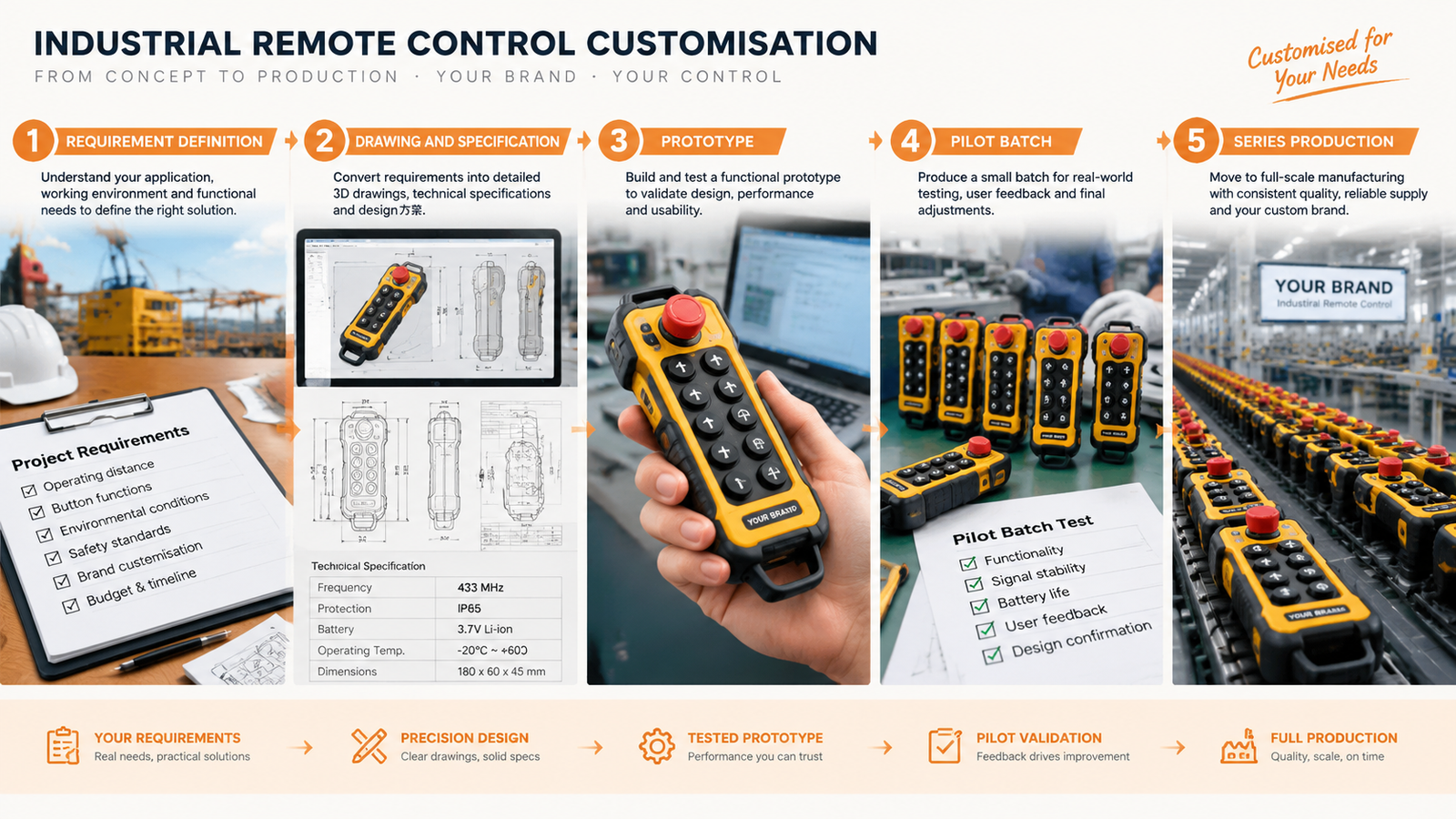
Suppliers can work from a rough brief, but the project moves faster when these eight items exist in a folder.
Items three and four cause more rework than everything else combined, because they are the two that cannot be inferred from a photograph.
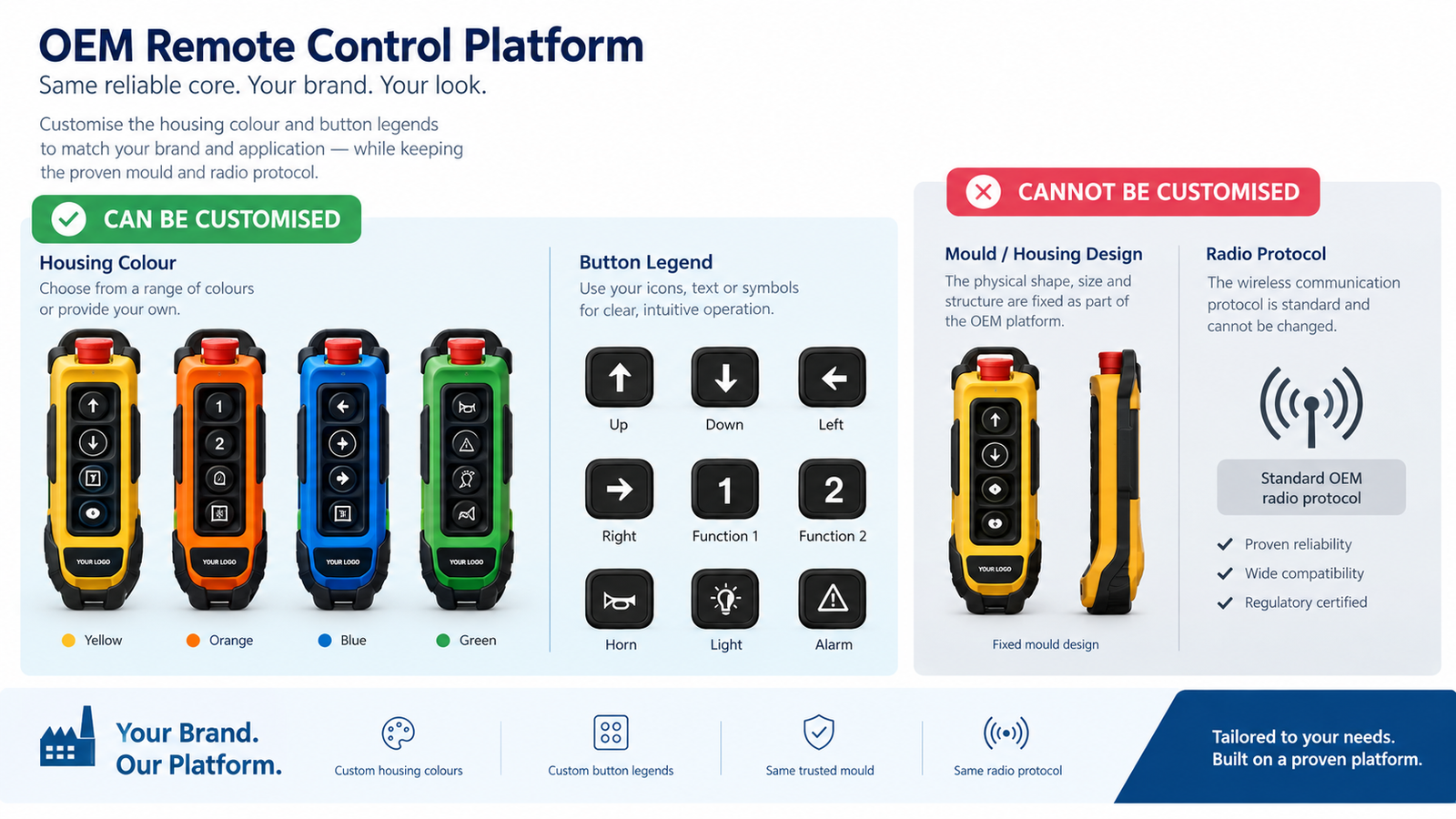
The practical boundary is between the parts of the product that are cosmetic or configurable, and the parts that are structural or safety-related.
| Customisable within a platform | Requires a new design |
|---|---|
| Housing colour and brand marking | Housing geometry and mould |
| Button legend and function assignment | Button count beyond the platform’s range |
| Button count within the family | Radio protocol or encoding scheme |
| Frequency band where the platform supports it | Safety architecture and emergency stop circuit |
| Receiver form factor and mounting | Certification of a protection concept not held |
| Ingress protection variant, where a build exists | Ingress protection beyond the tested rating |
| Packaging, manual language, accessory kit | Battery chemistry and charging system |
The right-hand column is not a refusal — it is a different project with tooling, testing and certification attached. A supplier who agrees to move an item across that line without discussion is not protecting your schedule.
Approval of a prototype should be a test, not an opinion. Before signing off, run the unit through the functions that will be hardest to fix later.
For the wiring side of that last point, the terminal layout and the common-terminal rule are the same as on a standard unit and are explained in this receiver output wiring guide.
Two questions decide whether a custom project is an asset or a dependency. Who owns the drawings and the mould? And what happens to them if the relationship ends?
Get both in writing before tooling starts. An OEM project normally carries a buyer-owned design with the supplier holding the tooling for the buyer’s production; an ODM project normally leaves the platform with the supplier, with your branding applied. Neither arrangement is wrong, but discovering which one you agreed to after the first order is expensive. A mutual confidentiality agreement covering drawings, legends and customer lists is standard practice on both.
Custom remote control projects fail at the brief, not at the factory. Decide whether you are buying OEM or ODM, prepare the legend and the coil voltage, keep cosmetically configurable items separate from structural ones, and test the first article against functions rather than impressions.
If you are building a branded handset on an existing platform, the remote control system for industrial cranes shows the platform architecture, and the F24-12S / 12D twelve-button system is the most commonly customised base for twelve-button projects. IEHC has manufactured control equipment in Yueqing, Zhejiang since 2003; the company profile is on the about page, and project enquiries can be sent through the contact form.
It depends on how much of the product changes. Branding, legend and colour changes on an existing platform generally run at lower quantities than a new housing or a new electronics configuration, because the latter carry tooling and setup. Give the supplier the full scope in the enquiry so the quantity can be quoted against the actual work.
Yes, on most platforms. Marking is applied at manufacture, so the artwork needs to be supplied as a file rather than described, and it should be approved on a prototype or a pilot sample before the production run.
Usually only by replacing the keypad or the housing face, because legends are set at manufacture. That is why the legend artwork is one of the items that must be frozen before production — changing it later means new parts, not a new label.
Only where the platform supports that band and the resulting product meets the destination market’s radio requirements. Frequency is a regulatory question, not a preference — state the country of sale in the enquiry and let the supplier confirm which band and which approvals apply.
It depends on the agreement, and it must be written down before tooling begins. OEM projects commonly carry buyer-owned designs with tooling held for the buyer’s production; ODM projects commonly leave the platform with the supplier. Confirm ownership and the exit arrangement in the contract.