Pendant Control Station Wiring: Cores, Common, Earth
Cores follow functions, not buttons. The sum that sizes the cable, why the stop must not share the button common, and five pre-power checks.
Read More

How many buttons a crane remote control needs comes down to arithmetic: count the directional functions on the machine, add start and stop, then add one button for every auxiliary circuit you want on the transmitter. A three-motion overhead crane with no accessories lands on eight buttons; add a horn and a work light and it becomes ten; a fourth motion or a second hoist pushes it to twelve.
The mistake that costs money is guessing from the old pendant. Pendants and transmitters do not count the same way, and a machine that has been running on a six-button pendant for years often needs eight buttons the moment the control is moved into the operator’s hand.
Work from the machine, not from the catalogue. Write down every function the operator has to command, then apply four additions.
The formula is therefore: two buttons per motion, plus two for start and stop, plus one per auxiliary circuit.
| Machine | Motions | Direction buttons | Start + stop | Auxiliary | Total |
|---|---|---|---|---|---|
| Electric chain hoist on a monorail | Hoist, travel | 4 | 2 | 0 | 6 |
| Single-girder overhead crane | Hoist, trolley, bridge | 6 | 2 | 0 | 8 |
| Same crane with horn and work light | Hoist, trolley, bridge | 6 | 2 | 2 | 10 |
| Double-girder crane with auxiliary hoist | Main hoist, aux hoist, trolley, bridge | 8 | 2 | 0 | 10 |
| Crane with four motions and two auxiliaries | Four | 8 | 2 | 2 | 12 |
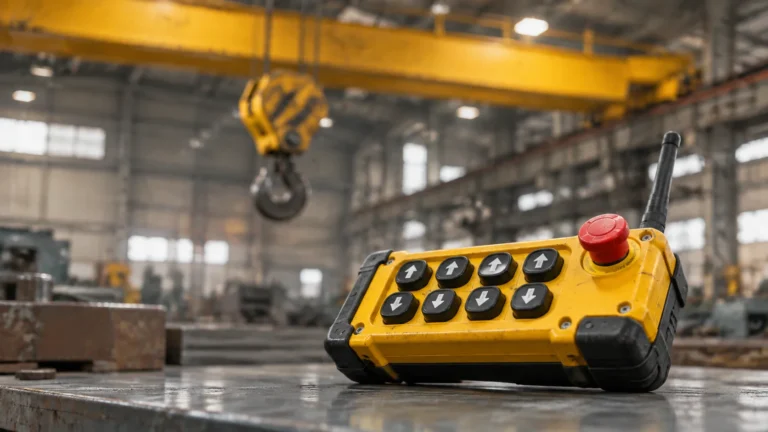
Read the total against the station classes. Eight buttons is the smallest count that still fits a complete single-girder crane — the F21-E1B is built exactly to that layout with one start, one stop and six single-speed directions, and its F24-8S/8D counterpart adds a wide-voltage receiver covering AC 36–380 V or DC 12–24 V.
Ten buttons buys headroom: the F24-10S/10D keeps the same six direction buttons and start and stop, then adds two assignable buttons — enough for the horn and work light that otherwise get left off the specification. Twelve buttons carries the F24-12S/12D across a four-motion crane, two complete three-motion sets, or a crane with several auxiliaries, with a receiver that switches between an AC/DC 18–65 V range and a 65–440 V range.
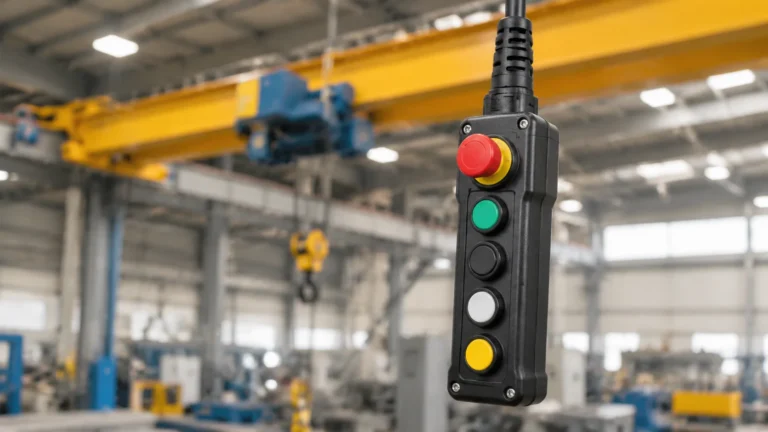
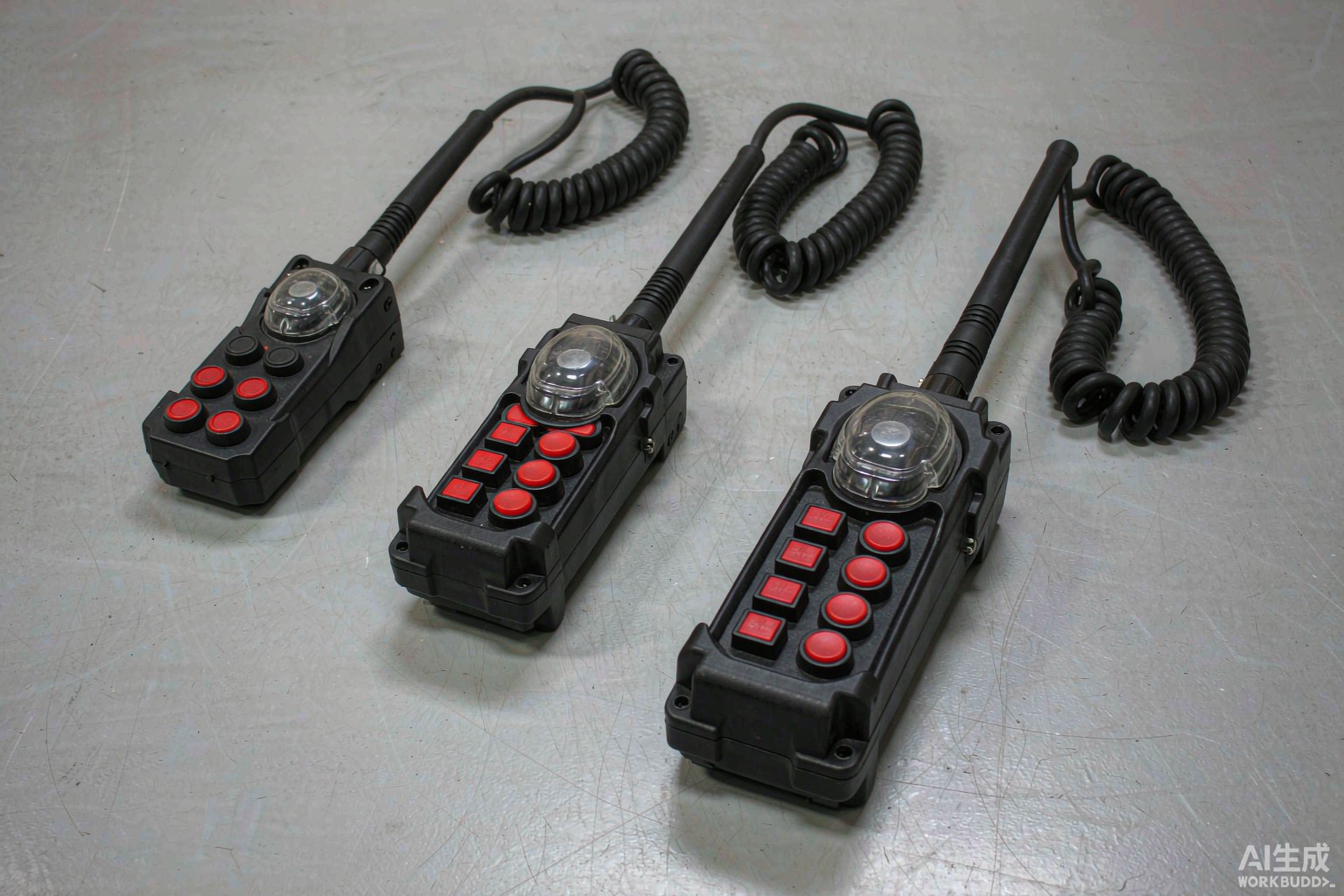
If a pendant is already fitted, it is still the wrong place to start, but it is a useful cross-check. A pendant station such as the COP-3MS or COP-3MD is offered in two, four or six directional button configurations with a red stop button, so a six-direction pendant maps to six direction buttons plus stop. What the pendant does not show is start, and most transmitters require one — the safety key and the separate start button are there so that powering the transmitter up does not immediately command a motion.
Two conversions catch people out. First, a pendant’s stop is often the only stop in view, so a retrofit has to decide where stop lives on the transmitter and confirm that both control points still drop the machine-level stop circuit. Second, a pendant may hide an auxiliary function on a selector switch rather than a button; moving to a transmitter turns that selector into a button, and the count goes up by one.
Buyers who size exactly to the current machine tend to come back for a second unit within a year. Two reasons.
The first is that auxiliary circuits accumulate. A work light gets added after the first winter of night shifts, a horn after the first near-miss, a second hoist when throughput rises. Each addition needs a button, and a transmitter with no spare cannot absorb it.
The second is fleet standardisation. A buyer running a mixed fleet will eventually want one part number across several cranes, and the largest machine in the fleet sets the specification. Moving up one class at the start usually costs less than stocking two.
There is a real limit, though. Extra buttons on a hand-held unit are not free in ergonomic terms — the operator has to find the right one by feel, with gloves on, without looking away from the load. Above roughly twelve buttons on a fixed button layout, the case for a joystick station becomes stronger than the case for more buttons.
Button counting assumes discrete commands: press, the motion runs, release, it stops. Some machines are not operated that way. A tower crane that has to slew while travelling, or a concrete boom pump whose sections have to be blended rather than stepped, is controlled by proportional joysticks instead.
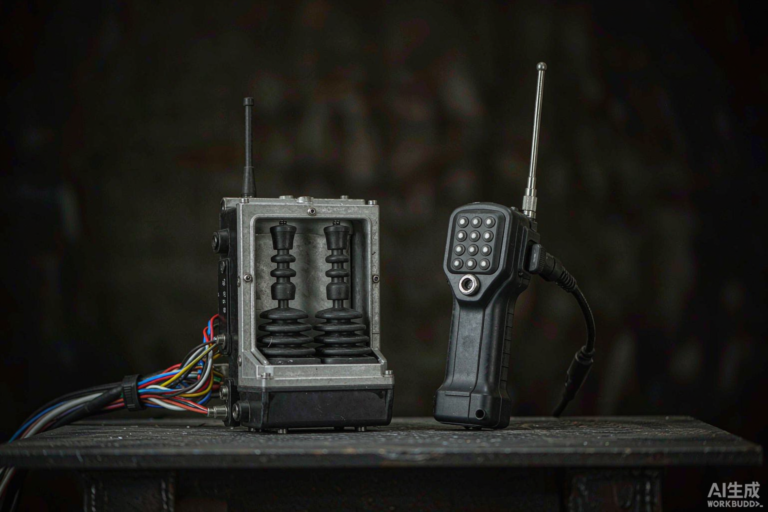
That is the point at which the specification changes shape. The F24-60 carries two five-step joysticks for four axes of travel, and the receiver closes its relay outputs step by step as the stick moves — which is what allows two functions to be ramped together. The SAGA1-L40 goes further with two five-step joysticks, two three-position toggles, two pushbuttons and up to forty programmable relay outputs for machines whose sequence has to be written rather than wired. In both cases you are no longer counting buttons; you are specifying axes and logic.
Two buttons per motion, two for start and stop, one per auxiliary — then round up to the nearest station class. Verify the count against the actual contactor list rather than the old pendant, decide separately whether dual speed is needed, and take the spare button if the machine is likely to grow. If the answer lands above twelve buttons or the machine needs proportional control, look at joystick stations instead of larger button panels.
Send the motion list, the auxiliary circuits and the control voltage through the contact form and the station class can be confirmed against a real configuration rather than a guess.
Eight: six direction buttons for hoist, trolley and bridge, plus start and stop. Add one button for each auxiliary circuit such as a horn or work light, which moves the specification to the ten-button class.
No, on this product family. The single-speed and dual-speed versions of a model share the same transmitter, and each direction button carries both a slow and a fast stage. Dual speed doubles the receiver outputs, not the button count.
Yes. The two extra buttons are simply left unassigned or mapped to functions added later. It is a common way to avoid a second part number when a fleet is being standardised, at the cost of two buttons the operator does not use.
The start button is a deliberate arming step. It means switching the transmitter on, or replacing a battery, cannot command a motion by itself. Combined with the magnetic safety key, it keeps an unattended transmitter from moving the machine.
That is usually a sign the machine needs a joystick station rather than a bigger button panel. Above twelve buttons the operator can no longer find functions by feel, and proportional axes are better handled by five-step joysticks such as those on the F24-60 or SAGA1-L40.