Pendant Control Station Wiring: Cores, Common, Earth
Cores follow functions, not buttons. The sum that sizes the cable, why the stop must not share the button common, and five pre-power checks.
Read More

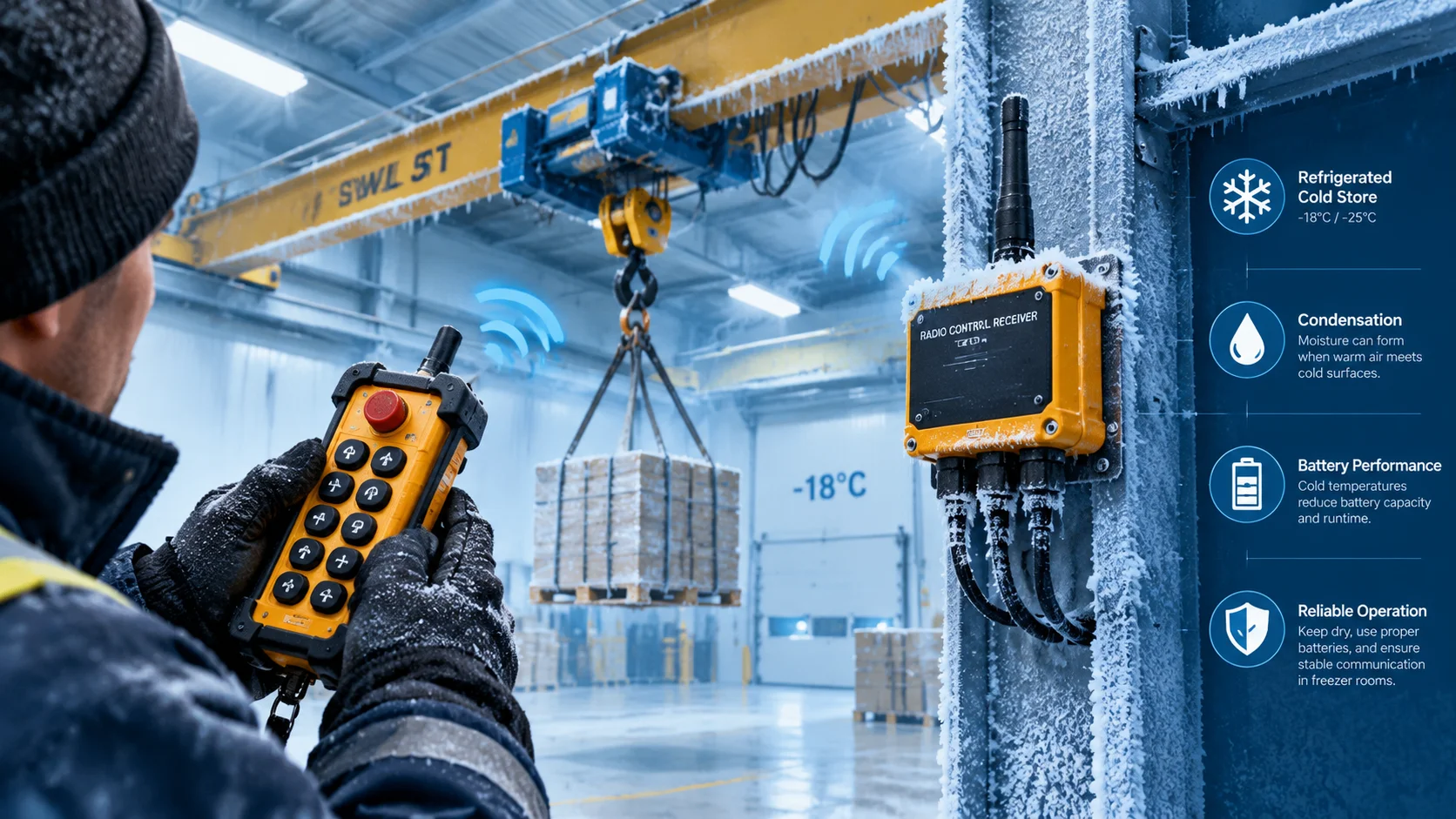
Cold stores break crane remote controls in ways that a datasheet rarely predicts. The electronics usually survive −25 °C without complaint; what fails is everything around them. Battery capacity collapses, display modules go sluggish, cable jackets stiffen until they crack, and every time the crane comes back out through the door the unit is soaked in condensation. A unit specified for an outdoor crane and pressed into freezer duty will pass its first winter and start failing in its second.
None of this is exotic. It is a short list of failure modes, each with a known remedy, and most of the cost sits in specifying correctly at the start rather than in paying for a special product. A cold store crane remote control is still an ordinary industrial remote control; what changes is the battery, the sealing, and the way the unit is looked after.
Walk into a freezer room and the failure pattern is consistent across sites and brands. The table below is the order in which problems normally appear.
| Item | What happens | Practical remedy |
|---|---|---|
| Battery capacity | Usable runtime drops sharply; a pack good for a full shift at 20 °C may not finish one at −25 °C | Low-temperature cells, a spare pack kept warm, and a charging regime outside the freezer |
| Display and indicators | Slow response and dim segments; liquid crystal types can stop updating | Prefer LED indication, or accept a slower display and train operators to read it in the warm |
| Cable jacket and grommets | PVC stiffens and cracks at flex points; gland seals lose grip | Cold-flexible jacket material, generous bend radius, no tight cable ties |
| Relay contacts | Condensation freezes on contact faces during off cycles, giving intermittent no-ops | Sealed receiver enclosure, and a heater or a location that stays above dew point |
| Push-button rubber | Hardens and stops returning cleanly, so a button appears stuck | Silicone rather than natural rubber, and periodic exercise of every button |
| Enclosure seals | Compression set after repeated freeze-thaw, then water ingress on the warm side | Serviceable gasket, inspected annually rather than replaced on failure |
The pattern in that table is worth noting: only one row is about the radio at all, and none of them is about range or frequency.
Buyers often assume a high IP rating covers cold. It does not. The two digits describe dust and water ingress only, and a unit can be IP67 and still be specified for 0 °C to +40 °C. If you take one thing from this article, take that: check the temperature range as a separate line, and check which part of the unit it applies to.
In practice you will see a transmitter quoted −35 to +80 °C and then find a battery pack inside it quoted −10 to +45 °C. The transmitter will indeed work at −25 °C with a suitable pack; with the wrong pack it will shut down early and the operator will report a flat battery, not a temperature problem. The IP65 and IP67 comparison covers the ingress side in more detail, including why a higher rating is not automatically the better choice for a unit that has to be serviced in the field.
The most damaging moment in a cold store application is not the night spent at −25 °C. It is the twenty minutes after the crane, or the transmitter in the operator’s pocket, comes out into a warm humid room. Moisture condenses on every surface colder than the dew point, including the inside of an enclosure that is not truly sealed and the contact faces of a relay that has just been sitting cold.
That last point causes more dead receivers than frost ever does. A service technician who opens a unit at −20 °C, brings it to a bench, and refits it an hour later has sealed warm moist air inside it.
Three chemistries turn up in industrial transmitters, and they behave very differently in the cold.
| Chemistry | Cold behaviour | Suitable for |
|---|---|---|
| Alkaline primary cells | Loses a large share of capacity near −20 °C but recovers when warm | Occasional use, with a warm spare carried by the operator |
| Rechargeable nickel-metal hydride | Noticeably weaker in the cold, and self-discharge is higher | Single-shift indoor work; poor fit for freezer rooms |
| Lithium primary cells | Best cold performance of the three, but not rechargeable | Freezer rooms, outdoor winter duty, remote sites |
| Lithium-ion packs | Good capacity but charging below 0 °C must be blocked by the charger | Fleets with disciplined charging stations outside the cold zone |
Two practical rules follow. First, charge outside the freezer, always, and let a cold pack reach room temperature before it goes on a charger. Second, rotate packs by shift rather than by failure: a pack that dies at 3 a.m. in a freezer room costs more in lost throughput than a year of scheduled replacement. The FAQ page covers pack types and charger behaviour for our units.
The receiver has an easier life than the transmitter because it does not travel, but its location still decides whether the installation works. Three rules cover most cases.
If the freezer is a large room with racking that blocks the path, the antenna position matters more than the unit’s rated range. That problem and its remedies are covered in the operating distance guide, and the same logic applies inside a cold store.
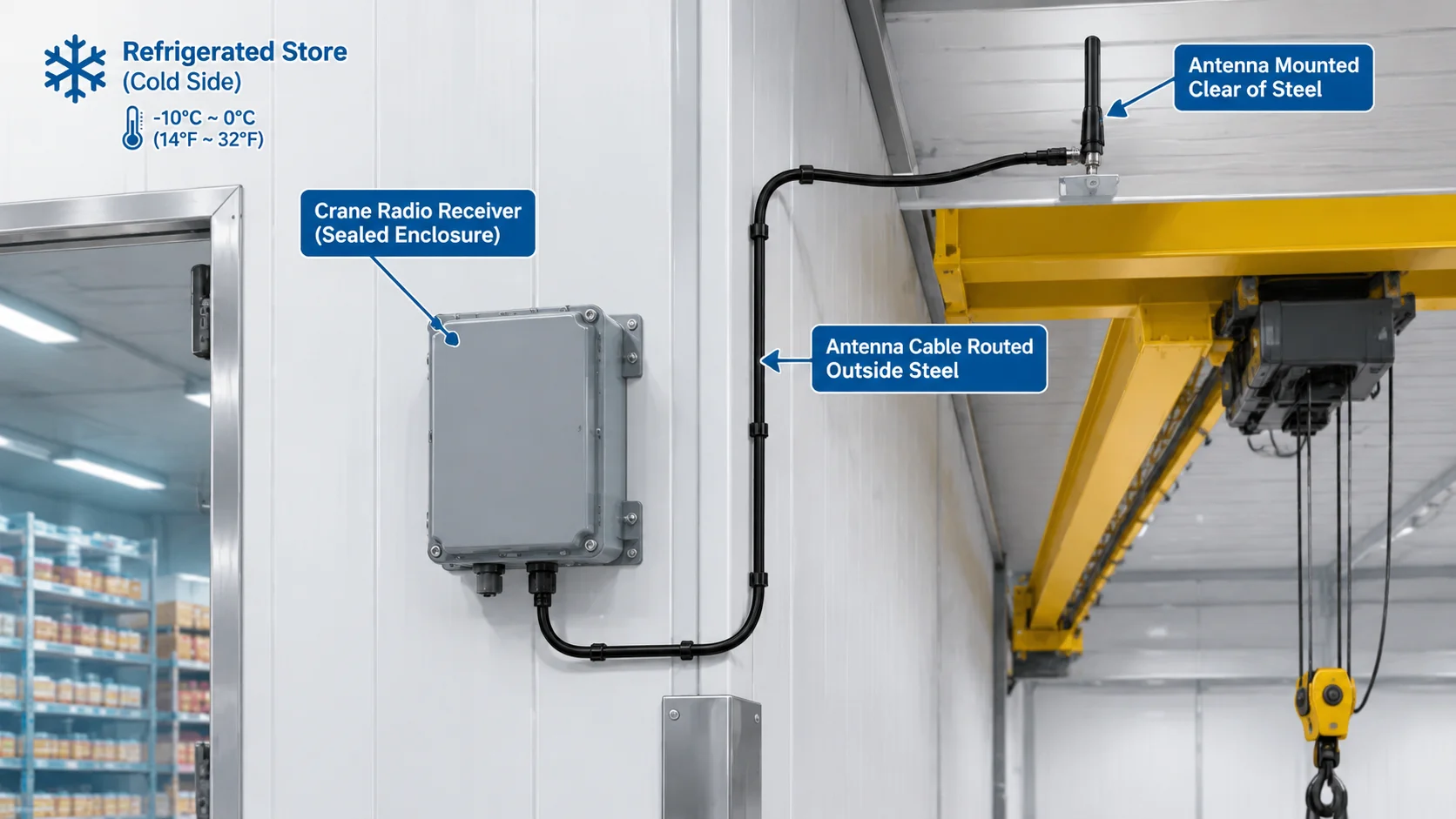
Freezer duty is one of the few applications where a short list of extra clauses in the purchase order is worth more than a change of product family. When you specify a cold store crane remote control, ask for the following, and ask for it in writing.
A unit built to those clauses does not need to be a special cold-store model. The F24-10S / 10D wireless remote control and the wider crane remote control systems range are configured this way for cold and outdoor duty. Send the room temperature, the door cycle and the shift pattern through the contact page and we will confirm which battery and enclosure options fit.
Usually yes, with two changes: a battery chemistry rated for the temperature, and an enclosure that stays sealed through freeze-thaw cycles. The radio and the electronics themselves are rarely the limiting factor at −25 °C.
Ingress protection and temperature are unrelated specifications. An IP67 unit is protected against dust and short immersion, and may still be rated only for 0 °C upwards. Check the temperature line separately.
Cell chemistry slows down at low temperature, so internal resistance rises and the usable capacity falls. The pack is not empty when the unit shuts down; it recovers when warm, which is why cold-store batteries should be rotated on a schedule.
Inside the cold envelope, in a sealed enclosure with downward-facing glands, is normally better. Mounting it on the warm side of the wall with the antenna inside creates condensation on every door cycle.
Quarterly for seals, cable jackets and button return, and annually for a full enclosure service with a new gasket. Any unit that has been opened in a warm room needs the enclosure dried before it is closed again.