Pendant Control Station Wiring: Cores, Common, Earth
Cores follow functions, not buttons. The sum that sizes the cable, why the stop must not share the button common, and five pre-power checks.
Read More

A jib crane is the easiest crane in the building to convert to radio control, and the one most often over-specified. It has two or three motions, a short travel, and one operator standing within a few metres of everything. You do not need twelve outputs, long range or a joystick. You need a unit whose button layout lets one person hold a load steady with one hand while nudging the hoist with the other, and a receiver that fits on a column with nowhere obvious to put it.
This guide covers what a crane remote control has to do on a jib or a workshop hoist, where it differs from an overhead crane specification, and the mounting question that decides whether the installation is tidy or a permanent snag hazard.
List the actions before you look at any product. Most jib cranes fall into one of three patterns, and the pattern decides the button count more than any catalogue table does.
| Jib type | Actions on the transmitter | Outputs needed |
|---|---|---|
| Fixed jib with chain hoist | Hoist up, hoist down, and two speed steps if the hoist is dual speed | 2 single speed, or 4 with dual speed |
| Slewing jib with chain hoist | Hoist up and down, slew left and right | 4, or 6 to 8 with dual speed |
| Wall-mounted jib with trolley | Hoist up and down, trolley in and out, sometimes slew | 4 to 6 |
| Any of the above with a vacuum lifter or magnet | All of the above plus one or two held-on functions | Add 1 to 2 latching outputs |
Notice how rarely the answer exceeds eight. A workshop hoist on a jib is not a container crane, and buying 12 outputs “for future expansion” usually means paying for a larger transmitter that is heavier to hold for a full shift.
Four differences matter, and all of them reduce the specification rather than increase it. Each one removes a line that a bridge crane enquiry would need.
That last point is the reason a pendant-to-radio conversion on a jib deserves a proper look at the stop circuit rather than just a receiver bolted to the column. The comparison of pendant stations and radio control covers when a wired handle is still the better answer, which for a fixed jib in a single work position is more often than suppliers like to admit.
Count the actions, add one for the stop function if the unit uses a dedicated button rather than a rotary switch, and stop there. Two layout questions then decide the rest.
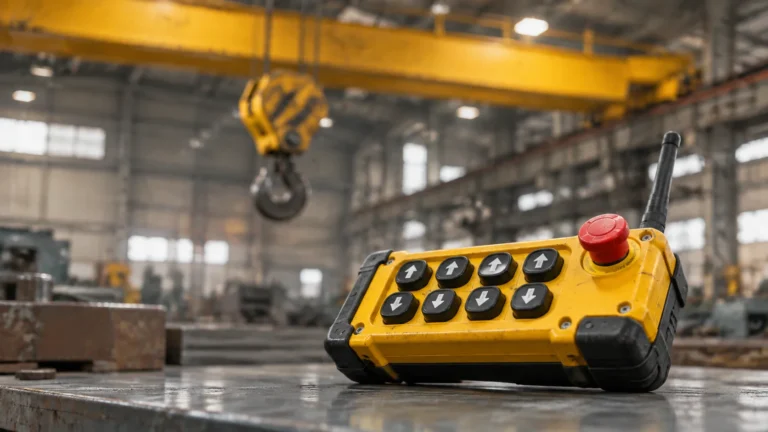
The first is whether the hoist buttons should be a pair on one side. Operators on a jib usually want hoist up and down under one thumb, with the slewing or trolley pair under the other, so the crane can be moved while the load stays steady. That physical arrangement matters far more to productivity than the total button count, and it is the reason a six-button unit with a sensible layout beats an eight-button unit with a single row.
The second is whether the buttons should be momentary or maintained. Motions must be momentary: release and the motion stops. Functions such as a vacuum pump or a work light may be maintained, but only if the receiver is configured to drop them when the link is lost. Mixing the two on one unit without checking that behaviour is a common source of surprise.
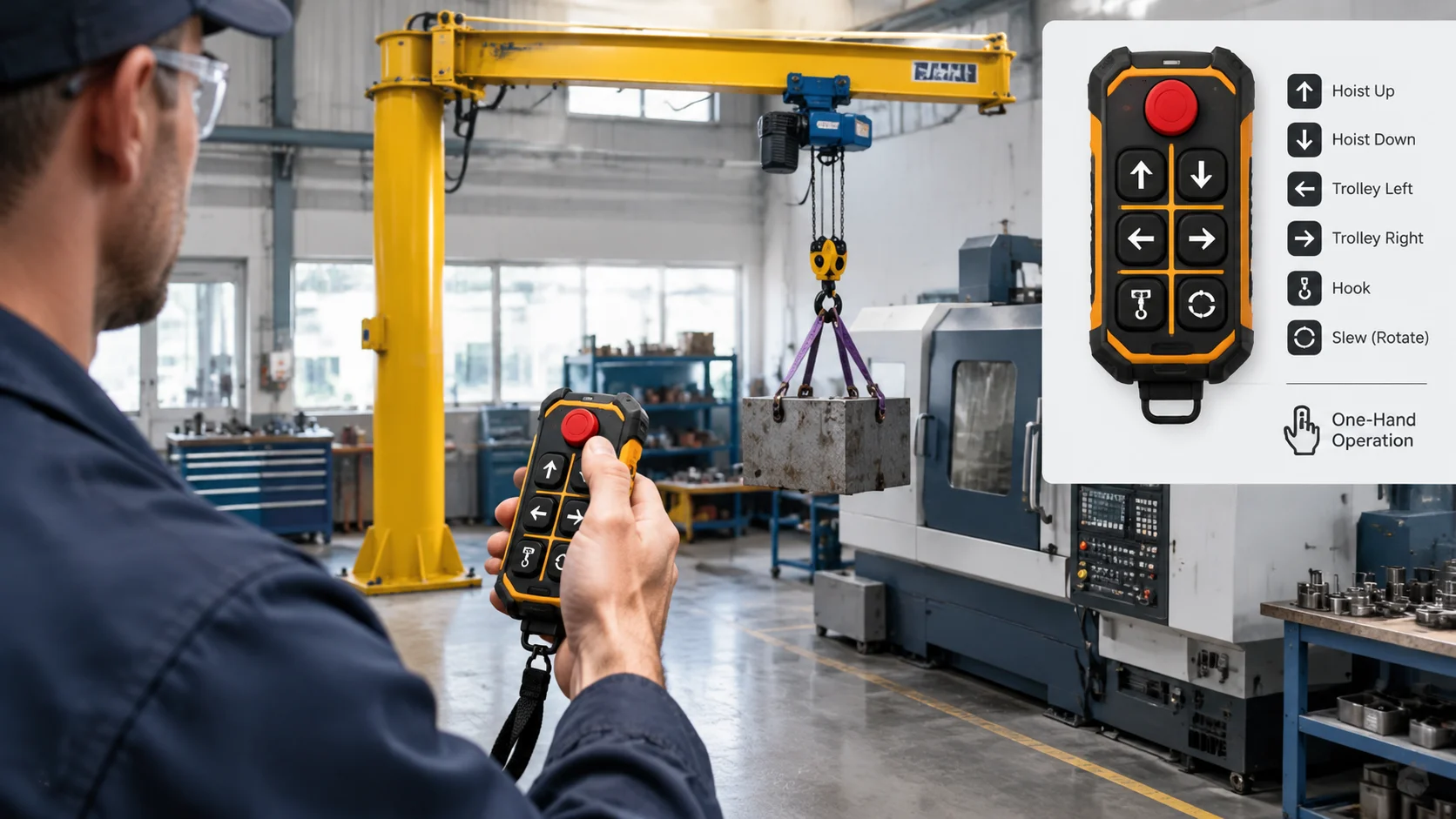
Whichever shape you settle on, the count comes first: two buttons per motion, two for start and stop, one for every auxiliary circuit, which is the arithmetic behind sizing a station by button count. A four direction station such as the COP-5MSS pendant control switch is the wired equivalent of that layout, useful where a jib keeps its cable and only the button count changes.
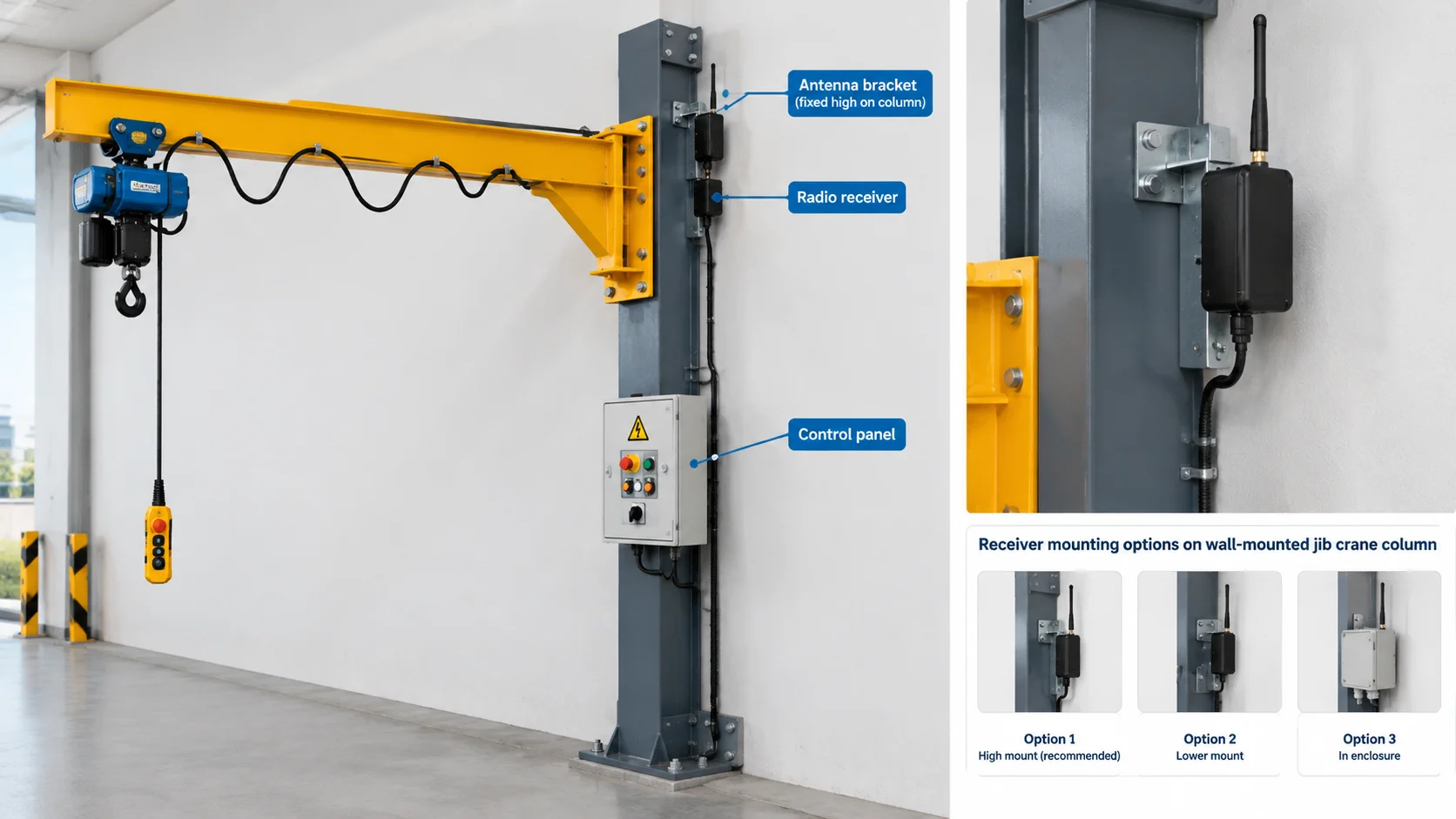
This is where most jib installations get untidy. The receiver has to reach the control panel, which is usually at the base, but the antenna works best high and clear, which is at the top of the column. Three arrangements cover almost every case.
Option two is the one that fails after a year, because a cable looped through a slew axis is a fatigue failure waiting for a busy shift. If the panel genuinely has to live on the arm, ask the panel builder about a slip ring before the receiver is ordered, not after. That small-conversion logic stops holding once the machine has turnouts or several trolleys on one runway, which is exactly where monorail and light rail crane control begins.
Wiring a receiver into a jib panel is the same job as any pendant-to-radio retrofit: the receiver’s outputs go in parallel with the pendant’s contacts, the control voltage has to match, and the stop circuit has to be dealt with deliberately. A jib crane remote control conversion is usually the cheapest place to start, because on a workshop hoist there is plenty of space and the cable runs are short. The chain hoist remote control upgrade guide walks through the sequence on a hoist panel, and the wiring logic is identical on a jib. Where the jib keeps a panel rather than a handset, a monolever switch in 2-way or 4-way format is the compact way to get the same motions from a 30 mm cut-out.
Jib enquiries are short, so a supplier who receives a clear one can quote the same day. A jib crane remote control quoted against these eight lines arrives with no open questions.
| Line | What to state |
|---|---|
| Crane type | Fixed, slewing or wall-mounted jib; capacity and hoist model |
| Actions | Numbered list of motions and functions, plus speed steps |
| Control voltage | From the panel transformer, or a photo of the nameplate |
| Existing control | Pendant button count and whether it stays as a backup |
| Stop circuit | Whether the stop is a separate loop or part of the common control circuit |
| Environment | Indoor workshop, washdown area, cold room or outdoor yard |
| Mounting | Where the panel is, and whether the arm rotates |
| Spares | Whether a second transmitter or a battery pack should be included |
Two or three units cover the whole range of answers. The F24-8S / 8D wireless remote control suits slewing jibs with dual-speed hoists, and the wider crane remote control systems range covers the smaller fixed-jib cases and the versions with held-on functions. If you are unsure which of the eight lines above you can answer, send us a photo of the panel and the pendant through the contact page and we will fill the gaps with you.
No. The operator works within a few metres of the load, so almost any industrial unit will have surplus range. Spend the difference on a better button layout and a spare battery instead.
Yes, and it is the usual arrangement on jibs. The receiver’s outputs are wired in parallel with the pendant contacts, so both stay usable. Leave the pendant connected as the maintenance backup.
Then any cable between the base and the arm must be routed through a slip ring or a properly sized cable loop. Plan this before ordering a receiver that has to be mounted on the rotating arm.
For a single-speed hoist with slew, yes: up, down, left, right. Add two more outputs if the hoist has two speeds, and one or two if there is a vacuum lifter or a light.
Only if the receivers are configured for it deliberately. Two receivers that both accept the same transmitter will both respond, which is a hazard rather than a feature unless the pairing is managed. Ask the supplier to lock each receiver to its own transmitter.