Pendant Control Station Wiring: Cores, Common, Earth
Cores follow functions, not buttons. The sum that sizes the cable, why the stop must not share the button common, and five pre-power checks.
Read More

A tandem lift puts two hoists under one load and asks a radio link to keep them together. That is a mechanical problem wearing a radio costume. The radio contributes a few tens of milliseconds of jitter, the mechanics contribute everything else, and a system that works perfectly in a supplier’s workshop can still put a spreader beam out of level on a real crane.
This guide defines what counts as a tandem lift, sets out three ways to control two hoists from one crane remote control, and gives the pairing, interlocking and acceptance points to settle before the first lift.

Two arrangements get called tandem and they behave differently. The first is one crane with two hoists, often a double-girder machine with a main and an auxiliary drum. Both drums are on the same bridge, so travel and cross-travel are shared and only the hoists have to be coordinated. The second is two separate cranes lifting one load between them, which adds independent travel, independent bridge alignment and two operators’ worth of coordination.
The distinction matters because the second arrangement has a failure mode the first does not: the cranes can move apart. A radio system that synchronises hoist speed but not bridge position solves half the problem only, and the lift plan has to say who owns the other half.
There are three practical ways to get one operator driving two driven points, and they carry different failure consequences.
| Architecture | How it works | Strength | Limitation |
|---|---|---|---|
| One transmitter, two receivers in tandem mode | A single transmitter address is accepted by two receivers, each driving one hoist | One operator, one set of buttons, identical commands to both | Both receivers must be linked; if one drops, the other may keep running unless interlocked |
| One transmitter, one receiver, two output groups | A single receiver wired to two contactor groups | Simplest electrically; one link to lose | Suits a single crane with two drums, not two separate cranes |
| Two transmitters with a coordination link | Two operators, each on their own unit, with a supervisory signal or a single enable | Two viewpoints, useful for long loads | Adds a human coordination failure mode on top of the radio one |
The first architecture is what most tandem enquiries actually need, and it is where the interlocking question must be answered explicitly. One transmitter driving two receivers means no independent control, which is the point, but the system must treat a silent receiver as a stop condition rather than a partial failure.

Buyers often assume the radio is the error source. It is the smallest one. In practice the error budget is dominated by mechanics.
Link latency and jitter. Each receiver decodes and acts on a message independently, so the two hoists never start on the same microsecond. The gap is small, typically milliseconds, and it stays constant rather than growing with load.
Brake release time. A hoist moves when the brake opens, not when the contactor closes. Two brakes with different wear or adjustment open at different times, and that difference can be an order of magnitude larger than the radio jitter. It is also the term that drifts over a machine’s life, which is why a pair that was level last year is not level now.
Drive and motor response. Two motors with different load, different rope stretch or different drive ramps accelerate differently. On a variable-speed machine the ramp settings have to match, and on a two-speed machine the high-speed transition timing has to match.
Load redistribution. As one end rises faster the load shifts toward the other, changing tension and therefore stretch. A tandem lift is a coupled system, and the coupling feeds error back into itself.
The practical instruction is to stop trying to buy a synchronisation accuracy figure and start measuring the outcome you actually care about, which is the level of the spreader beam under load. The radio response figures you will be quoted are covered in crane remote control response time.
Tandem mode is a configuration, not a feature that exists by default. Set it deliberately and write down what it does.
Step six fails quietly: a receiver left in a permissive pairing state accepts a transmitter that should not be talking to it, and the symptom is a crane doing something nobody commanded. Rules for keeping units separated are in two transmitters controlling one crane.
This is a contractual question more often than a technical one. The supplier can state what the radio contributes and how the receivers are configured. Nobody can state what two used hoists will produce under a particular load, and any millimetre guarantee offered on site is a guess.
What should be documented is narrower and more useful: the configured behaviour, the measured level under a defined test load, and the tolerance for that test. The appointed person signs the tolerance; the supplier signs the configuration. Each party is then accountable for what it controls.
Use this table to close out a tandem enquiry or a pre-use check. Every row should have a name against it before the first lift.
| Item | What to confirm | Evidence |
|---|---|---|
| Receiver count and channel assignment | Both receivers bound to one transmitter, no spare bindings live | Configuration record, photographed |
| Loss-of-link behaviour | Either link dropping stops both hoists | Physical test with the load just clear of the floor |
| Emergency stop scope | Stop button stops both ends, or the plan states otherwise | Test record signed by the appointed person |
| Speed and ramp match | Both drives set identically, brake release times measured | Maintenance measurement, not a visual check |
| Spreader level under load | Within the tolerance stated in the lift plan | Measurement at the stated test load |
| Adjacent unit isolation | Neighbouring transmitters cannot drive either receiver | Attempted unauthorised pairing test |
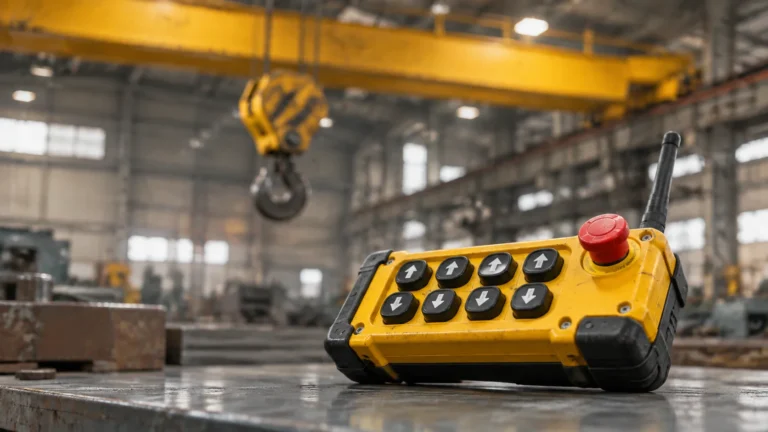
For a one-crane two-drum machine, the receiver configuration is usually the deciding item and a single unit with two output groups is adequate. For two separate cranes, the transmitter and receiver pairing becomes the critical path, and it is worth specifying a unit with an explicit tandem mode rather than relying on two units that happen to share a channel. A twelve-button controller such as the F24-12S 12D remote controller covers the usual tandem pushbutton count, while joystick layouts suit machines where proportional travel is part of the lift.
If the tandem pair is being specified from scratch, send the hoist count, the load, the level tolerance in the lift plan and whether the cranes share a bridge. We will confirm which architecture fits and what the receivers need to be configured to do. Start from the industrial crane remote control system page or send the lift details directly.
Yes, if the receivers are configured for tandem operation so that one transmitter address is accepted by both. The configuration must also make loss of either link stop both hoists, which is a setting rather than a feature that exists automatically.
The radio contributes milliseconds of difference, which is far smaller than the differences from brake release timing, drive ramps and rope stretch. Measure the level of the spreader beam under a defined test load rather than asking for a synchronisation accuracy figure.
It should stop both hoists. If the system is configured so that only the affected hoist stops, one end of the load keeps moving and the other does not, which twists the beam and shifts the load. Confirm this behaviour by test before the first lift, not by reading the manual.
Common is the safer default, because the operator’s instinct in an emergency is to hit one button and expect everything to stop. Making it common is an electrical wiring decision, so it has to be specified before the panel is built.
It is done for long loads where two viewpoints help, but it adds human coordination on top of the technical problem and needs a clear rule about who is in charge. A single transmitter bound to both receivers is easier to control and to audit.