Pendant Control Station Wiring: Cores, Common, Earth
Cores follow functions, not buttons. The sum that sizes the cable, why the stop must not share the button common, and five pre-power checks.
Read More

A used crane remote control is one of the few industrial purchases where the visible condition tells you almost nothing. A unit can look clean, power up, drive a crane in the yard and still be a poor buy, because the parts that decide its remaining life are inside the housing and the paperwork that decides its legality is usually missing.
This guide covers the three kinds of second-hand unit on the market, the six checks that separate a good buy from a liability, what to do when the model is discontinued, and the cases where used genuinely costs more than new.
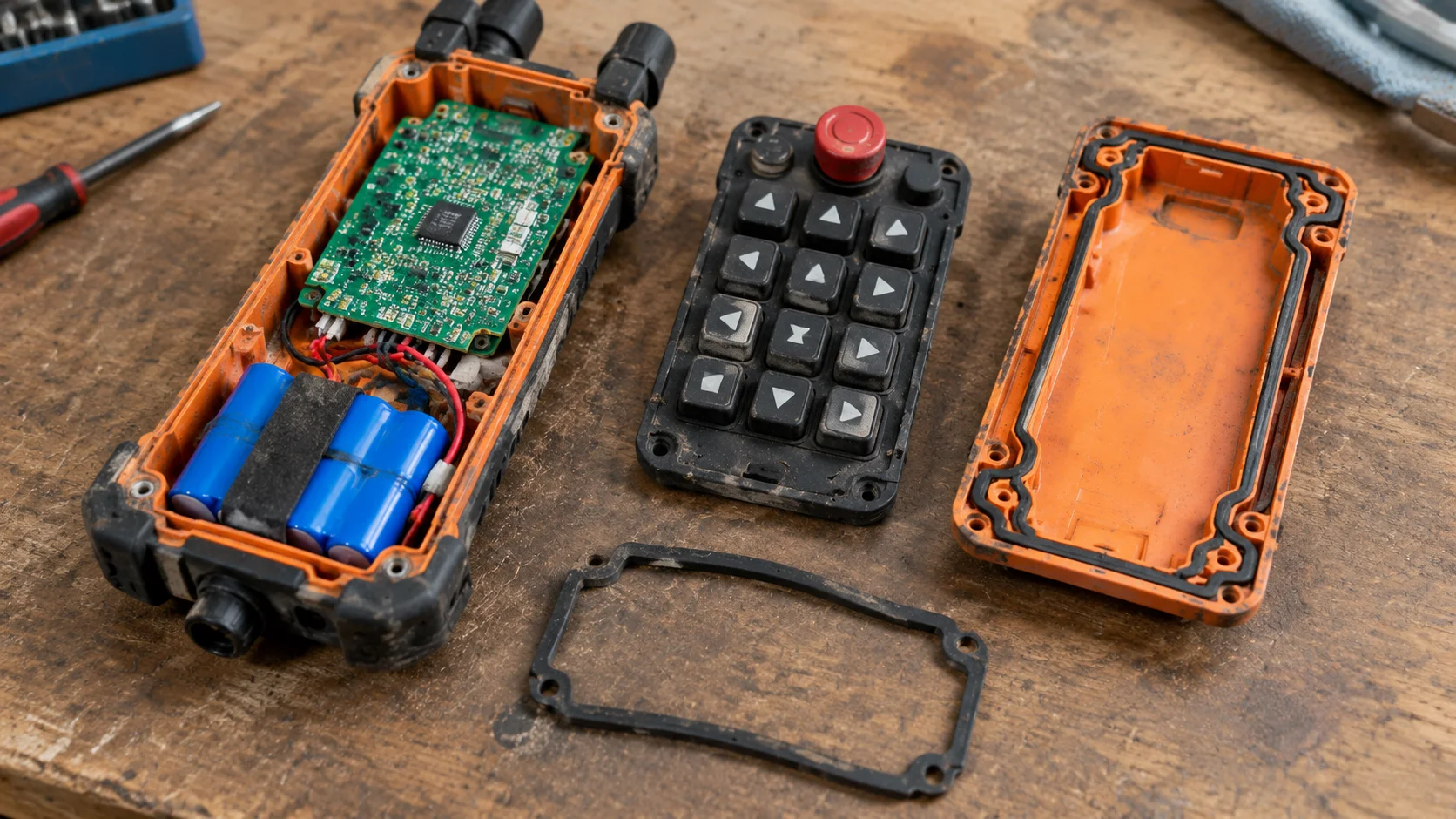
The word used covers three very different products, and sellers rarely distinguish between them.
Salvage or pulled units. Removed from a decommissioned crane, sold as-is. The honest version of this trade, and the risk is unknown history: it may have been pulled because it was faulty, and the fault may be intermittent.
Refurbished units. Salvage that has been opened, cleaned, re-gasketed and tested. Quality depends entirely on what “refurbished” meant. Replacing a gasket and wiping the case is not refurbishment; replacing relays, the battery pack and the antenna connector is. Ask which parts were replaced and get it in writing.
Clones and copies. New-built units that imitate a well-known model. They look right, they often work, and they are the highest-risk category, because the imitation usually stops at the enclosure. The radio coding may be weaker, the relay ratings optimistic and the certification marks printed rather than earned.
These are ordered by how often they decide the outcome rather than by how easy they are to check.
| Check | What to look for | Why it matters |
|---|---|---|
| Housing date and batch | Moulded date clock or label batch code inside the case | Gives real age, which the seller’s description rarely does |
| Pairing headroom | Whether the code is fixed at manufacture or configurable, and how many transmitters can bind | Fixed-code units cannot be secured and cannot be re-paired to a new receiver |
| Relay condition | Contact resistance and pitting on the output relays | Relay life is consumed by operations, not by years, and it is the usual cause of intermittent motion |
| Battery pack | Chemistry, manufacture date, measured capacity under load | A pack at end of life costs a replacement and may have damaged the charging circuit |
| Oscillator ageing | Whether the unit still sits on frequency, and whether the receiver has had to be re-tuned | Crystal drift shows up as reduced range that no amount of antenna work fixes |
| Firmware and protocol | Version, and whether it matches the receiver you intend to use | Mismatched versions can pair and then behave unpredictably |
The pairing check is the one buyers skip and the one that decides whether the purchase is usable at all. A unit with fixed coding is permanently tied to its original receiver, so buying the transmitter alone is worthless, and buying a used pair with fixed coding means every other unit in the yard that shares that code can drive your crane. How to read the specification sheet for these details is covered in how to read a crane remote control datasheet.
Most used purchases are driven by a discontinued model rather than by price. A crane has twenty years of life, a remote control has eight to twelve, and the second or third replacement is where the original model has disappeared.
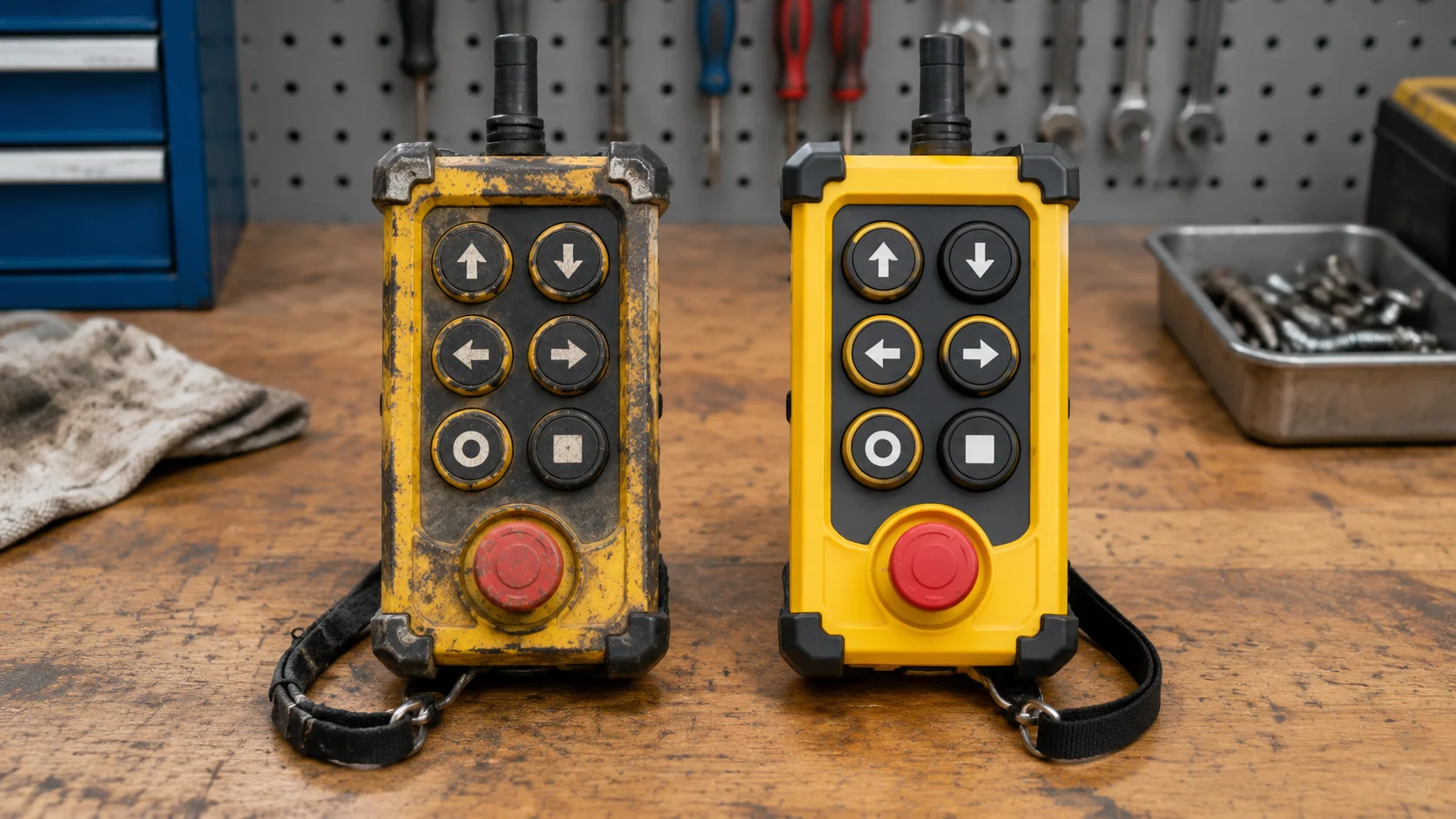
There are three paths and they are not equally good. Replacing like for like from remaining stock buys time and no future. Retrofitting a current model to the existing receiver is cheapest when the protocol is compatible, and impossible when it is not. Replacing transmitter and receiver together is the only path that resets the clock, and it is usually the right answer once the receiver is more than a decade old.
The practical constraint is the button layout, not the radio. Operators work from muscle memory, and a replacement that moves the hoist button will cause incidents in the first week. Match the layout first, then the electrical interface, then the radio. Where a third-party unit is being matched to an existing installation, the correct wording is compatible with or replacement for the original model, and the responsibility for verifying that compatibility sits with whoever specifies it. The considerations are set out in replacement units for Telecrane-compatible installations.
If the crane is otherwise sound and only the remote is obsolete, the economics usually favour a new matched pair over hunting for a second-hand original. A current industrial wireless remote control with a documented configuration is easier to support for the next decade than a fifteen-year-old unit with no spares.
Four situations make a cheap used unit the expensive choice, and they are worth checking before price becomes the deciding factor.
Spares that no longer exist. A unit is only as good as its consumables: gaskets, battery packs, antenna connectors, keypads. If none of these are available, the first wear item ends the unit’s life. Ask for a spares list and current availability before buying, not after.
Undocumented repairs. A unit that has been repaired without a record may have been re-wired to a different output arrangement, which will behave correctly in test and incorrectly under load. If the seller cannot describe the repair history, assume there is one.
Certification that cannot be evidenced. For equipment in a regulated site, or equipment being exported, the approval documents have to be traceable to the unit, not just to the model. A used unit with no paperwork may be perfectly functional and still unusable on a project that requires the file.
Insurance and inspection rejection. Many sites require lifting accessory and control equipment to be inspected and recorded. A used unit with no history is hard to put through that process, and the labour of doing so can exceed the saving. The wider economics of repair versus replace are set out in crane remote control spares strategy. The same checks, run in a fixed order and written down, are what acceptance testing on new equipment formalises — including the link-loss test that used units rarely get.
An inspection that consists of pressing the buttons in a car park proves nothing. Run it in this order, and stop at any failed step rather than negotiating a discount.
Step four is where most used purchases fail, and it fails late, after money has changed hands. Doing it before payment turns an argument into a decision.
If the honest answer to the inspection is that the receiver is also at end of life, price a matched transmitter and receiver instead of another round of used parts. Send the existing model, the button layout and the output arrangement, and we will confirm what is directly compatible and what needs a re-wire. Start from the industrial crane remote control system page or send the existing unit details.
Only if the refurbishment replaced the consumable parts, not just the gasket and the cosmetics. Ask specifically about output relays, battery pack and antenna connector. A unit that has had those replaced and been tested under load is a reasonable buy; one that has been cleaned is a used unit with a new label.
Only if the coding is configurable and you can perform the pairing. Units with fixed coding are permanently bound to their original receiver and cannot be transferred. Confirm the coding type before purchase, because this is the check that most often turns a bargain into scrap.
Eight to twelve years is typical for industrial use, with the relay contacts and the battery pack usually limiting life before the radio does. A unit stored indoors and used lightly lasts longer than the same model on a foundry crane, so hours and environment matter more than calendar age.
The enclosure usually imitates well and the radio does not. Weaker coding means other transmitters may be able to drive your receiver, and optimistic relay ratings mean the outputs may not survive the crane’s actual contactor load. Clones also carry certification marks they have not earned, which becomes a problem at inspection or export.
Repair while spares exist and the receiver is sound. Once the receiver is over a decade old and the model is discontinued, replacing transmitter and receiver together is usually cheaper over the next five years than chasing parts, and it restores a documented configuration.