Pendant Control Station Wiring: Cores, Common, Earth
Cores follow functions, not buttons. The sum that sizes the cable, why the stop must not share the button common, and five pre-power checks.
Read More

Most range complaints on a crane remote control end with somebody suggesting a bigger antenna. That is sometimes right and often wrong, because an antenna does not add signal so much as redistribute it, and the cable that connects it can give back every decibel the antenna earns.
This guide covers what an antenna choice can and cannot change, the real difference between internal and external types, three ways to mount an external antenna, and the cable arithmetic that decides whether the whole exercise is worth doing.
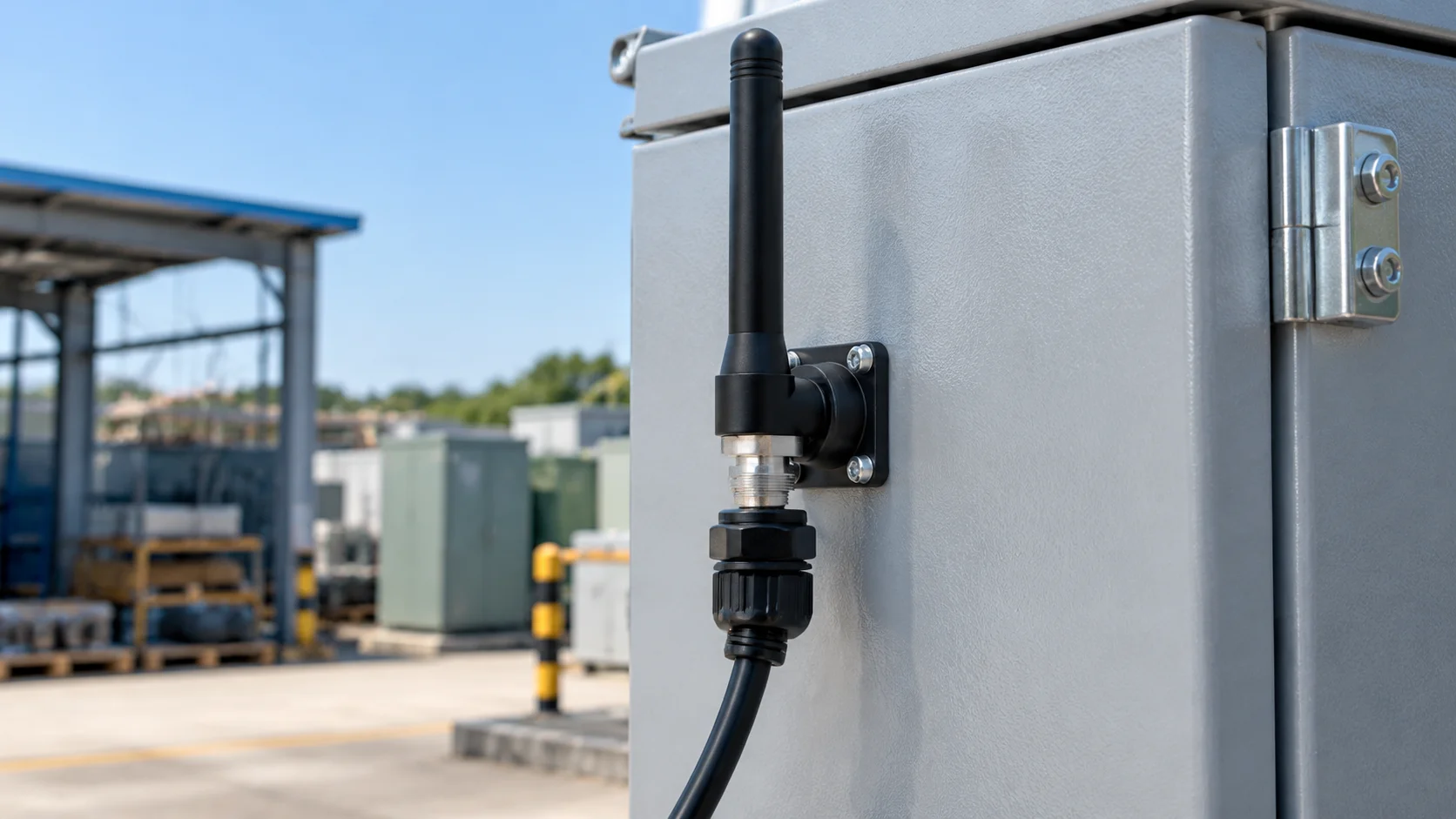
Antenna gain is not amplification. A 5 dBi antenna does not create 5 dB of power, it reshapes the pattern so that more energy goes in some directions and less in others. Compared with a simple dipole, a higher-gain vertical antenna squeezes the pattern flatter, which extends reach along the horizon and reduces it above and below.
That is useful for a crane receiver mounted at height with the operator on the floor, and it is unhelpful for a receiver that has to hear an operator standing almost underneath it. Gain is a shape decision, and the shape has to match the geometry. The other thing an antenna position changes is polarisation: two vertical antennas hear each other well, and a vertical talking to a horizontal loses a large part of the signal regardless of gain figures.
The choice is usually presented as aesthetic. It is really a trade between protection and placement freedom.
| Type | Advantages | Penalties | Best used when |
|---|---|---|---|
| Internal, inside a plastic housing | Nothing to damage, nothing to break off, no connector to corrode | Enclosure and hand attenuate the signal; no freedom of position | Short-range pendant-style work and handheld transmitters |
| Internal, inside a metal cabinet | Protected and tidy | The cabinet is a shield. This is the single worst antenna arrangement on a crane | Never, if range matters |
| External, direct-mounted on the enclosure | Outside the shield, short cable, replaceable | Exposed to impact and to the antenna connector corroding | Most fixed receivers in workshops and yards |
| External, remote-mounted on a bracket | Height and clearance from steel, can clear an obstruction | Cable loss, more joints, needs surge protection on long runs | Tall structures, dense steel, container yards |
The metal cabinet row is worth stating plainly because it is a common installation error. A receiver bolted inside a steel enclosure with its antenna still attached will work in the workshop and fail in service, and the fault is often misdiagnosed as a weak transmitter for months.
Once the antenna leaves the enclosure there are three practical arrangements, and the difference between them is where the loss and the risk sit.
Whichever is chosen, mount the antenna vertically, keep it clear of metal by at least a quarter wavelength where the structure allows, and route the coax away from drive cables rather than alongside them.
Coax loss is quoted in decibels per metre and it is frequency dependent, roughly doubling each time the frequency quadruples. Thin general-purpose cable runs around 0.6 to 0.7 dB per metre at 433 MHz and over 1 dB per metre at 2.4 GHz. Low-loss cable of the same physical size class runs nearer 0.2 dB per metre at 433 MHz.
The number that matters is that about 6 dB costs half the usable range in free space. So ten metres of thin cable at 433 MHz, around 6 dB, halves the range before the antenna has done anything at all. If the point of the exercise was to gain 3 dB from a better antenna, the cable has just removed twice that.
| Arrangement | Typical cable loss | Verdict |
|---|---|---|
| Antenna direct on receiver bulkhead | Under 0.5 dB | Always preferred where geometry allows |
| 2 m pigtail, thin cable, 433 MHz | Around 1.3 dB | Acceptable; the position gain usually exceeds it |
| 10 m run, thin cable, 433 MHz | Around 6 dB | Halves range. Only justified by a real obstruction |
| 10 m run, low-loss cable, 433 MHz | Around 2 dB | The correct way to remote-mount |
| 10 m run, thin cable, 2.4 GHz | Over 11 dB | Pointless. Use low-loss cable or move the receiver |
Two further decibels hide in the connectors and the joints. Every additional adapter costs a fraction of a decibel, and a corroded one costs much more, which is why an external antenna needs a sealed connector, a cap when unused and dielectric grease at assembly. The broader limits of any radio link are covered in industrial remote control operating distance.
Antenna placement is mostly about what is near it. Three rules cover most installations.
Keep the antenna away from variable frequency drives and their motor cables, which radiate broadband noise that the receiver front end cannot reject. A metre of separation is a minimum and more is better, and the coax should not share a trunking with motor cables.
Keep the antenna clear of large vertical steel. A crane leg or a column close to the antenna distorts the pattern and can create a null in the direction the operator actually stands. Moving the antenna half a metre sideways often fixes a dead spot that no amount of gain would fix.
Mount it high enough to clear the obstacle the link has to cross. In a yard that means above container height where the structure permits, and on a tall crane it means at or near the top of the structure rather than at the drive panel.

These solve different problems and choosing wrongly wastes money. An antenna change redistributes signal in space. It helps when the operator is in a direction the current antenna under-serves, when the antenna is badly placed or shielded, or when the cabling is losing what the antenna provides.
It does not help when the path is blocked. If the link has to get around a corner, through a wall of stacked steel or from one bay into another, no antenna shape will bend the signal into the shadow, because there is nothing to shape. That is a coverage problem, and the answer is a second receiver point that relays the link. The arrangements for doing that are set out in crane remote control signal repeater.
If the receiver position and the cable are both already sensible and the link still fails in one specific place, measure before buying hardware. If the failure moves when the antenna moves, it is a pattern or reflection problem. If it does not move at all, it is blockage, and a repeater is the answer.
For a receiver that needs a remote antenna from the start, a unit designed for an external connector saves the retrofit. The F24-10S 10D wireless remote control is commonly installed with an external antenna in yard and portal applications. Tell us the receiver height, the operator’s usual position and the distance between them, and we will confirm the antenna arrangement and cable type. Start from the industrial crane remote control system page or send the site layout directly.
It can extend reach along the horizon, which suits a receiver at height with the operator on the floor. It will not help an operator standing directly underneath, because a high-gain vertical antenna radiates less energy in that direction. Gain reshapes the pattern rather than adding power.
Not in a metal cabinet. The enclosure shields the antenna and the link will be short and unreliable. If the receiver has to live in a steel enclosure, fit a bulkhead connector and mount the antenna outside.
Length is limited by loss rather than by a fixed rule. Aim to keep total loss under about 3 dB, which allows a long run only with low-loss cable. Roughly, 6 dB of cable loss halves the usable range, so a long run of thin cable is worse than no external antenna at all.
The transmitting and receiving antennas should share the same orientation. If the transmitter is held vertically, mount the receiver antenna vertically. A mismatch costs a significant part of the signal and is easy to avoid.
When the failure is caused by blockage rather than by weak signal in a direction the antenna could favour. If the link has to reach around a corner or through dense steel, a second relay point is the only thing that works, because an antenna cannot direct energy into a shadow.