Pendant Control Station Wiring: Cores, Common, Earth
Cores follow functions, not buttons. The sum that sizes the cable, why the stop must not share the button common, and five pre-power checks.
Read More

A crane remote control that used to run a full week between charges and now runs a shift is not usually a failing transmitter. In most cases the pack has aged, the charging habit has damaged it, or something in the transmitter is drawing current when the operator believes it is off. The transmitter is the last thing to replace, not the first.
This guide separates the four causes of fast battery drain, shows how to tell them apart with a multimeter in about twenty minutes, explains why cold storage and charging practice matter more than the pack itself, and sets out a battery standard that stops the same complaint returning across a fleet.
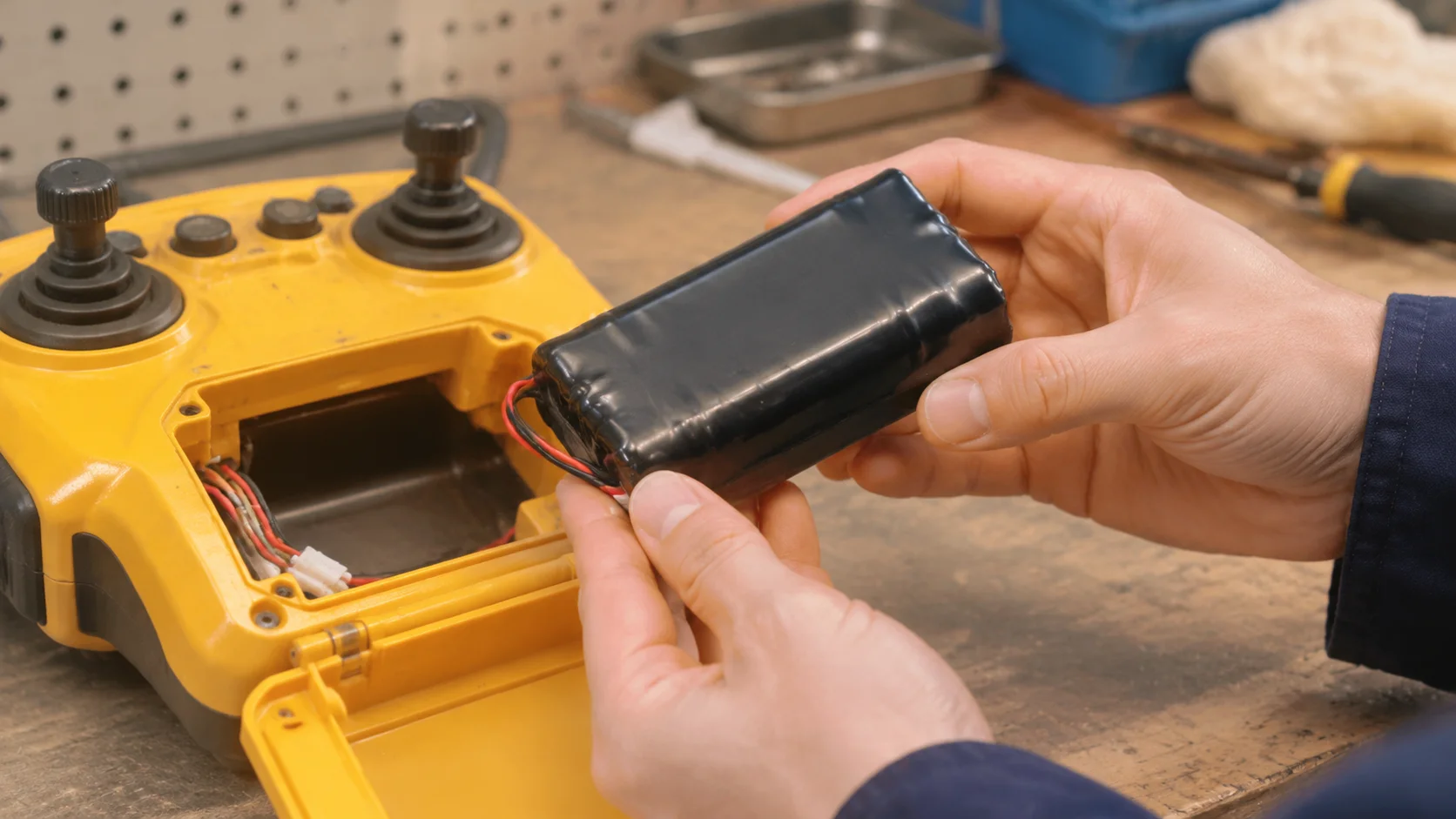
An industrial transmitter is idle most of the time. The radio transmits in short bursts when a button is pressed, the display and backlight are the largest steady draw, and the receiver is powered from the crane so the transmitter carries none of that load. A healthy pack therefore delivers a long standby period plus a comparatively short period of active use.
Which means the honest baseline is not “how long does it last” but “how many hours of button-pressing does it deliver”. A site that runs two shifts of constant hoist work will legitimately consume a pack much faster than a site that uses the same crane for occasional lifts, and comparing the two is how a normal pack gets replaced for no reason.
Write the baseline down when the unit is new: shift pattern, pack model, charge routine, and how many days a full charge lasts. Without that number, every later complaint is an opinion.
Once the baseline exists, a sudden drop in runtime falls into one of four patterns, and each has a different fix.
| Cause | Typical pattern | Diagnosis | Fix |
|---|---|---|---|
| Aged pack | Gradual decline over months, warm pack after charging, shorter and shorter runtime | Runtime falls steadily regardless of duty | Replace the pack; capacity loss is not recoverable |
| Charging practice | Runtime never reaches full, pack hot after charge, swelling | Charger left connected permanently, or pack charged cold | Change the routine; replace if swollen |
| Standby leakage | Pack flat after a weekend in the cabinet with the unit switched off | Current measured with the unit off is not near zero | Dirty or worn power switch, moisture on the board, or a stuck key |
| Permanent load | Runtime fine in use, poor in standby, display or backlight always lit | Current measured with the unit on but idle is high | Backlight timeout, a display left on, or an option board drawing continuously |
The distinction that matters is between a pack problem and a transmitter problem. A pack problem shows up as reduced capacity. A transmitter problem shows up as current flowing when it should not. Both present to the operator as “the battery is bad”, and only a measurement separates them.
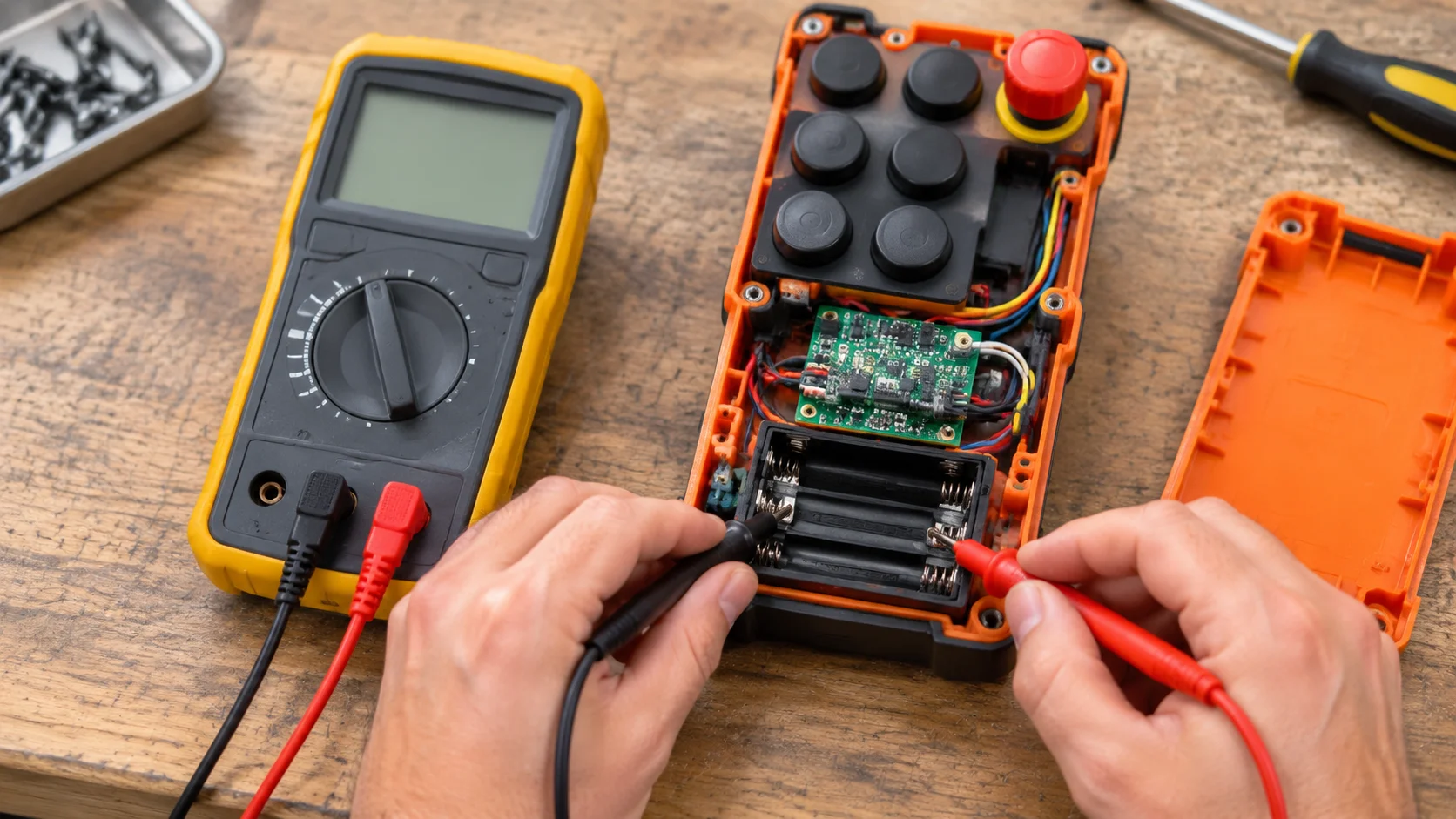
Two measurements are enough for a first diagnosis, and both can be taken at the battery contacts with the pack removed.
If the current with the unit off is not zero, stop there. The transmitter needs opening, and the usual findings are a worn power switch, moisture on the board after a washdown, or a keypad dome that has deformed and is holding a contact closed. A stuck key is worth checking first because it also explains intermittent functions, and it is the same class of fault covered in crane remote control not working.
Most of the packs that arrive as warranty complaints were damaged by charging rather than by use. Three habits account for nearly all of it.
The first is leaving the transmitter on the charger permanently. Industrial chargers are usually simple, and a pack held at full charge for weeks at a time loses capacity faster than one that is cycled. A charge cradle by the cab door with the unit never removed is the most common version of this.
The second is charging a cold pack. Capacity falls with temperature, and a charger in an unheated store will attempt to charge a pack that should not be charged at that temperature. The damage is cumulative and permanent, and it presents as a pack that never quite reaches full again. Sites with cold storage or unheated yards see this constantly, and the cold-duty considerations in cold store and freezer room remote control apply to charging as much as to operation.
The third is charging a swollen pack. A pack that has visibly expanded has vented or is about to, and continuing to charge it is a fire risk rather than a performance problem. Remove it from service immediately and do not leave it in a cab overnight.
Replacing a transmitter because of a battery complaint is expensive and does not fix a leakage fault. Work through the order below and stop at the first item that resolves the symptom.
| Step | Action | When this is the answer |
|---|---|---|
| 1 | Fit a known-good pack from another unit | Runtime returns to baseline — the pack was the fault |
| 2 | Check the charger output and contacts | The pack never reaches full, or the charger runs hot |
| 3 | Measure off-state current | Steady draw with the unit off — transmitter fault |
| 4 | Inspect the keypad and gasket for moisture or a stuck dome | Off-state draw plus one function behaving oddly |
| 5 | Replace the transmitter | Only when the housing or board is beyond repair |
On a fleet, step 1 is worth institutionalising: keep one known-good pack per site as a reference, and the first diagnosis takes five minutes instead of a purchase order.
The complaints stop when three things are standard. One pack model per transmitter family, so a spare fits any unit. One charging location that is indoors and above freezing, with a rule that units come off the charger at the end of the shift. One recorded replacement date per pack, written on the pack or in the maintenance log, so ageing is expected rather than discovered.
Standardising the pack model is the lever that also simplifies stocking, since the same spare covers every transmitter in the group. That argument is set out in crane remote control battery and spare parts planning, and it applies whether the site runs three units or thirty.
For a transmitter family where the pack, charger and spare are all interchangeable, the ten-function industrial remote control is a common reference point. If you are specifying packs and chargers for a group of cranes, send the transmitter models, the shift pattern and where the units are stored and we will confirm the pack and charging arrangement against them. Send the fleet list directly and we will mark up which units share a pack.
Long enough that the shift pattern, not the pack, is the limit. Rather than a single figure, record how many days a full charge lasts on your own duty when the unit is new, and treat a fall of more than about a third from that baseline as the point to investigate.
It should not. A correctly configured receiver drops its outputs when the link is lost, so a flat pack stops the crane rather than letting it continue. If the crane keeps moving, the problem is the loss-of-signal behaviour, not the battery.
Only if the pack matches the chemistry, voltage and charge profile the charger was built for. A mismatched pack may charge acceptably and still lose capacity quickly, and a pack without a protection circuit is a risk in a cab. Ask the supplier for the pack specification rather than matching by shape.
Because something is drawing current with the switch open: a worn switch, moisture on the board after a washdown, or a keypad contact held closed by a deformed dome. Measure the off-state current before buying a pack.
No. Store them charged but off the cradle, indoors and above freezing, and put them on charge at the start of the shift rather than the end. That single change removes most of the premature capacity loss sites report.