Pendant Control Station Wiring: Cores, Common, Earth
Cores follow functions, not buttons. The sum that sizes the cable, why the stop must not share the button common, and five pre-power checks.
Read More

A rainproof control switch is built to shed water that falls on it or sprays across it. A waterproof control switch is built to survive being under water, even briefly. On an outdoor crane those are different duties with different consequences: the first is a normal weather condition, the second is an accident or a wash-down. Choosing between them is not a matter of buying the higher number — it is a matter of deciding which failure you are actually protecting against.
This guide separates the two claims, shows which part of an outdoor control station fails first, and gives the specifying and installation points that decide whether either rating survives three winters on a mast.
Only one of these words appears in a standard. Ingress protection is defined by IEC 60529 and written as IP followed by two digits: solids first, liquids second. Waterproof is a marketing term with no fixed meaning, and rainproof is a construction description rather than a rating — which is exactly why two suppliers can both say “rainproof” and deliver hardware that behaves very differently.
The liquid digit is what matters here. IPX3 is protection against spraying water at up to 60 degrees from vertical. IPX4 is protection against splashing from any direction. IPX5 adds a 6.3 mm nozzle jet, and IPX6 a 12.5 mm jet at higher pressure. Below all of these, IPX1 and IPX2 cover only vertical dripping and enclosures tilted up to 15 degrees.
| Second digit | Test condition | What it means outdoors |
|---|---|---|
| IPX2 | Vertical drip with the enclosure tilted 15° | Sheds light rain on a sheltered wall. Not adequate for an exposed crane column. |
| IPX3 | Spray at up to 60° from vertical | Handles driving rain on a vertical face. The usual basis for a “rainproof” claim. |
| IPX4 | Splash from any direction | Survives rain blown in from below or bounced off a steel column. |
| IPX5 / IPX6 | 6.3 mm and 12.5 mm water jets | Hose-down and wash-down areas, quayside decks, food and foundry plant. |
| IPX7 | Immersion 1 m for 30 minutes | Genuinely waterproof. Relevant to flooding, not to rain. |
| IPX8 | Continuous immersion, depth by agreement | Submersible equipment. Almost never justified on a crane control station. |
Direction of attack. A pendant hanging from a festoon or cable is normally face-on to the weather. Its top face collects water and its cable entry points upward, so a rainproof design that sheds water off the front can still admit it at the top. A waterproof design has to seal that entry path rather than divert it.
Standing water. Button stations mounted on a trolley frame or a hatch cover can sit in a puddle after rain or wash-down, even though nothing is submerged. That is a horizontal-surface problem: gaskets and diaphragms must resist continuous contact, not just a passing splash.
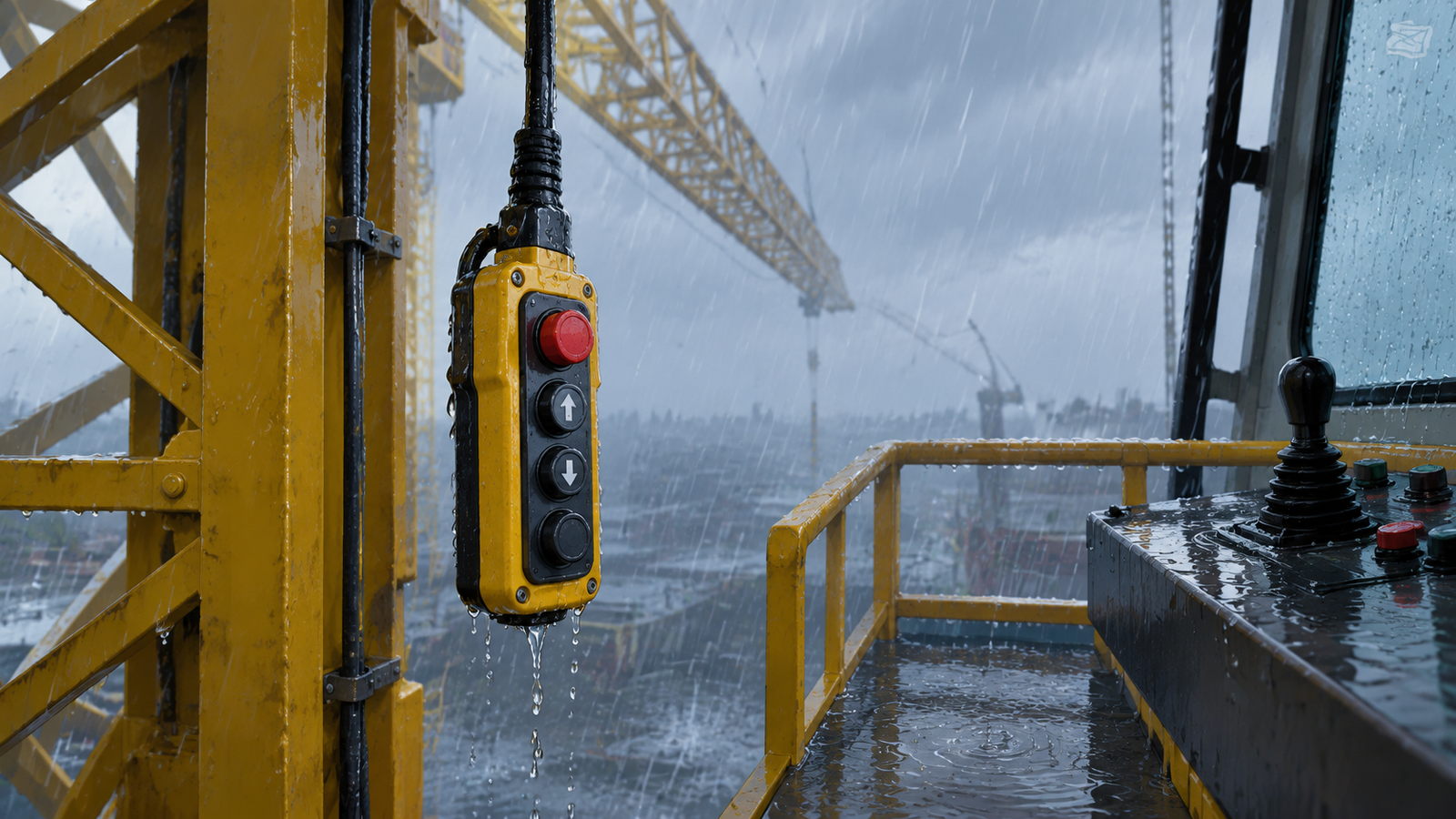
Field failures on outdoor control stations follow a short list of mechanisms. None of them are dramatic, and all of them are visible during a routine inspection if anyone is looking.
| Failure point | What causes it | What it looks like |
|---|---|---|
| Cable entry and boot | Water tracking down the cable into the gland | Corrosion on the terminal block, intermittent functions after rain |
| Gasket compression set | Years of clamping plus UV and heat | Gasket flat and hard, water film inside the lid, no visible split |
| Button diaphragm | Repeated actuation and sun exposure | Perished rubber, cracked legend, stiff or sticky button |
| Condensation | Day-night thermal cycling of a sealed box | Green corrosion on silver contacts, no external water at all |
| UV degradation | Unstabilised plastic in direct sun | Chalky surface, colour fade, brittle mounting tabs |
Only the first two are solved by buying a higher IP rating. Cable entry and condensation are solved by installation detail, and a station rated IP67 installed with the cable entry facing up will still fill with water.
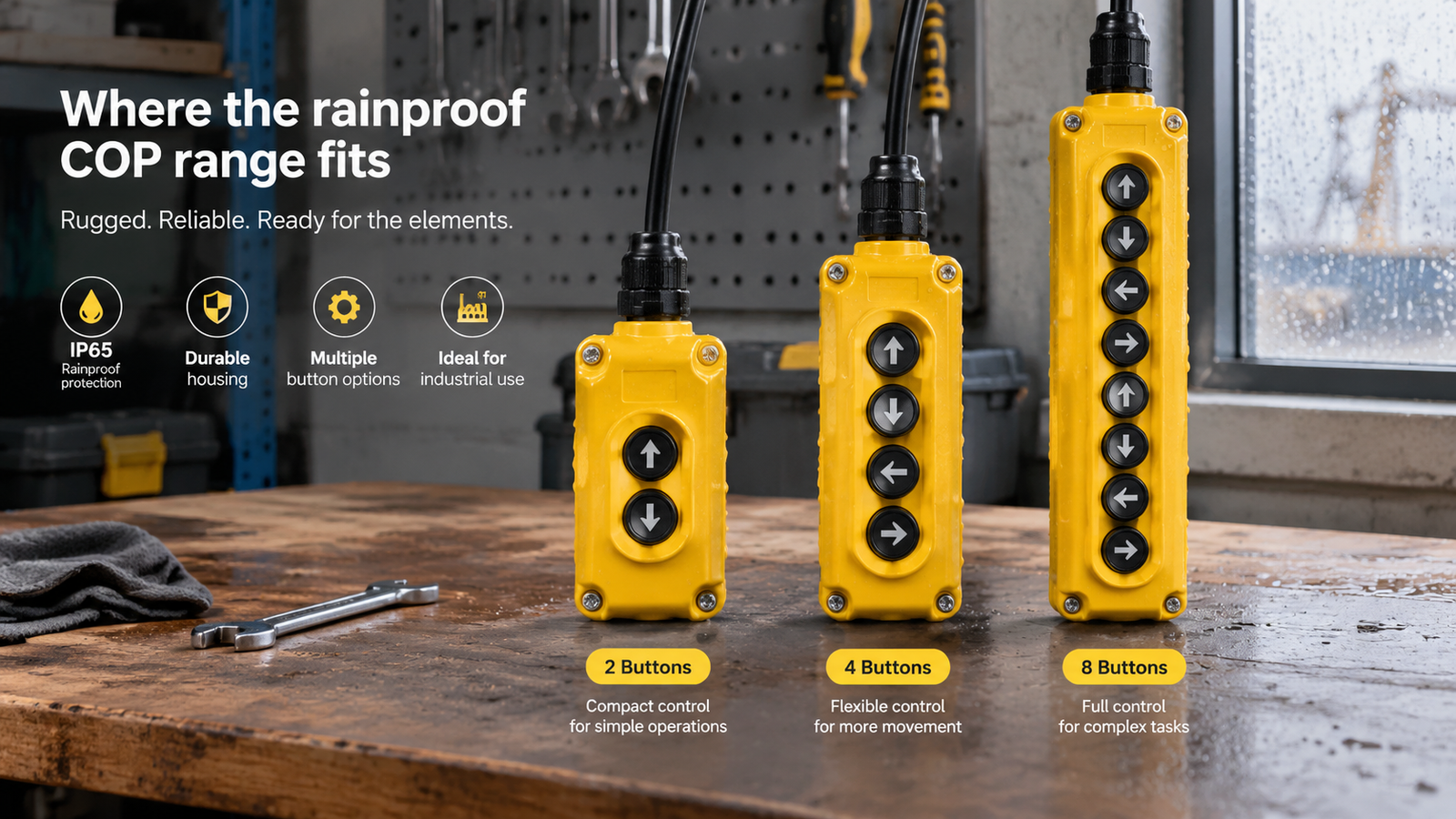
The IEHC rainproof pendant family covers three sizes of outdoor crane control station, all in a high-visibility yellow enclosure with a dark base and a moulded strain-relief cable boot at the top that directs water away from the entry.
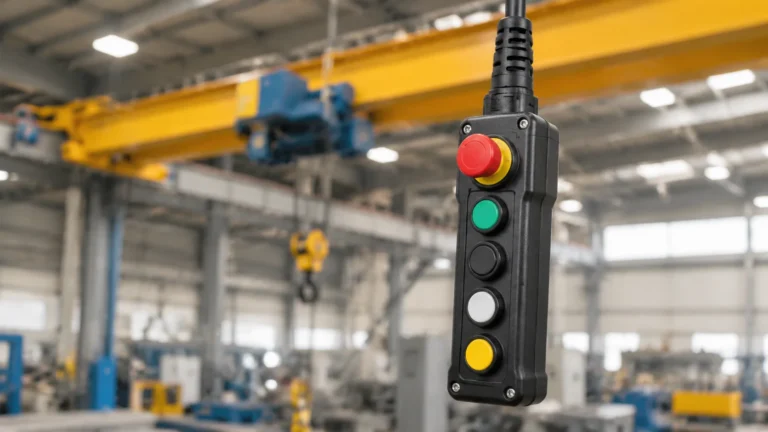
The COP-82ER rainproof control switch is the two-motion station: four actuators made up of an up and down direction button, a separate ON button and a mushroom-head emergency stop. It suits a single hoist or the lifting motion of a light crane where the operator walks with the load.
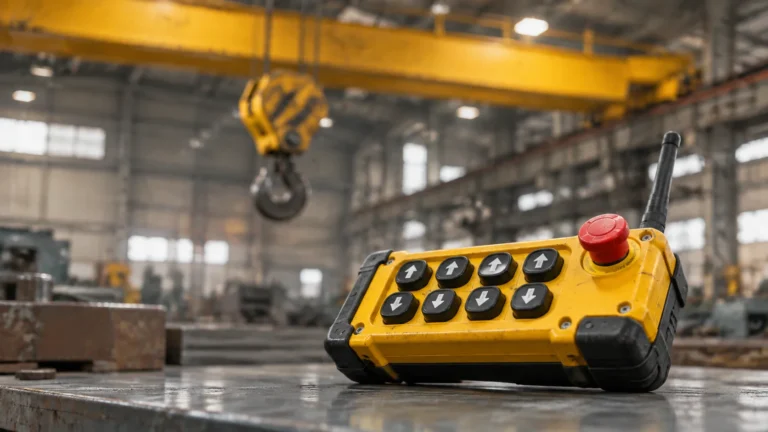
The COP-83ER adds two more direction buttons for two independent axes — long travel and cross travel, or a hoist with a separate travel drive — while the COP-84ER carries eight direction buttons in a slim body shaped to be held along the forearm, for machines with four motions plus an auxiliary axis. All three are rated 500 V, 10 A and CE marked, and all three are rainproof designs rather than immersion-rated ones. Where the duty involves continuous spray, wash-down or standing water, the ingress rating has to be confirmed against the application before ordering — a rainproof boot is not a substitute for a sealed enclosure. Within that range the COP-82 four button pendant is the four direction version, with up, down, left and right plus a stop, which matches most outdoor single girder cranes.
Where the station is being renewed rather than repaired, the sequence matters more than the part number, and replacing a worn control handle walks through isolating, marking and re-terminating without guesswork. Stations are only half of the panel story: the isolators, changeover switches and foot pedals that feed them are specified the same way and are collected in the control switch range.
Mount the station so that the cable leaves downward and forms a drip loop below the gland. Water running along a cable is the single most common route into an otherwise sound enclosure, and a loop costs nothing to form. Avoid mounting a station face-up on a horizontal surface where rain can stand; if the machine geometry forces it, fit a deflector above the station rather than relying on the gasket.
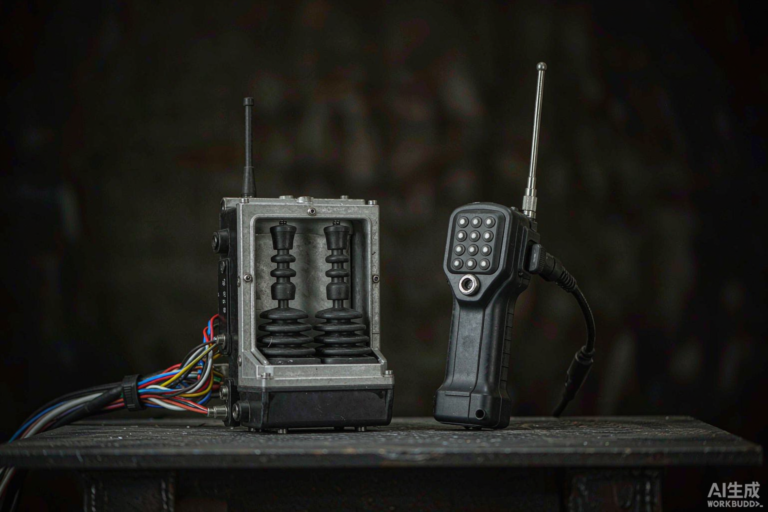
If the site is moving from pendant control to radio, the reverse of this article applies: the transmitter is the part exposed to the operator’s hands and the weather, and its enclosure rating deserves the same scrutiny as the station it replaces. The industrial remote control range lists the radio options with their protection ratings so the two can be compared directly.
Rainproof means water is diverted; waterproof means water is excluded. Buy the one that matches the water condition on your crane, ask for the IP digits rather than the adjective, and put the cable entry at the bottom. Most outdoor station failures are installation failures wearing a rating problem’s clothes.
If you are replacing an outdoor station and are unsure which rating the duty needs, send the mounting position, the exposure (rain, wash-down or standing water) and the function list through the contact form and the station can be specified against it.
No. IP65 is a defined test result: dust-tight plus protection against water jets from a nozzle. Rainproof is a construction description with no fixed value behind it. A station described as rainproof may test anywhere from IPX3 upward, so ask for the rating before comparing two suppliers.
Rarely. IP67 adds temporary immersion, which matters if the station can end up under water — flooding, a flooded pit, or a deck wash that leaves it submerged. For rain and normal wash-down, IP65 or IP66 with correct cable entry does the job. Buying IP67 will not fix a cable entry that points upward.
Condensation. A sealed enclosure heats in the sun and cools at night, and the resulting pressure change pulls damp air past the seal. The water you find is not rain that got in; it is moisture that was already in the air. Correct cable entry and a sound gasket reduce the effect, and a station with a proper breather design eliminates it.
Both, in most installations. The pendant stop is there so the operator can act without moving; the panel circuit is the machine-level safety function. The pendant contact must be designed as part of that circuit — a positive-opening contact wired in the correct category, tested at commissioning.
Quarterly is a practical baseline for a station in continuous outdoor service, with a check of the cable boot, the gasket line and the button diaphragms. Add an inspection after any event that leaves the station under water, and replace rather than reuse a gasket or boot that has hardened.