Pendant Control Station vs Radio Remote Control: Which Fits?
Pendant control station or radio remote control? Compare cost, safety, operating range and maintenance, see which fits your working conditions, and plan a hybrid setup.
Read More
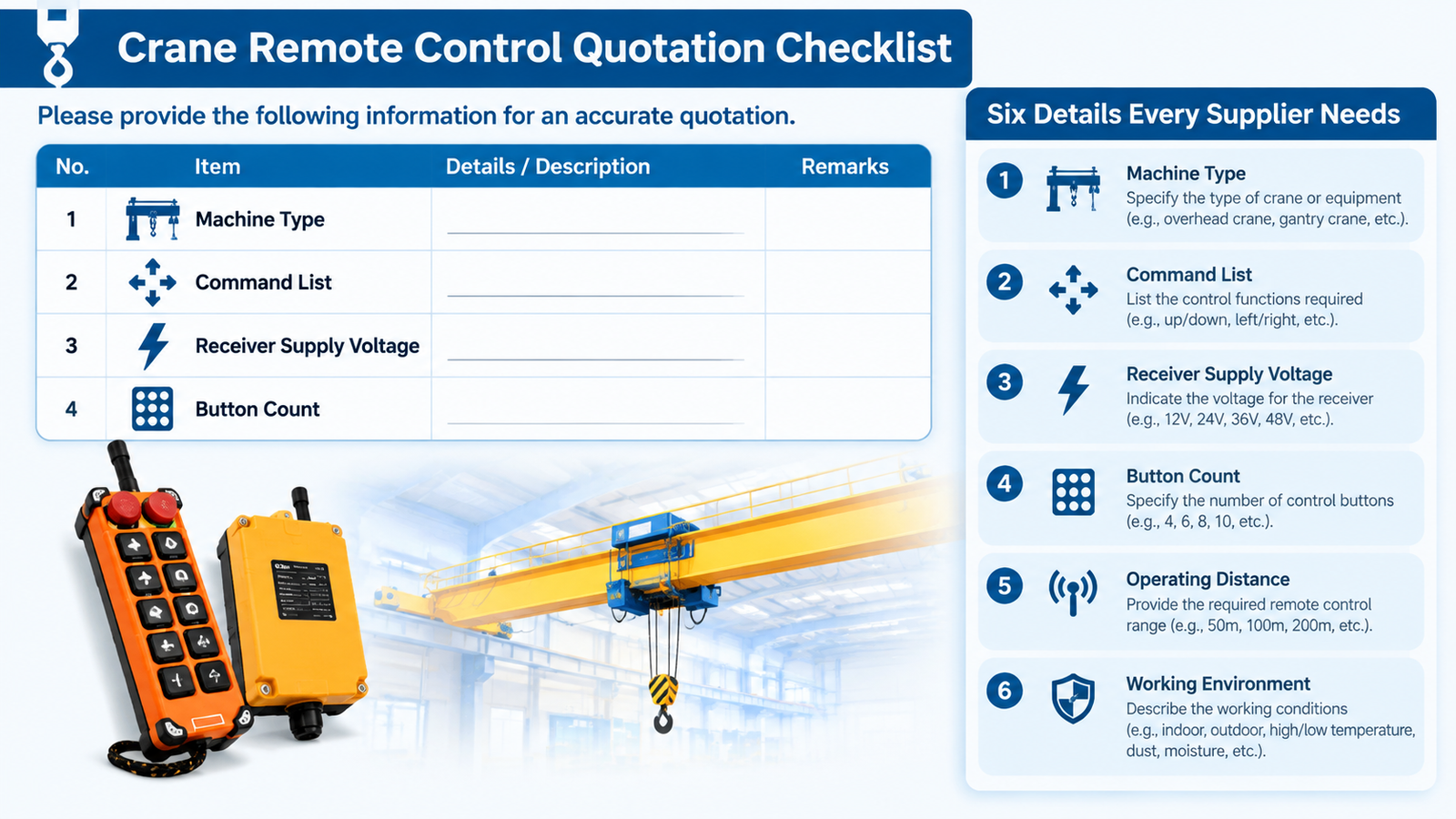
Send six details and you will get an accurate crane remote control quote on the first reply: the machine type, a complete command list, the receiver supply voltage, the button count and layout you need, the required operating distance, and the working environment. Everything else is optional and can be refined later.
Suppliers ask the same questions in the same order every time, because those six items decide which industrial remote control configuration matches your machine and what it will cost. Missing any of them turns a same-day quote into a week of email.
A remote control is not a stock item that can be priced from a catalogue page. The transmitter is configured to a button layout, and the receiver is configured to a supply voltage and a set of outputs. Two enquiries that both say “one crane remote control” can produce two completely different products.
When a detail is missing, the supplier has three options, and only one of them is helpful to you:
Treat the list below as remote control selection information rather than a wish list. Every line has a technical consequence: the command list sets the output count, and the supply voltage sets the receiver configuration. There is no way to price around a missing line, only to guess at it.
The practical effect is that complete enquiries get faster, firmer prices. That is worth ten minutes of preparation.
Machine type and lifting arrangement. State whether the equipment is a single-girder or double-girder overhead crane, a gantry crane, a jib crane, a hoist, a winch or a truck-mounted crane. Include the number of motions: hoist up and down, trolley travel, bridge or long travel, and any auxiliary function such as a grab, magnet or hatch.
A complete command list. Write out every function you need, one line each: hoist up, hoist down, trolley left, trolley right, bridge forward, bridge reverse, plus any auxiliary. Then mark each function as single-speed or double-speed, and note any commands that must be able to operate simultaneously. This single list determines the number of outputs and is the most valuable page you can send.
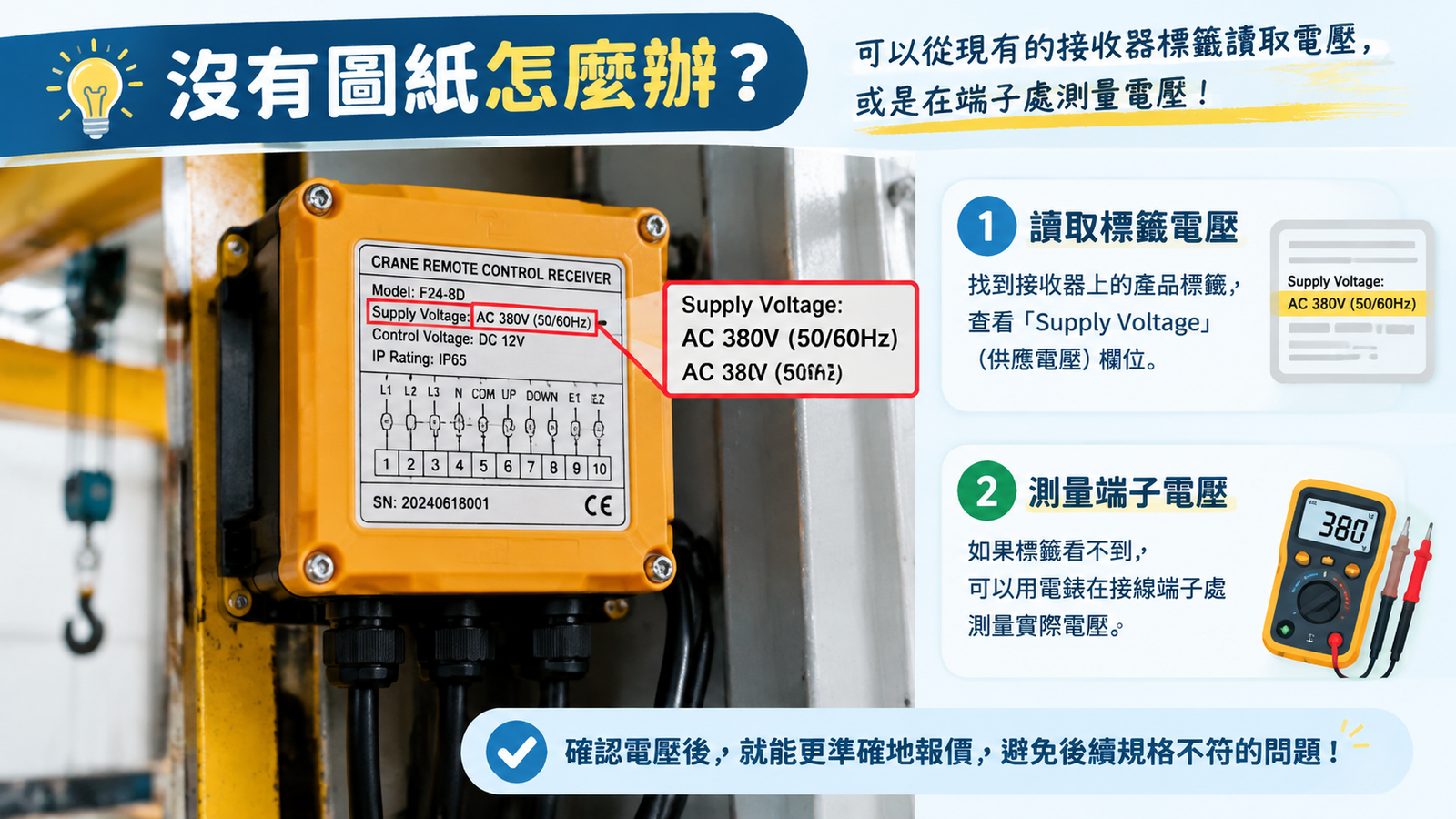
Receiver supply voltage and output requirements. Read the voltage from the existing receiver label or the control transformer, and state the type — AC or DC. Common values include AC/DC 24 V, AC 48 V, AC 220 V and AC 380 V. Also state whether the receiver must switch relay contacts into the existing contactor circuit or interface with something else. If the panel has a wide-range supply, say so; multi-voltage receivers such as the F24-12S/12D remote controller accept AC 36 V to 380 V or DC 12 V to 24 V and can remove the need for extra hardware.
Button count, layout and transmission type. Give the number of buttons and what each one should do, including start, stop, emergency stop and any selector switch. If operators wear gloves or work in low light, say so, because legend size and button spacing affect the choice. State whether you need the transmitter only, the receiver only, or a complete system.
Required operating distance. Give the real working distance in metres, not the distance you would like in ideal conditions. Say whether the operator must control the crane from the far end of a bay, from behind an obstruction, or from an adjacent floor level. Range is affected by steelwork, building shape and local radio conditions, so describing the layout is more useful than quoting a single number.
Working environment. Describe indoor or outdoor use, temperature extremes, dust, humidity, washdown, oil mist, vibration and impact risk, and whether the site is a foundry, a port, a cold store or a general workshop. Environment decides the enclosure protection level and whether an explosion-proof solution is required.
Use this as the body of your enquiry. Delete the lines that do not apply, but keep the numbering — suppliers scan enquiries in this order.
1. Machine type: (e.g. single-girder overhead crane, 5 t)
2. Motions required: hoist up/down, trolley left/right, bridge fwd/rev
3. Speed stages: single / double (state per motion)
4. Simultaneous commands required: yes / no (which ones)
5. Receiver supply: AC / DC ____ V, 50-60 Hz, measured at receiver terminals
6. Output type required: relay contacts into existing contactor circuit
7. Emergency stop: required / already in panel / dedicated circuit
8. Transmitter layout: button count ____, functions ____
9. Operating distance required: ____ m, layout notes: ______
10. Environment: indoor / outdoor, temperature ____, dust / rain / oil / washdown
11. Protection level expected: IP ____ (or advise)
12. Quantity for first order: ____ pcs, annual volume: ____
13. Branding: no / yes (logo supplied as PDF), custom button legends: yes / no
14. Existing model being replaced (if any): ______
15. Preferred delivery date and destination port: ______
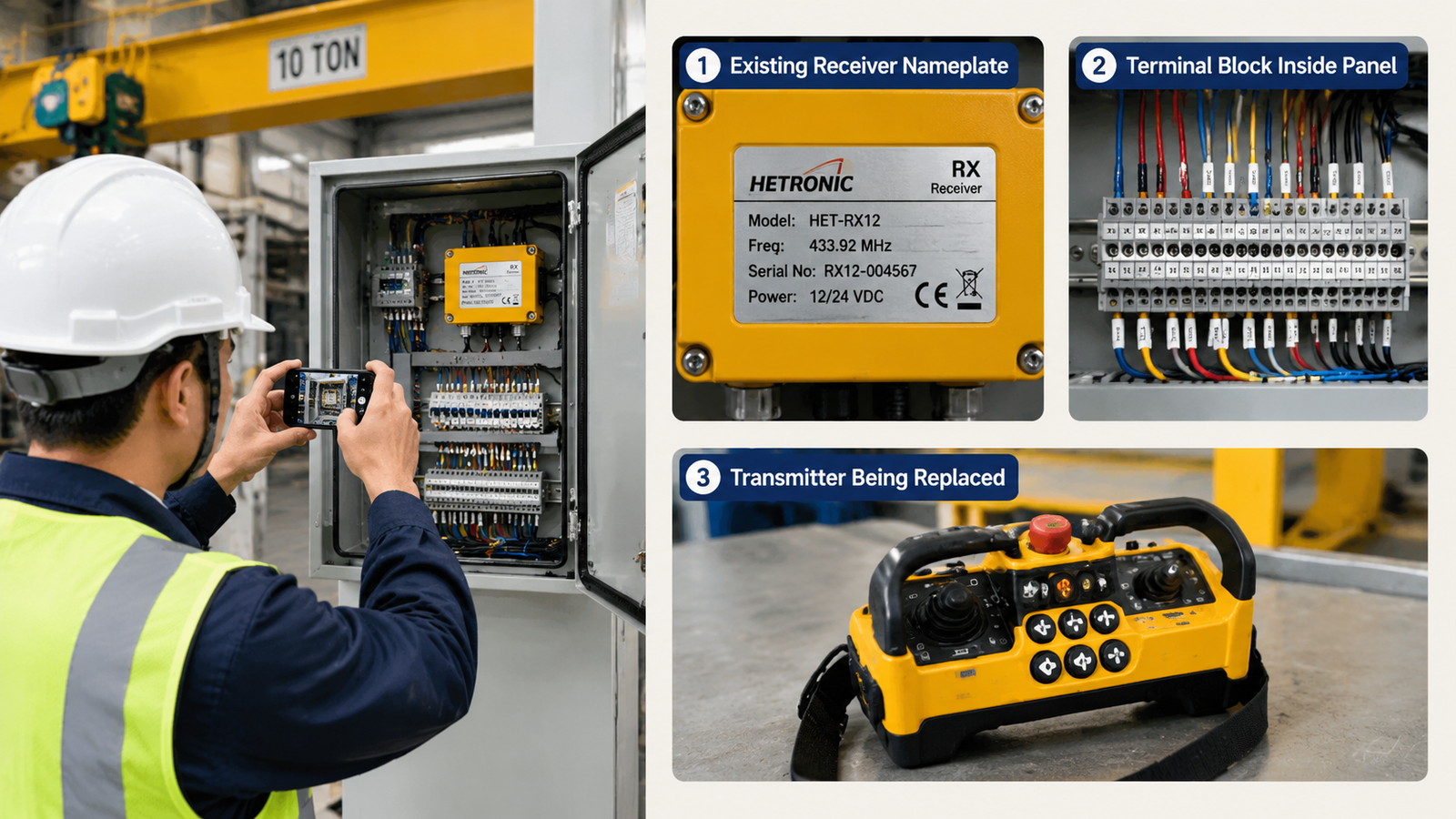
16. Photos attached: receiver nameplate / terminal block / existing transmitter
Attach three photographs: the existing receiver nameplate, the terminal block inside the panel, and the transmitter you are replacing. Those three images answer a dozen questions that are tedious to describe in words.
You do not need formal drawings to get a usable quotation. Engineers can work from clear photographs, the model numbers on the existing equipment, a hand sketch of the panel layout, and the motion list written out by an operator who knows the machine.
What you should avoid is guessing the voltage. Reading a label takes a minute; correcting a wrongly specified receiver takes weeks and shipping. If the label is unreadable, measure the supply at the receiver terminals with the machine isolated and send the measured value, noting that it was measured rather than taken from a drawing.
Send the six required details and the four optional ones, and you will receive a configuration recommendation rather than a generic price list. Complete systems include a transmitter, a receiver with connecting cable, a transmitter bag, a spare fuse and a manual with the wiring diagram, so ask the quotation to state whether a full set or a single component is being supplied.
If you are still deciding which model suits the machine, compare the options in the range: the F21-E1B industrial wireless remote control for an eight-button single-speed layout, the F24-8S/8D wireless remote control for a compact eight-button double-speed configuration, and the remote control system for industrial cranes for a wide-voltage six-button arrangement with emergency stop and safety key. When you have the details ready, use the contact form and attach your photographs.
The command list with its speed stages. It determines how many receiver outputs the system needs, and therefore which models can do the job at all. Voltage comes second, because it decides the receiver configuration.
You can get an indicative quote, but not a firm one. The receiver must match the panel supply, and multi-voltage options may cost more or less than a fixed-voltage version. Reading the label on the existing receiver is the fastest way to remove this uncertainty.
Not always. Replacing a single transmitter with one that has the same functions is common, provided the existing receiver supports learning or re-pairing. Replacing the receiver usually means confirming the wiring, voltage and output map first.
Give the normal working distance and the longest distance from which the operator must control the crane, then add a sentence about the layout — bay length, steelwork, columns and whether the operator works from an adjacent level.
A model number and its configuration, the supply voltage, the number of outputs, the protection level, the enclosure material, the certification provided, the scope of supply including cable and manual, the minimum order quantity, the lead time, the packing method and the payment terms. Ask for all of these in writing so competing offers can be compared line by line.