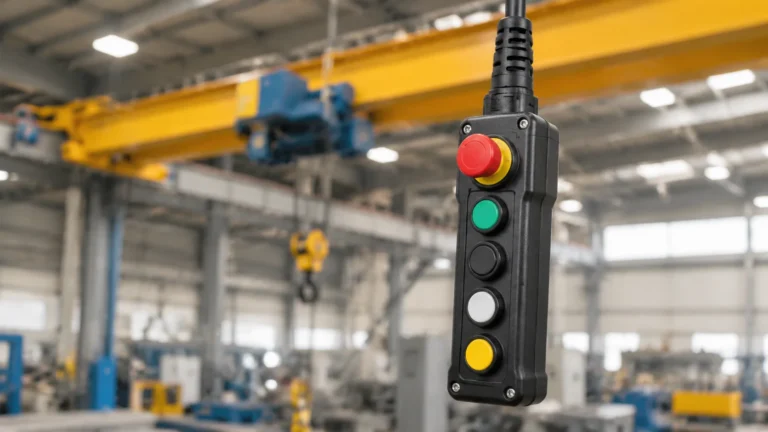
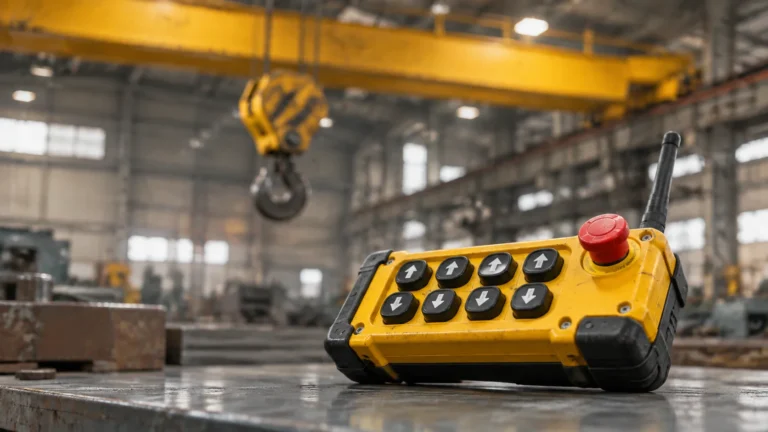
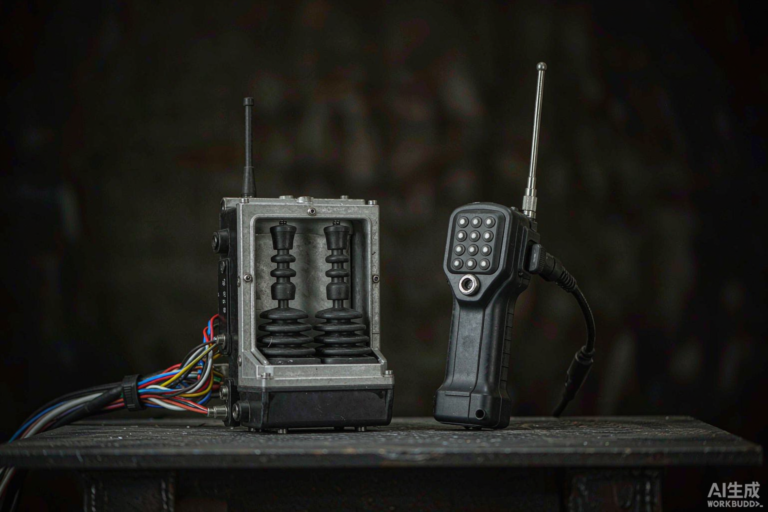
Pendant Control Station Wiring: Cores, Common, Earth
Cores follow functions, not buttons. The sum that sizes the cable, why the stop must not share the button common, and five pre-power checks.
Read More

Every crane remote control installation eventually gets the same question: the hook already carries a wireless crane scale, so why does the operator need two handsets hanging off the belt? The commercial answer is often yes; the engineering answer is that a scale is a measuring instrument and a remote is a control, and the two fail differently. Whether they should share one housing depends on which failure you can live with. A crane scale remote control that fits both jobs into one handset sounds like integration; in practice it is a compromise with a hard boundary.
A crane remote control commands motion: its outputs close contactors, and when one sticks the crane keeps moving. A wireless crane scale reports a number, and its failure modes, wrong or frozen or absent, do not stop the load. That difference sets almost every other decision here.
They are also powered and paired independently. The crane receiver is fed from the crane panel through a control transformer, so it lives as long as the crane has power. The scale transmitter runs on AA or AAA cells and the display on its own battery or a 24 V supply. The scale transmitter is paired to its display, the crane transmitter to its receiver, and the two pairs normally speak different protocols at different data rates.
| Item | Crane remote control | Wireless crane scale |
|---|---|---|
| What it delivers | Motion commands to contactors | A weight value to a display |
| Typical failure | Output stuck, link lost, no response | Reading drifts, freezes or drops out |
| Consequence of failure | Uncontrolled movement | Wrong lift decision, wrong paperwork |
| Power source | Crane panel, control transformer | Cells in the transmitter, battery or 24 V display |
| Pairing | Transmitter to receiver, fixed at commissioning | Transmitter to display, often re-pairable in the field |
| Latency tolerance | Tens of milliseconds matter | A few hundred milliseconds is invisible |
| Regulatory duty | Electrical safety and machine guarding | Weighing instrument verification where trade weight applies |
Operators blame the radio first because it is the part they can see. In practice it is the last suspect.
Mechanical first. A shackle that is not seated, a load hanging off centre, a rope bearing on the load cell body or a scale pin that has worn oval all shift the reading. A swinging load also reads heavy then light as it accelerates.
Then the cell and its cable. Crushed or stretched cable, water in the connector, a cell that has been overloaded once too often. A cell that reads low at one point and high at another is usually damaged rather than mis-scaled.
Then power. Cells that sag under load cause dropouts that look exactly like radio interference, and they appear when the hoist starts because that is when the transmitter works hardest.
Then the radio. If the site runs 2.4 GHz for both the crane and the scale, that band is shared with WiFi, tablets and access points. 433 MHz is narrower but wraps around steel better, which is why many yards prefer it. Whichever band you use, separate the two antennas by at least a metre, keep their cables apart, and give each system its own channel rather than letting two devices fight over one.
The diagnostic detail worth recording is whether the error appears only while the hoist or trolley is running. If it does, the culprit is usually motor or drive noise coupling into the scale cable rather than the radio link, and interference between several radio controls on one site covers the channel-planning side of that.
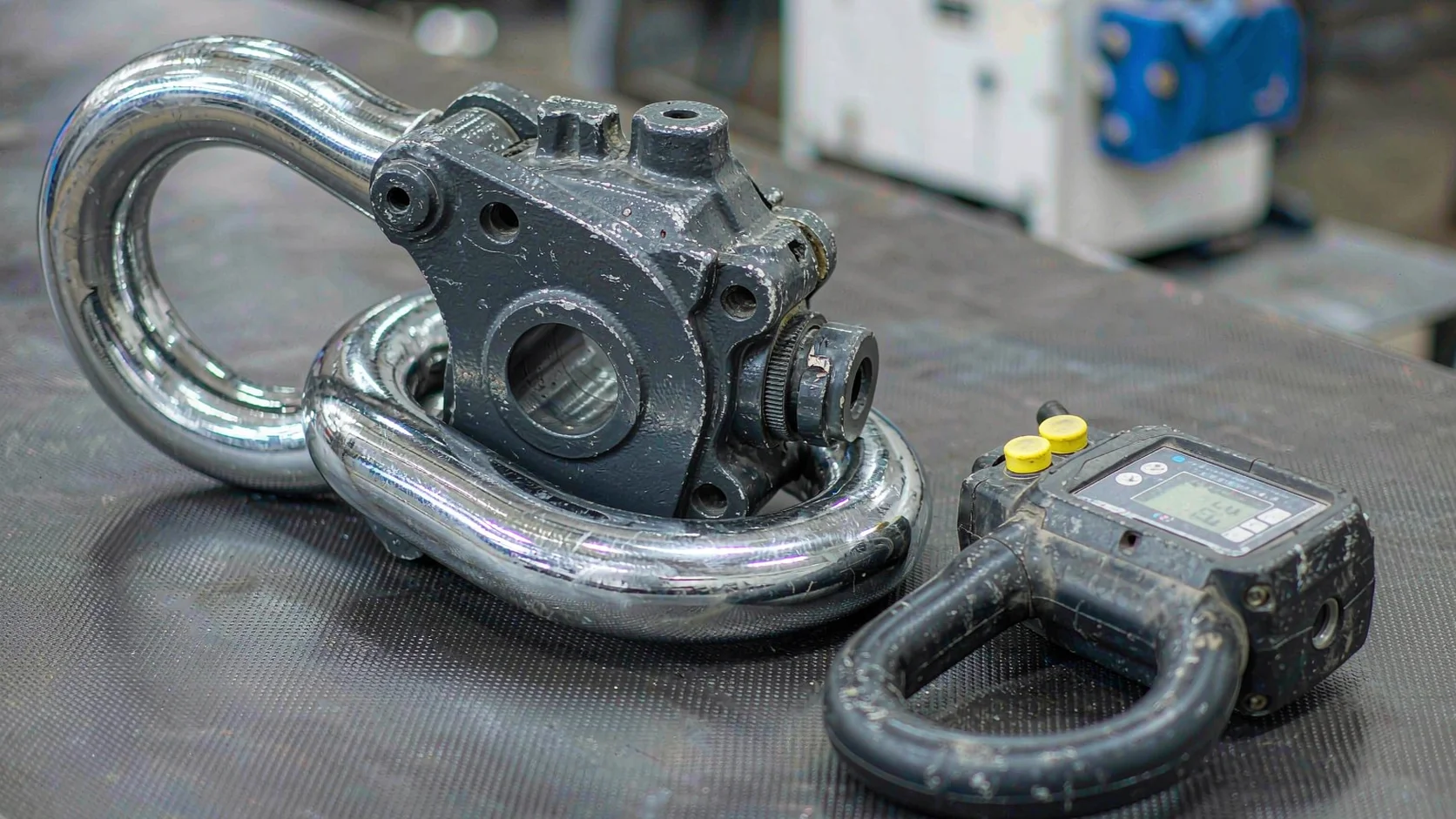
Sharing is feasible in one specific shape: the crane receiver still has spare output channels, and the scale accepts a dry-contact or wired command such as tare, zero, print or accumulate. A six-motion crane on an eight-function receiver has two spare keys, and one of them can close a relay that tells the scale to do something. Nothing about that is exotic.
What does not work is reading the weight back on the handset. Almost every industrial transmitter is one-way: it sends commands and receives nothing. A handset can therefore trigger a scale function but cannot display the result, so the number still has to arrive somewhere else. Only purpose-built bidirectional systems carry a display in the handset, and those are a different product class with a different price.
There is a harder boundary. If the weight decides whether a lift is legal, or decides what a customer is invoiced for, put the scale on its own link. Sharing a handset means sharing a battery, a housing and a drop. One fall onto concrete then costs you both the control and the weighing record, and the two are needed for different reasons. The same logic that governs two transmitters controlling one crane applies in reverse: independence is a feature you pay for once and rely on for years.
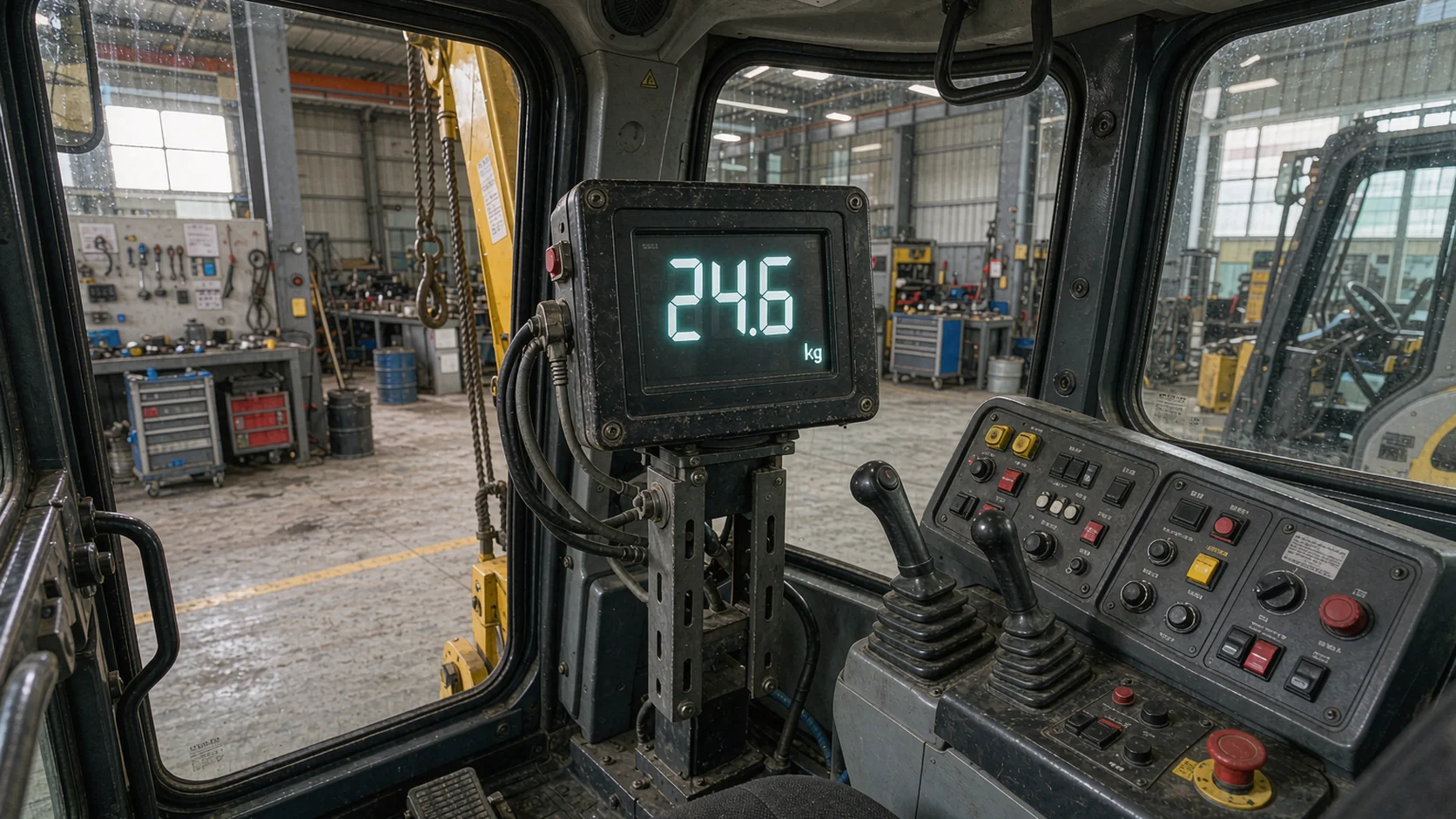
The display belongs wherever the person making the decision is looking. If the operator works from a cab, a panel-mounted display with large digits wins, because it is fed from the crane supply, cannot be dropped and cannot walk away. If the operator walks beside the load, a handheld display is the only way the number stays in view.
The test is simple: at the moment of the decision, can the operator read the weight without looking away from the load and the rope? If not, the display is in the wrong place. Sunlight readable contrast, glove-friendly keys and a display readable through cab glass all matter more than the resolution figure on the datasheet.
Where a printer or a logger is part of the job, the receiver module sits in the cab on its own supply, and that is the one case where a spare key on the crane handset genuinely earns its place.
A crane scale used for trade weight is a verified instrument, and the interval is set by local weights and measures rules rather than by the supplier. Twelve months is common, shorter where the scale works hard or outdoors. The certificate that matters ties the serial number to the actual shackle body, lists the test weights used, and records the error at each point rather than a single pass or fail.
Three habits keep that paper trail usable. Record the pairing identity whenever a transmitter or display is replaced, because a swapped transmitter with an old certificate is an audit finding waiting to happen. Note battery changes, since some scales require a recalibration after a cell replacement. And never let the scale display stand in for the crane’s rated capacity limiter: a scale tells you what the load weighs, it does not stop the hoist, and treating the two as one device is how overload incidents get missed.
Most enquiries are a photo of the hook and nothing else. Send the following and a supplier can quote in one pass.
For a multi-motion crane the receiver is normally the industrial crane remote control system; a single-hoist unit with spare keys is often covered by a twelve-function wireless remote control. Either can be specified with the scale arrangement through the contact form, and the supplier should state plainly whether the display is shared or separate.
Yes, if the crane receiver has spare output channels and the scale accepts a dry-contact command. The handset can trigger a scale function but cannot show the weight unless the system is bidirectional.
Only if both systems sit on the same band and the same channel, or if their antennas and cables are bundled together. Separate the antennas by a metre and give each system its own channel.
Not on a standard industrial transmitter, which is one-way. Handsets with a built-in weight display are a separate bidirectional product class and should be quoted as such.
Usually not, since most industrial scales use licence-free bands. Where a country restricts a band or power level, both systems must comply separately, and the import documents should name each device.
A healthy system holds its reading. If the number jumps when the motor runs, look at cable routing and shielding before suspecting the radio, because motor and drive noise coupling into the cell cable is the common cause.