Pendant Control Station Wiring: Cores, Common, Earth
Cores follow functions, not buttons. The sum that sizes the cable, why the stop must not share the button common, and five pre-power checks.
Read More

A winch remote control looks like a crane remote with fewer buttons, and that resemblance is where most of the trouble starts. A winch pulls on one axis, often horizontally, often outdoors, often with the operator standing well back from the drum. What it needs from the radio is not more functions but a specific output behaviour, a brake that holds on its own, and a link that lets go the instant the button does.
A crane moves a load in three axes and cannot leave them: hoist, trolley, bridge. A winch has one axis, drum in or drum out, and on a recovery truck or a skid unit there is no travel motion at all. That difference changes the specification more than any other.
A crane is built to lift vertically, so its structure, rope path and limit switches assume a load hanging under the hook. A winch is often asked to drag instead, so the rope leaves the drum at an angle and the tension is unpredictable. A control that suits a hoist may therefore end up on a machine doing something the crane design never anticipated.
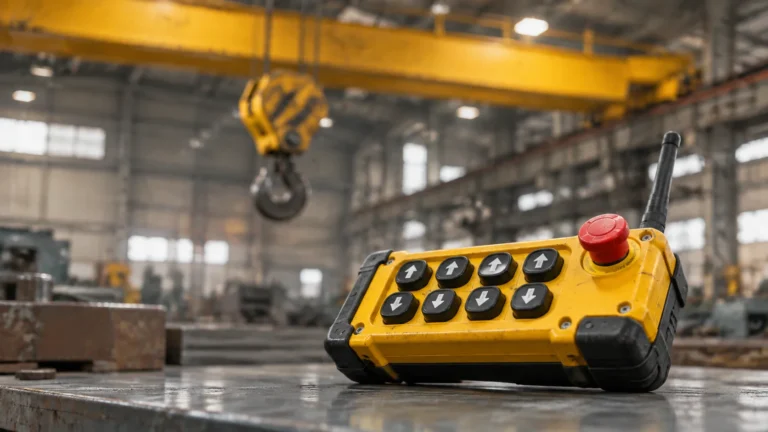
Function count drops accordingly. Two directions plus stop and emergency stop covers most winches, with a speed change if the drum has two speeds. That is a four or six button transmitter, so the choice usually comes down to output behaviour, supply voltage and enclosure rather than to how many keys the handset carries. A fixed drum unit such as the compact electric wire rope winch follows the same rule, with two directions, a stop and a hook limit covering most of the work.
Winch work is jog work. The operator tightens until the rope is just loaded, releases in short pulses to let a load down by centimetres, and holds the load stationary while someone at the anchor point repositions a sling. All three are momentary actions, and momentary means the output drops the moment the button is released.
This is the setting to confirm before anything else. A receiver configured with maintained or latching outputs, which is legitimate for some machinery, will keep the drum turning after the operator lets go. On a crane that is dangerous; on a winch with a dragging load and an operator close to the rope it is the classic recovery accident. momentary and maintained outputs are not interchangeable, and the transmitter alone cannot tell you which one you have.
Response time matters more here than on a crane. A jog that takes 400 ms to act produces an overshoot the operator corrects with a second jog, and a chain of corrections is how loads get shock loaded. Under 200 ms from button to contactor closure makes the machine feel direct. Range figures on a datasheet are quoted for open air, so treat them as an upper bound rather than a promise.

The remote does not hold the load. Whatever holds it is mechanical, and it is worth knowing which arrangement you have before specifying a handset.
| Arrangement | How it holds | What the operator must know |
|---|---|---|
| Worm gear winch | Largely self-locking through the worm drive | Little or no brake to adjust, but a worn worm will creep |
| Spur gear winch with band or disc brake | Spring applied friction brake on the drum | Air gap and lining wear set the holding torque |
| Motor with DC injection or dynamic braking | Electrical braking, then a mechanical hold | Behaviour on power loss must be tested, not assumed |
| Free spool clutch | The drum is disengaged and the rope runs free | Never command the drum with the clutch open |
That last row is the one to design around. A free spool clutch lets the operator pull rope out by hand, and if the drum is then commanded while the clutch is still open, the load runs away with nothing holding it. Where a clutch is fitted, the safe arrangement is an interlock: a clutch switch that inhibits the radio outputs, or a procedure with a physical check before the handset is picked up. Ask the supplier which of the two the control panel actually provides, because the answer is not always the one in the brochure.
Brake condition is checked the same way as on a hoist: measure the air gap against the maker’s figure, watch for oil on the lining, and hold a test load with no measurable movement. A winch that creeps a few centimetres after release is settling; one that keeps paying out rope is not.
Receivers are available for 12 V and 24 V DC, for 110 V and 230 V AC, and for panels fed from a three-phase supply through a control transformer. The important point is that the receiver only drives contactor coils, drawing a few volt-amperes, so its supply has nothing to do with the motor rating. A 24 V receiver inside a 380 V three-phase panel is entirely normal.
On a recovery truck or trailer the supply comes from the vehicle battery, and that is where installations go wrong. Take a dedicated fused feed with its own isolator rather than tapping a lighting circuit, because cranking voltage sag drops the receiver out and the handset appears to have failed. Size the cable for the run, not the coil current, or the receiver will reset every time the engine starts and be diagnosed as a radio fault by everyone who touches it.
Outdoors, the enclosure and the cable entry do more damage than the electronics. Glands that point upwards collect water, so route the cable in from below with a drip loop. Control voltage selection covers the supply side in more detail and is worth reading before a panel is ordered.
Radio control exists so the operator can stand where the work is visible, which on a recovery job is usually beside the vehicle rather than at the drum. That freedom is also the risk: the rope path is not visible from every position, and standing in the bight of a loaded rope is fatal and has nothing to do with the radio.
Fit the antenna clear of the drum frame and above it, keep the antenna cable uncoiled, and avoid mounting the receiver behind a steel panel. Expect real range of roughly half the open-air figure once the vehicle body, ground reflection and terrain are in the path. Walking the site with the handset before the first lift is the only reliable coverage test, and operating distance explains why the figures differ between machines.
Emergency stop on the transmitter sends a stop command; it is not a mechanical isolator. For recovery work with a person near the anchor, a second person at the isolator is still the practice that matters. Equally important is what the receiver does when the link is lost: every output must open and the brake must set. Test it deliberately by switching the handset off under a light load, and read emergency stop and deadman circuits before assuming a stop button covers the same ground.
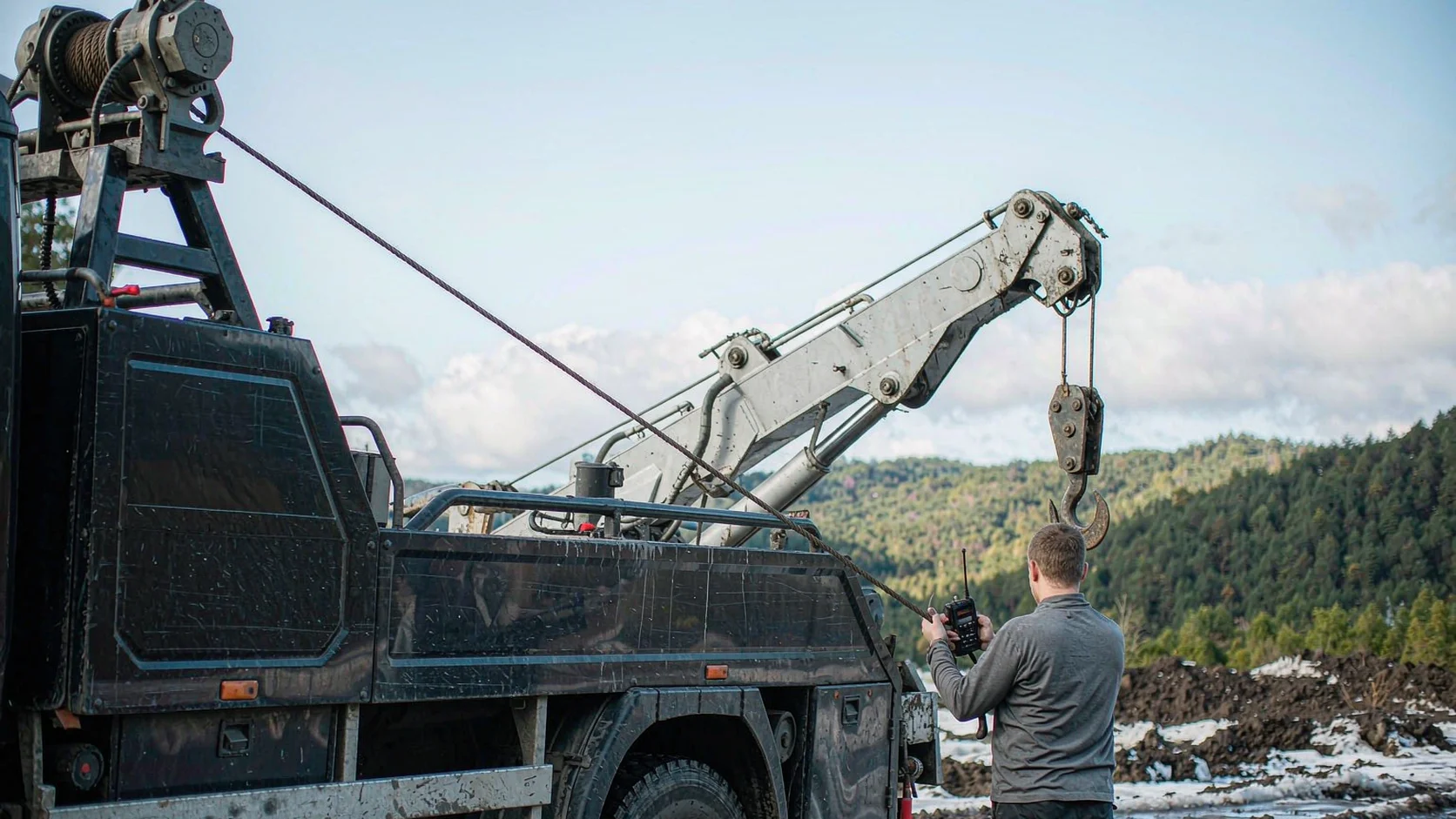
Winch enquiries that arrive with a line pull figure and nothing else produce three rounds of questions. Send these instead.
For a stationary installation the usual match is an electric wire rope winch with a four or six function handset; for smaller trailer and workshop units an electric mini winch suits the same control family. A single-axis machine often reuses the hardware specified for jib cranes and workshop hoists, which is worth asking about because it shortens the lead time. Send the list through the contact form and it can be quoted in one pass.
Two for direction plus stop covers most winches, a four button handset with emergency stop. Add two more if the drum has two speeds or a horn is needed.
Often yes, provided the receiver outputs are set momentary and the enclosure suits the site. Confirm both before ordering rather than after.
A correctly configured receiver opens every output and the mechanical brake sets. Test it by switching the handset off under a light load; if the drum keeps turning, the receiver is not configured as a winch control.
Only with the clutch engaged. Fit a clutch switch that inhibits the radio outputs, or keep the handset out of reach until the clutch is closed, because a commanded drum with the clutch open has nothing holding the load.
The handset is the same and the receiver differs only in its supply module. Voltage affects the receiver and the coil circuit, not the radio link or the range.