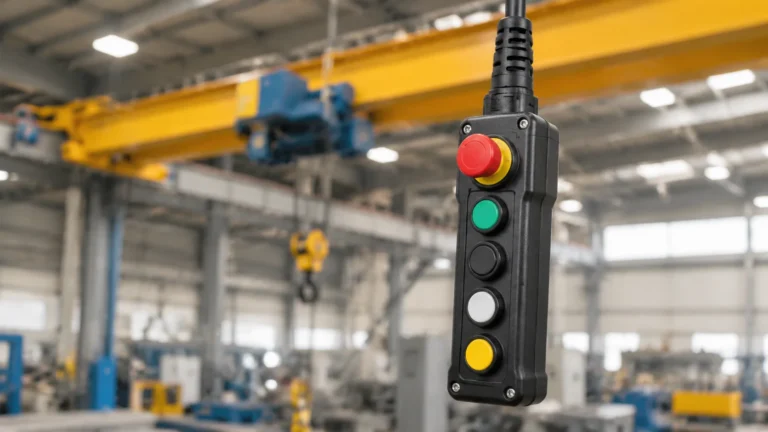
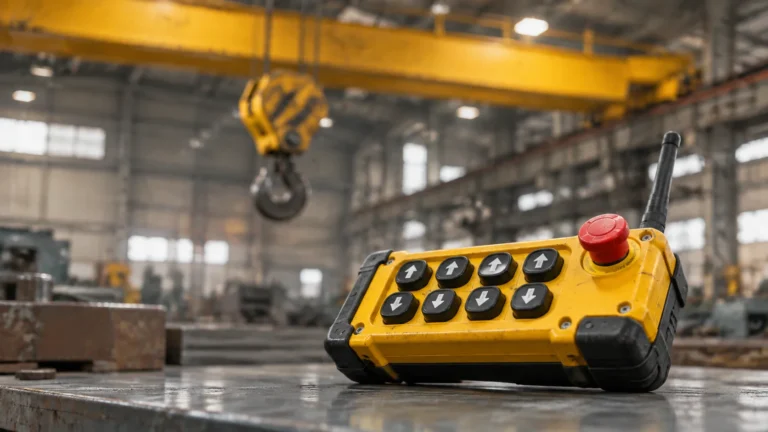
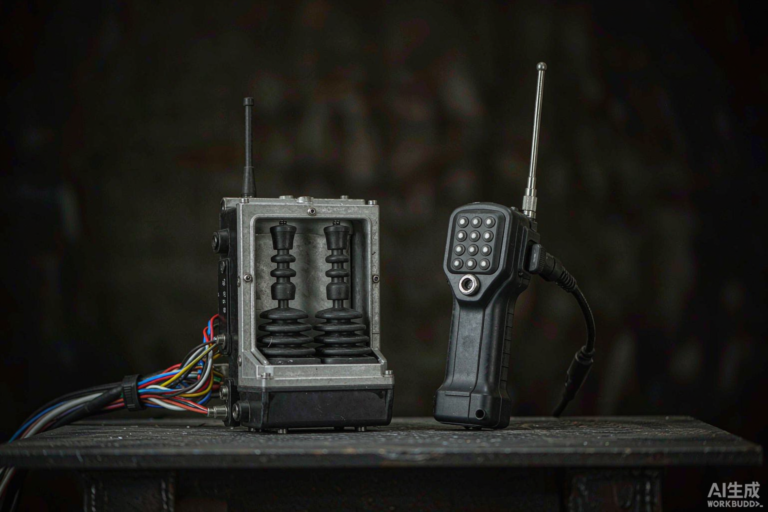
Pendant Control Station Wiring: Cores, Common, Earth
Cores follow functions, not buttons. The sum that sizes the cable, why the stop must not share the button common, and five pre-power checks.
Read More

A hydraulic hatch control box is a small local station that drives a hydraulic hatch, door or cover through its open and close stroke, usually on a hold-to-run basis: the mechanism moves only while the button is held. On a marine crane the box is judged less by its button count than by three things — whether the enclosure survives salt atmosphere, whether the cable entry survives a wet deck, and whether the operator can stop the movement with the same hand that started it.
This guide covers how to count buttons against hydraulic circuits, why marine installations fail differently from land ones, and the inspection points that keep a hatch control station working through a season of deck operations.
Hatch drives are rarely operated from a crane cab or a remote transmitter. The operator needs to see the hatch edge and the load at the same time, so the control point sits at the hatch or on a short lead beside it. That single fact drives the whole specification: the station is exposed, it is used in short bursts with long idle periods, and it is used by people wearing gloves in poor light.
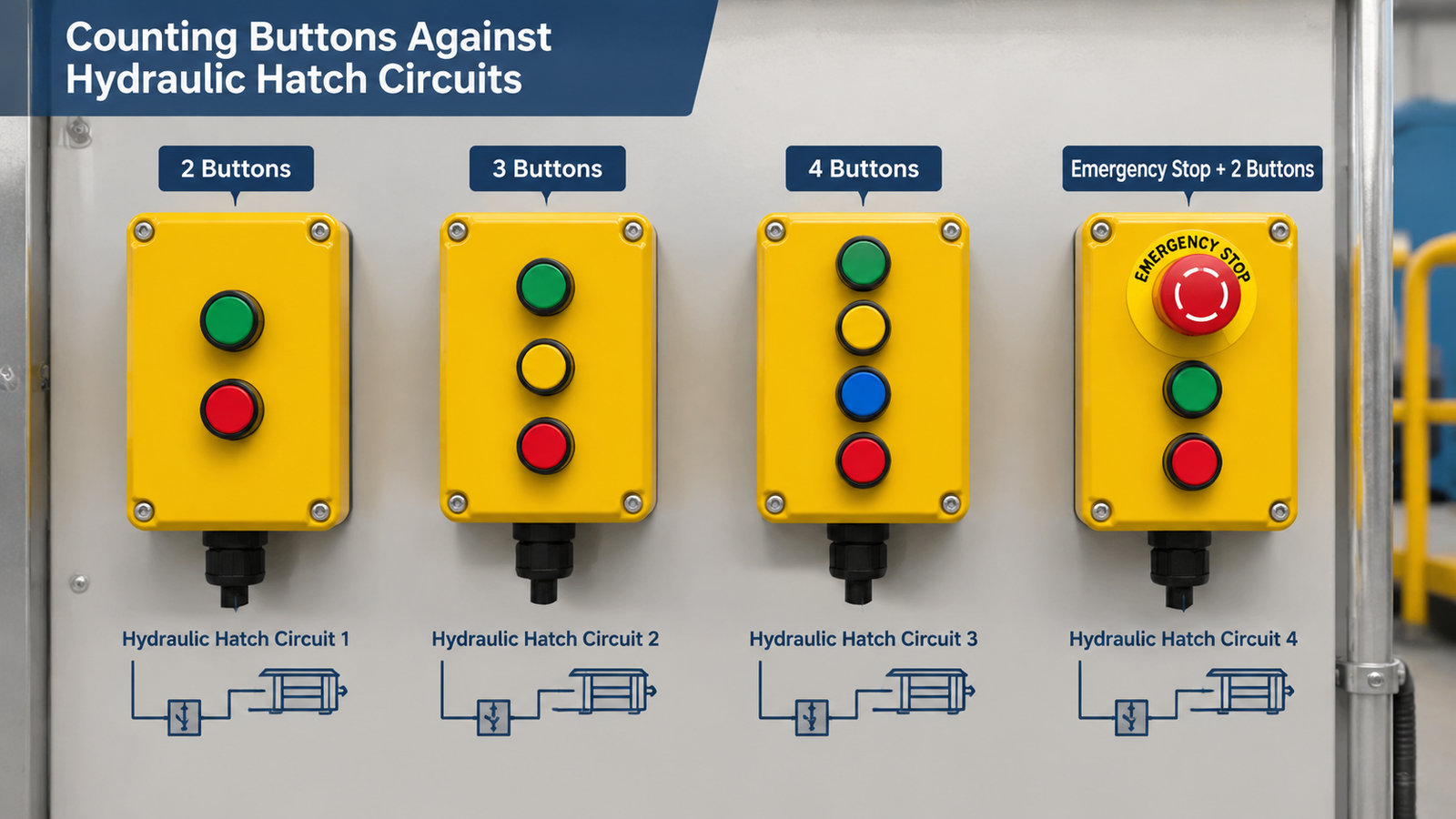
The button count is not a preference. It is a count of the functions the operator must command from that location, and it should be read off the hydraulic schematic rather than from the old box.
| Station | Functions it provides | Typical marine duty |
|---|---|---|
| COP-2B | Two spring-return buttons for one function in two directions | Single hydraulic hatch or door drive with open and close only |
| COP-3B | Three spring-return buttons | Open and close plus a third function — a stop, a lock release or a second drive direction |
| COP-4B | Four spring-return buttons | Two actuator pairs: a main hatch drive plus a secondary actuator or a hold-down function |
| COP-A2B | Two spring-return buttons plus a mushroom-head emergency stop | Where a local stop is required at the hatch, in addition to the two directions |
Where the site requires a stop at the hatch, the choice is between a third button and a proper emergency stop actuator. They are not interchangeable. A stop button interrupts the command; a mushroom-head emergency stop is part of the machine’s safety function, with a latching action and a defined release. The COP-A2B carries the emergency stop at the head of the station, where it can be struck without adjusting grip, above the two direction buttons.
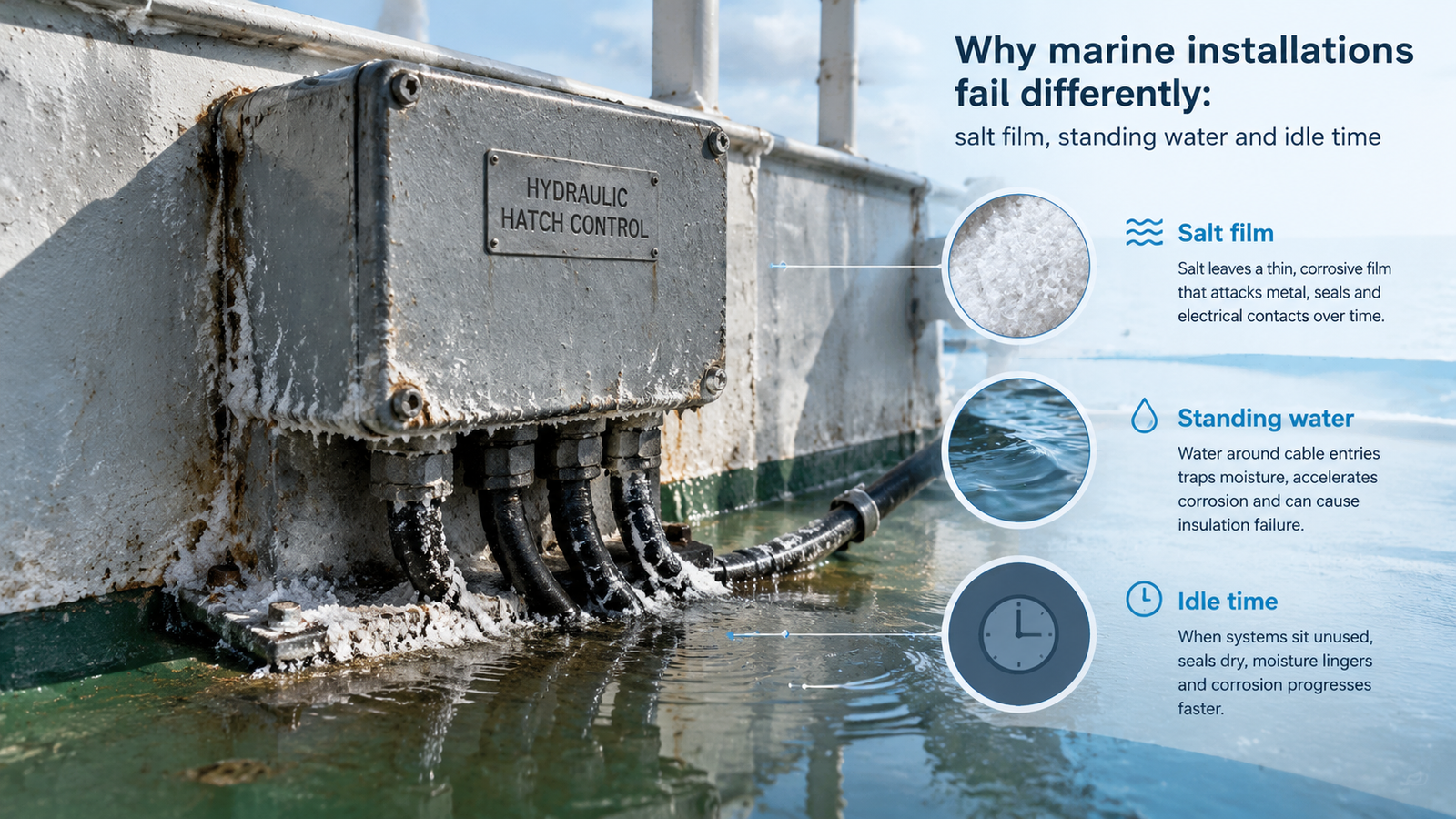
A land installation fails from dust, vibration and thermal cycling. A marine installation fails from salt, standing water and idle time. The difference matters because the failure appears in a different place.
Salt film rather than dust. Salt does not block an enclosure; it corrodes it. On a deck, salt deposits sit on the housing and on the cable, and every dew cycle dissolves them into a conductive film. That film attacks the terminal screws and the contact faces long before anything visible happens on the outside. Silver contacts are chosen for stable low-resistance switching, but silver and salt are not friends over years.
Standing water at the entry. Hatch control points are often mounted low, on or near the hatch coaming, where water collects. A station rated for splash from any direction can still take water through a cable entry that sits in a puddle, because the entry is a path, not a face.
Seven parameters decide whether a box survives a season on deck.
| Parameter | What to specify | Why it matters here |
|---|---|---|
| Enclosure protection | Confirm the IP rating against the position; IP54 suits sheltered outdoor hatch service but is not an immersion or jet-wash rating | Deck wash-down and standing water are jet and immersion conditions, not rain |
| Housing material | Non-metallic, double-insulated where available; avoid uncoated steel in salt atmosphere | Corrosion at fixings and mounting tabs is a common write-off cause |
| Actuator type | Spring-return, hold-to-run | Releasing the button must stop the movement on a hydraulic drive |
| Emergency stop | Mushroom head, twist release, positive opening contact where the circuit requires it | The hatch is a crush hazard; the stop must latch and must be findable by feel |
| Cable entry | Gland at one end, sized for the conductor count, with strain relief | A four-button station carries more conductors than a two-button one; the bend radius matters |
| Legend visibility | Moulded or engraved direction markings | Printed legends disappear under a wet glove and salt film |
| Operating temperature | Confirm against the route — open deck versus an enclosed hold | Low-temperature embrittlement affects gaskets and cable sheaths |
| Interval | Check | Action if it fails |
|---|---|---|
| Weekly (during operation) | Visual: housing intact, legends readable, no water inside the lens or at the entry | Report and schedule; take out of service if the stop is affected |
| Monthly | Button return action, stop latch and release, cable sheath and boot condition | Replace the station if the stop does not latch; replace the cable if the sheath is cracked |
| Quarterly | Open the station, inspect for salt film and corrosion on terminals and contacts, check gasket compression | Clean and re-terminate; replace the gasket rather than reusing a hardened one |
| Annually | Insulation resistance, function test at working pressure, review of the mapping record against the drawing | Correct any drift between the record and the machine before the next season |
| After any immersion or flood | Full strip and inspect; do not energise a wet station to “see if it works” | Replace — a flooded station’s contacts are already compromised |
Where the vessel is also moving hatch or crane functions onto radio control, the local box normally stays as a fallback and as the maintenance control point. The industrial remote control range covers receivers that can be wired alongside an existing station so both control points stay live, which is the arrangement most operators want on deck.
Count the circuits, not the buttons. Specify the enclosure against the water condition at the mounting position rather than against the word on the datasheet, and put the cable entry at the bottom with a drip loop. Keep the mapping record current — on a marine installation that record is what keeps the hatch opening in the direction the legend promises.
If you are replacing a marine crane control box, send the function list, the hydraulic schematic reference and a photograph of the mounting position through the contact form and the station can be matched to the circuit and the exposure.
Function, not construction. A hatch control box commands a hydraulic valve through short jog movements, usually two to four spring-return buttons, and is mounted at the hatch. A pendant station controls a hoist or crane motion and often carries more buttons plus a stop. Both are hand-held or surface-mounted local control points.
On a hold-to-run hydraulic drive, yes. Releasing the button removes the command and the movement stops, which is the behaviour the operator expects when they lose sight of the hatch edge. A latching selector changes that behaviour and should only be used where the circuit has been designed for it.
It can, provided the enclosure rating matches the water condition at the mounting position. The common mistake is to specify against rain and then mount the station where it takes deck wash-down or stands in water — the position matters more than the rating.
As many as the hydraulic schematic has functions to command from that location. Most installations need two for open and close; a third is added for a stop, a lock release or a second drive, and a fourth where a second actuator is controlled from the same point. Count the circuits rather than copying the old station.
Where the hatch presents a crush hazard, a local stop at the control point is the practical arrangement, because the operator is standing there and can act immediately. The station’s stop must still be part of the machine’s safety circuit, with the correct contact type and a latching action, tested under load.