Pendant Control Station Wiring: Cores, Common, Earth
Cores follow functions, not buttons. The sum that sizes the cable, why the stop must not share the button common, and five pre-power checks.
Read More

A crane remote control datasheet is a sales document before it is a technical document. It tells you what the unit can do under favourable conditions, and it usually stays quiet about the conditions. That is not dishonesty, it is how the category works: two units that both claim 100 m range, IP65 and 12 outputs can behave very differently on the same crane, because the numbers were measured against different definitions.
Read the sheet in the right order and it becomes useful. Six rows decide whether a unit fits your machine, another four decide whether it will survive your building. This guide walks through both groups and ends with the lines worth writing into your RFQ.
Before anything about protection or battery, a remote control has to be electrically compatible with the panel it will drive. Those six rows are unambiguous and rarely inflated, so start here and disqualify units quickly.
| Datasheet row | What it tells you | What to check on your crane |
|---|---|---|
| Number of outputs | How many independent commands the receiver can switch | Count every motion and every non-motion function you want on the transmitter |
| Output contact rating | Voltage and current each relay can switch | Contactor coil current inrush, not just holding current |
| Control voltage | Supply the receiver expects | The panel’s control circuit voltage, read from the transformer secondary |
| Output type | Relay, solid state, or a mix | Whether any function must hold (magnet, grab, light) or pulse |
| Speed steps supported | Single or dual speed per motion | Whether the hoist has two speeds and how the pendant selects them |
| Number and type of buttons | What the operator physically has | The action list you built, and whether any action needs a lever |
If a unit fails one of these, no amount of range or protection rescues it. If it passes all six, you have a shortlist rather than a catalogue.
Every electrical figure on the sheet has a hidden qualifier. Contact ratings are usually quoted for a resistive load, while a contactor coil is inductive and draws several times its holding current for the first few tens of milliseconds. A relay rated 5 A resistive may be asked to switch a coil whose inrush is 8 A. That is not always a failure, but it is a duty question the sheet does not answer, and it is the reason a receiver that works on a small hoist can weld its contacts on a bigger panel.
Battery figures have the same problem. A quoted standby time counts the hours the transmitter spends powered up but idle; an operating time counts the hours it transmits. Real shifts sit between the two, with the transmitter on for eight hours and working for maybe forty minutes of that. Read both lines, then halve the operating figure for a cold store.
Range is the most quoted and least comparable number of all. Measure it in an open yard and a 433 MHz unit will comfortably pass 100 m. Measure it from the cab of a crane inside a steel-framed bay with the receiver bolted to a girder and the same unit may lose the link at 40 m. The sheet is not wrong, it answers a different question. The article on what actually affects operating distance breaks the loss down by obstruction, antenna position and frequency.
IP65 on the sheet almost always refers to the enclosure it was tested in, and it does not say whether that is the transmitter, the receiver, or both. Ask. A transmitter rated IP65 and a receiver rated IP54 in a washdown area is a different proposition from two units both at IP65, and the difference will show up eighteen months later as a corroded receiver board.
The second number people skip is temperature. A range of −35 to +80 °C on a transmitter is a housing and electronics claim; the battery inside it usually has a narrower window, and the display, if there is one, narrower still. On a unit with a rechargeable pack, treat the low end of the temperature range as a battery question rather than an electronics question. The IP65 and IP67 comparison explains what the two digits do and do not cover, including the fact that neither of them says anything about temperature.
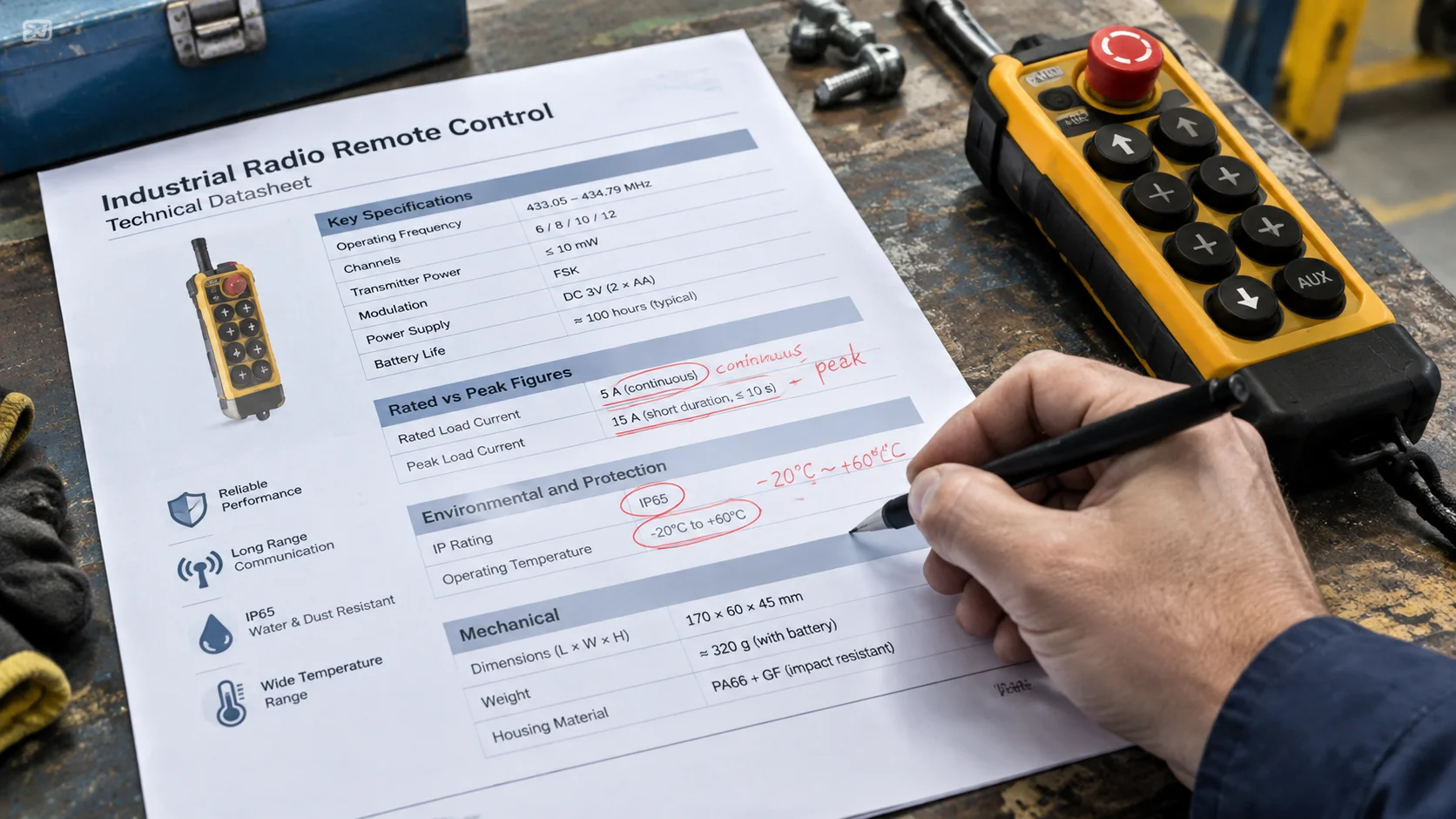
These four appear on almost every sheet and mean something different on each one. Do not rank units by them; use them only to ask a follow-up question.
If a supplier cannot answer the follow-up question in one sentence, that tells you as much as the number did. Turning those rows into language a tender can be judged against is the next step, and writing a specification that keeps quotes comparable is the part most documents get wrong.
The fastest way to turn a datasheet into a decision is to stop reading and go and look at the crane. Five steps, in this order.
Step four is the one buyers skip, and it decides whether a 100 m unit is generous or marginal. If the receiver sits inside a closed panel on a girder, antenna placement matters more than the range figure. The guide to repeaters and range extension covers what to do when the geometry is against you.
Most quote requests come back incomparable because the buyer sends a photo and a question. Send a specification instead, and make the supplier answer against your rows rather than their brochure.
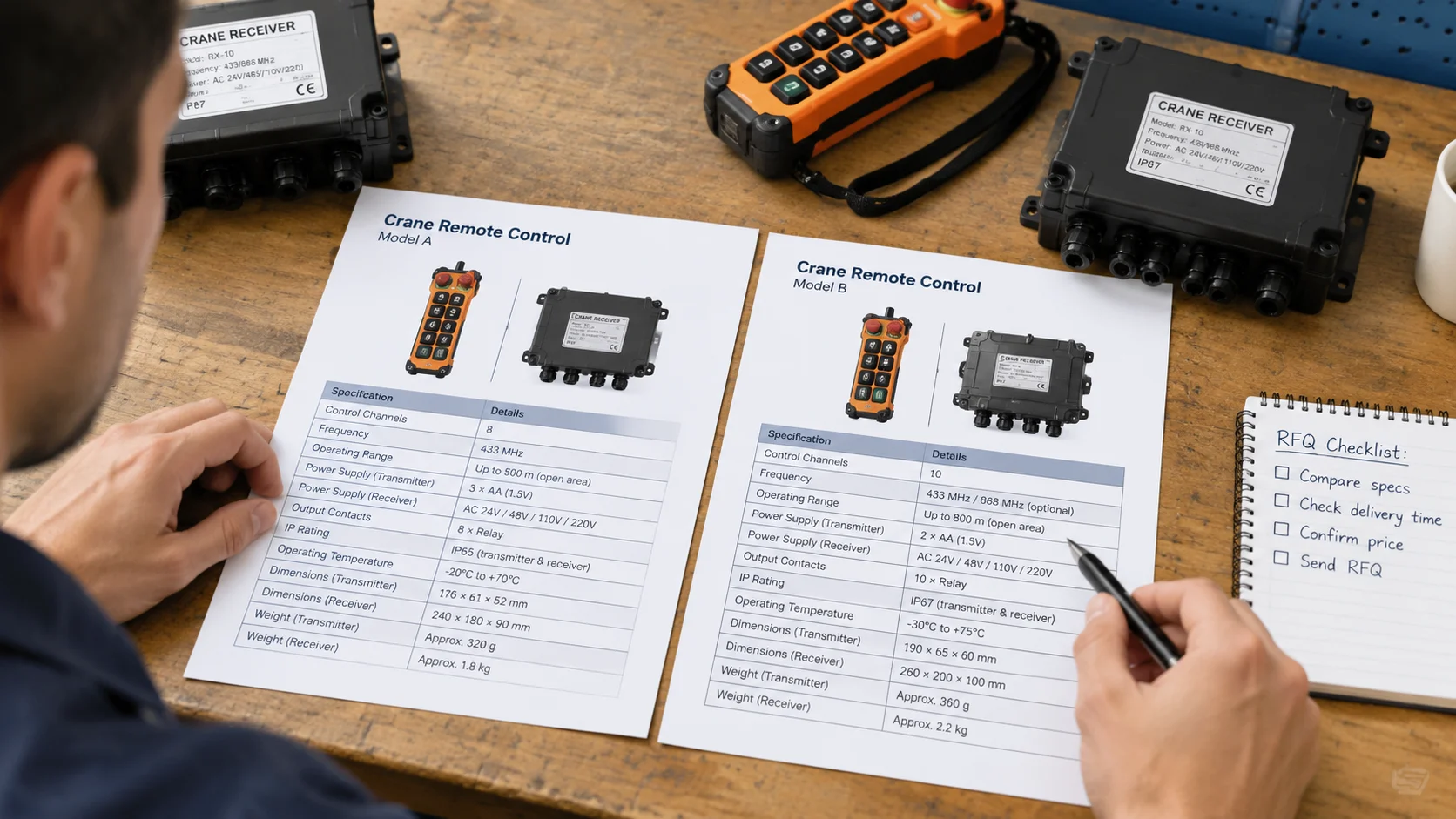
| RFQ line | Ask for | Why it matters |
|---|---|---|
| Outputs | Count, plus which are relay and which are solid state | Determines wiring and service life |
| Control voltage | Confirmed receiver supply and tolerance band | Wrong voltage is the most common retrofit failure |
| Protection | IP rating stated separately for transmitter and receiver | Prevents a washdown area being quoted a splash-rated receiver |
| Temperature | Limiting item named, plus battery type and its own range | Cold stores and foundries both fail here |
| Range | Figure with the test condition described | Makes two quotes readable side by side |
| Documents | Declaration of conformity, test report, wiring diagram | Needed for commissioning and audit |
A supplier who answers all six in writing is telling you they build to a specification. One who replies with a brochure is telling you something else. The quote request checklist has the full list of items worth sending in the first message, and the industrial crane remote control systems range shows how those rows map onto real configurations. If you would rather have a specification checked before you send it out, send it to our engineers and we will mark the lines that need a decision.
No. A higher rating usually means a sealed enclosure, which traps heat and makes the unit harder to service in the field. For indoor workshop cranes, IP65 is normally sufficient and easier to live with; for washdown and outdoor duty, the higher rating earns its cost.
Because range depends on antenna design, receiver sensitivity and the height of both antennas as much as on transmit power. A figure quoted in an open field is a best case; assume 40 to 60 percent of it in a steel-framed building.
Usually the radio link and the receiver’s decode, not the output relay and not the contactor. Add roughly 10 to 20 ms for the relay and 20 to 60 ms for a contactor to pick up when you are calculating how far a crane travels before it starts to stop.
Yes, and it is often the better choice if you plan to add a grab, a magnet or a light later. Unused outputs stay unwired, and the transmitter’s extra buttons can be blanked or labelled as spares.
Rarely. Pairing capacity is a receiver feature and is often left out. Ask directly whether the receiver holds more than one transmitter ID and whether switching between them is by a selector or by whoever powers up first.