Pendant Control Station Wiring: Cores, Common, Earth
Cores follow functions, not buttons. The sum that sizes the cable, why the stop must not share the button common, and five pre-power checks.
Read More

A monorail or light rail system looks like the simplest crane on site and is usually the most awkward to control. The loads are light, the structure is small, and the operator often stands within arm’s reach of the moving trolley. But the track branches, several trolleys share one beam, and the failure that matters is not a dropped load — it is a collision between two units on the same rail.
This guide explains how a crane remote control is specified for this class of equipment, why turnouts and anti-collision decide the design, why a light load is not a light duty, and where the boundary sits between a monorail and a jib crane.

A monorail is a single track — a rolled beam or an enclosed profile — with a trolley that carries a hoist and runs along it. The track can curve, can rise and fall, and can branch. A light rail system is the modular version: standard straight and curved sections, bolted joints, suspended from the roof structure, with manual or motorised turnouts joining the sections into a network.
The distinction that matters for control is whether the track is a line or a network. A single line with one trolley behaves like a very simple crane. A network with branches, several trolleys and shared sections behaves like a small transport system with a traffic problem, and the remote has to support whatever the control panel does about that problem.
A turnout is a switch in the track. A trolley can only pass when the blade is fully in position, and a trolley passing a partly-set turnout derails. So the first control requirement is confirmation: the switch position must be proven before motion along the track is permitted.
That confirmation has to reach the operator, because the operator is usually working from a position where the turnout is not visible — around a corner, behind a machine, or forty metres down the line. A transmitter that cannot show switch state leaves the operator to guess, and the workaround operators invent is to drive slowly and watch, which is exactly the habit that eventually fails.
The second requirement is anti-collision between units on shared track. Two trolleys on the same beam cannot pass each other, and a section between two turnouts may only hold one unit at a time. Where the control system enforces zones, the radio must be able to request a zone and show whether the request was granted. Where it does not, the zone discipline is procedural and the remote is not the right place to fix it — but the specification should still say which of the two situations applies.
If the site runs several units in the same bay, the radio planning matters as much as the logic. Sharing channels, reusing frequencies and picking antenna positions is the subject of multiple crane remote controls on one site, and light rail installations are where that problem appears most often because the units are close together.
A 250 kg trolley on a light rail gets cycled far more than a 20 tonne overhead crane. It runs short moves all shift: pick, transfer, place, return, twenty or thirty times an hour. Every one of those cycles is a contactor operation, a brake release and a radio transmission.
The consequences are concrete. Keypad domes wear out before the housing does. Contactors reach their electrical life while the mechanical parts are still new. Battery packs are cycled hard because the unit is in almost continuous use. And the transmitter is dropped more often, because the operator carries it while walking rather than leaving it in a cab.
There is also a proximity argument. On a large crane the operator stands well clear. On a light rail system the operator often walks alongside the load with the transmitter in hand, at head height, in an aisle with other people in it. That raises the value of a clear indication of which unit the transmitter is bound to, and it argues against a transmitter that looks identical to the one used on the crane next door.
Sites often want one transmitter to serve several trolleys, on the reasoning that the operator only uses one at a time. That is usually workable, with three conditions.
First, the pairing must be deliberate rather than automatic. A transmitter that binds to whichever receiver answers first will bind to the wrong unit at some point, and on a shared beam that is a collision. Key-based pairing or a unit selector with a visible confirmation is the requirement.
Second, a transmitter must not be able to talk to two receivers at once. Where a site genuinely needs simultaneous control — a transfer section where two trolleys must move together — that is a tandem arrangement and should be specified as one, not improvised through pairing.
Third, the transfer of control has to be observable. The operator needs to know which unit is currently bound before pressing anything, and the receiver should show it. The general rules for multi-unit arrangements are in two transmitters on one crane, which covers the same pairing logic from the other direction.

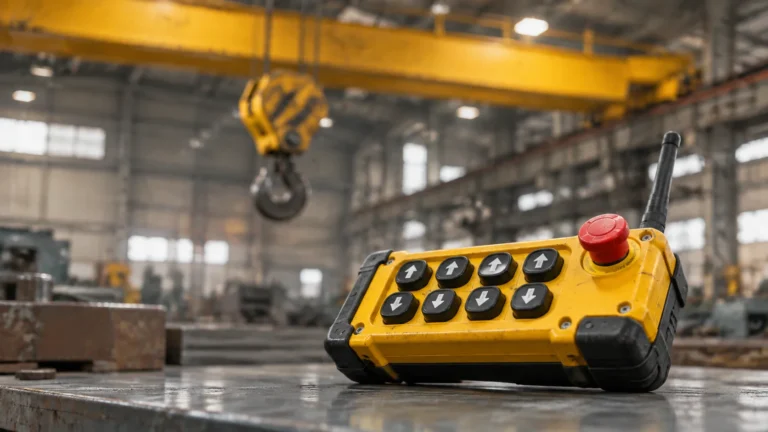
Practically that points to a small, sealed unit rather than the largest button count available. The eight-function industrial wireless remote control covers hoist, travel, fast and slow, which is most of what a light rail trolley needs.
The three overlap in load range and are often confused at the enquiry stage. The control requirements differ more than the mechanical ones.
| System | Track geometry | Dominant control risk | What the remote must handle |
|---|---|---|---|
| Jib crane | Single fixed pivot, one arm, one trolley | Slewing into people or structures | Motion functions only, with a clear stop |
| Monorail, single line | One track, one trolley, no branches | End-of-track and obstruction | Motion functions plus limit inputs |
| Light rail network | Branched track, turnouts, shared sections | Derailment at a turnout and collision between units | Motion, turnout proof, zone request, unit selection |
The jib crane is the simplest of the three and its control is covered in jib crane and workshop hoist remote control. The moment a system has a turnout, it has left that class and needs a control panel conversation, not just a remote control order.
Most light rail systems on site are retrofits: a manual system that someone wants to control from a distance because the operator keeps walking into the aisle. The work differs from a new installation mainly in what has to be discovered first.
The retrofit sequence for a conventional crane follows the same shape and is set out in adding radio remote control to an existing crane. On a branched track the extra work is nearly all in steps 1 to 3, and it is worth doing before any equipment is ordered.
If you are working on a monorail or light rail system with turnouts, send the track layout, the number of trolleys and what the existing panel can accept and we will confirm whether a standard receiver arrangement covers it. Send the layout directly and we will mark up the control points.
On a single line with one trolley, yes: the functions are the same as a hoist and the duty is unremarkable. On a branched track with turnouts, the limit is not the radio but whether the system can prove switch position and enforce zones. That logic belongs in the panel.
Because the trolley passed while the blade was not fully in position. The mechanical cause is a switch that moved or was never fully set; the control cause is a system that allowed motion without proving position. The second is the one a specification can prevent.
Yes, with deliberate key-based pairing, no possibility of two receivers responding at once, and a visible indication of which unit is bound. Improvised pairing is where this arrangement fails.
On cycle count rather than on age. These units run far more operations per shift than a crane transmitter, so keypads and contactors reach their life earlier. Logging operations or replacement dates is the practical way to replace before failure.
Not inherently, but several units working close together in one bay need coordinated channel planning. The constraints are the same as any multi-crane site and are usually solvable with channel allocation and antenna placement.