Pendant Control Station Wiring: Cores, Common, Earth
Cores follow functions, not buttons. The sum that sizes the cable, why the stop must not share the button common, and five pre-power checks.
Read More

A vacuum lifter is not a crane with extra buttons. It is a load-holding device with its own failure logic, and a crane remote control that treats vacuum as one more function will produce a machine that can release a load while the operator is still holding the transmitter. The functions that matter are the ones the operator cannot see: vacuum level, retention after a power loss, and the interlock between grip and motion.
This guide covers what a vacuum lifter or spreader beam adds to a radio system, why the vacuum command has to be part of an interlock rather than a lone button, what should happen when power or the radio link is lost, and how to build the function table before anything is quoted.

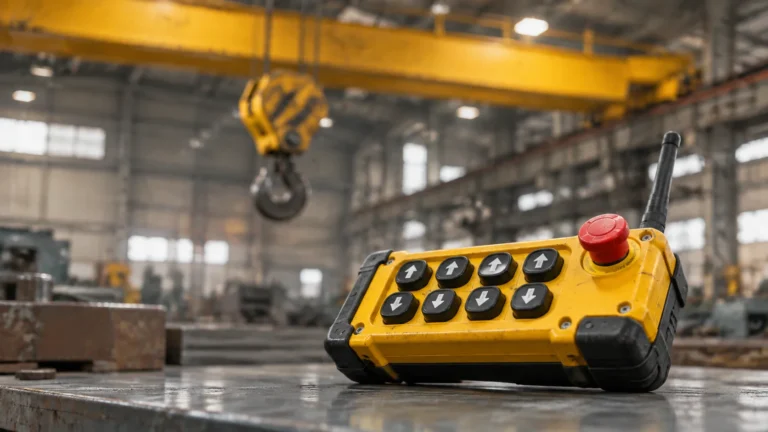
A basic hoist needs four or six functions. Add a vacuum lifter and the list lengthens in a specific way: vacuum on, vacuum release, and usually a separate “release permitted” or grip-confirm action. Some units add pad selection for handling different plate sizes, and a tilting or rotating head adds two more motions.
The count is not the problem. The problem is that two of those functions are irreversible in the physical sense: releasing vacuum drops the load, and there is no undo. On a hoist, pressing the wrong direction produces movement the operator can correct. On a vacuum pad, pressing the wrong function produces a load on the floor.
That asymmetry is why the vacuum group should be physically separated on the transmitter, and why it should not share a button with any motion. Where the function list is still being assembled, the checklist in what to send a supplier for a remote control quote covers how to describe the motion side, and vacuum is added on top of that result rather than inside it.
On a well-planned lifter, vacuum is interlocked in both directions. Motion is inhibited unless vacuum is established above the set threshold. Release is inhibited while the load is above a defined height, or unless a second deliberate action confirms it. Both conditions are logic in the lifter’s own control panel, but the radio has to be able to express them.
In practice that means the remote needs feedback inputs, not only outputs. A transmitter with an indicator for “vacuum established” lets the operator see the interlock state without looking at the panel, which matters on a gantry where the panel is behind the load. A system that only sends commands leaves the operator guessing whether a refusal to move is a radio fault or an interlock doing its job.
The release action itself is worth planning as a two-stage command. The common arrangement is a sustained press, or a press of a dedicated release button that is only accepted when the load is low enough. Either way the requirement should be written down, because a single momentary release on a keypad next to the hoist buttons is the arrangement that produces accidents.
The scenario to specify is the one where the operator is holding a plate and everything stops. Three separate failures can cause it, and the lifter should behave in a defined way in each.
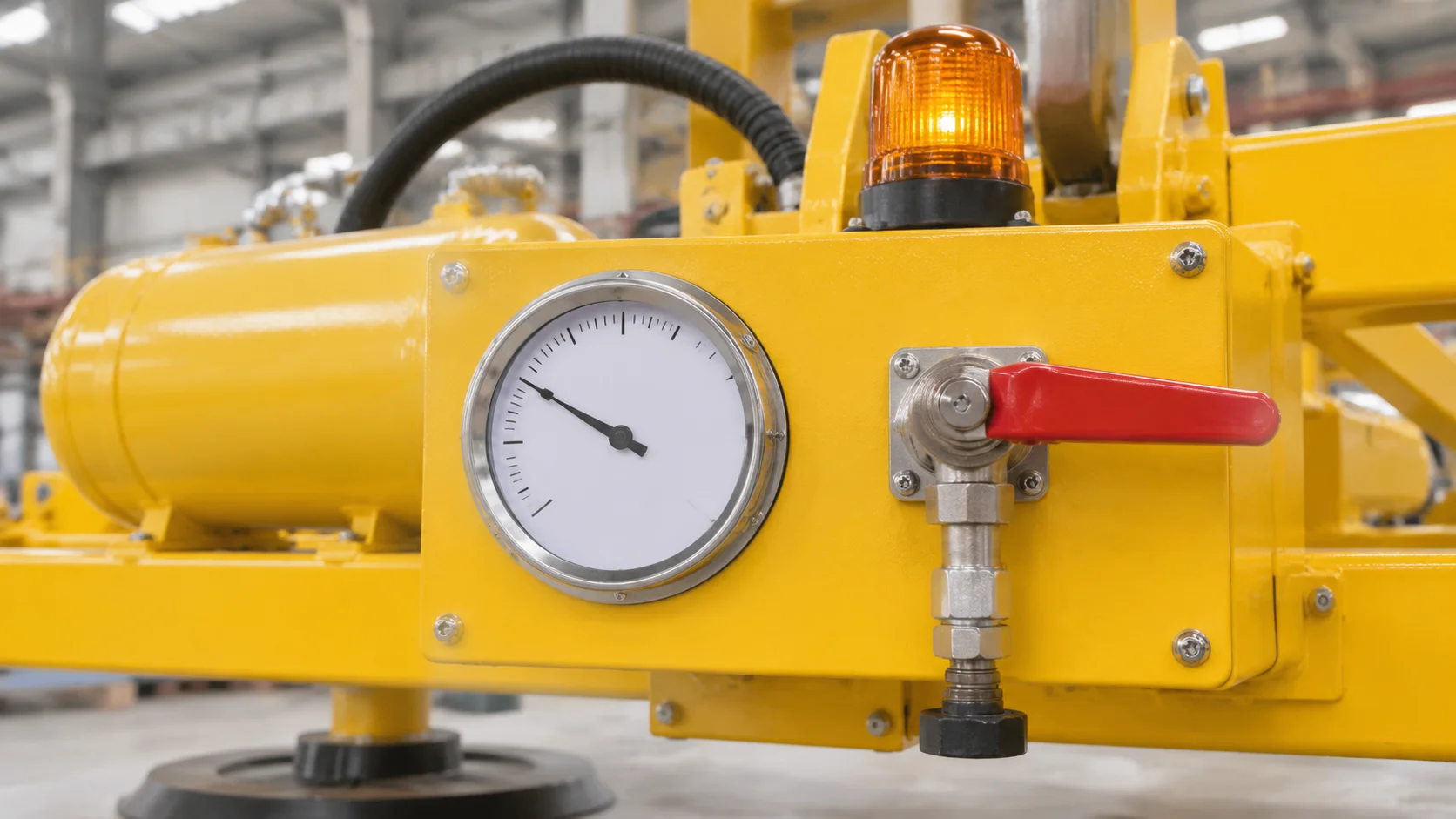
If the radio link drops, the receiver drops its outputs. A vacuum that is held by a pump will lose vacuum unless the pump is not the only thing holding it. This is why vacuum lifters carry a reservoir and a non-return valve: the vacuum is stored, and the retention time after loss of supply is a specified property of the lifter, not of the remote. The remote’s contribution is to make sure the loss is signalled — an audible or visual warning on the transmitter or on the lifter tells the operator to lower the load while retention still holds.
If crane power fails, the same logic applies to the vacuum circuit, and the hoist brake engages. The load stays where it is until power returns, and the retention time is what governs whether it stays attached. On a lifter with a battery-backed hold, that battery becomes a maintenance item in its own right.
If the transmitter battery fails, the receiver should treat it as a lost link. That is the correct behaviour and it is the reason a failing transmitter pack is a safety event on vacuum duty rather than an inconvenience. The drain patterns behind that failure are covered in crane remote control battery drain.
A spreader beam changes the geometry rather than the vacuum logic. The beam distributes load across two hooks, so the remote now controls either two hoists in tandem or one hoist with a beam that must be levelled. If the beam carries vacuum pads at its ends, the pad groups may need to be commanded separately for long loads and together for short ones.
Two-hoist tandem work is the harder case because the two hoists must move together within a tolerance, and a single transmitter can only send one command per function unless the receiver is configured to drive both. The design questions — pairing, tolerance, and what happens when one hoist lags — are covered in tandem lift remote control. What matters here is that the spreader does not double the button count; it duplicates the functions across two receivers.
All three are below-the-hook devices with a release that cannot be undone, but the failure modes and the operating disciplines differ enough to change the specification.
| Device | What holds the load | Behaviour on supply loss | What the remote must signal |
|---|---|---|---|
| Vacuum lifter | Stored vacuum in a reservoir, sealed by pad and valve | Holds for a defined retention time, then fails | Vacuum established, and a warning as retention is consumed |
| Grab bucket | Hydraulic or mechanical closing force | Holds position if the valve blocks; drops if it bleeds | Open and closed end positions |
| Lifting magnet | Electrical current in the coil, or permanent magnet | Electromagnet releases at once; permanent magnet holds | Magnet energised, and often a battery-backed hold state |
The function table is the document that prevents most of the expensive mistakes on this kind of system. Build it with the lifter supplier and the crane supplier in the same conversation, because the interlock lives between them.
The last step decides the model. A twelve-function unit such as the twelve-function industrial remote controller usually covers a single-pad lifter with a rotating head, while a beam with two pad groups and tilt will need more.
If you are planning a vacuum lifter or a spreader with pads, send the function table, the retention time and the interlock conditions and we will confirm the transmitter and receiver arrangement against them. Send the lifter details directly and we will return a proposed function allocation.
It can drive the outputs, but a standard unit may not carry the feedback the operator needs. What matters is whether the transmitter can show vacuum state and whether the receiver can accept the interlock conditions. Ask for those two capabilities rather than for a vacuum-specific model.
The receiver drops its outputs and the lifter holds on stored vacuum for its rated retention time. The load does not fall immediately, but the operator has a limited window to lower it. That window is a property of the lifter and should be stated on the unit.
Momentary, and preferably accepted only when a second condition is met, such as the load being below a set height. A maintained release means a single press can drop a load with no further confirmation, which is the arrangement to avoid.
Count motions first, then pad groups, then any tilt or rotate axis, and keep the vacuum group on separate buttons. A two-group beam typically lands above twelve functions once rotate and tilt are included, which moves the choice to a larger transmitter.
The radio is part of the control system, so the retention behaviour and the release logic have to match what the lifter was assessed against. When the remote is replaced on an existing lifter, confirm that the release and loss-of-signal behaviour are unchanged before returning it to service.