Pendant Control Station Wiring: Cores, Common, Earth
Cores follow functions, not buttons. The sum that sizes the cable, why the stop must not share the button common, and five pre-power checks.
Read More

A precast concrete crane remote control fails for reasons that have nothing to do with radio. Cement dust is alkaline and abrasive, release agents are solvent and oil based, the curing chamber runs hot and close to saturated, and the gantry outside it runs in rain and frost. A handset that survives a machine shop can still be dead in eighteen months in a precast yard, and the usual cause is a seal that was rated for water and never for chemistry.
Four exposures act on the same handset, and each one attacks a different part of it. Separating them is what makes a specification possible.
| Exposure | What it attacks | Typical symptom | Specification response |
|---|---|---|---|
| Alkaline cement dust, wet or dry | Housing surface, keypad edges, connector pins | Chalky bloom, stiff keys, intermittent buttons | Dust-tight housing, no exposed aluminium, sealed keypad skirt |
| Release agent and mould oil | Rubber gaskets, printed legends, plastic windows | Swollen seals, worn lettering, cloudy display | Oil-resistant gasket material, legends moulded into the key rather than printed |
| Curing chamber heat and steam | Display, battery, internal condensation | Blank or slow display, short runtime, water inside the lens | Chamber-rated components, pressure-equalisation vent, charging kept outside the chamber |
| Outdoor gantry weather | Antenna, cable glands, battery contacts | Range loss after rain, corroded contacts | IP65 minimum, correct gland torque, antenna above the girder line |
Read down the fourth column and you have most of the enquiry. Read the third column and you have most of the warranty claims.
Portland cement dust is not neutral dirt. Mixed with condensation or rain it forms a mildly alkaline film with a pH high enough to attack aluminium and to creep into any joint that is not compressed. The damage is slow: the housing goes chalky, the keys stiffen, and one button starts to need a harder press.
The practical rules follow from that. Aluminium alloy housings are a poor choice in a wet alkaline environment unless properly coated: alkali attacks aluminium once abrasion breaks the oxide layer. Engineering plastics are the safer base, and the keypad is the real weak point: a moulded silicone keypad with a skirt that seals against the housing survives far longer than a flat membrane glued to a plastic window. Legends should be moulded into the key rather than printed, because release agents remove print long before they remove silicone.
Release agents add a second chemistry. Mould oils exist to prevent adhesion, exactly what a gasket must not do, and some solvent-based products swell EPDM and stress-crack polycarbonate windows. If the yard uses a solvent-based release agent and the handset hangs in the casting area all shift, ask for oil-resistant gasket material and a polycarbonate-free window. The comparison in remote control enclosure material covers the trade-offs between the common housing plastics; the dust behaviour in a timber yard, described in sawmill and timber yard crane remote control, is a useful contrast because wood dust is acidic rather than alkaline.

Steam curing is the exposure most often left out of a specification, and it kills handsets fastest. A chamber at 50 to 70 °C and near saturation is outside the comfort range of ordinary components: liquid crystal displays go sluggish, cells should not be charged above roughly 45 °C, and housing plastic softens near its deflection temperature.
Condensation is subtler. Each move from the hot wet chamber to the cooler yard and back makes the air inside the housing contract and expand, and every cycle pulls a little moisture past the seal. A gasket alone does not stop this; a pressure-equalisation vent does, because it lets the housing breathe through a membrane that passes vapour slowly and blocks liquid water. Without a vent, a handset that tests dry on Friday can have a teaspoon of water behind the lens by the end of the month.
The robust arrangement is procedural as much as electrical. Keep the receiver and its panel outside the chamber, hang the handset on a bracket at the chamber door rather than carrying it inside, and charge batteries in the yard office instead of on the gantry. Radio does not need to enter the chamber; the operator does, and the operator can leave the handset on the hook.
A precast yard is a long, low site. Beds run well over a hundred metres, and between the operator and the crane stand stacks of finished panels two or three high. Concrete is an effective barrier at radio frequencies, so the range figure on a datasheet is not the range you will get when the driver stands behind a stack of wall units.
Two things fix that, and neither is a bigger number on the box. The first is antenna position: mount it high on the gantry, above the girder line and clear of the motors, so it works over the stacks rather than through them. The second is frequency choice. A lower band such as 433 MHz bends around obstructions better and generally gives more usable range in a cluttered yard, while 2.4 GHz suits sites where neighbouring yards operate close together and channel separation matters more than distance.
Rain and frost then act on the same hardware. Water ingress usually starts at a cable gland that was tightened by hand rather than to a torque, or at a connector left unmated under the gantry. Winter adds a mechanical effect: gasket materials stiffen in hard frost and take a set, so a seal that was correct in summer can leak in February. The outdoor exposure in port and shipyard crane remote control is harder still, with salt on top of everything described here.
A precast yard is electrically noisy in a way that a machine shop is not. Moulds are opened and closed by hydraulic power packs with large motor starters, beds are compacted on vibrating tables, and gantry long travel is increasingly driven by variable-frequency drives. All three produce interference that shows up as a missed command rather than a dead handset, which makes it harder to diagnose.
Three precautions cover most of it. Mount the receiver on the gantry structure, never on a vibrating table or on the mould frame, and use a gland that grips the cable so vibration is not carried into the terminal block. Keep the receiver’s control cable away from motor and drive cables, crossing at right angles where they must cross. Check the emergency stop and signal-loss behaviour with the drives running: a receiver that is perfect on a stationary crane can drop commands once long travel starts. The checks in crane remote control daily checks and handover are worth adapting into a shift-start routine for a yard like this.

Most precast enquiries describe the crane and omit the environment, which is the part that decides whether the unit lasts. Eight items turn a generic quotation into a specification.
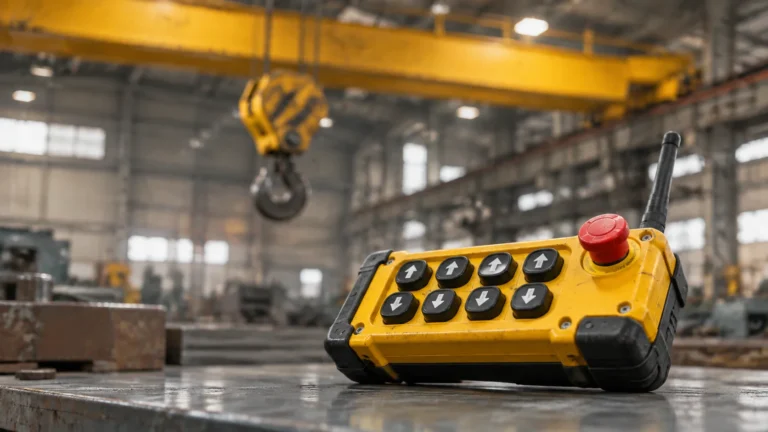
With those eight answers a supplier can choose housing, gasket, keypad, vent and battery chemistry instead of quoting a catalogue number. The ten-function wireless remote control and the wider industrial crane remote control system cover most yard configurations, and the eight answers can go straight into the contact form for a written recommendation.
IP67 covers dust tightness and short immersion, which handles rain but says nothing about steam, heat or alkaline chemistry. In a curing chamber, IP67 without a pressure-equalisation vent still draws moisture in through thermal cycling.
It can, but it should not be stored there: heat shortens display and battery life even when the seals hold. Leave it on a bracket at the chamber door and charge in the office.
Almost always alkaline dust combined with release agent at the keypad skirt. The dust abrades the seal, the oil stops it seating, and a film bridges the contacts. A moulded keypad with a sealing skirt and moulded legends prevents most of it.
433 MHz is usually the safer choice for range and for working around stacks of concrete panels. Choose 2.4 GHz when several cranes or neighbouring sites share the air and channel separation matters more than distance.