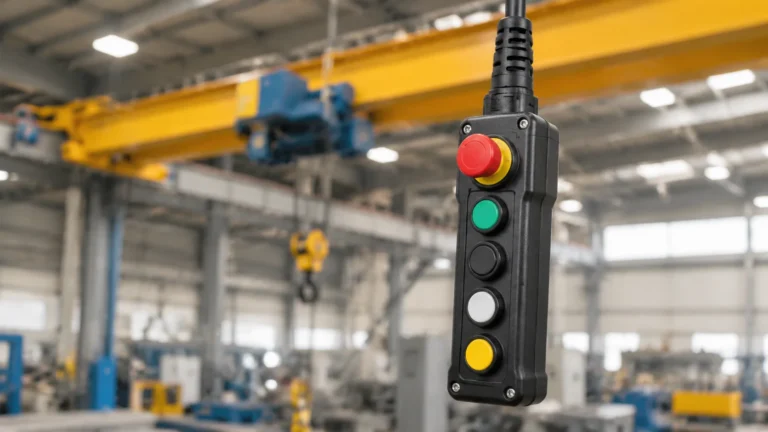
Pendant Control Station Wiring: Cores, Common, Earth
Cores follow functions, not buttons. The sum that sizes the cable, why the stop must not share the button common, and five pre-power checks.
Read More

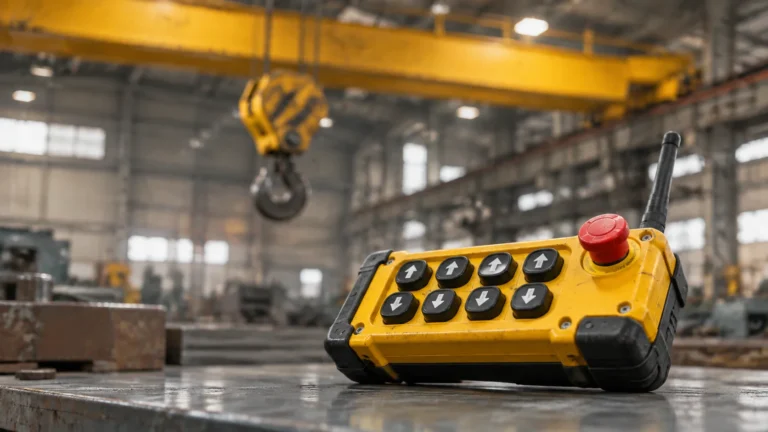
A steel coil crane remote control has to do something most crane radios never do: put a twenty-tonne coil into a rack within a few centimetres without touching the coil beside it. The radio link is the easy part. What decides whether the job works is how the transmitter divides speed, how fast the receiver lets go of an output, and whether the tong or magnet is wired into the same safety circuit as the hoist.
A coil is a soft-edged cylinder. It is damaged at the moment of contact, not during the lift: a coil set down twenty millimetres hard dents the outer wrap, and a coil pushed sideways into a rack deforms the eye. That is why the operator spends most of the cycle in the last two hundred millimetres, not in the twenty metres of travel, and why the whole specification should be built around the last two hundred millimetres.
Read the sequence from the driver’s seat and the requirements reorder themselves: travel speed barely matters, while creep resolution and the release behaviour of the grab matter a great deal.
| Handling step | What it actually demands | Where radios usually fall short |
|---|---|---|
| Lifting off the saddle | A straight vertical pull with no swing induced | Single-speed output overshoots when the coil is light |
| Carrying across the aisle | No lost commands behind stacked coils | Antenna mounted low on the bridge, range collapses at the far bay |
| Lowering into a rack tier | Creep of a few millimetres per second, with jog | Only fast and slow, and slow is not slow enough |
| Opening the tong or dropping the magnet | Release only when the coil is genuinely supported | Release command not interlocked with brake or load state |
| Withdrawing the hook | Slow reverse with no snatch | Receiver release delay turns a gentle reverse into a jerk |
The third column is where coil warehouses lose coils, and every entry in it is a specification decision rather than a maintenance problem.
Three functions decide positioning quality, and only the first is normally quoted. The first is a genuine creep speed. Almost every industrial handset offers two speeds, but the ratio between them varies from about 1:3 to about 1:10, and a 1:3 ratio is useless for rack work: the fast speed is right for the aisle and the slow speed still moves a coil too far. Ask for the measured ratio at the hoist, not the ratio printed in the brochure.
The second is a jog or point-mode behaviour, where a short press produces a short, bounded movement rather than a movement that continues while the button is held. On inverter-driven long travel this is sometimes a parameter in the drive rather than in the receiver, and it is worth knowing which device owns it before the panel is wired.
The third is resolution in the hoist direction. A proportional joystick gives continuously variable speed and is the cleanest answer for C-hook work, but it costs more, needs an analogue or bus interface at the drive, and is wasted if the hoist itself only has two contactor steps. On a contactor hoist, a two-speed transmitter with a 1:8 ratio will place coils better than a joystick driving a two-step machine.

When the operator releases the hoist button, the brake does not close instantly. There is the receiver’s output release time, the contactor drop-out time and the mechanical brake setting time, and under a full coil the load descends by a few millimetres while all three happen. That drift is normal and predictable. It becomes a problem when it grows between services, because the operator compensates by stopping higher, and the compensation hides a brake that is wearing.
Two symptoms deserve different diagnoses. One consistent drop on every stop points at brake gap or contactor release. A second, smaller drop a fraction of a second later points at the receiver holding an output longer than the contactor, which happens when a solid-state output drives a contactor with a large coil, or when a release delay has been set for another purpose. The measured figures in crane remote control response time give the numbers to compare against.
One mechanical consequence is worth knowing before blaming the radio. A C-hook carries the coil off-centre, so bridge and trolley brakes see a torque the crane was not designed around. If the bridge creeps after release, inspect the brake.
Coil storage is a maze of steel walls. Once racks are three tiers high, the driver at floor level is looking at the side of a stack for most of the cycle, and the receiver is looking through it. Steel attenuates at both common bands, so the range printed on the datasheet is a line-of-sight figure that the aisle will not deliver.
Position is worth more than power. Mount the antenna high on the bridge, above the girder line and clear of motor frames; a receiver bolted to the trolley at rack height will drop commands as soon as a stack comes between it and the driver. Where the driver works from a fixed pulpit rather than following the crane, a second antenna point or a repeater costs less than a bigger transmitter that still cannot get through steel. The band choice is the usual one: 433 MHz bends around obstructions better, 2.4 GHz separates neighbouring systems better in a dense warehouse.
Handover is the other blind spot, and it is procedural. Two drivers on two shifts, one transmitter, three tiers of identical coils: the confirmation that the right coil in the right bay is being lifted has to be spoken or scanned, not assumed from a label the driver cannot see. A five-second radio call before the first lift of a shift prevents more damage than any receiver upgrade.
Coil tongs, C-hooks, vacuum pads and lifting magnets all add a state the crane does not otherwise know about: whether the load is gripped. On a manual pendant that state lives entirely in the operator’s head. On a radio system it can be wired into the safety circuit, and in a coil warehouse it usually should be.
The arrangements are simple. The tong open command can be blocked while the hoist is in motion, or while a load cell reads below a threshold. A magnet controller returns a “load present” signal that must be true before the hoist lowers into a rack. A transfer car in the aisle drops the travel enable rather than merely sounding an alarm. None of these need a smart transmitter; they need spare receiver outputs and a wiring diagram agreed before the panel is built. The logic is the same for scrap handling in grab bucket and magnet crane remote control, and radiant heat changes housing and cable choice in foundry and steel mill crane remote control.

Coil warehouse enquiries usually describe the crane and forget the rack. The rack is what breaks coils. Eight answers are enough to specify a system properly.
With those answers a supplier can choose speed steps, output count, antenna position and interlock wiring in one pass. The ten-function wireless remote control covers a single-hoist coil crane with tong or C-hook, the industrial crane remote control system covers multi-motion bays, and the eight answers can be sent through the contact form for a written recommendation with a wiring proposal.
It can be, if the ratio is around 1:8 or better and the hoist stops repeatably. A 1:3 ratio is not enough: the slow step still overshoots a rack tier. Measure the actual speed at the hook before accepting a two-speed solution.
Usually the receiver is holding the output slightly longer than the contactor, or a programmed release delay is active. Check the measured release time against the brake setting time before adjusting the brake.
Rarely. Steel attenuates the signal, so the answer is antenna position above the girder line, or a repeater in a long bay. Extra power mostly increases interference for neighbouring cranes.
For rack work, yes. Wiring the release so it cannot be given while the hoist is moving, or while load is not confirmed, removes the most common cause of a dropped coil without slowing the cycle.