Pendant Control Station Wiring: Cores, Common, Earth
Cores follow functions, not buttons. The sum that sizes the cable, why the stop must not share the button common, and five pre-power checks.
Read More

Inside a crane remote control receiver, the output stage is either a set of electromechanical relays or a set of solid-state switches. Both will operate a contactor coil on a bench. They behave very differently after two years of inching a hoist, or when the load is a solenoid valve that only needs a few milliamps of leakage to stay partly open.
This guide compares remote control receiver relay and solid state outputs on the characteristics that actually decide the choice: contact resistance, life under load, leakage, voltage drop, inrush tolerance and what happens when one output fails on a Sunday. It closes with a short decision table you can use against your own panel drawing.
The receiver’s output is a low-current control signal asked to do a high-current job indirectly. In most crane panels it energises an AC contactor coil, which in turn switches the motor. In other installations it drives a hydraulic valve solenoid, a brake coil, a horn, a work light or a magnet controller input. Each of those loads has a different current profile, and the profile — not the nominal voltage — is what stresses the output.
Before choosing, write down what each output pair feeds, the coil’s steady-state current, its inrush current, whether it is AC or DC, and how many times per hour it operates. Those five numbers answer the relay-versus-solid-state question in most cases.
| Characteristic | Electromechanical relay | Solid-state output |
|---|---|---|
| On-state resistance | Milliohms, negligible drop | Typically 1–2 V drop, so it dissipates heat |
| Off-state leakage | Effectively none | Small leakage current, usually milliamps |
| Inrush tolerance | High; contacts handle coil inrush well | Limited; needs a rating above the inrush |
| Switching speed | Several milliseconds | Microseconds |
| Mechanical life | Finite, reduced by arcing | No moving parts, but sensitive to transients |
| Isolation | True galvanic isolation when open | Not a physical break; leakage remains |
| Failure mode | Usually fails open or welded closed | Usually fails shorted |
| Field repair | Plug-in replacement if socketed | Board-level replacement |
Two rows carry most of the risk. The leakage row decides whether a valve can be trusted to close, and the failure-mode row decides what the crane does when the output dies. A relay that welds closed on a hoist-up command is dangerous. A solid-state output that fails shorted is dangerous in exactly the same way, so neither technology is intrinsically safer; what matters is whether the panel has a monitored or redundant path that catches it.
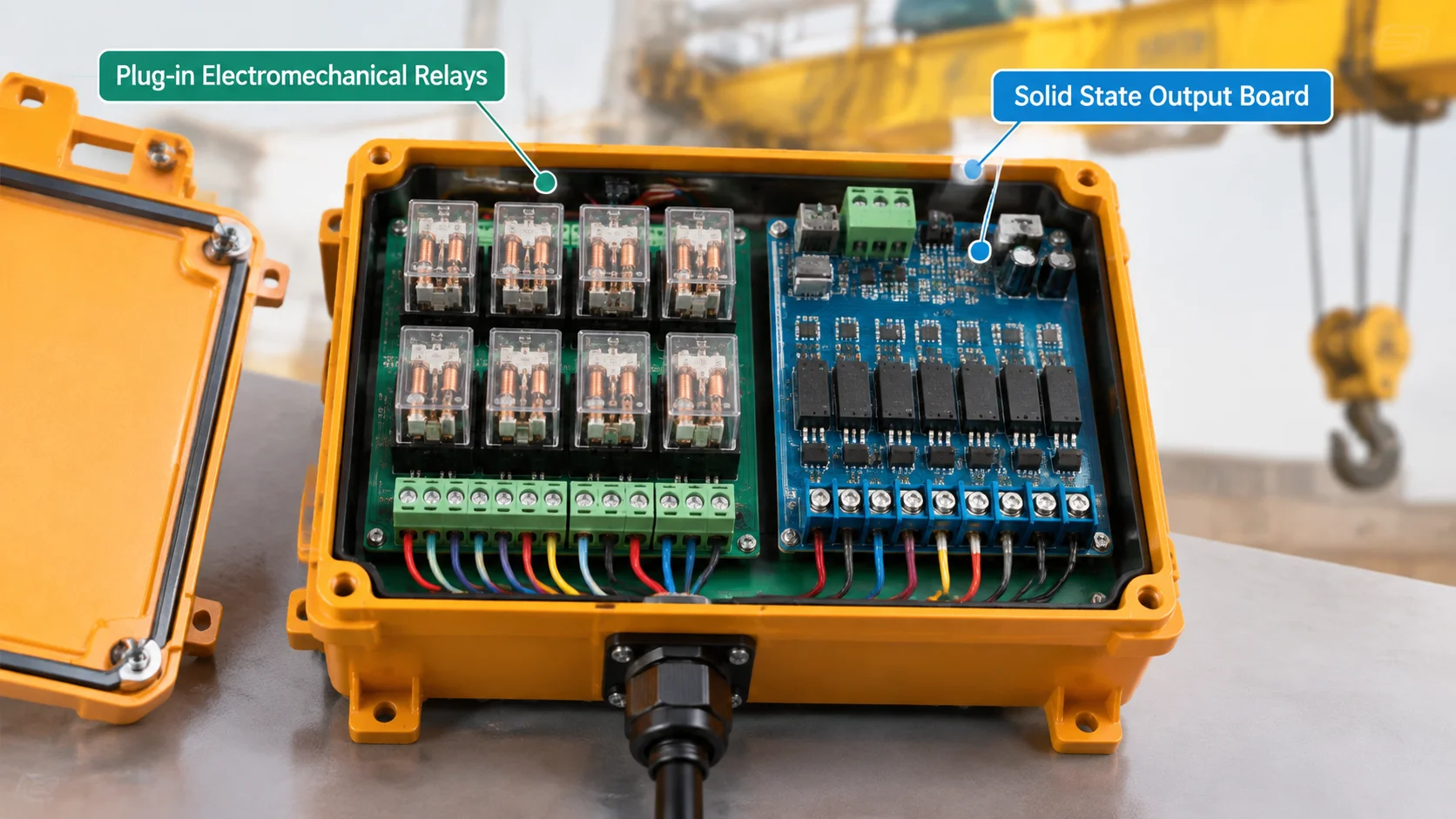
An AC contactor coil is an inductive load with an inrush current several times its holding current. Relay contacts handle that inrush comfortably because a metal contact closure is not current-limited. Solid-state outputs can also handle it, but only if the device is rated for the inrush rather than the holding current, and plenty of small receivers are not. This is the point where a twelve-function F24-12S 12D class receiver with relay outputs is the easy answer for direct contactor switching.
A hydraulic valve solenoid is the opposite problem. Steady-state current is low, the coil is inductive, and the valve may begin to shift at a fraction of its rated current. A solid-state output with a milliamps-level leakage current can hold that valve partly open even when the receiver says the output is off, which shows up as a slow drift rather than a clean fault. If you are driving valves from a solid-state output, confirm the leakage figure against the valve’s drop-out current, and fit a flyback diode or an RC suppressor across the coil as the valve maker specifies.
The receiver output wiring diagram shows the terminal arrangement for both types, including where suppression components belong.
DC solenoids and brake coils generate a collapsing voltage spike when switched off. Relay contacts survive it with visible arcing; solid-state devices may not survive it at all. Whatever the output type, fit suppression across the coil as the coil manufacturer specifies: a flyback diode on DC, an RC network or varistor on AC. Suppression is not an optional extra on a solid-state output, it is part of the installation.
Also check the output’s voltage drop against the coil’s minimum pull-in voltage. On a 24 V DC system, a 1.5 V drop plus a long cable run can leave the coil below its guaranteed pull-in value, and the symptom is a valve that clicks but does not shift. Measure at the coil, not at the receiver terminal.
Crane work is inching work. An operator positions a load by tapping a button, often dozens of times per lift, and every one of those taps is a contact making and breaking an inductive load. The arc at the contact face erodes material a little each time, contact resistance creeps up, and eventually the contact either fails to make or welds.
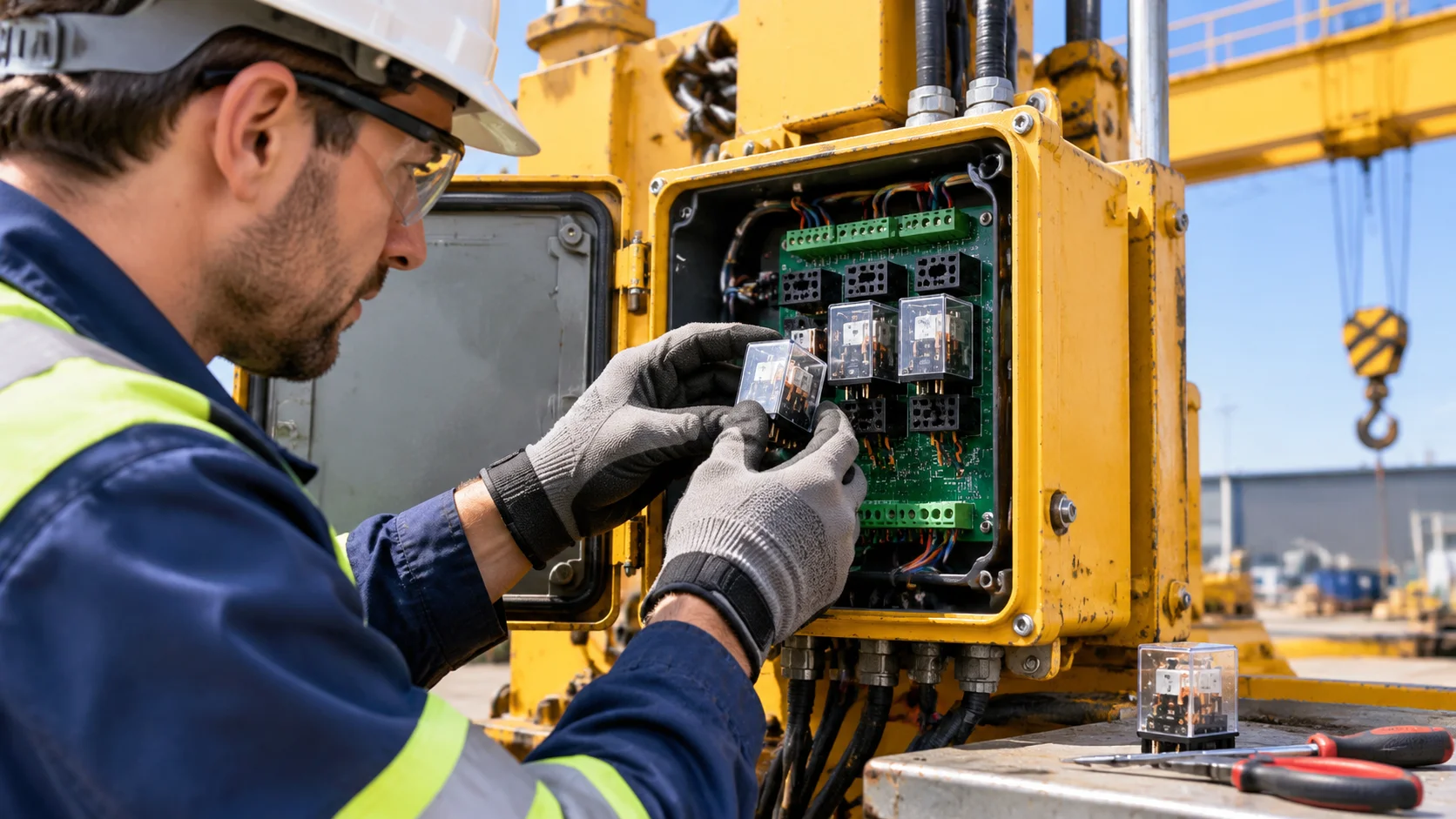
For a crane doing heavy inching on hoist and trolley, the hoist-up and hoist-down outputs are the first to go, and they usually go within the same month because they see the same duty. Keeping a spare pair of plug-in relays on the shelf is cheaper than a lost shift, and it is the single most useful spares decision on a relay-output receiver. When the symptom is that nothing moves rather than that one direction is weak, the fault is usually upstream of the output stage, and the not working checklist works through the layers in the order that finds it fastest.
This is where the two technologies diverge most in real plants. A socketed relay is a five-minute field swap by any maintenance technician, and the spare costs almost nothing. A solid-state output board is a receiver-level or board-level replacement, usually a stocked item rather than a shelf item, and the lead time is the supplier’s.
That does not make solid state worse; it makes the spares plan different. If you specify solid-state outputs, hold one spare receiver per critical crane or negotiate a guaranteed replacement lead time into the contract. A complete crane remote control system specification that names the output type, the relay part number or the board revision is worth more than one that says only twelve functions.
| Your situation | Reasonable choice | Watch out for |
|---|---|---|
| AC contactor coils, moderate duty | Relay output | Keep spare plug-in relays |
| Heavy inching, high operations per hour | Solid state or relay with planned replacement | Inrush rating, heat |
| DC solenoid valves | Either, with suppression fitted | Leakage against valve drop-out current |
| Hazardous area or sealed enclosure | Solid state, no arcing | Thermal derating inside the enclosure |
| Site with limited technical staff | Socketed relay | Contact erosion, monitor resistance |
| Long cable runs to the load | Relay, or solid state with verified drop | Cable capacitance and voltage drop |
Cost follows the choice closely. A relay-output receiver is usually the cheaper unit, but over a five-year horizon the relay spares and the downtime may reverse that, which is one of the variables covered in the price factor breakdown. For grab and magnet duty, where outputs hold a state rather than pulse, the duty cycle on the output is lower but the consequences of a welded contact are higher, so read the grab and magnet guide alongside this one.
Only if the receiver was built with that option, because the driver circuit, the terminal arrangement and often the power supply differ. Retrofitting a solid-state board into a relay receiver is not a field modification; specify it when you order.
Most often leakage current through a solid-state output, and occasionally induced voltage on a long cable run. Check the output’s leakage specification against the valve’s drop-out current, then check the cable route and add suppression at the coil.
It depends almost entirely on load and operations count, so treat the datasheet life figure as a starting point and compare it with your inching rate. In heavy inching duty, replacing the hoist output pair on a planned interval is normal practice.
They dissipate heat in proportion to current and voltage drop, and inside a closed panel that heat has nowhere to go. Confirm the derating curve for the enclosure temperature rather than the ambient in the workshop.
Solid state has no arcing contacts, which is attractive where the enclosure is sealed, but the certification is what decides the answer, not the switching element. Ask for the certificate that covers the complete unit in the intended zone. Tell us the load type and duty through the contact page and the output recommendation can be confirmed against the panel drawing.