Pendant Control Station Wiring: Cores, Common, Earth
Cores follow functions, not buttons. The sum that sizes the cable, why the stop must not share the button common, and five pre-power checks.
Read More

When the power fails, a correctly configured crane remote control lets go. The receiver loses its supply, its output relays open, the contactor coils drop out and the spring-applied brake sets. The load stops where it is and stays held by the brake, not by the radio. That is the intended behaviour, and it is the reason the control circuit is designed to hold the contactor in rather than to command a stop.
The interesting cases are the ones that do not follow that pattern: a magnet that has to keep holding, a grab that was mid-cycle, a receiver that reboots into a state nobody tested, and a flat transmitter battery that looks exactly like a power failure from the operator’s side. This article covers crane remote control power failure behaviour in the order it happens, and how to prove it on your own machine before you need to know.
Three things happen almost together, and the order matters. The receiver’s supply collapses, so its output contacts open. The contactors holding the motions drop out because their coils are no longer energised. The hoist brake, which is released electrically and applied by spring, sets as its coil loses current. Nothing in that chain depends on the transmitter, the radio link or any software decision, which is exactly why it is reliable.
| Device | State without power | What the load does |
|---|---|---|
| Receiver output relays | Open | Motions stop being commanded |
| Motion contactors | Dropped out | Motor supply removed |
| Hoist brake | Spring applied | Load held in position |
| Trolley and bridge drives | Coasting, then stopped by brake or friction | Short overshoot depending on speed |
| Lifting magnet | De-energised unless separately backed up | Load released |
That last row is where power failures stop being routine. A crane with a magnet is not a crane with a hook, and no remote control can fix the difference.
A magnet needs continuous current to keep holding. If the supply fails, the magnet releases and the load drops, regardless of what the transmitter is doing. The remedy is a magnet controller with its own battery backup, sized for a defined hold time, and that equipment is a separate system from the remote control. When you specify a unit for magnet duty, ask what the remote control is expected to do at the moment the magnet controller switches over, and make sure the receiver’s magnet output does not pulse off during the transition.
Hydraulic grabs are different. A grab that is holding a load hydraulically usually stays closed when the pump stops, because the cylinder is held by a check valve or a pilot-operated valve. What it will not do is open, so a load can be stranded in the grab until power returns or until the valve is manually relieved. That is a procedure question as much as an electrical one, and the grab and magnet specification guide covers how the outputs have to be configured for these two tool types.
Any function that is set to latch inside the receiver — a magnet, a grab, a horn, a work light — is latched by an output relay that itself depends on the receiver’s supply. Latching survives a button release, not a power failure, so never treat a latched output as a hold-safe state. Where a magnet or grab has to be switched between two sources rather than simply dropped, that selection sits in a HZ5 rotary cam changeover switch, and the position diagram decides what stays connected at rest.
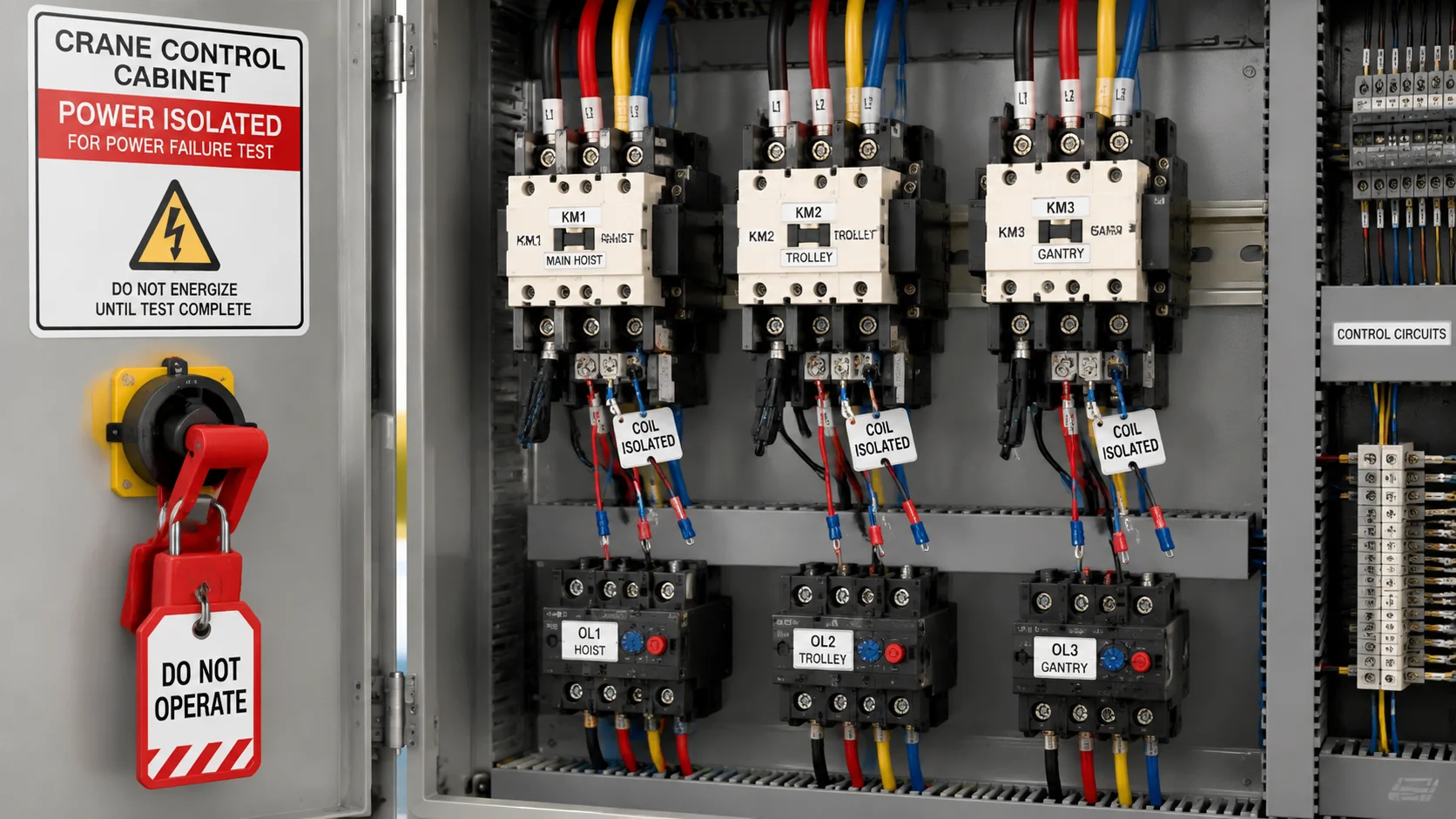
Restoring the supply does not restore the motion, and it must not. When the receiver powers up it needs to re-establish its link with the transmitter, and the transmitter has to be live and paired. Until that happens the outputs stay open. The dangerous version of this behaviour is a panel where the main contactor is wired to pick up automatically when the supply returns, because the crane can then start in whatever direction a stuck button or a fault is calling for.
Ask the panel builder whether the main contactor is held in by a maintained circuit or by a start-and-hold circuit that needs a deliberate reset. On cranes that run continuously, auto-restart of auxiliaries is normal and desirable; auto-restart of motion contactors is not. If the site has ever had a crane move on power restoration, that is the circuit to look at before blaming the remote control. A lorry crane changes that supply question completely, because the radio draws from the vehicle rather than from a panel, and specifying a truck-mounted kit turns on five decisions that a fixed crane never raises.
From the operator’s side the symptoms are identical: the crane stops responding. The causes are entirely different, and so is what happens afterwards. On a transmitter, a low battery gives a warning period — an indicator, sometimes a vibration or a beep — before the unit shuts down. When it does shut down, the radio link goes quiet and the receiver times out and releases its outputs, so the crane stops in the same safe way.
The FAQ page covers the indicator patterns for the common configurations, and the receiver output wiring diagram shows which terminals to measure when you need to tell a dead receiver supply from a dead output. A load that creeps down after the command has stopped is a different fault again, usually mechanical rather than electrical, and separating brake drift from a radio problem is the first ten minutes of any such call-out.
Treat the restart as a procedure rather than a hopeful button press, and write it into the shift handover so it does not depend on who is on site.
If the crane is fitted with a ten-function F24-10S 10D class unit, the restart procedure is short, because a simple relay-output receiver keeps no motion state to restore. Confirm that on your own hardware during commissioning rather than assuming it.
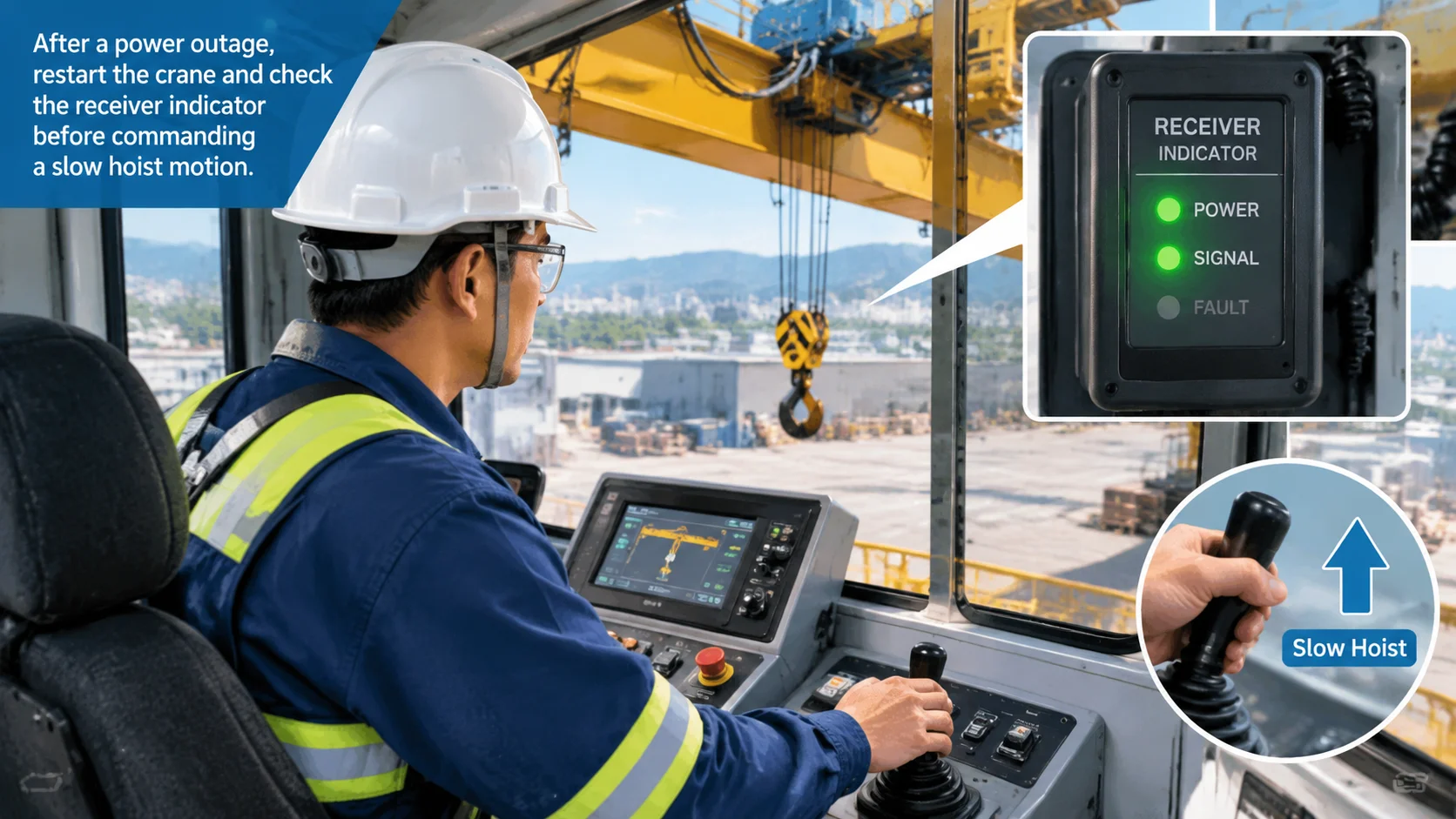
Do this deliberately, at a planned stop, with an authorised person at the panel and nobody under the load. The point is to observe, not to prove that it works.
Record the observations, especially the coasting distance, because that figure is what a risk assessment needs and what an inspector will ask for. A complete crane remote control system supplied with a documented stop behaviour saves this work later.
It should not, because the hoist brake is spring applied and needs power to release. The load will settle slightly as the brake sets, and any overshoot depends on speed and load. A load that falls means the brake or its control circuit needs attention, not the remote control.
The receiver will power up and can re-link with the transmitter, but it will not command a motion by itself. Motion contactors should require a deliberate command. If the crane moves on restoration, the panel’s hold-in circuit is the place to look.
It releases unless it has a separate battery-backed magnet controller. Sizing that backup is a decision for the magnet system supplier, and it should be stated as a hold time in minutes for the site’s evacuation and clearance procedure.
It is possible but it changes the failure mode, because a receiver that stays alive can keep commanding motions while the panel has lost the protection that goes with the supply. Any backup has to be designed with the panel, not added to the receiver on its own.
At commissioning, after any change to the panel or the receiver, and on the same interval as your other crane safety checks. The test takes minutes and it is the only way to know the brake and the stop circuit still behave as documented. Ask for the receiver’s stop behaviour in writing through the contact page when you order.