Pendant Control Station Wiring: Cores, Common, Earth
Cores follow functions, not buttons. The sum that sizes the cable, why the stop must not share the button common, and five pre-power checks.
Read More

Hoist capacity feels as though it should decide the remote control, and buyers routinely ask for “a two tonne remote”. The honest answer is that a one tonne hoist and a ten tonne hoist can use the same handset, and frequently do. What changes with capacity is not the radio link but the panel behind it: contactor coil current, the number of speed stages, and how much of the safety circuit the receiver is trusted with. Sorting those three out is the entire wireless remote control selection exercise, and it collapses into about four questions.
The reason is structural. A radio receiver never switches motor current. Its relay contacts close a circuit that energises a contactor coil, and the contactor carries the load. A 5 A contact at 250 V AC is rated for roughly 1,250 VA of resistive load, while a hoist contactor coil draws a handful of volt-amperes and a brief inrush two or three times that. The coil of a large contactor is not proportionally larger than the coil of a small one, because the coil’s job is to pull an armature, not to move the load.
So a handset rated for 5 A serves a 0.5 t chain hoist and a 10 t double girder crane equally well, provided the number of functions matches. The specification that matters is on the panel drawing: how many motions, how many speed stages, what coil voltage the contactors use, and whether the emergency stop is wired through the receiver or separately.

Three variables move as capacity rises, and only three.
Everything else, including range, enclosure rating and battery life, is set by the working environment rather than by the load: a 1 t hoist in a foundry needs a harsher specification than a 10 t crane in a clean hall.
At this size the machine is usually a single speed chain hoist on a monorail or a short jib. A wireless remote control for 1 ton hoist duty is therefore a simple unit: hoist and lower, plus travel if there is a trolley, which is two to four functions, one speed stage and one contactor per direction.
The natural configuration is a four button handset with a single step per key, or a six button unit if the trolley travels in both directions and a spare pair is wanted for a horn or a second hoist. A compact single speed handset such as the F21-E1B covers the four function case economically; as soon as the machine has more motions, an eight button F24 becomes the simpler answer because the extra keys cost less than the wiring changes needed to share them.
Two details decide whether the installation goes smoothly. The first is the control voltage at the panel terminals, which is often 380 or 400 V on a Chinese-built hoist and occasionally 48 V on an older import. The second is whether the existing pendant has a common return or individually wired buttons, because that determines how the receiver is connected and whether the pendant can stay in parallel as a backup. Both are visible on the wiring diagram, not on the capacity plate.
The jump from two tonnes to five is mostly about speed staging. A 3 to 5 t hoist is expected to inch a load into position, so a dual speed or inverter-driven hoist is common, and the handset needs two step buttons. This is where the single speed and dual speed versions of the same model diverge: identical shells, different boards and different relay counts. Buying the single speed version and hoping to upgrade later does not work, because the second stage is missing in firmware and in hardware rather than disabled in a setting.
The jump to eight or ten tonnes adds motions more often than it adds speed. A double girder crane of that size usually has long travel, cross travel, hoist and often a second hoist for a rotating or auxiliary function, and the operator may be running a grab or a magnet rather than a hook. Ten functions and above is normal, which puts the machine into the territory of an eight or twelve relay receiver and a transmitter with a function selector.
What does not change is the logic of the buttons. A four motion crane still maps to four pairs of outputs, whatever the tonnage, and the button count question is answered by counting motions and speed stages rather than by reading the capacity plate.
Yes, and this is one of the practical advantages of standardising a fleet. A receiver does not know or care what it is bolted to; it closes relays when a paired transmitter sends the matching word. If a plant has a 1 t jib crane, a 3 t monorail and a 5 t overhead crane all built to the same function layout and control voltage, one handset type can serve all three, with each receiver paired to its own transmitter.
Two constraints apply. A transmitter paired to one receiver will not command another until it is paired there, unless the receivers are deliberately set to accept the same identity, which is what master and backup arrangements do within a single crane. And the spare handset in the stores must be the same speed version as the machine it is meant to rescue, otherwise it half-works, commanding slow where fast is expected.
Standardising is worth doing deliberately: pick the highest function count in the fleet and order that model everywhere, accepting a few unused keys on the small machines.
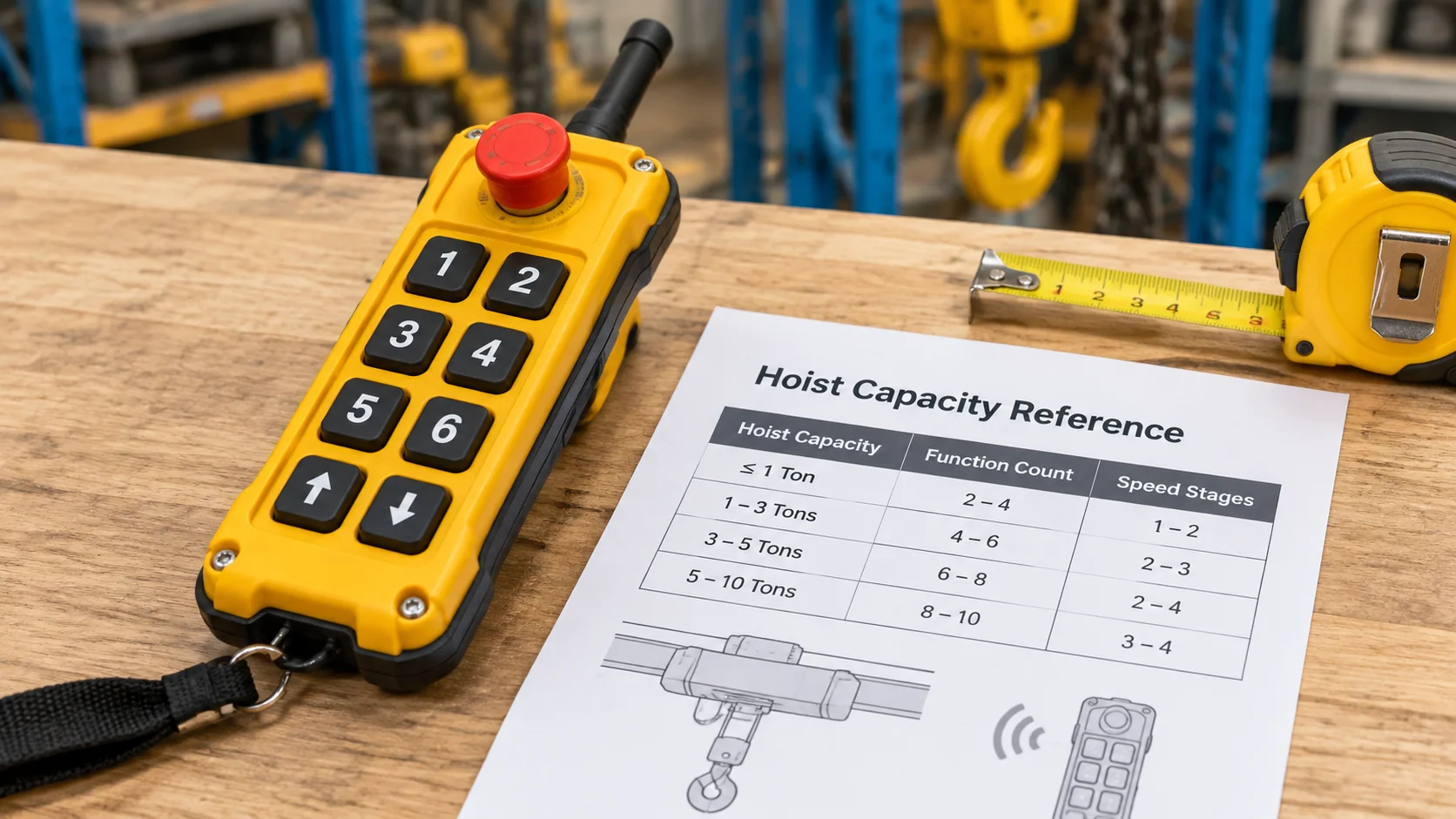
Read the table by function count rather than by tonnage, and treat the capacity column as the typical case it is.
| Typical capacity | Motions | Speed stages | Relay outputs needed | Handset type |
|---|---|---|---|---|
| 0.5–2 t chain hoist | 1–2 | Single | 2–4 | 4 or 6 button, single speed |
| 2–5 t hoist with trolley | 2–3 | Single or dual | 4–8 | 6 or 8 button, speed version per hoist |
| 5–10 t overhead crane | 3–4 | Usually dual | 8–16 | 8 or 10 button, dual speed |
| 10 t and above, multi hoist | 5+ | Dual | 12–20 | 12 button with function selector |
Four checks close the selection. Confirm the control voltage at the panel, not at the nameplate. Confirm whether the hoist has one or two speed stages by listening to it, because operators often describe a dual speed hoist as single speed when they never use the slow stage. Confirm that the emergency stop circuit can accept a series contact from the receiver. And the environment, since a washdown area or a foundry pushes the sealing specification up regardless of capacity.
The F24-6S and F24-6D system is a useful reference point because it makes the speed version explicit: six button positions, six relays plus an independent emergency stop output, 5 A contacts and a 65 to 440 V supply, with the 6S single speed and the 6D dual speed. Neither is a heavy crane remote by tonnage, and both will run a five tonne hoist quite happily, which is the point of the whole article. Send the panel drawing and the motion list through the contact form and the output count can be confirmed against the drawing rather than guessed from the load.
Usually not. The receiver switches contactor coils, not motor current, so capacity barely affects the relay rating. What changes is the number of motions, the number of speed stages and the control voltage.
Yes, if the function count and speed version match and the receiver is paired to the transmitter. The relay contacts carry coil current only, which is similar at both capacities.
The speed version. Single and dual speed units share a shell but differ in board, firmware and relay count, so the choice must be made at order time.
Count motions and speed stages. A four motion dual speed crane needs sixteen outputs, which is normally a twelve button handset with a function selector rather than sixteen separate keys.
No. Range is set by the site, not the load. Steel structure and drive interference reduce it, and the answer is antenna placement, not a different handset.