Pendant Control Station Wiring: Cores, Common, Earth
Cores follow functions, not buttons. The sum that sizes the cable, why the stop must not share the button common, and five pre-power checks.
Read More

Most plants do not lack maintenance effort on crane remote controls; they lack a split. Someone wipes the handset, someone else changes the batteries when the crane stops, and nothing happens in between until a fault forces the issue. A schedule that works divides the work by interval and by who does it, so the ten minute jobs go to the operator and the panel jobs go to the electrician. This is that split, and what each interval is actually looking for.
The pre-shift check is a function test, not maintenance. The operator presses every button with the crane unloaded, listens for each contactor, tries the emergency stop, and confirms the handset battery indicator is not already warning. It catches a dead key, a flat battery and a stop button that will not latch.
What it cannot catch is everything that degrades slowly: a gasket that has started to harden, a terminal screw that has lost a quarter turn, a battery that holds voltage but not capacity, a relay whose contact has pitted. These are invisible from the floor and they are the failures that stop production. The daily checks and shift handover routine therefore needs a companion schedule behind it, and a fleet with more than a handful of units needs a register to prove the schedule ran.
Weekly work is still operator-level, needs no tools, and belongs to whoever signs for the crane.
Ten minutes covers all five. The value is in recording a date and an initial, because a run of four clean weeks followed by a soft key tells a story that a single observation cannot. Two findings also escalate immediately rather than waiting for the quarterly visit: an emergency stop that does not drop the crane, and a crack anywhere near the battery compartment, since water finds that path first.

Quarterly work is electrical and goes to a competent person with the isolator locked off.
First, confirm pairing. Press each button and watch the corresponding receiver LED rather than the crane, so the test separates radio from power circuit. Second, spot-check range: walk the normal operating positions with a load on, and record where control is lost. A range that has shortened by a third since commissioning usually means antenna damage or a new obstruction rather than a radio fault.
Third, tighten the terminals. Ferrules work loose under thermal cycling, and a loose output terminal produces a fault that looks like a receiver failure and moves when the panel is bumped. Fourth, inspect the seals: receiver gasket, cable gland and the handset’s own joint line. A gasket that has gone hard is not sealing, however good it looks.
This is also the point to read the receiver’s diagnostics if it has them, since status LEDs and blink codes log intermittent events that the operator never reports.
Annual work is about consumption rather than condition. Relay contacts have a mechanical and an electrical life, and both are counted in operations. A receiver driving eight outputs on a busy crane can be several hundred thousand operations into its rating after a year, and the contacts pit before the coil fails. Replace output relays on the count if the receiver logs it, or on inspection if it does not.
Battery capacity is the second item. A set of cells that reaches the low battery warning at half the interval it managed when new has lost capacity, and it will fail on a cold morning rather than in the workshop. Measure, do not guess; the symptom of a failing set is covered in why handsets eat batteries.
The third is paperwork: confirm the firmware version and the nameplate match the machine file, and that the rating still fits the panel. Panels get modified, hoists get replaced, and a receiver installed for a single speed machine can end up on a dual speed one.
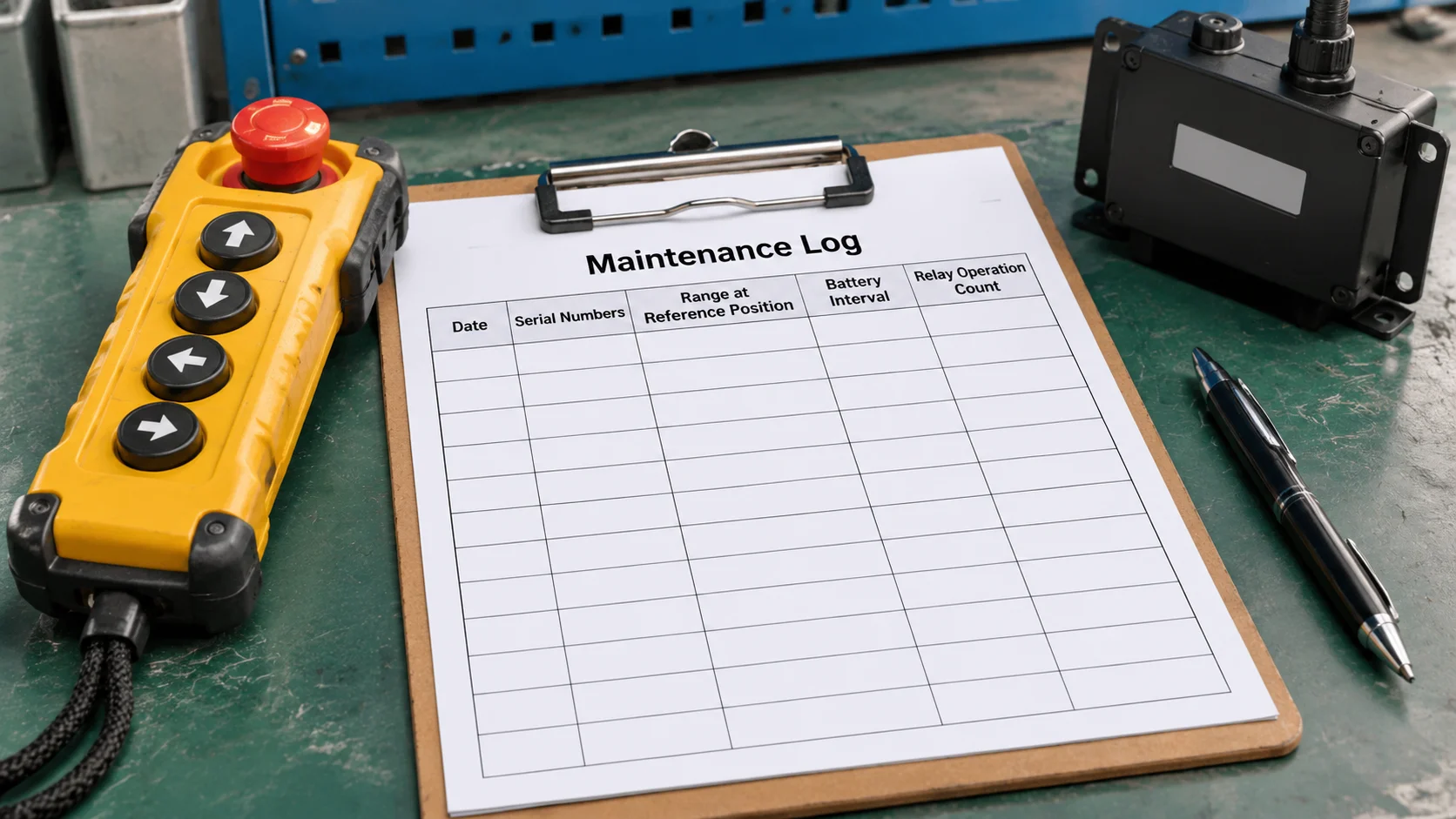
A record with too many fields is not filled in. Six are enough to show degradation over time.
| Field | Why it earns its place |
|---|---|
| Date and interval | Shows whether the schedule actually ran, which matters after a failure. |
| Serial of handset and receiver | Prevents a swapped unit hiding a repeat fault on the same machine. |
| Range at reference position | The single best early indicator of antenna, cable or interference problems. |
| Battery interval to warning | Turns a vague “battery seems weak” into a trend line. |
| Relay operation count | Schedules contact replacement instead of reacting to it. |
| Result and action | Pass, adjust, replace, or escalate. One word, and it forces the decision. |
Keep the record against the crane, not against the handset, because the handset moves between machines and the crane is what has to keep running. The fleet audit format does the same job across a site, and running both is not duplication: the audit finds the machines with no record, and the record keeps the machines the audit passed from drifting.
Three findings should end the discussion. A hard or cracked gasket is replaced, never re-seated with sealant, because the seal relies on compression rather than adhesion. A relay contact that has pitted or welded is replaced as a unit, since a filed contact changes its rating. A handset shell cracked at a screw boss is replaced, because the crack propagates and the unit will fail in the rain rather than in the workshop.
Two findings justify a whole-unit replacement instead of a part. A receiver with a corroded board, typically from a gland that leaked for a season, is not economic to repair. And a handset several years old with worn legends, a worn belt clip and a tired keypad is usually cheaper to replace than to refurbish, which is also why keeping spares on a single source matters more than buying the cheapest unit each time.
The F24-6S and F24-6D system is straightforward to schedule against because its serviceable parts are few: relay outputs rated 5 A, a sealed IP65 enclosure, a gasket, and a transmitter running on four AA cells. Fewer wear items means the annual review is mostly a count and a battery measurement. For a site building the schedule from scratch, send the fleet list and the shift pattern through the contact form and the intervals can be set against your operating hours rather than a generic table.
Weekly for housing, belt, key feel, battery and emergency stop; quarterly for pairing, range, terminal torque and seals; annually for relay counts, battery capacity and documentation.
The operator does the weekly items with no tools. The quarterly and annual work needs a competent person with the isolator locked off, because the panel is open and live terminals are exposed.
When the interval from a full charge to the low battery warning has roughly halved. Capacity fades gradually, then fails suddenly in cold weather.
No, on an operation count or an inspection. Contacts pit with switching cycles rather than with calendar time, so a lightly used receiver can run for years on the same relays.
Yes, because range is the earliest signal of antenna damage, water in a connector or new interference, and it degrades long before the crane stops responding at normal distances.