Pendant Control Station Wiring: Cores, Common, Earth
Cores follow functions, not buttons. The sum that sizes the cable, why the stop must not share the button common, and five pre-power checks.
Read More

Most crane remote control datasheets quote two life figures, one in millions of operations for the mechanics and one in hundreds of thousands for the contacts, and buyers usually read past both. Those numbers are the only honest statement in the document about how long the unit will last, and they explain why identical receivers installed in the same month fail years apart on different cranes. The difference is duty cycle: how many operations the machine performs per hour, and how the operator actually uses the buttons. It is also the item most purchase specifications leave out.
Nothing inside a radio remote control wears out while it sits in its holster. Wear happens in discrete events: one dome collapses and recovers, one relay contact makes and breaks, one output terminal heats and cools. Because the unit is idle most of the day, calendar time is a poor proxy for anything. A crane doing forty lifts a shift and a crane doing four hundred lifts a shift use the same hardware at ten times the rate, and the second crane answers to a completely different replacement interval.
This is why the datasheet gives operations rather than years, and why the useful question is not how long a unit lasts but how many operations a crane will put on it in a year.
Operating style changes which part fails first, and the two styles are not interchangeable.
Jogging is a run of short presses used to inch a load into position. Every press is a make and a break, and every break draws a small arc across the contact face. A hook nudged twenty times on the way down turns one lowering movement into twenty electrical operations, all of them at whatever current the coil and the load present. The contact does the counting, not the operator.
Holding is the opposite: one long press for a travel move. Electrically that is a single operation. Thermally it is not, because the relay coil, the output driver and the transmitter’s own stage stay energised for the duration and heat accumulates in a panel with nowhere to go. Sixty seconds of holding is cheap on contacts and expensive on temperature, which is why a dusty panel and a long travel can cook a receiver that is nowhere near its operation limit.
The published operation count assumes a mix of both. A machine that does almost nothing but jog will reach its contact limit long before that number suggests, and a machine that does nothing but long holds will reach a thermal limit instead.
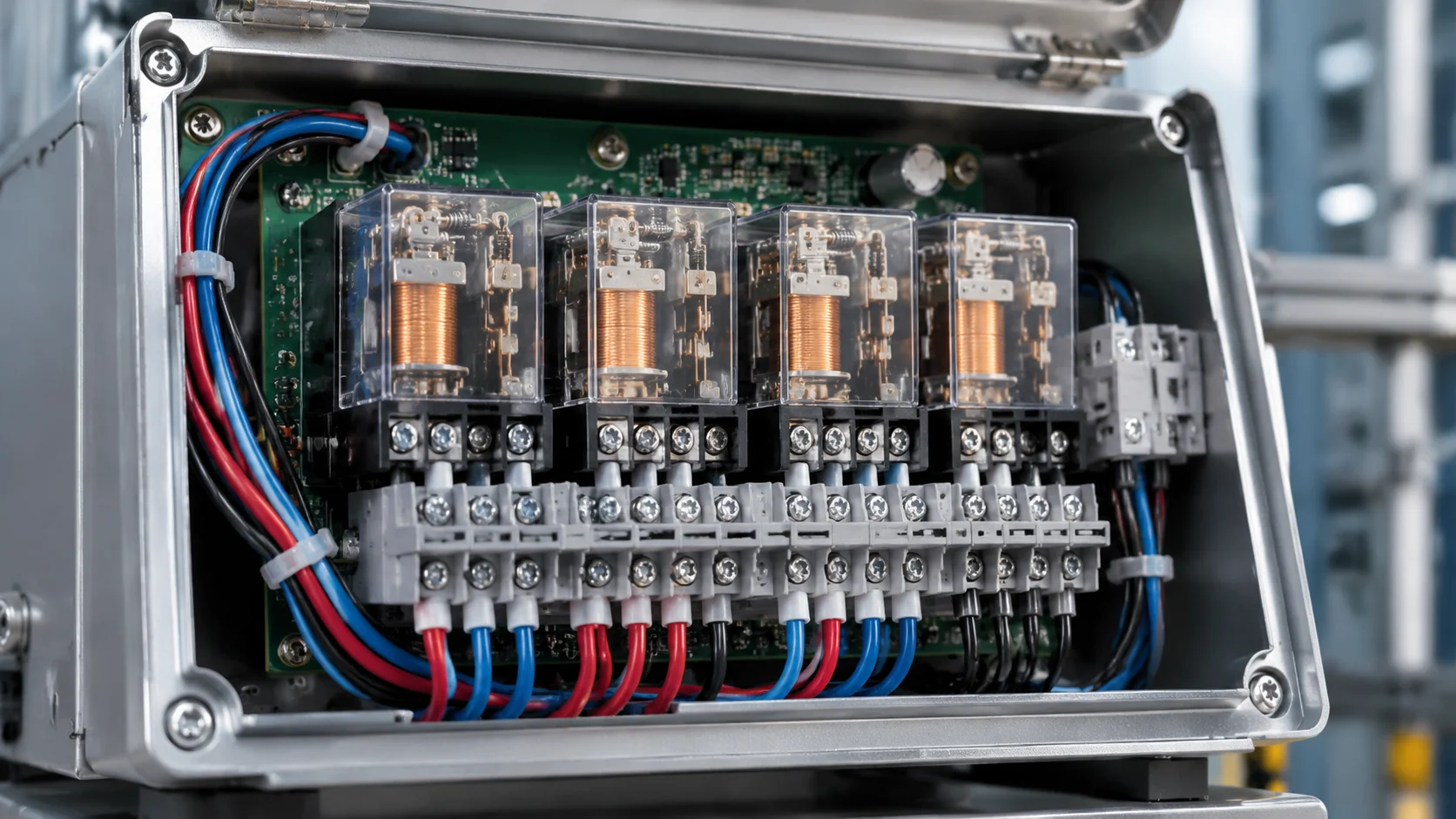
A mechanical relay and a solid state output switch the same circuit and fail on different clocks. The relay is limited by arc erosion at the contact face, so its life falls steeply as switched current rises: a 5 A contact switching a 2 A coil lasts far longer than the same contact switching a 5 A load. There is no contact to erode in a solid state output, so operations are effectively free and the limit becomes junction temperature, where continuous conduction into a warm enclosure is what shortens life.
The practical consequence is simple. Jogging-heavy machines suit solid state. Holding-heavy machines at moderate current suit a relay with a properly rated contact. Machines that do both at high current need the panel cooling confirmed before either is chosen, because the receiver is not the only thing in the box generating heat. The engineering comparison is set out in relay versus solid state receiver outputs.

An estimate does not need a data logger. Count the presses in one lift cycle, watch the operator for ten minutes, and multiply.
A five tonne overhead crane with four directions averages about nine presses per lift once corrections are counted: raise, jog, jog, cross travel, long travel, jog, lower, jog, stop. At thirty lifts an hour, seven productive hours a shift and three shifts, that is roughly 5,700 operations a day and around 1.4 million a year over 250 working days. Against an electrical life quoted in the hundreds of thousands at rated load, that crane is replacing output relays about once a year and consuming the receiver’s mechanical life in roughly two. A second crane in the same bay doing eight lifts an hour reaches only 380,000 operations a year and will run on its original relays until the machine is scrapped. Same part number, different answer.
The estimate is worth doing before the order, because it decides whether relays are a consumable or a lifetime part. Where the count is high, the fault pattern follows: welded or pitted contacts, occasional missing directions that recover when the panel is tapped, and stop-and-restart behaviour that looks like a radio problem. Those symptoms are covered in reading receiver fault codes, and their appearance is usually the first hard evidence that the crane is outside the duty band the unit was bought for.
Six lines in an enquiry replace every assumption with a number, and they cost nothing to write.
Suppliers who receive these six answer with a technology choice and an expected relay interval instead of a generic warranty statement, and the quotes that come back become comparable against each other rather than against a price list.
The bands below are a working guide for quoting, not a standard. Their value is that they force the conversation onto a number the buyer can defend.
| Duty band | Operations per day | What it changes |
|---|---|---|
| Light | Under 500 | Standard relay receiver, no special measures, relays are lifetime parts. |
| Medium | 500 to 2,000 | Relay still correct, but record the count and inspect contacts annually. |
| Heavy | 2,000 to 6,000 | Choose output technology deliberately, schedule relay replacement, verify panel cooling. |
| Severe | Over 6,000 | Solid state or scheduled relay changes, interposing relays, a spare receiver held on site. |
Duty also decides the spares policy, which is where the real cost sits. A severe-duty machine without a spare receiver on the shelf is one failed contact away from an unplanned stop, and the argument for holding spares is made in spares on a single source. A light-duty machine holding a full spare set is tying up capital for a part that will never be needed.
The F24-12S and F24-12D are the usual starting point for heavy-duty work because the twelve outputs cover hoist, long travel and cross travel with spare capacity for a grab or a second hoist, and the receiver is a serviceable relay type rather than a sealed module, so contacts can be replaced without replacing the box. For the six-output layout and its 5 A contacts, the F24-6S and F24-6D system covers the same duty argument at a smaller panel. Send the operation count and the shift pattern through the contact form and the reply will be built around the count rather than a generic specification.
It is the pattern of use expressed as operations per hour, hours per day, and the mix of short jogs against long held moves. It is not the motor duty rating on the hoist, though the two usually track each other.
Not on its own. A unit rated for millions of operations at low current can be the wrong choice on a machine that switches high current slowly, where a properly rated replaceable contact lasts longer and costs less to maintain.
Replace the relay when the board, gasket and housing are sound and only the contacts show pitting or welding. Replace the receiver when the board is corroded, the housing is cracked, or the relay type is no longer available.
The handset tolerates it; the receiver and its enclosure do not like it in warm conditions. Continuous conduction plus a closed panel is a thermal case, so confirm the panel has ventilation before a long-hold duty is accepted.
Only if they do the same work. Cranes in one bay often differ by a factor of three in operations per hour, so each machine needs its own count even when they share a spare set.