What to Send a Supplier for a Crane Remote Control Quote
Get an accurate crane remote control quote on the first reply: the six details every supplier needs, four optional extras, and a copy-and-paste RFQ template.
Read More
Neither option is automatically safer. The right choice follows one question: where must the operator stand to see the hook, the load and the destination clearly while staying clear of the load path? If a fixed hanging position gives that view, a pendant control station is simpler, cheaper and perfectly adequate. If the best viewing position changes during the lift, radio remote control earns its extra cost.
This guide works through the pendant control station vs radio remote control decision on the factors that actually affect purchasing and operation, and covers the third option most sites end up using: keeping both. If you are replacing a worn pendant rather than changing control method, the control handle range covers pendant switches, hydraulic control boxes and multi-button handles.
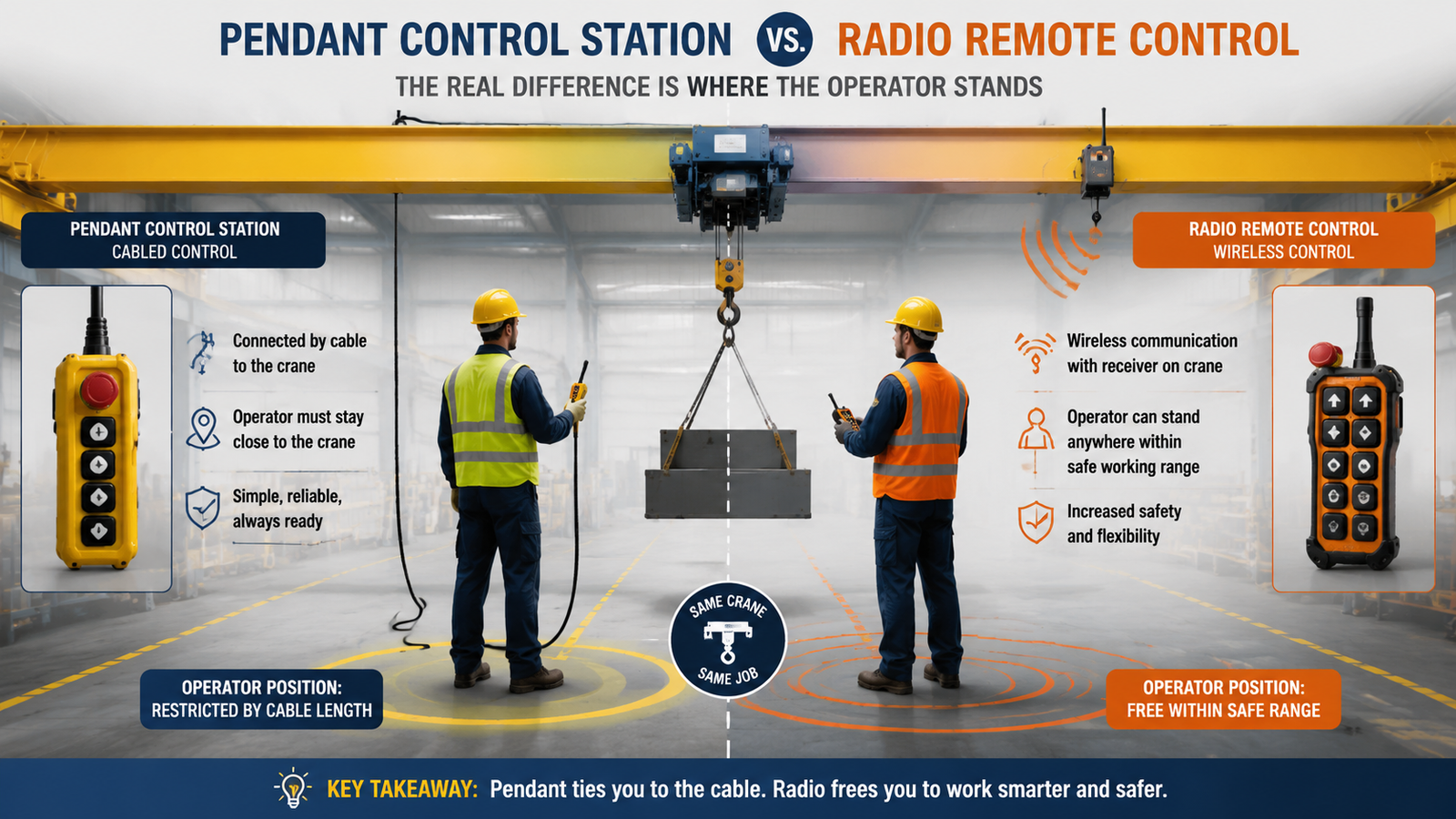
Both systems deliver the same commands to the same contactors. What separates them is whether the operator is physically tied to one position by a cable.
| Factor | Pendant control station | Radio remote control |
|---|---|---|
| Operator connection | Connected to the crane by a control cable | Wireless transmitter paired to a receiver in the panel |
| Freedom of position | Limited by cable length and the pendant travel arrangement | Operator can choose an approved position within radio range |
| Installation complexity | Straightforward wired control | Adds transmitter, receiver, pairing and battery management |
| Main wear items | Pendant cable, strain relief, pushbuttons, travel trolley | Transmitter enclosure and buttons, battery, receiver and antenna |
| Signal interference | Not applicable | Requires radio planning and site assessment |
| Operator standing near the load | Often unavoidable | Avoidable by design |
| Typical purchasing reason | Simple local operation, predictable hardware, lower cost | Better visibility, safer operator position, longer travel paths |
Two entries in that table deserve emphasis. First, a pendant is not inherently less safe: when the load path is clear, travel is short and the operator has an unobstructed walking route, a wired pendant provides direct feedback with no radio link to lose. Second, a radio remote is not a solution to a badly planned operating position — it only lets the operator move, and the site still has to define where that is permitted.
Pendant selection still deserves care. The button count must match the motions, the contact arrangement must match the control circuit, and the enclosure must suit the environment. For a hoist with a single lifting motion in a wet area, a compact pendant such as the COP-2AG2 telephone-type pendant control handle for electric hoists covers the job without overspecifying. Where more functions and an emergency stop are needed in one handle, a six-button arrangement with an integrated stop, such as the XAC-A6713 control handle switch, is a more practical match.
Range needs honest assessment rather than optimism. Manufacturers quote a control distance under defined conditions, and real performance depends on obstruction, building shape and local radio conditions. Plan for the distances the operator genuinely needs, not the maximum on the datasheet.
| Working condition | Better starting point | Reason |
|---|---|---|
| Short lifts at one workstation | Pendant | Operator stays in one place; cable length is not a constraint |
| Long bay with repetitive travel | Radio remote | No need to walk the load from end to end |
| Hazardous, hot or dirty load path | Radio remote | Operator can maintain distance from the load |
| Low-budget installation, low duty | Pendant | Lower hardware cost and simpler installation |
| Cluttered floor with forklift traffic | Radio remote | Removes the cable from the traffic route |
| Critical lift needing guaranteed availability | Both | Radio remote for normal work, pendant retained as backup |
| Washdown or heavy rain exposure | Assess both | Protection level matters more than the control method |
Most production facilities do not need to choose permanently. A common arrangement is radio remote control as the normal operating method with the pendant retained for backup, maintenance or inspection use.
If you take this route, define the rules before commissioning rather than after:
On a crane with a pendant already fitted, a receiver can generally be integrated into the existing control circuit, but the outputs, control voltage, interlocks and emergency stop arrangement must be reviewed by a qualified engineer first. The industrial remote control range includes wide-voltage receivers designed to drop into existing panels, which simplifies the retrofit considerably.
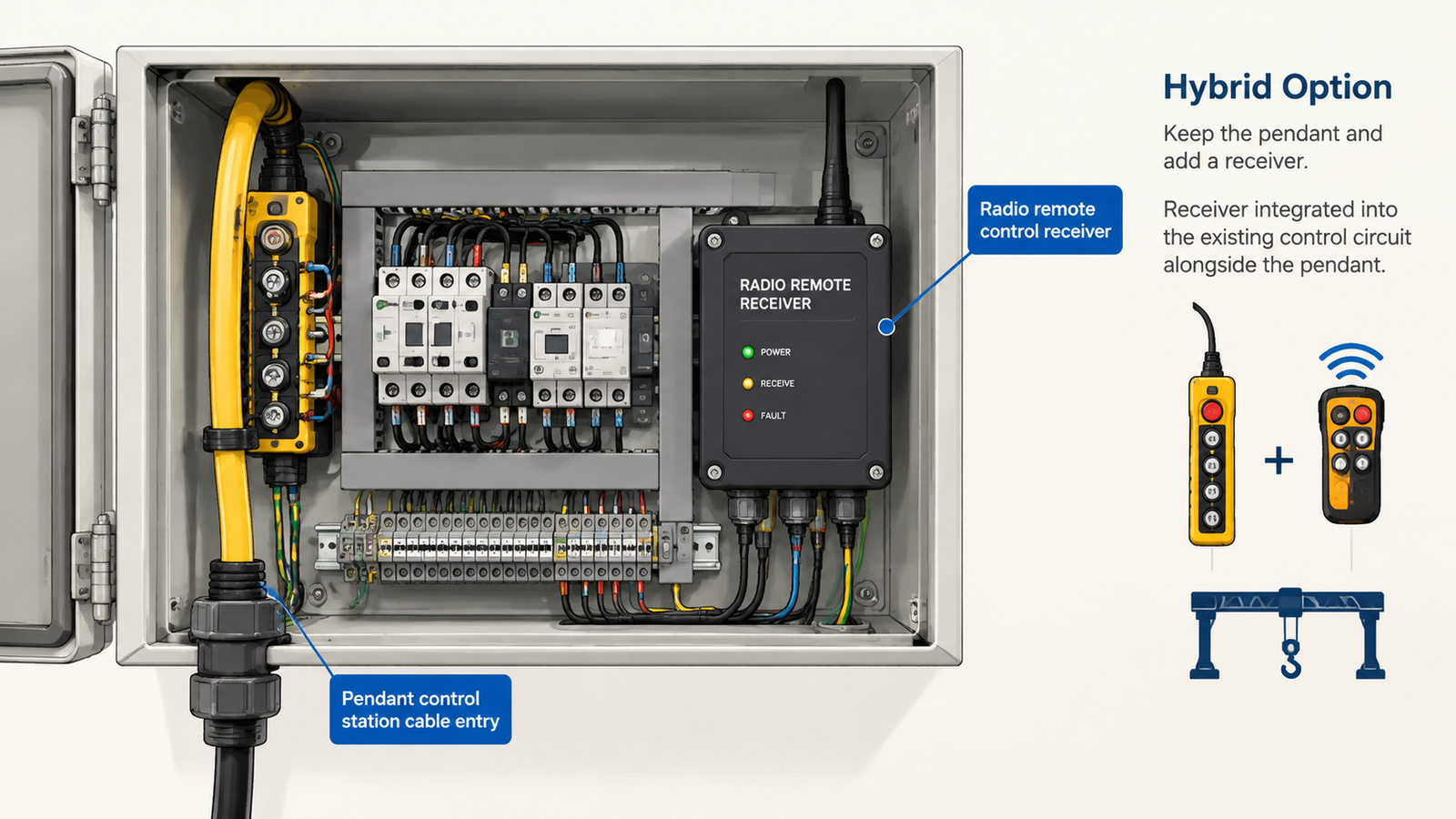
An upgrade is usually cheaper and faster than most buyers expect, but it is an electrical project, not a swap of the control device. Before ordering, collect the following:
If the crane already has unstable movements or a history of electrical faults, deal with those before the retrofit. A remote control reproduces the health of the circuit it controls, and a control fault that was tolerable at walking pace can become dangerous at a distance.
Write down where the operator stands during pick-up, travel and set-down. If it is the same place each time, a pendant is doing its job. If it changes, radio remote control is the practical answer. If the answer differs by shift or by load, install both and document the handover.
Send us the crane type, the motion list, the panel voltage, the working distance and a description of the operator’s position, and we will recommend a configuration and quote it. Complete systems are supplied with a transmitter, receiver, connecting cable, spare fuse and a manual including the wiring diagram, so the installation team has what it needs on arrival.
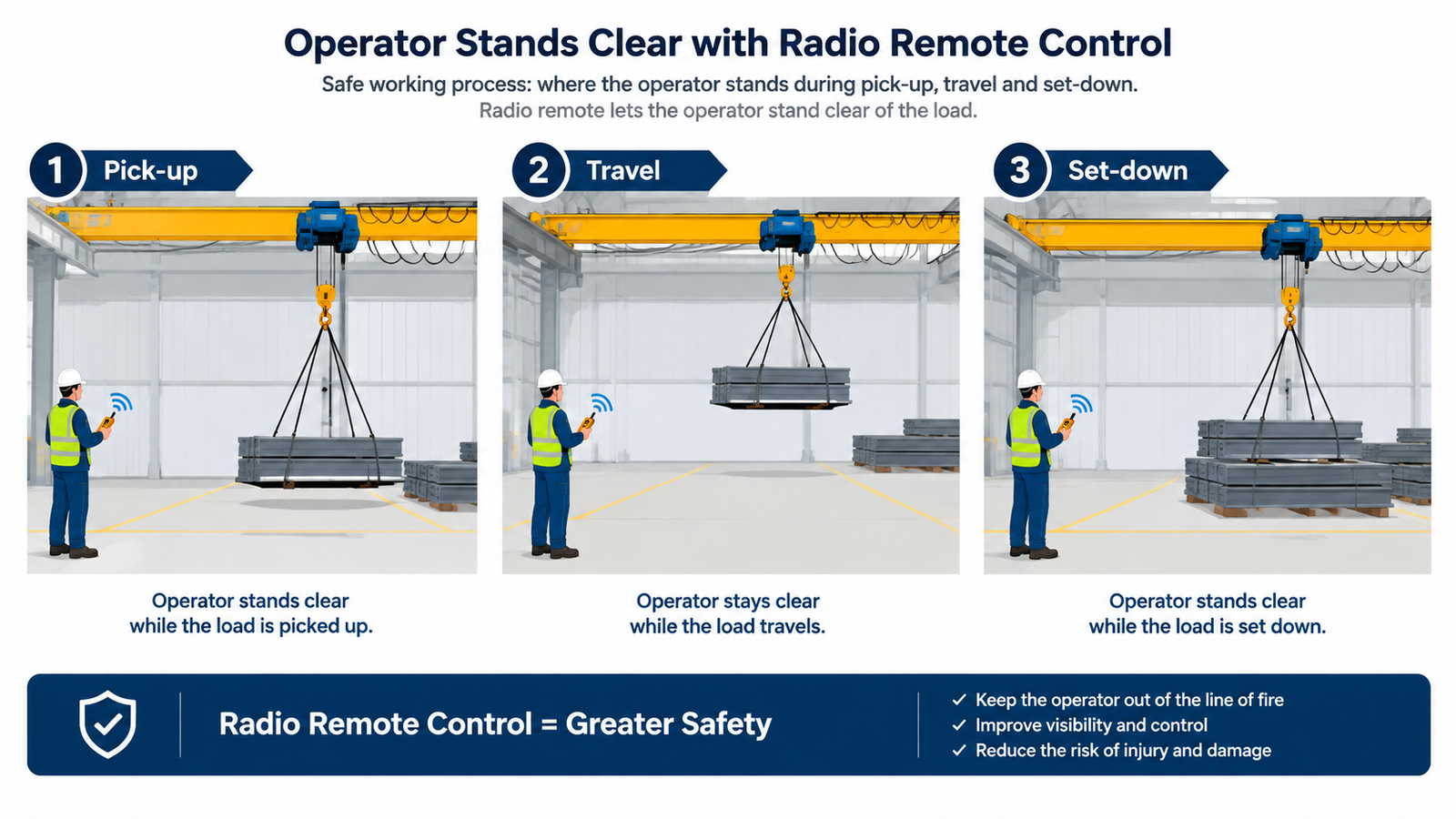
Not by itself. Radio remote control allows the operator to stand away from a hazardous load path and choose a better viewing position, which improves safety in many applications. A pendant control can be equally safe where the load path is clear, the operator’s walking route is unobstructed and travel distances are short.
Yes, in most cases. The receiver is integrated into the existing control circuit, so the output requirements, control voltage, interlocks and emergency stop arrangement must be reviewed first. Keeping the pendant as a backup is a common and practical arrangement.
The hardware and installation cost of a pendant control station is generally lower, and its maintenance is simpler. Radio remote control adds a transmitter, a receiver and battery management, so it should be justified by improved visibility, longer travel paths or operator separation from the load.
The required response must be defined by the machine risk assessment and control-system design, not assumed. Confirm with your supplier that the selected system’s behaviour when the link is lost, and its emergency stop function, match the safety requirements of your equipment.
Yes, and it is common on critical installations. The control priority, emergency stop logic, handover procedure and spare transmitter storage need to be defined clearly and documented so that two control positions can never issue contradictory commands.