Industrial Remote Control Voltage: 24V, 48V, 220V or 380V?
Published: Author: Lisa
Industrial remote control voltage is a match, not a preference. The receiver must be ordered for the voltage that actually exists at the control circuit feeding your contactor coils: 380 V AC on most crane panels in Asia, 220 V AC on older single-phase hoists, 24 V DC on PLC-controlled machines, and 48 V on some marine and imported equipment. Get it wrong and the set cannot be adjusted afterwards — you buy a second receiver.
This guide covers how to find the real voltage on a machine, what separates the four common levels, and how to read a fixed-voltage or wide-range industrial remote control specification before you order.
Start with the control circuit, not the motor
The most common ordering error is reading 380 V off the motor nameplate and buying a 380 V receiver.
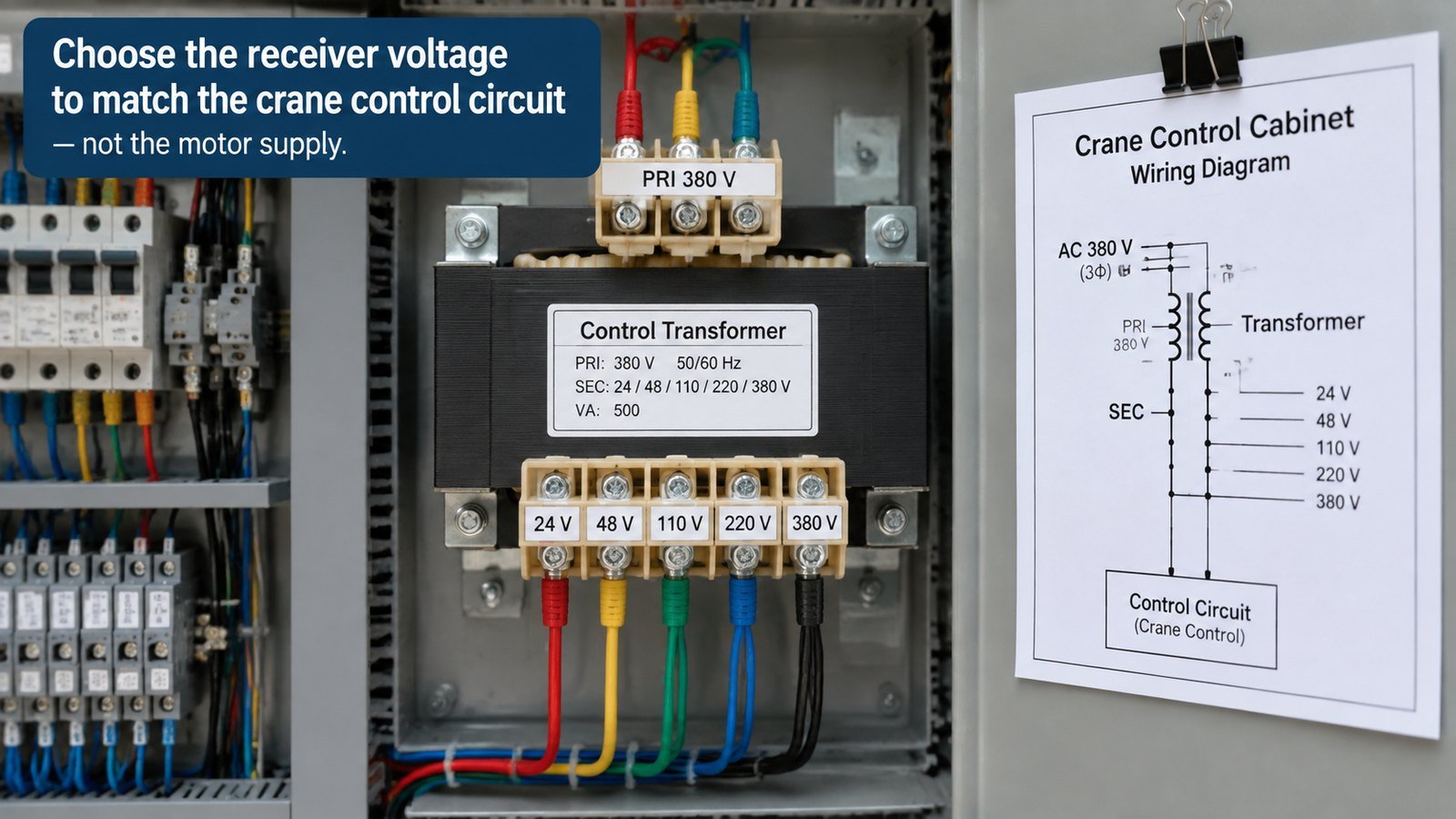
A crane has two voltage systems. The main circuit carries 380 V three-phase to the motors. The control circuit energises the contactor coils and may run at 24 V DC, 48 V, 110 V, 220 V or 380 V depending on the panel designer and the year of manufacture. A 380 V motor behind a 24 V DC control circuit is normal.
The receiver sits in the control circuit. Its supply powers the radio module and the output relays, and its contacts then switch the coil circuits. Those output contacts are dry and isolated — the voltage across them is set by what you wire to them, not by the receiver’s supply. That is why a receiver supplied at 380 V can switch a 24 V coil, and why the supply and the switched circuit are two separate numbers to confirm.
How to confirm the voltage on an existing machine
Work through these four sources in order. In most retrofits the first two settle it.
The label on the existing receiver. Its rating plate states the input voltage and whether it is AC or DC. Photograph the plate rather than copying the model number alone — the same model is built in several voltage versions.
The control transformer secondary. Panels that derive a lower control voltage from the 380 V supply do it with a transformer. Note which secondary tap is in use: 220 V, 110 V, 48 V or 24 V.
The wiring diagram. The receiver supply terminal reference, and the coil voltage printed beside the contactor symbols, both confirm it. Diagrams also show whether the panel uses a phase-to-phase or phase-to-neutral 220 V, which matters when ordering.
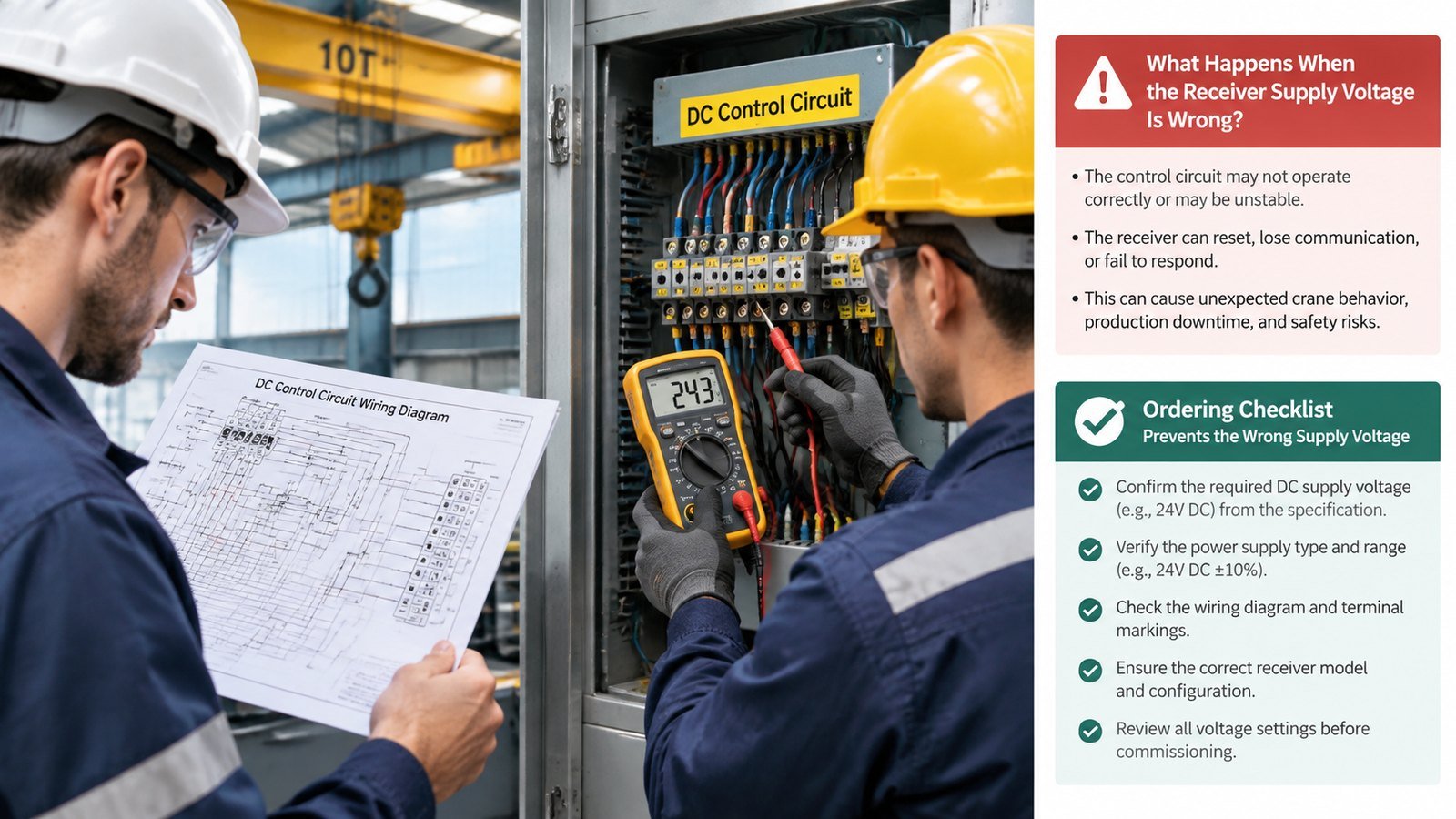
A measurement. With the panel isolated and proven dead, identify the terminals; then measure with the panel live and the machine idle. Confirm AC or DC on the meter before reading the number. A DC range reading on an AC supply produces a plausible but wrong figure.
Do not read a voltage off the cabinet door label — cabinets get re-used and re-powered, and the label is often older than the wiring inside.
The four common voltages and where they appear
Most enquiries land on one of four levels.
Voltage
Where it usually appears
What decides the order
24 V DC
PLC and inverter-controlled panels, European-built machinery, panels with sensors and safety relays
AC or DC must be stated — 24 V AC and 24 V DC are different builds. Confirm polarity and that a 0 V rail is available at the mounting point
48 V
Marine and offshore equipment, some imported cranes, older mining and steel plant panels
The one that causes the most returns: 48 V AC and 48 V DC are not interchangeable, and many wide-range receivers cover one but not the other
220 V AC
Older crane panels, small single-phase hoists, panels taking 220 V phase-to-neutral from a 380 V system
Confirm whether the 220 V is a transformer secondary or a phase-to-neutral derivation, and state 50 Hz or 60 Hz
380 V AC
The default control voltage on a large share of crane and hoist panels in Asia
Confirm it is the control circuit and not only the motor supply; state 50 Hz or 60 Hz
Where a machine has both a 380 V main circuit and a low-voltage control circuit, the receiver goes on the control circuit. A 380 V hoist remote control is a valid build, but it is the wrong build for a 24 V DC panel — and there is no tap or jumper that converts it.
Fixed-voltage, wide-range and two-range receivers
Three receiver architectures are in common use, and they differ in how much freedom is left after the order.
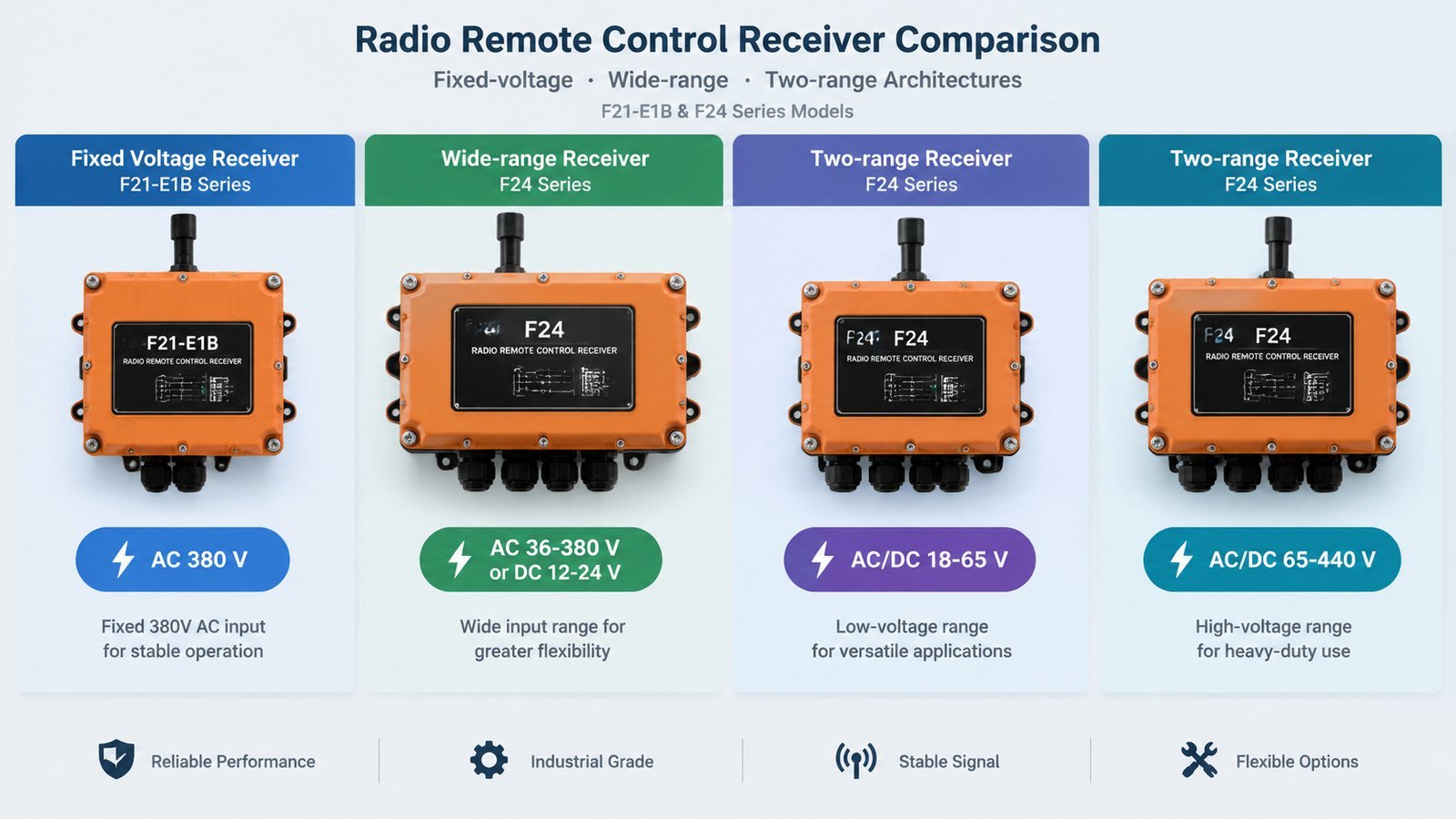
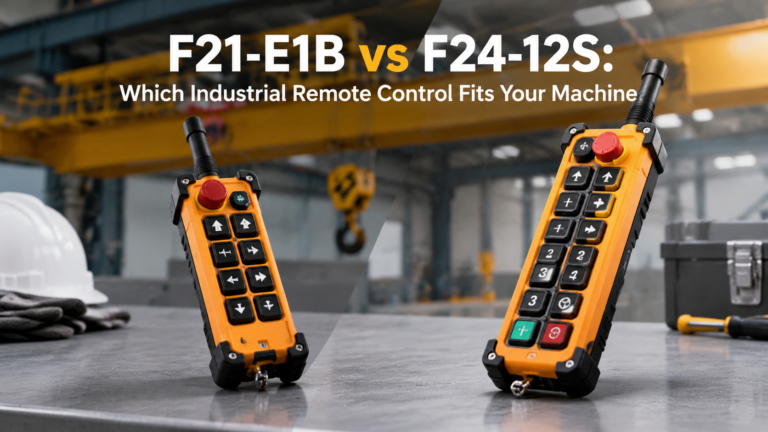
Fixed voltage. Built for one input level. Cheapest and simplest, but the decision is locked at manufacture. The F21-E1B industrial wireless remote control works this way: AC 380 V as standard, with AC/DC 24 V and AC 220 V available as options ordered at the same time.
Wide range. One receiver covers a band of AC voltages plus a low DC range. The F24-8S/8D wireless remote control accepts AC 36–380 V or DC 12–24 V, so one build covers 220 V and 380 V panels and 24 V DC panels.
Two range. The receiver has a low band and a high band selected at build. The F24-12S/12D remote controller offers a low range of AC/DC 18–65 V and a high range of AC/DC 65–440 V, which is what makes it the practical choice for a fleet mixing 24 V or 48 V machines with 380 V machines.
Model
Receiver input
Practical consequence
F21-E1B
AC 380 V standard; AC/DC 24 V or AC 220 V as options
Fixed build. Confirm the voltage before manufacture; a later change means a second receiver
F24-8S / 8D
AC 36–380 V or DC 12–24 V
Covers 220 V and 380 V AC panels and 24 V DC panels from one build. Does not cover 48 V DC
F24-10S / 10D
AC 36–380 V or DC 12–24 V
Same input flexibility, with ten buttons for an auxiliary circuit on top of three motions
F24-12S / 12D
Low range AC/DC 18–65 V; high range AC/DC 65–440 V
The only arrangement here that takes 48 V DC as well as 380 V AC, in two separate builds
That last row matters on real orders. A 48 V DC control circuit sits outside the DC range of the 8S/8D and F24-10S/10D wireless remote control builds, so a specification that simply reads “wide voltage” is not enough — the band has to contain the number.
What a wrong voltage actually does
Low-rated receiver on a high supply. The internal supply is overstressed and usually destroyed at first energisation. There is no field repair; the receiver is scrap.
High-rated receiver on a low supply. The receiver may power up and then behave unpredictably — relays that fail to pull in, dropouts under load, or a unit that works on the bench and fails once the contactors start switching. Harder to diagnose than a dead unit.
AC receiver on a DC supply, or the reverse. Depends on the internal supply design. Some wide-range models accept both; a fixed-voltage model generally does not. Confirm the letters on the label, not the number alone.
Because the receiver supply is seldom adjustable in the field, a voltage error is an order error. On one crane it costs a receiver; across a fleet it means two spare-part lines and the risk of fitting the wrong spare during a breakdown.
What to put on the order
The control-circuit voltage, with AC or DC stated explicitly.
Where that voltage was measured — transformer secondary, terminal block or coil — and whether it is phase-to-phase or phase-to-neutral.
The supply frequency, 50 Hz or 60 Hz.
The number of motions and whether each needs single or dual speed, since the model follows from the button count.
How many different voltages exist across the fleet, so the spares policy is set with the first order rather than after the second breakdown.
If the site mixes 24 V and 380 V machines, decide early whether to hold one two-range receiver as a universal spare or one spare per voltage.
Voltage is the one specification that cannot be corrected after delivery, and the one most often taken from the wrong label. Send the control-circuit voltage, the AC or DC designation, the motion list and the existing model through the contact page so the receiver build is confirmed before manufacture. Ordering and documentation questions are answered on the frequently asked questions page.
FAQ
Can I use a 380 V receiver on a 220 V control circuit?
Only if the receiver is built to accept both, as a wide-range model is. A fixed 380 V receiver on a 220 V supply will normally fail to operate or behave erratically, and it is not adjustable in the field.
My crane motors are 380 V. Do I need a 380 V remote control?
Not necessarily. The receiver belongs to the control circuit, which may run at 24 V DC or another level. Check the coil voltage or the existing receiver label, not the motor nameplate.
Does the receiver supply have to match the voltage of the coils it switches?
No. The output contacts are dry and isolated, so the receiver supply and the switched coil circuit are separate. Both must be confirmed, but they need not be the same number.
Which model covers both 48 V and 380 V?
A two-range receiver does, in two separate builds: the low band covers AC/DC 18–65 V and the high band AC/DC 65–440 V. A single fixed build will not span both, so a mixed fleet needs the band stated on the order.
Area classification decides the product. A practical guide to zones, Ex marking, transmitter certification and enclosure choice for explosion-proof crane remote control.
One set for a standard configuration, five for volume pricing, ten for OEM branding: how MOQ, lead time and customization scope actually work on crane remote controls.
Eight buttons or twelve, single speed or dual, fixed 380 V or wide-range receiver: a side-by-side comparison of the F21-E1B and F24-12S and which crane each one fits.