Wireless Remote Control for Truck-Mounted Cranes: What to Specify
Published: Author: Lisa
A truck-mounted crane wireless remote control is specified by counting valve sections, not by choosing a transmitter. Each hydraulic section you want to operate remotely needs its own actuator bolted to the existing manual handle, and everything else — receiver logic, harness, transmitter layout, price — follows from that count. Get the section count and the fail-safe behaviour right before ordering and the conversion stays a mechanical and electrical job.
This guide covers what a bolt-on kit changes on the vehicle, the five decisions that define it, and what an industrial remote control supplier needs before the actuators are assembled.
What a wireless kit changes on a lorry crane
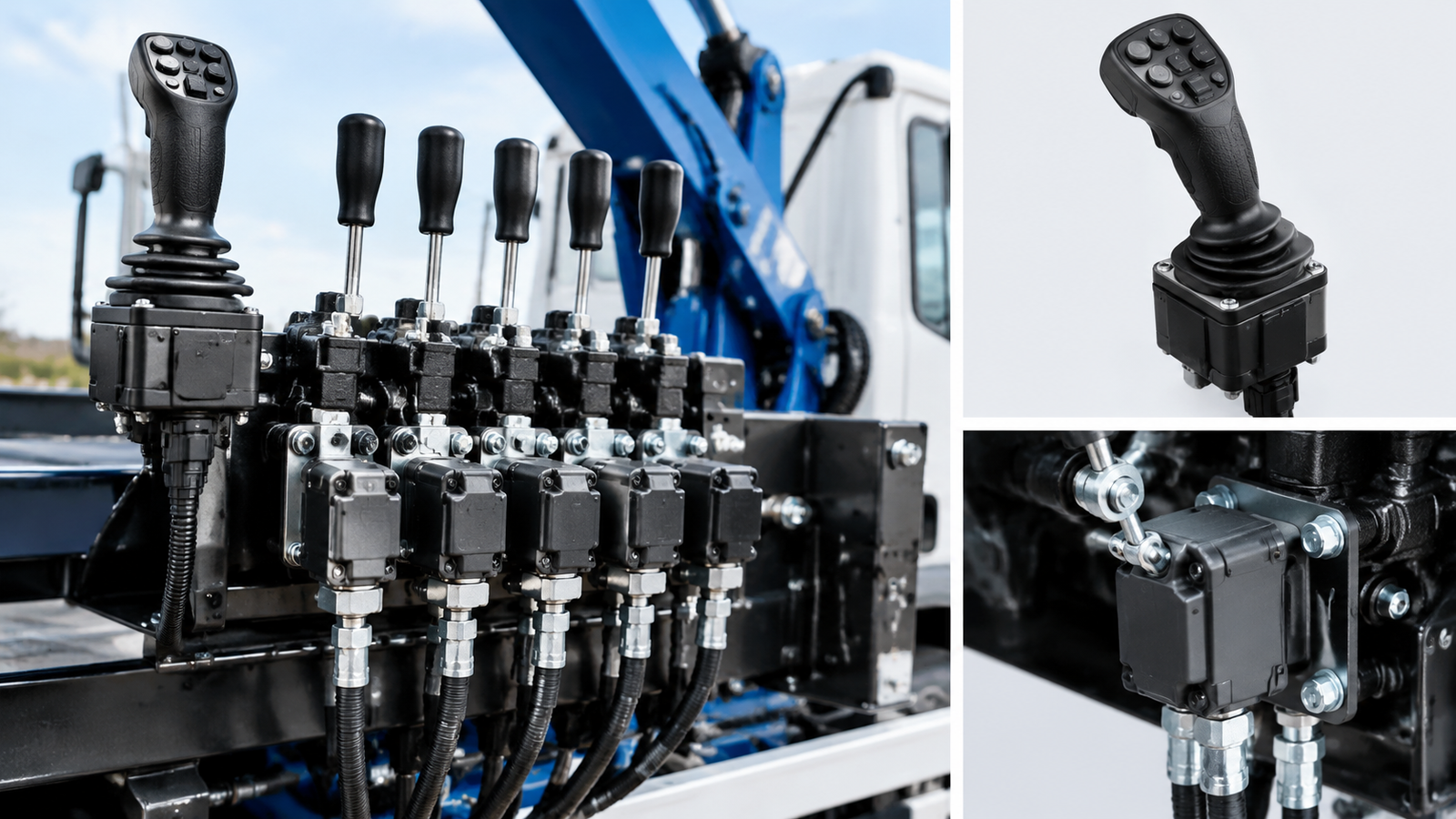
Most lorry-mounted and knuckle-boom cranes in service already have a sound hydraulic system and a working lever bank. Opening that circuit to fit proportional valves is expensive, needs oil handling and takes the crane out of service for days. A bolt-on kit avoids all three: DC actuators clamp to the existing handles, the receiver drives the actuators, and no oil is drained.
Three things stay exactly as they are — the valve block and hydraulic circuit, the manual lever bank, and the vehicle’s original control positions. What changes is where the operator stands. On a flatbed, tipper or recovery truck the lever bank sits at the base of the mast, which forces the operator to work by ear and by shouted instruction. Radio control moves them to where the load and the ground are both visible, which is usually why the conversion is approved in the first place.
The applications repeat across fleets: knuckle-boom cranes on service and flatbed trucks, recovery vehicles with boom and winch functions, skip loaders and hook lifts, municipal vehicles with outriggers, booms or grabs. The kit itself is specified on the truck-mounted crane wireless remote control page.
The five decisions that define the kit
The kit is assembled per vehicle rather than pulled from a shelf, so the same nominal product ships as a two-actuator package or a six-actuator package at very different prices.
Count the sections to be remote-controlled. Boom lift, boom extension, winch or rotator and outriggers are separate sections. Outriggers are often left on manual control deliberately, which cuts cost and conversion time. Finalise the count at order stage — extending a system later costs more than buying the actuators up front.
Identify the valve type and handle geometry. The actuator needs a mounting face and clearance through the full handle travel. Photographs of the lever bank with a tape measure in shot resolve most fitting questions before anything is built.
Choose the transmitter layout. A proportional joystick suits operators who blend two functions at once; a paddle layout suits operators who want one control per section. Both work with the same receiver, so this is a working-habit decision.
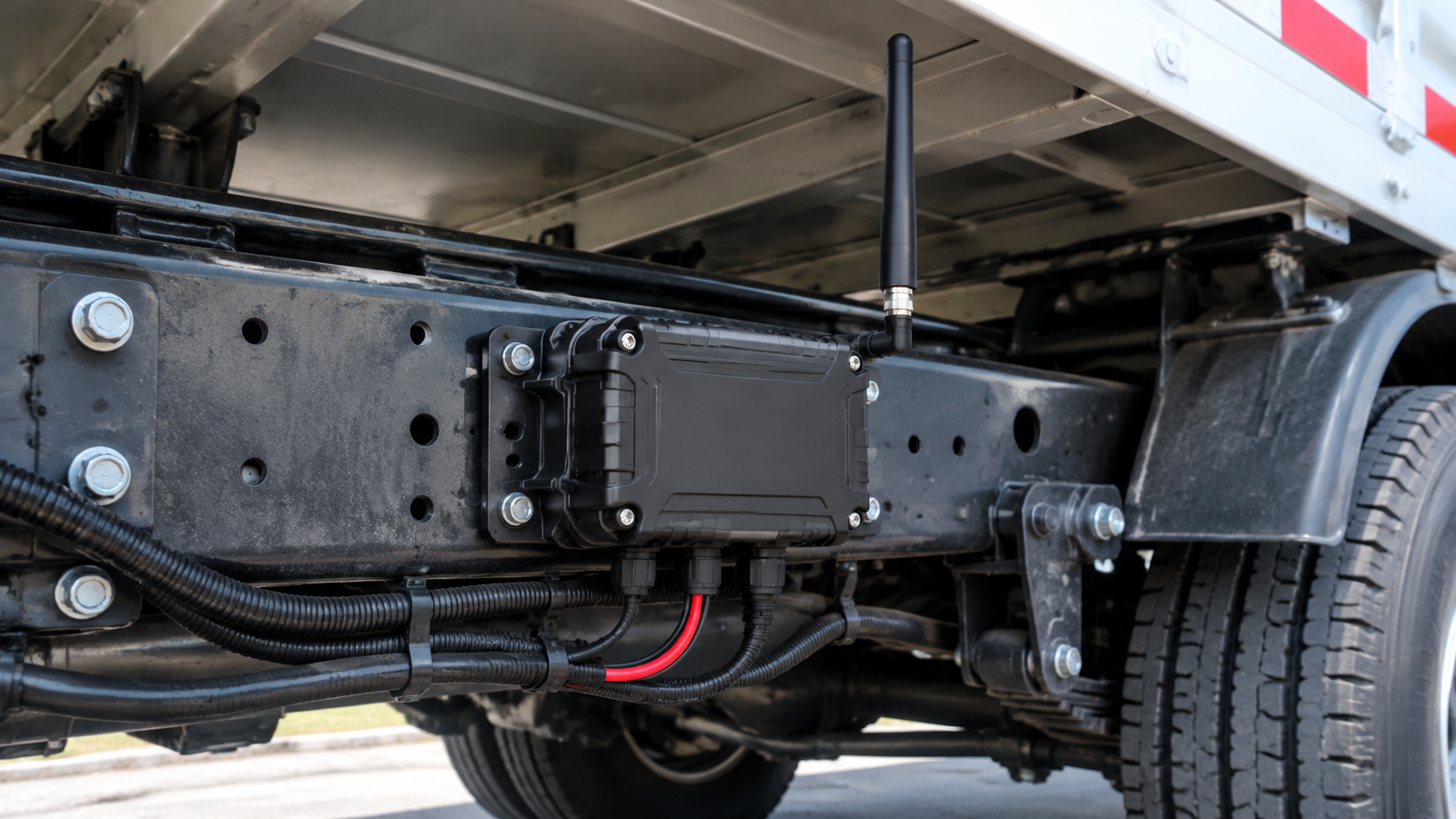
Confirm the vehicle supply. The system runs from 12 V or 24 V DC. Measure at the mounting position rather than assuming nominal voltage, and feed the receiver from a dedicated circuit — not one shared with the alternator or a two-way radio.
Agree fail-safe behaviour per section. A boom and a winch rarely want the same response when the link drops. The receiver logic is written to the behaviour you specify, and it must be tested on the vehicle before it returns to service.
A kit that skips the fifth decision still works in the yard — which is why the first dropped link under load finds nobody who agreed what the crane should do.
Actuator count, transmitter type and cost
Price tracks actuator count before anything else, then whether the transmitter is a proportional joystick or a paddle unit, harness length, and whether the receiver needs machine-specific logic. The bands below are indicative export prices per kit, ex-works Zhejiang, not fixed package prices.
Kit configuration
Typical use
Indicative price (USD)
Single actuator, one section
Winch-only or boom-lift-only conversion
180 – 420
Dual actuator, two sections
Boom lift plus winch on a small knuckle boom
280 – 620
Four actuator, four sections
Full knuckle-boom control with rotator
460 – 980
Additional actuator, later
Extending an installed system
Quoted per unit
For fleets, list every vehicle with its section count in one enquiry. Mixed fleets assembled as one project keep the same transmitter layout and receiver logic across vehicles, which matters more than unit price: an operator who moves between trucks should not have to relearn the joystick.
Range, protection and supply on a vehicle
Vehicle-mounted equipment faces what a factory panel does not: rain, washdown, vibration, unpaved ground and a charging system that puts noise on the DC bus. Five specification points cover most of the risk.
Parameter
Specification
Why it matters on a truck
Wireless range
Up to 500 m in open conditions
The operator may work from the far side of a long bed
Ingress protection
IP67 / IP68 on outdoor-mounted parts
Rain, washdown and dust at a chassis-mounted receiver
Supply voltage
12 V or 24 V DC
Covers most light and medium commercial chassis
Control method
Proportional, infinitely variable at the joystick
Removes the valve steps that make precise placement hard
Emergency stop
Integrated on the transmitter
The operator is away from the lever bank and needs a stop to hand
Treat range figures as open-air ratings. A steel-bodied truck or a reinforced building will reduce usable distance, and antenna position is what you still control at installation — keep it clear of the chassis rail and away from the alternator and radio equipment.
Installation and commissioning
The conversion is a mechanical and electrical job. Working in this order keeps the vehicle movable at every stage.
Isolate and lock off the vehicle electrical system before any work at the lever bank.
Mount the actuators and check clearance through full travel by hand before energising anything.
Route the harness along existing looms, with a service loop at the actuator and a drip loop before the receiver gland.
Terminate the receiver on a dedicated DC circuit, protected at source, and confirm polarity.
Set and record the logic for each section, then verify every section through its full travel.
Test the stop paths — transmitter emergency stop, switch-off and simulated link loss — before dispatch.
What to send with the enquiry
An enquiry containing the following can be quoted firmly without a second round of questions. Anything missing usually comes back as a request for photographs, which adds a week.
Crane make, model and year
Sections to be remote-controlled, and which stay manual
Lever bank photographs with dimensions and a tape measure visible
Vehicle supply voltage measured at the mounting position
Preferred transmitter type: proportional joystick or paddle
Quantity of vehicles, listed with their section counts
Intended fail-safe behaviour for each section
Individual kits are quoted from one set and fleet conversions from five kits. Typical lead time is 15–25 working days for a single kit and 25–40 working days for a fleet order with per-vehicle actuator sets. Sets ship in export cartons with mounting hardware, harness and manual, and carry a twelve-month warranty against manufacturing defects covering actuators, harnesses and hardware.
A truck-mounted crane conversion succeeds on paper before it succeeds on site. Count the sections, decide which stay manual, confirm handle geometry with photographs, measure the DC supply, and write down what each section should do when the link drops. Transmitter type, harness length and price follow from those five answers.
Send the crane model, section count, lever bank photographs and vehicle voltage through the contact page and IEHC will confirm the actuator set and return a firm price. If you are still assembling the specification, the crane remote control quote checklist covers the same ground for fixed cranes.
FAQ
Will the kit fit my existing valve, or does the valve block have to be replaced?
The actuators bolt onto the existing handles, so the valve block, hydraulic circuit and oil charge stay as they are. What must match is handle geometry and the space around the lever bank: the actuator needs a mounting face and clearance through full travel. Photographs with a tape measure plus the crane model normally confirm fit before assembly.
How many actuators does a knuckle-boom conversion need?
Two to four is the common range. Boom lift, boom extension and the winch or rotator usually go on remote control, while outriggers stay manual. The receiver is built for the number ordered, so settle the final count at order stage rather than adding sections afterwards.
Can the crane still be operated by hand after fitting?
Yes. The manual lever stays usable, which matters for fleets: a crane that cannot move without its transmitter is a vehicle that cannot be dispatched. The actuator should not obstruct the lever in normal service, and changeover should be possible without tools.
What happens if the radio link is lost while a valve is open?
The receiver returns its outputs to a safe state when the link drops, the transmitter is switched off or the emergency stop is pressed. Because the safe state differs between a winch and a boom, the behaviour is agreed per section before the kit is built and tested on that vehicle before it returns to service.
Does a 24 V truck need a different kit from a 12 V one?
No. The same system covers 12 V and 24 V DC supplies, which suits most light and medium commercial chassis. Feed the receiver from a dedicated circuit rather than one shared with the alternator or two-way radio, and measure voltage at the mounting position instead of assuming nominal.
Area classification decides the product. A practical guide to zones, Ex marking, transmitter certification and enclosure choice for explosion-proof crane remote control.
One set for a standard configuration, five for volume pricing, ten for OEM branding: how MOQ, lead time and customization scope actually work on crane remote controls.
Eight buttons or twelve, single speed or dual, fixed 380 V or wide-range receiver: a side-by-side comparison of the F21-E1B and F24-12S and which crane each one fits.