IP65 vs IP67: Waterproof Crane Remote Control Ratings
Published: Author: Lisa
IP65 and IP67 are both dust-tight, so the difference is entirely about water. IP65 survives low-pressure jets from any direction; IP67 survives temporary immersion to 1 m for 30 minutes. Neither is a general upgrade on the other, because the two tests reproduce different accidents — and a transmitter rated IP67 has not necessarily been tested against jets at all.
For an industrial remote control, that distinction decides whether a unit survives a wet shift or fails in its first month. This guide sets out what each rating actually tests, which site conditions need which, and what the number does not cover.
What the two digits actually measure
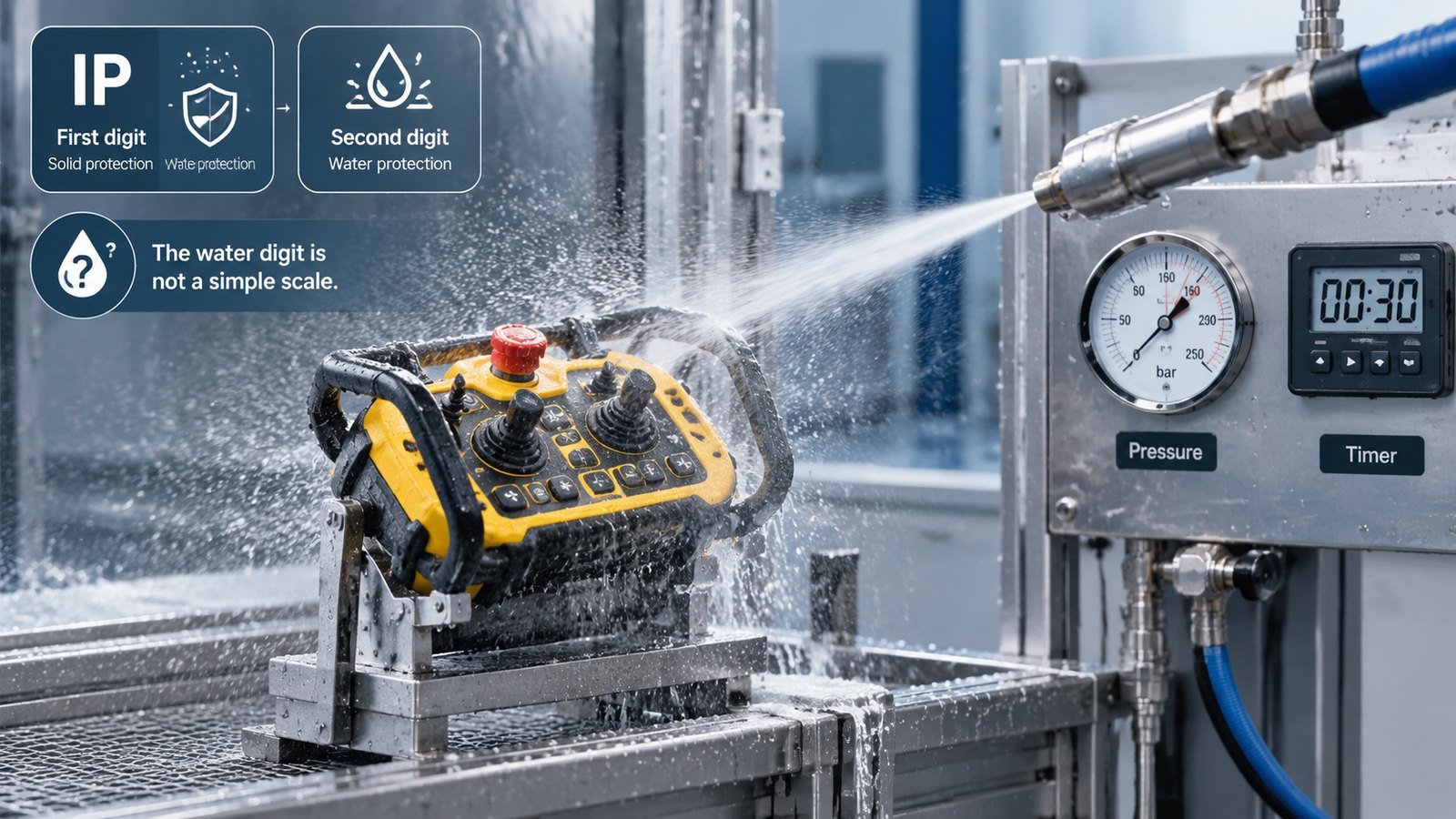
The IP code comes from IEC 60529. The first digit covers solids and contact, the second covers water. Both ratings here carry a first digit of 6, which means dust-tight: no dust ingress at all, and no access to live parts with a wire.
The second digit is where they separate, and the test conditions are specific rather than a scale of “wetness”.
Rating
Water test condition
What it reproduces on site
IPX5
6.3 mm nozzle, 12.5 L/min, 30 kPa, 3 minutes, from any direction
12.5 mm nozzle, 100 L/min, 100 kPa, 3 minutes, from any direction
Strong jetting from a short distance, deck washing, heavy spray
IPX7
Temporary immersion, 1 m below the surface for 30 minutes (0.15 m if the enclosure is under 850 mm tall)
A unit dropped into a sump, a flooded pit or standing water on a quay
Read the numbers as three separate tests rather than three grades of the same test. A unit can pass X7 and never have been jet-tested, and a unit can pass X6 and fail X7.
Why IP67 is not simply one grade higher
Buyers routinely assume that a higher second digit contains everything below it. It does not. The X5, X6 and X7 tests are alternatives in the standard, not layers, and a manufacturer that wants both properties has to test and mark both — which is why good datasheets read “IP65/IP67” or “IP66/IP67” rather than just the higher number.
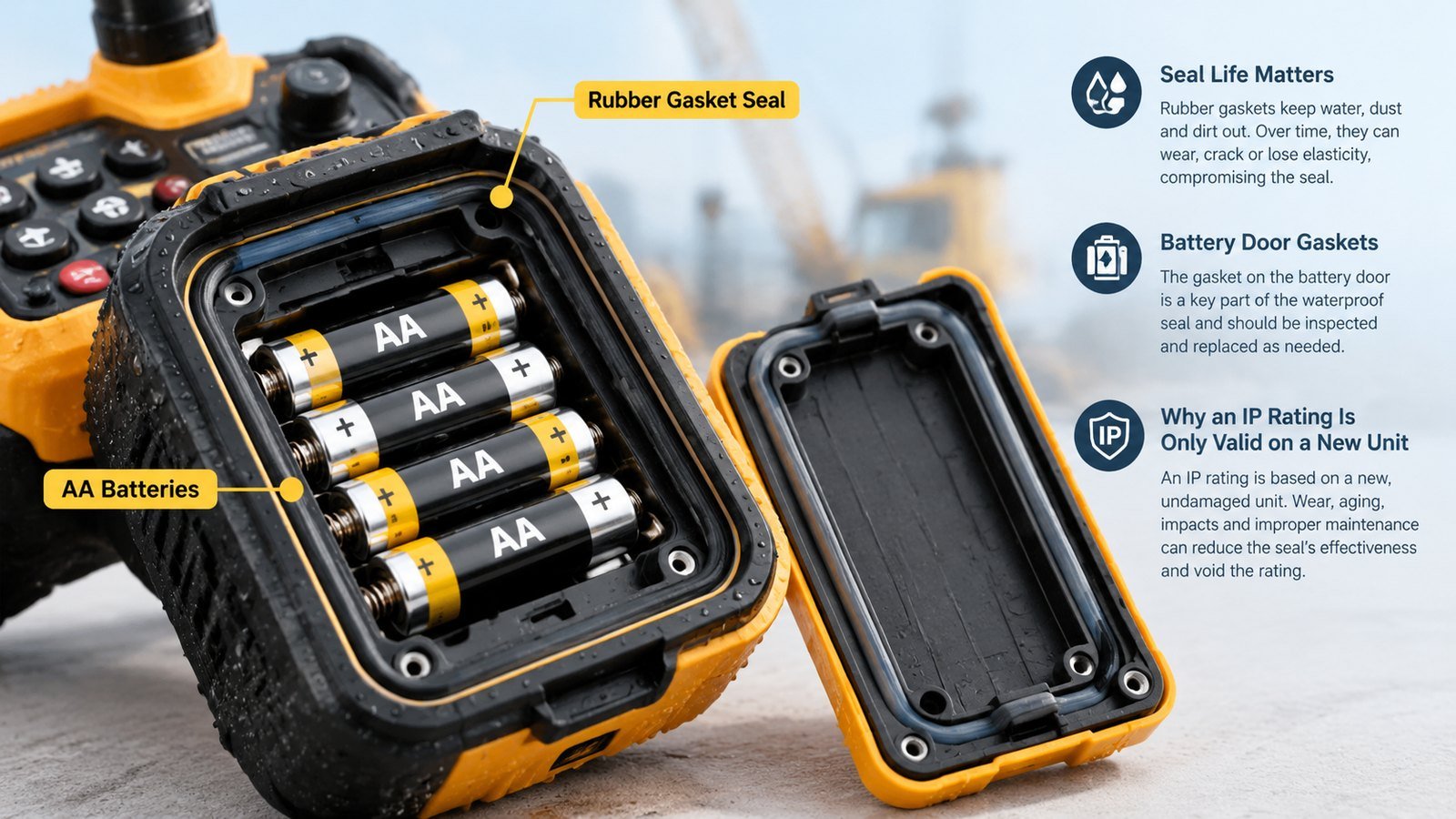
There is a physical trade-off as well. Immersion protection depends on static seals: gaskets, O-rings and a battery door that compresses evenly. Those seals are what fail after a drop, after a battery change done in a hurry, or after a year of UV and oil exposure. A jet-rated housing can drain and breathe; a fully sealed one cannot, so temperature cycling between a cold store and a warm cab can leave condensation inside a unit that no water ever entered.
That is the practical answer to “should we just buy IP67 everywhere”: only if the site has standing water or total immersion. If the wet risk is spray, an IP65 or IP66 housing with a serviceable seal is usually the better long-term choice, because it can be opened, inspected and resealed.
Match the rating to the actual site
Grade the location, not the industry. Two cranes in the same plant can need different ratings if one works under a leaking roof and the other sits over a dry assembly line.
Site condition
Realistic exposure
Rating to specify
Covered workshop, dry process
Dust and occasional spillage
IP54 minimum; IP65 if the unit is handled with oily or wet gloves
Open yard, general outdoor crane
Rain from any direction, seasonal dust
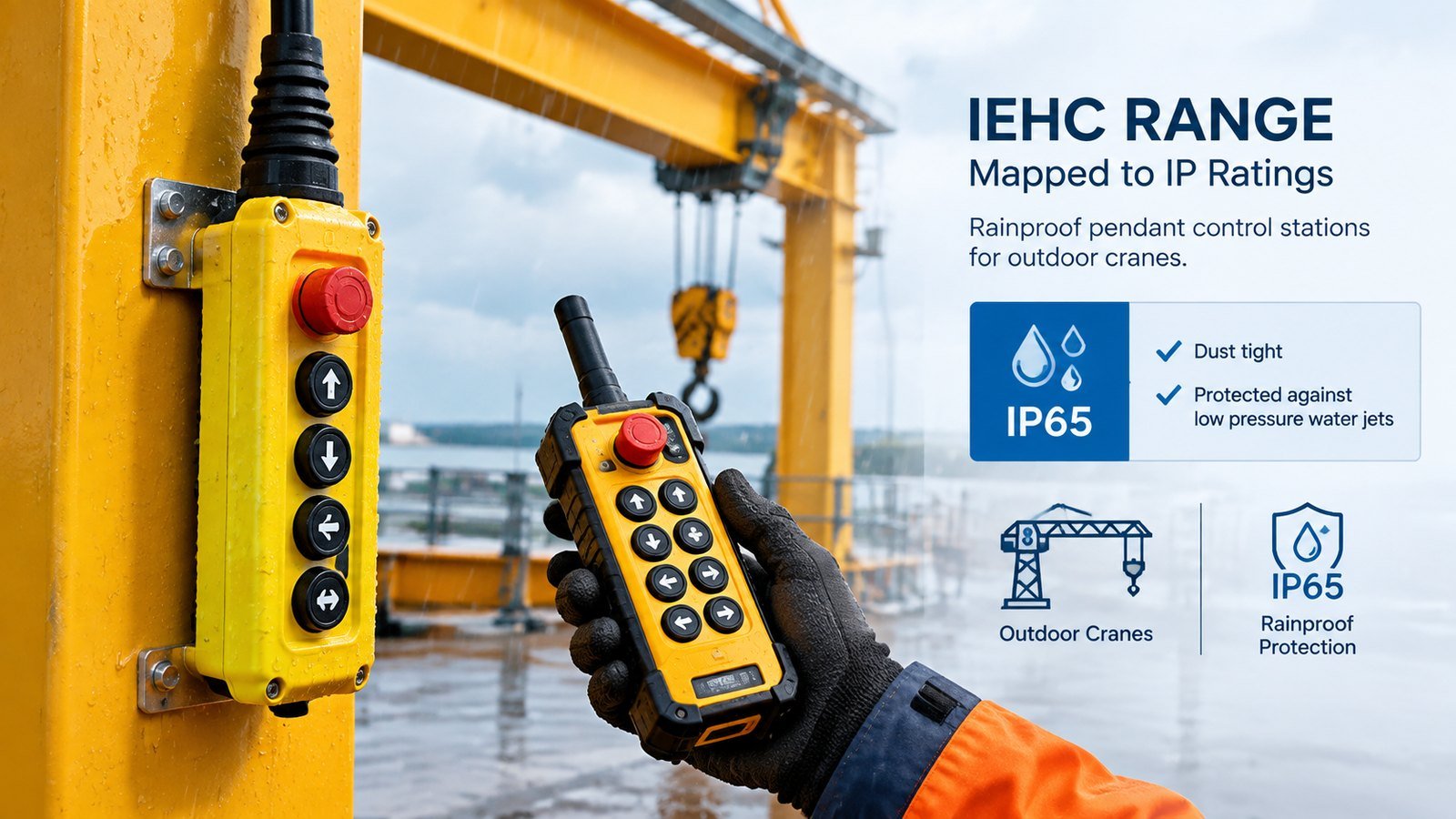
IP65 as the working baseline
Wash-down bay, food or pharma plant
Directed jets and cleaning chemicals
IP66 for the jets; check chemical compatibility of the seal separately
Port, quarry, steel plant with standing water
Immersion risk in pits, salt spray, grit
IP67, and confirm it is also jet-rated if wash-down happens on site
Cold store or freezer room
Condensation on every transfer, ice formation on seals
IP65 or IP66 with a seal that tolerates repeated freeze-thaw; the IP digit alone does not cover this
In practice most sites resolve to one of two answers: an IP65 waterproof crane remote control for rain and spray, or an IP67 industrial remote control where immersion is a realistic event rather than a theoretical one.
What the IP rating does not tell you
An IP number is one property measured on a new sample. It says nothing about the following, all of which matter more than the digit in real service.
Seal life. Gaskets harden, compress and take a set. A rating tested on a new unit is not a promise for year three.
Condensation. A sealed enclosure that cycles between temperatures can hold moisture that entered as vapour, not as water. This is a cold-store problem, not an IP problem.
Corrosion. Salt spray and process chemicals attack contacts and hardware without any water ingress at all.
Impact. A dropped transmitter can crack a housing or deform a seal seat and still look intact. The IP test does not include a drop.
Explosive atmospheres. IP and hazardous-area certification are separate requirements. An IP67 unit without the relevant certification is not acceptable in a classified zone, whatever its ingress rating.
Pressure washing deserves its own warning. The X5 and X6 tests are run at 30 kPa and 100 kPa respectively, roughly a third of a bar and one bar. A pressure washer operates an order of magnitude above that, so “IP66 protected” is not a licence to clean a transmitter at close range with a lance.
How the current range maps onto these ratings
The standard remote control series do not all sit at one rating, and the difference follows the housing and the duty rather than the price bracket.
F24-12S/12D remote controller — IP65 or IP66 depending on build, with a two-range receiver covering AC/DC 18–65 V and 65–440 V.
Where the machine is still operated from a cable rather than by radio, the pendant stations are the equivalent decision. The COP-84ER rainproof control switch and the COP-82ER rainproof control switch are described as rainproof designs in high-visibility housings, with the cable entering through a moulded strain-relief boot at the top so running water is carried away from the entry. Rainproof is a construction description, not an IP number: if the position sees continuous spray, deep wash-down or immersion, state the required rating at enquiry so it is confirmed against the exact build rather than assumed from the product name.
Specifying the rating on the order
Describe the position, not the industry: covered, open, wash-down, standing water, freezer.
State both digits you need, and whether jets and immersion are both required.
Say if the unit will be jet-washed, and from what distance — this is often the real requirement.
Confirm the chemical environment: salt, chlorinated foam, cutting oil, food-grade wash chemicals.
Ask what the seal replacement interval is, and whether the transmitter can be opened on site for a battery change without compromising the seal.
Two further points keep the rating meaningful after delivery. Train operators to close the battery door fully and to check the gasket for grit each time cells are changed, because most water damage on a rated unit enters through a door left slightly open. And record the rating in the maintenance file, so a replacement ordered three years later is matched to the original specification rather than to the cheapest equivalent.
Send the site description, the required rating and the crane duty through the contact page and the housing can be confirmed against the actual exposure rather than against a product name. General technical and spare-part questions are covered on the frequently asked questions page.
FAQ
Is IP67 better than IP65?
It is different, not better. IP67 adds temporary immersion protection but does not include the jet test that IP65 covers, so a unit marked only IP67 may be less resistant to wash-down spray than an IP65 unit.
Do I need IP67 for an outdoor crane?
Usually not. Rain and general outdoor exposure are covered by IP65. IP67 becomes relevant where the transmitter can fall into standing water, a pit or a flooded deck.
Can I pressure-wash an IP66 transmitter?
Not with a lance at close range. The IPX6 test is run at about 1 bar from 3 m, while a pressure washer operates far above that. Wash-down proximity matters as much as the rating.
Does IP67 mean the transmitter is dust-proof too?
Yes. Both IP65 and IP67 carry a first digit of 6, which is dust-tight. The difference between them is entirely in the water digit.
Why does condensation appear inside a sealed unit?
Because the enclosure is sealed against water but not against water vapour, and repeated temperature cycling can deposit that vapour as liquid inside. It is a design and duty-cycle issue that the IP test does not address.
Area classification decides the product. A practical guide to zones, Ex marking, transmitter certification and enclosure choice for explosion-proof crane remote control.
One set for a standard configuration, five for volume pricing, ten for OEM branding: how MOQ, lead time and customization scope actually work on crane remote controls.
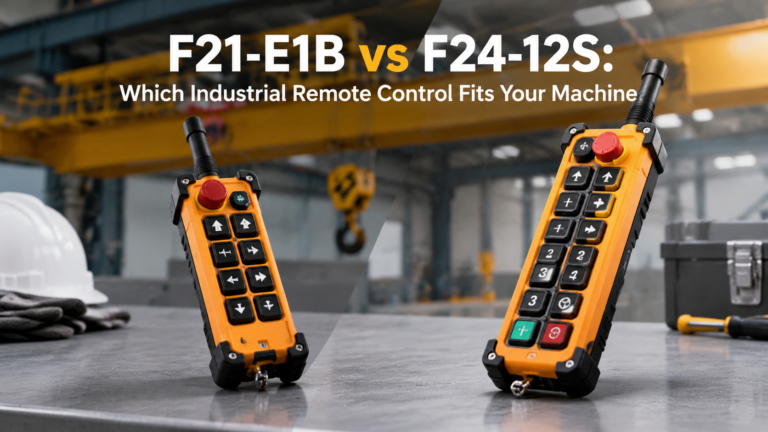
Eight buttons or twelve, single speed or dual, fixed 380 V or wide-range receiver: a side-by-side comparison of the F21-E1B and F24-12S and which crane each one fits.