Pendant Control Station Wiring: Cores, Common, Earth
Cores follow functions, not buttons. The sum that sizes the cable, why the stop must not share the button common, and five pre-power checks.
Read More

Most distributors who add a crane remote control line start by comparing unit prices, and most of them regret it within a year. Price is the easiest thing to compare and the least useful, because a distributor does not resell a box. They resell availability, pairing support, spares and the confidence that a replacement will behave like the unit it replaces. Get those wrong and the margin on the box disappears in the first service call.
This article sets out what a workable distributor programme contains, what to put in a first order, and the questions that separate a supplier who supports a channel from one who simply sells to anyone who asks.
The purchase order says “twenty transmitters and twenty receivers”. The business being built is something else, and the cost structure reflects it.
| What it looks like on the invoice | What it costs you if it is missing |
|---|---|
| Unit price | Nothing — it is the one line everyone negotiates |
| Stock availability across the range | Lost sales when a customer needs a 6-output unit and you only stock 12 |
| Pairing and cloning tools | Every replacement becomes a site visit instead of a counter sale |
| Spares held at your end | A dead transmitter becomes a warranty argument rather than a battery sale |
| Documentation pack | Commissioning delays, and no answer when a customer’s auditor asks for a declaration |
| Consistent firmware and behaviour | Two batches that pair differently, and a reputation for unreliability |
The pattern is that everything below the first row is what makes the line profitable. A distributor who buys purely on price usually ends up supporting a mixed bag of near-identical units that share nothing.
A programme is more than a price list. Five elements decide whether a distributor can sell without becoming a technical support desk.
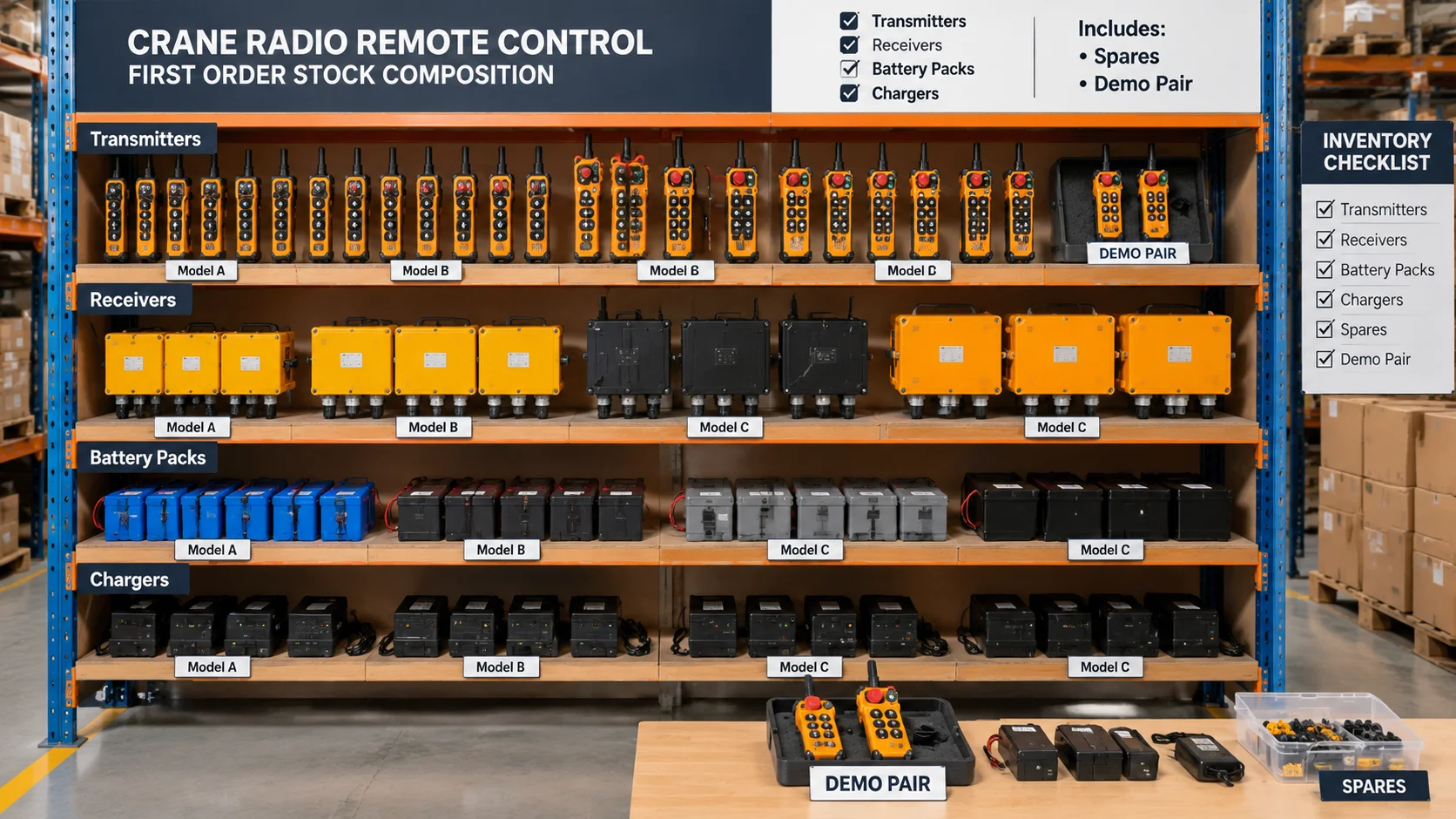
The temptation is to order breadth. The better first order is depth on the two models that cover most of the local market, plus spares that turn over quickly. A shape like the one below is easy to defend to a bank and easy to reorder.
| Item | Role in the first order | Reorder logic |
|---|---|---|
| Entry-level 4 to 6 output unit | Workshop hoists, jibs, small monorails — the volume end of the market | Reorder against stock cover, not against orders |
| 8 to 12 output dual-speed unit | Overhead and gantry cranes, the higher-value sale | Keep one or two on the shelf as demonstration stock |
| Joystick unit | Truck cranes, proportional applications, differentiation from local competitors | Order to demand; rarely a stock item |
| Battery packs and chargers | Repeat revenue, and the fastest way to build a customer list | Continuous, small and frequent |
| Output relays and antennas | Keeps service local instead of returning units | Small kit per model sold |
| Demonstration transmitter and receiver | You cannot sell this category from a datasheet alone | One per model, not for resale |
That last line is not filler. Buyers in this category want to hold the transmitter, feel the button travel and see the receiver’s terminals. A distributor with a demo pair closes sales a price list cannot.
Volume tiers are standard; what matters is how they are measured and when they reset. Three questions worth asking before signing anything.
Beyond price, negotiate the two things that cost a supplier little and save a distributor a great deal: a small spares allowance with the first order, and the right to return a limited number of units against a future order if a model does not move. Both are normal in industrial channels and both are easier to get before the first order than after it.

The single most common channel complaint in this category is not reliability. It is pairing. A customer replaces a transmitter, cannot get it to talk to the existing receiver, and calls the distributor, who calls the supplier, who asks for photographs of a label nobody photographed. That chain costs days.
Fix it at the point of sale with three habits: record the model and serial number of every unit you ship, keep one pairing procedure per model printed and laminated behind the counter, and stock a spare receiver for the two models you sell most. The spare parts strategy guide covers how to size that holding without tying up capital, and the quote checklist is a useful script for the questions to ask a customer before you quote a replacement.
Five signals that a supplier is not set up to support a channel, in the order they usually appear.
None of these is fatal on its own. Together they describe a supplier selling boxes rather than building distribution, and the cost lands on whoever holds the local relationship.
A channel programme works when the supplier treats the distributor’s stock, spares and technical confidence as part of the product. The industrial crane remote control range is organised around a small number of models precisely so that a distributor can stock it. If you are evaluating the category for your market, tell us the region, the crane types you see and your existing range, and we will send a programme outline rather than a price list.
It depends on the model mix rather than on a single number. Suppliers usually set a lower quantity for standard models and a higher one for customised units with your branding or a specific button layout. Ask for the figure per model before you plan your first order.
Yes. Most failures in the field are transmitter-side, but the receiver is what a customer needs when a unit is damaged or a second crane is added. Stocking only transmitters limits you to replacement sales.
Usually yes, subject to a minimum quantity per model and to the labelling rules for the declaration of conformity. Confirm both in writing, and confirm who holds the technical file after rebranding.
Enough to pair a transmitter, read a receiver’s indicator codes and identify a control voltage mismatch. That covers the majority of support calls and takes less than a day to learn on two or three models.
Only if your market includes truck cranes or proportional applications. Otherwise keep it as an order-to-demand item and use a push-button unit as your demonstration stock.