Pendant Control Station Wiring: Cores, Common, Earth
Cores follow functions, not buttons. The sum that sizes the cable, why the stop must not share the button common, and five pre-power checks.
Read More

A crane remote control specification fails a tender in one of two ways: it is so vague that every bid quotes a different product, or it is so specific that only one supplier can respond and the process is challenged. The fix is not more words. It is locking down nine parameters precisely and leaving the rest free.
This guide sets out what a radio remote control clause should contain, which phrasing makes bids comparable, how to write the function table so that an “equivalent” offer cannot slip through, and what to attach so the evaluation committee can score rather than argue.

Any item that changes price materially must be in the specification. If it is not, the bids will differ on it, and the cheapest bid will be cheap because it omitted something you assumed everyone included. Nine items carry almost all of the price spread on a crane remote control.
| Parameter | What to state | What goes wrong if omitted |
|---|---|---|
| Control functions | Number of motions, single or dual speed, and any grab, magnet or auxiliary command | Bidders count buttons differently; a 12-button quote may be an 8-function quote |
| Supply voltage | Receiver supply and the coil voltage of every output | Coil voltages get substituted, then the crane contactors have to be changed |
| Output configuration | Relay or solid state, contact rating, and whether outputs are interlocked | Under-rated contacts fail on hoist duty; interlocks are quietly left out |
| Enclosure protection | IP grade with the washdown or dust regime that justifies it | IP65 quoted against a washdown duty that needs IP66 or IP69K |
| Failsafe behaviour | What happens on signal loss, on receiver power loss and on battery removal | Three different behaviours quoted, none of them what the risk assessment asked for |
| Pairing method | Fixed code or remappable, and whether more than one transmitter may bind | Site cannot add a spare transmitter without factory involvement |
| Compliance | The directives and the documents required to evidence them | Declarations arrive after award, or not at all |
| Spares and lead time | Consumables list, spare transmitter quantity, quoted delivery | No spare transmitter on site for the first six months of operation |
| Warranty | Period, what is excluded, and the response commitment | Water ingress and wear parts excluded, which removes most real failures |
Function count and failsafe behaviour are the two items bidders read differently. Both deserve a table row, not a sentence of prose.
Comparability comes from one rule: every line the bidder prices must map to a line you wrote. A vague scope statement such as “suitable for a 10 tonne overhead crane” produces five bids that cannot be compared, and the comparison becomes a conversation about brand.
Write requirements as measurable statements. “Handheld transmitter with IP66 enclosure, minimum 8 functions, dual speed on hoist and long travel” can be checked against a datasheet. “Robust, high quality transmitter” cannot, and it invites a bidder to price the smallest unit that satisfies the reading.
Two phrases cause most disputes. “Or equivalent” with no definition of equivalence lets a bidder substitute a different architecture and argue it later. “Comply with all applicable standards” with none named lets the bidder choose which apply. Where you want alternatives, say what they must achieve, not what they must be called.
Separate mandatory from desirable. A short enforced mandatory list beats a long wish list that the low bid ignores, because the evaluation then has no rule for the gap. Mark each line required or scored, and state the weighting.
The function table is the part of the specification that decides whether the delivered unit matches the crane. Write it as a matrix with one row per movement and one column per requirement, so a bidder has to answer each cell rather than describe the product in general.
For each movement require four answers: direction commands, single or dual speed, whether it is interlocked with another movement, and the output type driving it. A hoist that must not run with the grab open is an interlock, and unwritten interlocks are not fitted.
Then state the physical layout: button count, joystick or push button, legend language, and whether it must be operable with gloves. Glove use changes the keypad on a foundry or cold store, yet it is rarely written down and gets discovered at commissioning.
Finally, require the bidder to return the completed matrix as part of the bid. A bidder who leaves cells blank has told you something useful before award rather than after delivery.
Acceptance is where a technically correct specification still produces a disappointing result. The clause should state what will be tested, on what load, by whom, and what constitutes a pass. Signal loss is the test most often skipped and the most important, because nobody observes that behaviour until an incident.
A workable acceptance clause requires, at minimum, a full function test on each movement, a range test at the furthest normal operator position with the crane in its worst orientation, a deliberate signal-loss test with the result recorded, and confirmation that every interlock in the function table operates. The procedures behind those tests are set out in daily checks and handover for crane remote controls, which is also a sensible basis for the operator handover at commissioning.
Spares deserve a stated quantity rather than a price list. At least one spare transmitter per shift-crew, a spare battery set, and a spare receiver output module where the design allows it. Lead time should be quoted as a delivery commitment from order, not as a stock position, and the difference between the two is worth asking about explicitly. Typical ranges are covered in MOQ and lead time for industrial remote controls.
For warranty, name the exclusions you will accept. Wear parts, batteries and damage from incorrect supply voltage are reasonable exclusions. Water ingress is not, if the unit was specified for a washdown area, and that exclusion is common enough to be worth removing in writing before award.
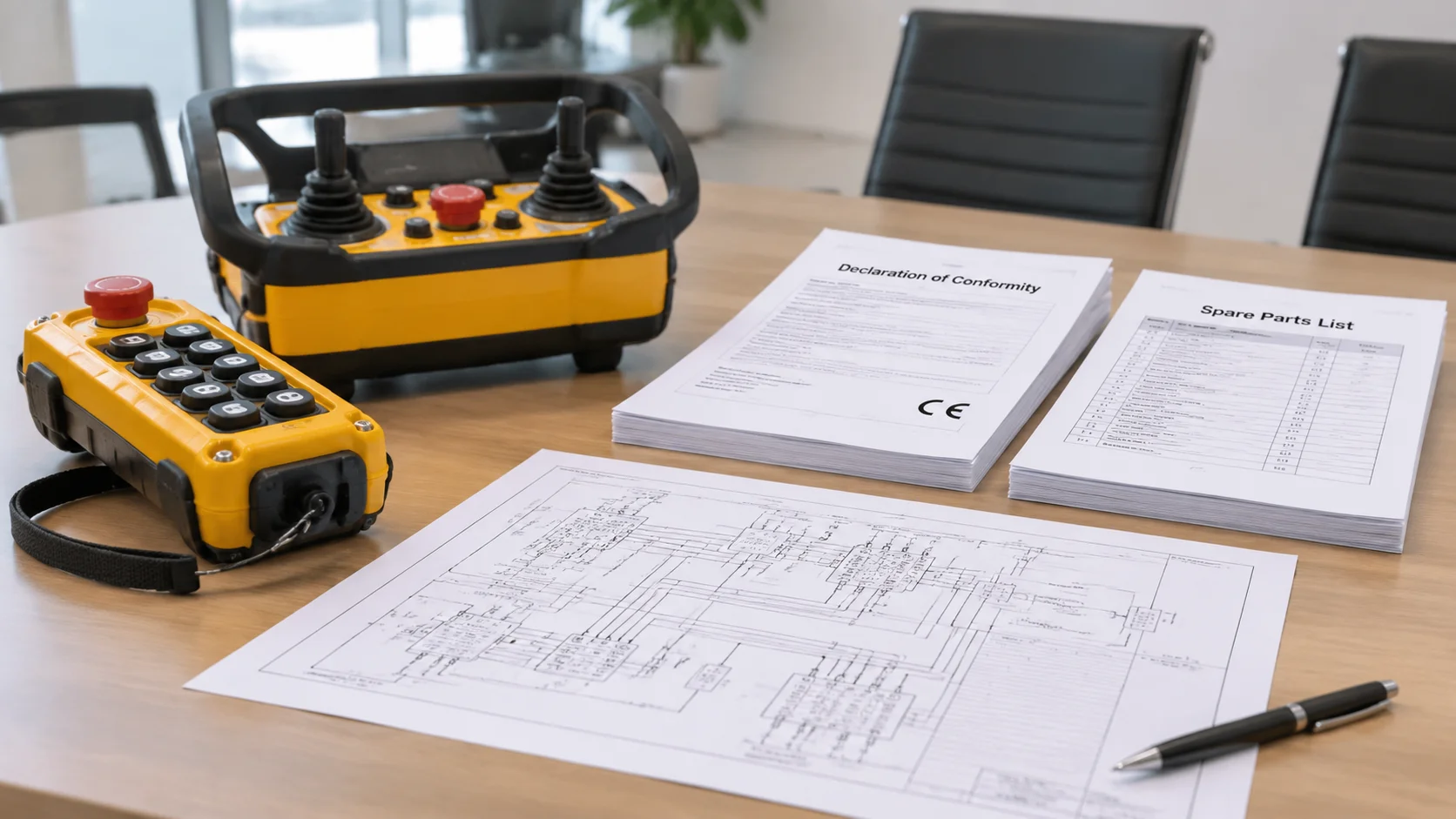
Compliance claims are cheap; documents are checkable, so name them. For the EU the set is the declaration of conformity covering the applicable machinery, EMC and radio equipment directives, the test reports behind it, and the frequency and power data for the band in use.
Ask for the declaration as a document with the bid rather than a statement that one exists. The difference between a supplier who can produce it in a week and one who cannot is the difference between a project that ships and one that stalls at customs. What the marking itself does and does not prove is covered in CE marking for crane remote controls.
Two more documents are worth requiring and rarely are: a wiring diagram for the receiver as delivered rather than a generic one, and a spares list with order codes, because a remote that cannot be re-ordered in year four becomes a crane with a pendant.
Put the sections in this order. It matches how bidders price and how evaluators score, and it keeps the mandatory list short enough to be enforced.
Keep it under four pages. A twenty-page specification usually failed to separate mandatory requirements from preferences, and bidders respond by pricing the cheapest reading of every ambiguous line. The pricing side is set out in what drives industrial remote control price, and the pre-issue checklist in the crane remote control quote checklist.
If you are writing the clause for a specific project, send the crane data, the function list and the environment with the draft and we will mark up the mandatory lines and flag the ones that will not be comparable across bids. Start from the industrial crane remote control system specification, or send the tender draft directly for a review.
Specify functions, not buttons. List each movement and its speed, then let bidders propose a layout. A twelve-button unit may deliver eight usable functions once dual-speed and interlock commands are counted.
Naming a model is defensible for a direct replacement or fleet standardisation. For new equipment, specify performance and require the function matrix instead, which controls scope just as tightly.
Only if you define what equivalent means. State the measurable outcomes the alternative must meet, and require supporting data with the bid. Without that definition, equivalence becomes an argument after award.
Failsafe behaviour on signal loss. Most tenders state that the unit must be safe but never define whether outputs drop out, hold, or ramp to stop. That choice belongs in the risk assessment.
Usually yes. A sample reveals keypad feel, glove operability and legend quality faster than any datasheet, though it does not replace the acceptance test on the crane.