Pendant Control Station Wiring: Cores, Common, Earth
Cores follow functions, not buttons. The sum that sizes the cable, why the stop must not share the button common, and five pre-power checks.
Read More

Most sites maintain crane remote controls one failure at a time. A transmitter stops working, it goes to the workshop, it comes back, and the same fault appears on another crane three weeks later. A fleet audit replaces that loop with a single pass over every unit, scored against the same twelve points, so that replacements are planned rather than triggered by a breakdown.
This guide sets out the twelve check points, how to score each one into a stop, replace or watch decision, how long the audit actually takes, and how to turn the findings into a purchase list that a manager will approve.

Reactive maintenance answers the wrong question. It asks why this unit failed, when the useful question is which units are about to fail. On a mixed fleet the answer is rarely random: units on the same duty, in the same environment, bought in the same year, fail within months of each other.
An audit also exposes the faults that no single operator reports, because they degrade so slowly that they become normal. A keypad that needs a firmer press, a battery that lasts four hours instead of six, a receiver whose antenna was moved during a repair — none of these generate a complaint until they generate an incident.
The list below is deliberately ordered from the outside in, so that a single walk around the crane collects the first six and the workshop session covers the rest.
| # | Check point | What to look at | Typical finding |
|---|---|---|---|
| 1 | Housing | Cracks at the screws, worn corners, a battery door that no longer seats flat | Drop damage on units carried rather than cab-mounted |
| 2 | Sealing | Gasket compression set, latch tension, any gap visible with the door closed | A gasket that has taken a set and is no longer dust tight |
| 3 | Keypad | Dome feel, legend wear, sticking on release, water or dust under the membrane | Slow release on the most used buttons |
| 4 | Battery | Runtime against the recorded baseline, swelling, terminal corrosion | Packs at half the original runtime, still in service |
| 5 | Charger | Output voltage, contact condition, location, whether units are left on it | Chargers in unheated stores or permanently occupied |
| 6 | Antenna | Position, cable routing, connector torque, damage to the whip | Antenna moved inside a steel cabinet during a repair |
| 7 | Pairing margin | Range at the worst operating position, not at the panel | Interference that only appears at one end of the bay |
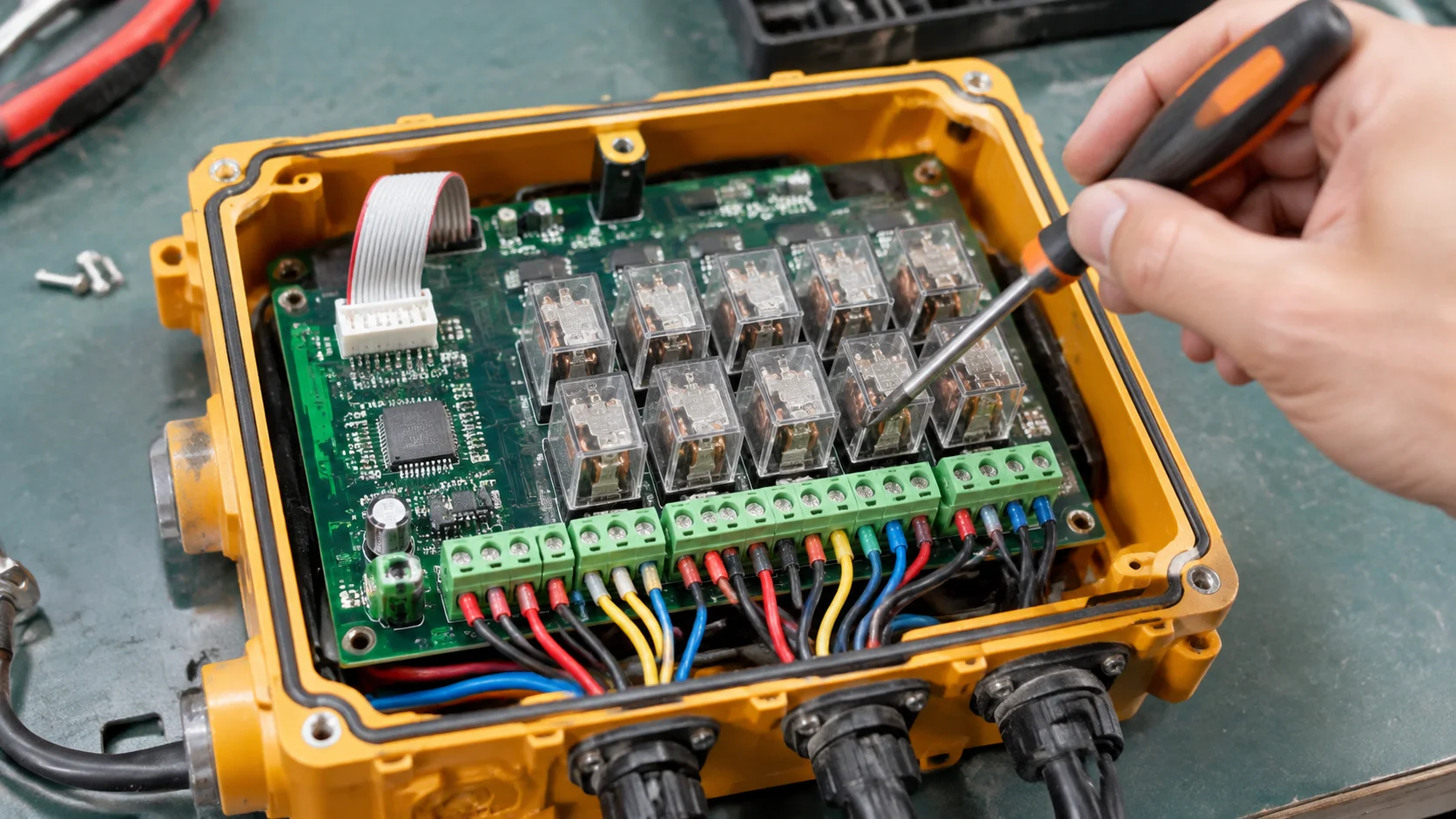
| 8 | Output relays | Contact resistance, pitting, chatter, welded contacts | High-cycle hoist contacts well past their life |
| 9 | Configuration | Function behaviour, loss-of-signal action, speed and interlock settings | Units configured differently from the same original order |
| 10 | Nameplate | Model, serial, date, voltage, IP rating legible and matching the receiver | Transmitters and receivers that no longer match on paper |
| 11 | Spares | Pack, charger, keypad and one receiver board per family on the shelf | No spare for the oldest and most used family |
| 12 | Documentation | Wiring diagram, function list, pairing record, last audit date | Nothing on file since commissioning |
Points 7 and 9 are the two that reactive maintenance never reaches. Range is tested at the panel because that is where the technician stands, not where the operator works. Configuration drifts because every replacement board is set up by whoever fitted it, and after three years the fleet contains three different behaviours under one model number.
A twelve-point checklist produces twelve opinions unless it produces a decision. Use three outcomes and assign them before the audit starts, so the judgement is not made by the person holding the screwdriver at the end of a long day.
Stop applies to anything that defeats the safety function: a lost or intermittent link at the working position, an output that does not drop on release, an emergency stop path that cannot be proven, a housing cracked through to the board. The unit comes out of service the same day.
Replace applies to wear that is measurable but not yet dangerous: runtime below the agreed baseline, a keypad with two or more slow-release buttons, a gasket that has taken a set, relays past their electrical life. The unit stays in service with a date attached.
Watch applies to cosmetic or documentary findings: a worn legend, a missing nameplate, a diagram that needs redrawing. These are cheap to fix and are the items that make the next audit faster.
The honest answer is that the first one takes several times as long as the second. The first pass creates the documentation that later passes read. Plan the work in this order.
The output of an audit is only useful if it becomes a list a buyer can act on. Group the replace and watch items by transmitter family rather than by crane, because that is how purchasing works: one model, one quantity, one enquiry.
Two patterns usually emerge. The first is a family that is fully obsolete, where the spares list cannot be filled and every failure is a replacement. The second is a family that is healthy but under-spared, where the fix is a shelf of packs, keypads and one receiver board rather than new units. The second is far cheaper and is the finding most sites miss. The stocking logic is set out in crane remote control spares strategy.
Where a family is obsolete, the decision is between continuing to repair, replacing like for like, and standardising on one current model across the fleet. Buying used or refurbished units to extend an obsolete family is sometimes right and often not, for the reasons in used and refurbished crane remote control. The audit gives you the numbers to decide rather than the impression.
The audit works best as a joint exercise. The site electrician knows the cranes and the history; an external technician knows what the model looks like when it is healthy. Splitting it that way also means the scoring is not being done by the person who has been repairing the same four units for years.
Frequency should follow duty, not the calendar. A two-shift foundry with units in a hot, dusty bay needs a full pass annually and a visual pass quarterly. A warehouse with six light-duty units can run a full pass every two years and a visual check at the same time as the crane inspection. The visual pass is essentially the daily check extended to the whole fleet, and the daily version is covered in crane remote control daily checks and handover.
If you are planning an audit and need the reference data to score against, send the model list and the duty of each crane and we will return the function and configuration baseline for each family, plus the spare parts list that should be on the shelf. Start from the industrial crane remote control system range or send the fleet list directly.
Follow the duty. Heavy two-shift work in dust or heat justifies an annual full pass with quarterly visual checks. Light warehouse duty can go two years between full passes. The visual pass should be tied to the existing crane inspection so it is not a separate event.
Only for the receiver work. Points one to seven can be done between lifts with the operator present, and the workshop session for relays and configuration needs the crane isolated for perhaps half an hour per unit. Scheduling it against planned maintenance avoids a stoppage.
Battery packs running at well below their original capacity while still in service, followed by gaskets that have taken a set. Both degrade slowly, neither generates a complaint until it generates an incident, and both are cheap to fix once they are on a list.
For points one to six, yes, with a checklist and a baseline. Points seven to nine need test equipment and knowledge of the correct configuration, which is where an external pass earns its cost. A joint audit splits the work along that line.
One page per crane with photographs, the twelve scores, the outcome and the date; plus a fleet summary that groups units by outcome and by model family, so the purchase list can be written directly from it.