Pendant Control Station Wiring: Cores, Common, Earth
Cores follow functions, not buttons. The sum that sizes the cable, why the stop must not share the button common, and five pre-power checks.
Read More

A single girder vs double girder crane remote control is not a choice between two radios. It is the same radio matched to two different machines. On a single girder the hoist is the trolley, running under one beam with three motions. On a double girder the trolley is a separate frame riding on top of two beams and usually carrying two hoists, so the receiver needs twice the outputs, a second panel and its own anti-collision logic. Count motions before you count buttons.
The trolley wheels run on the bottom flange of a single I-beam or box girder, and the hoist hangs from that frame rather than sitting on top of it. Hoist, cross travel and long travel are therefore the complete motion list, and there is nothing else for the operator to command.
Electrically that is one contactor panel, usually at the end of the girder or on the trolley, holding the reversing contactors for all three motions. A retrofit receiver sits beside it, takes its control voltage from it, and its output relays close the same coils the pendant buttons used to close. Six outputs cover three motions with spares for a horn and a start relay.
Panel and receiver normally end up within a couple of metres of each other, so the control cable is short and the antenna can be kept clear of the motor housings. That is why adding radio control to an existing crane of this type is usually a one-day job.

On a double girder crane the trolley is a rectangular frame with four wheels running on rails on top of both girders, and the hoist is bolted onto that frame instead of being the frame. That is the structure that lets a main and an auxiliary hoist share one trolley, and it changes the control count immediately.
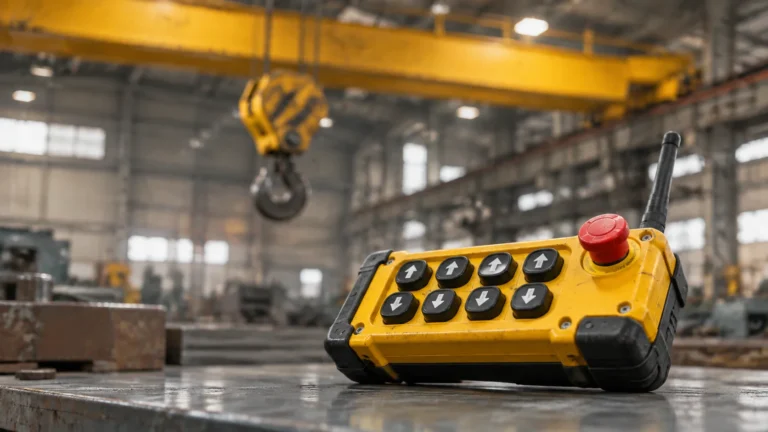
Two hoists mean four hoist directions instead of two: main up, main down, auxiliary up, auxiliary down. Add cross travel and long travel and the machine needs eight outputs before a horn, a start relay or a hoist selector. A six-button handset cannot express that and an eight-relay receiver cannot drive it.
Where the hardware lives changes as well. Panels are often split between the trolley, the bridge and the auxiliary hoist, so cable runs are longer and the receiver must sit where the cable does not flex itself to death.
Limit switches belong to the machine, not to the radio, and that does not change between crane types. What changes is how many of them the operator works against at once, and how the receiver must behave when one trips.
A hoist upper limit normally cuts the coil of the up contactor. If the receiver is still holding its up relay closed at that moment, nothing dangerous happens, because the limit breaks the circuit downstream of the relay. The dangerous version is a maintained output: the relay stays closed after the hand leaves the button, so when the limit resets the hoist starts again on its own. With one hoist that is a nuisance. With two it is a hazard, because the second hoist may still be moving while the first one re-energises.
A double girder also creates a collision problem that a single girder does not have in the same form. Both hoists share the same cross-travel rails and can be driven into each other. The receiver has no idea where the other hoist is, so the interlock has to come from the crane: a mechanical stop with a limit switch, a proximity sensor pair wired into both hoist circuits, or an anti-collision unit that cuts the approach direction. The radio’s only job is to stop repeating a command that has been overruled. If the enquiry never says the crane has two hoists, nobody will quote the interlock.
There is more than one way to drive two hoists from one handset, and the right answer depends on how often the auxiliary hoist is actually used.
| Arrangement | Hardware | How the operator switches | Best for |
|---|---|---|---|
| One receiver, extended relay set | 10 to 12 outputs, all functions on the panel | Dedicated buttons, always live | Both hoists used in quick succession |
| Two receivers, one transmitter | One receiver per hoist panel, both paired to one handset | Rotary or key selector chooses the active hoist | Auxiliary used occasionally, panels far apart |
| Two transmitters, one machine | Two handsets, transfer by key or explicit handover | Operators hand over control | Long cycles where the driver walks the bay |
The first arrangement is what most double girder buyers end up with, and it matches a crane remote control system built around 10 to 12 functions. The second is common on older machines whose two panels were never designed to talk to each other. The third is a working practice rather than a product, covered in two transmitters for one crane. None of the three is interchangeable at the wiring level, so choose the arrangement before the receiver is ordered.

Function count decides which receiver and which transmitter you need. Count motions and directions separately, because every direction is one relay and one wire.
| Machine | Motions | Outputs | Receiver |
|---|---|---|---|
| Single girder, one hoist | Hoist, cross travel, long travel | 6 | 8-output |
| Single girder, two-speed hoist | Hoist in two speeds plus travel | 7 to 8 | 8-output |
| Double girder, main hoist only | Hoist, cross travel, long travel | 6 | 8-output |
| Double girder, main and auxiliary | Two hoists plus both travels | 10 to 12 | 12-output or dual receiver |
| Double girder, two trolleys or rotating trolley | As above plus rotation | 12 or more | Dual receiver, shared handset |
A two-speed hoist adds one function per speed and is normally done with a changeover rather than a second full motion. Button count is a layout question, not a functional one: a 12-function machine fits an 8-button handset with a selector, and a 6-function machine is often bought with 8 buttons because the spare pair drives a horn and a work light. The crane remote control quote checklist settles the layout in six questions, and the ten-function wireless remote control is the model most double girder retrofits land on.
The sequence is the same on both crane types, but a double girder adds two steps that catch people out. Work through it in this order.
Two further items matter on a double girder: the second hoist panel usually needs its own fused supply for the receiver, and the antenna must sit clear of the trolley motors and the festoon system. A receiver that behaves perfectly on a single girder can behave badly on a double girder because the antenna ended up inside the steel box formed by the two girders. The conventions are set out in crane remote control wiring diagram. If you would rather have the function list checked before ordering, send the panel photos through the contact form and we will map them to a receiver.
The transmitter usually can, if it has enough buttons and the right frequency band. The receiver cannot, because the two machines need different output counts and, on a double girder, different interlock logic.
Ten is the practical minimum for a main and auxiliary hoist with both travels, plus a horn. Twelve is common once a start relay, work light or hoist selector is added. A double girder with a single hoist needs the same six as a single girder.
Not necessarily, but often in practice. One 12-output receiver is cleaner when both panels sit close together; two receivers are the usual answer when the panels are far apart or the auxiliary hoist has its own control system nobody wants to rewire.
Because the two girders, the walkway and the trolley frame form a steel enclosure. An antenna mounted low between the girders can lose line of sight to a driver at the far end of the bay. Mount it high and test from the worst operating position, not from the panel.