Pendant Control Station Wiring: Cores, Common, Earth
Cores follow functions, not buttons. The sum that sizes the cable, why the stop must not share the button common, and five pre-power checks.
Read More

A washdown crane remote control fails in a food plant for reasons that have almost nothing to do with rain. A high-pressure jet hits a sealed enclosure with several bar of force, a chlorinated foam sits on the gasket for twenty minutes, and the plant washes the same unit twice a day for six years. An IP rating alone does not describe that duty. What follows is the practical difference between a housing that survives a washdown bay and one that only survives the weather.
Rain falls; washdown is aimed. Water arrives at pressure and at an angle, so it pushes against seals instead of running over them. It usually carries a chemical — caustic, chlorinated foam, quaternary ammonium — that attacks the elastomer rather than the plastic. And it arrives on a schedule, at every shift change rather than once a season.
The failure is rarely dramatic. A transmitter does not fill with water and stop: it develops a film of moisture behind the keypad, one direction goes intermittent three weeks later, and the unit is written off as old before the electronics have aged. Worth remembering when a supplier quotes a grade and stops there.
The second digit of an IP code describes water. The two numbers that matter here are 7 and 9K, and neither is a washdown certificate on its own.
| Rating | Test condition | What it proves | What it does not prove |
|---|---|---|---|
| IP65 | Water jets from a nozzle at low pressure | Dust tight, splash and light jet resistant | Nothing about immersion or high-pressure cleaning |
| IP67 | Temporary immersion at a stated depth and time | Water does not enter when submerged and static | Nothing about a jet at pressure, and nothing about chemicals |
| IP69K | High-pressure, high-temperature jets from close range at several angles | The seal survives the cleaning method itself | Nothing about repeated chemical exposure or ageing of the gasket |
The most common misreading is treating IP67 as “better than IP65, so good for washdown”. Immersion is a static load; a washdown jet is a dynamic one, and a seal that holds at 1 m depth can be pushed past its lip by a lance held 200 mm away. If the cleaning procedure uses a pressure washer, the honest requirement is IP69K on the housing — and even then the rating describes a new unit, not one whose gasket has been compressed for four years. Our comparison of IP65 and IP67 crane remote controls covers the outdoor cases where 67 is genuinely enough.
Three materials are offered for hygiene areas and they fail differently. Stainless steel resists the chemicals and the heat, but it is heavy, it is cold to hold in a freezer room, and a dented corner can lift a seal face. Food-grade engineering plastics resist most cleaning agents, are light and warm to the touch, but some grades stress-crack under repeated caustic exposure and a drop onto a concrete floor can crack a corner. Coated aluminium is the cheapest and the worst choice here: one chip in the coating becomes a corrosion cell, and the coating itself is what the chemical attack removes.
Material choice is also ergonomic: a washdown transmitter is carried in one hand for eight hours with gloves on, and a heavy stainless housing gets dropped — a bigger cause of failure than corrosion. The trade-offs of each option are set out in remote control enclosure material, including the salt-spray and UV cases that overlap with food plants.
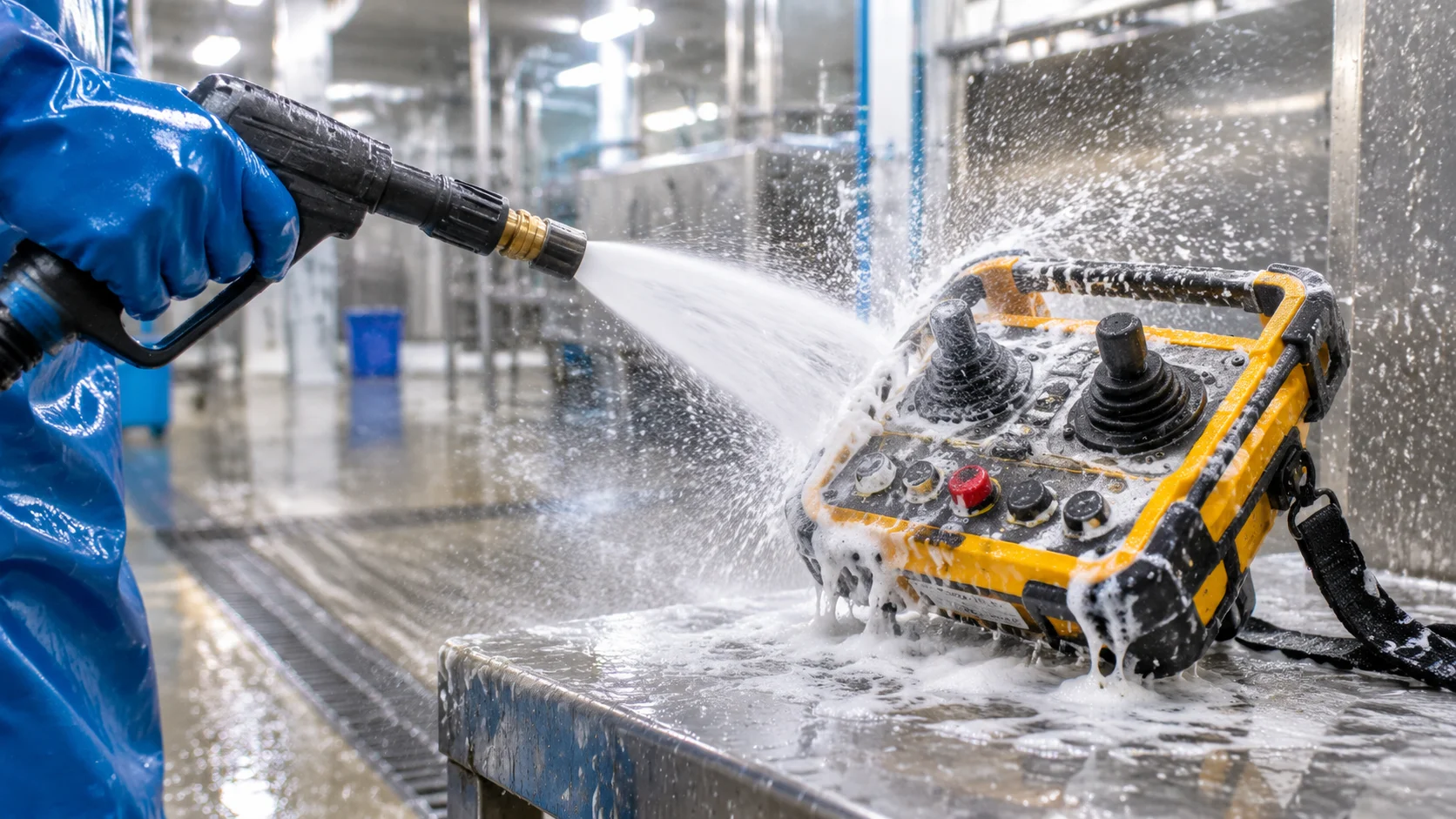
The housing grade is the easy part. The places where a washdown unit actually takes on water are the joints, and there are four of them on a typical transmitter.
Then there is the part no IP rating addresses: cleanliness. A textured surface, a deep groove around a button, or a two-part seam that traps product gives bacteria somewhere to sit, and the unit becomes a hygiene finding rather than an electrical fault. Smooth surfaces, no horizontal ledges, and a housing that can be wiped are worth more in an audit than another digit on the IP code.

A plant that packs chilled product usually runs three environments through one shift, and the unit has to survive the transitions as well as the endpoints. A transmitter that goes from a 4 °C cold store to a 25 °C packing hall condenses water inside the battery compartment within minutes, because the enclosure cools faster than the air that enters it. The same unit then meets a 60 °C steam lance at the end of the shift.
Two design answers reduce it: a sealed battery pack charged outside the transmitter, so the compartment is opened in a dry area rather than in the wash bay, and a holster that keeps the unit off the floor and out of the run-off. Cold-store duty on its own is covered in cold store and freezer room crane remote control, including the low-temperature battery behaviour that has nothing to do with water.
The cleaning procedure matters as much as the hardware. A workable sequence for a washdown area looks like this.
With a foam regime rather than a rinse, chemical contact time dominates and the gasket compound matters more than the housing. Ask for the agent and concentration in writing; a supplier who will not comment on compatibility has not tested it.
Washdown enquiries go wrong when the buyer sends only a protection grade. Six items let a supplier recommend a construction instead of guessing.
A sealed transmitter should be quoted with the receiver enclosure in mind — the cabinet in the wet area is often the weaker half. The industrial crane remote control system overview shows how the transmitter, receiver and enclosure are specified together, and the six answers can be sent through the contact form for a recommendation against your actual cleaning regime. If the problem is outdoor weather rather than a wash bay, the distinction between rainproof and waterproof crane control equipment is the better starting point.
Usually not. IP67 covers static immersion, while a washdown applies a jet at pressure. A unit rated IP67 will often survive splashing but not a lance held close to a seam. IP69K is the relevant grade when a pressure washer is used.
It can be installed, but the housing, keypad construction and gasket compound decide the service life. A general-purpose unit in a daily washdown bay typically needs replacing far sooner than the electronics would suggest.
Not always. Food-grade plastic housings resist most cleaning agents and survive drops better, while stainless resists chemicals and heat but dents and weighs more. The cleaning chemicals and the drop risk decide the answer.
Moisture behind the keypad is the usual cause, followed by chemical swelling of the membrane. Intermittent directions that appear weeks after a wash are a seal problem, not a radio problem.
Only if the battery cover is a sealed, screwed type that is fitted correctly. On units with a sliding or quarter-turn cover, remove the pack before washing and charge it outside the wet area.